UK Recognises India’s CCTS for Conditional CBAM Relief
Why in News?
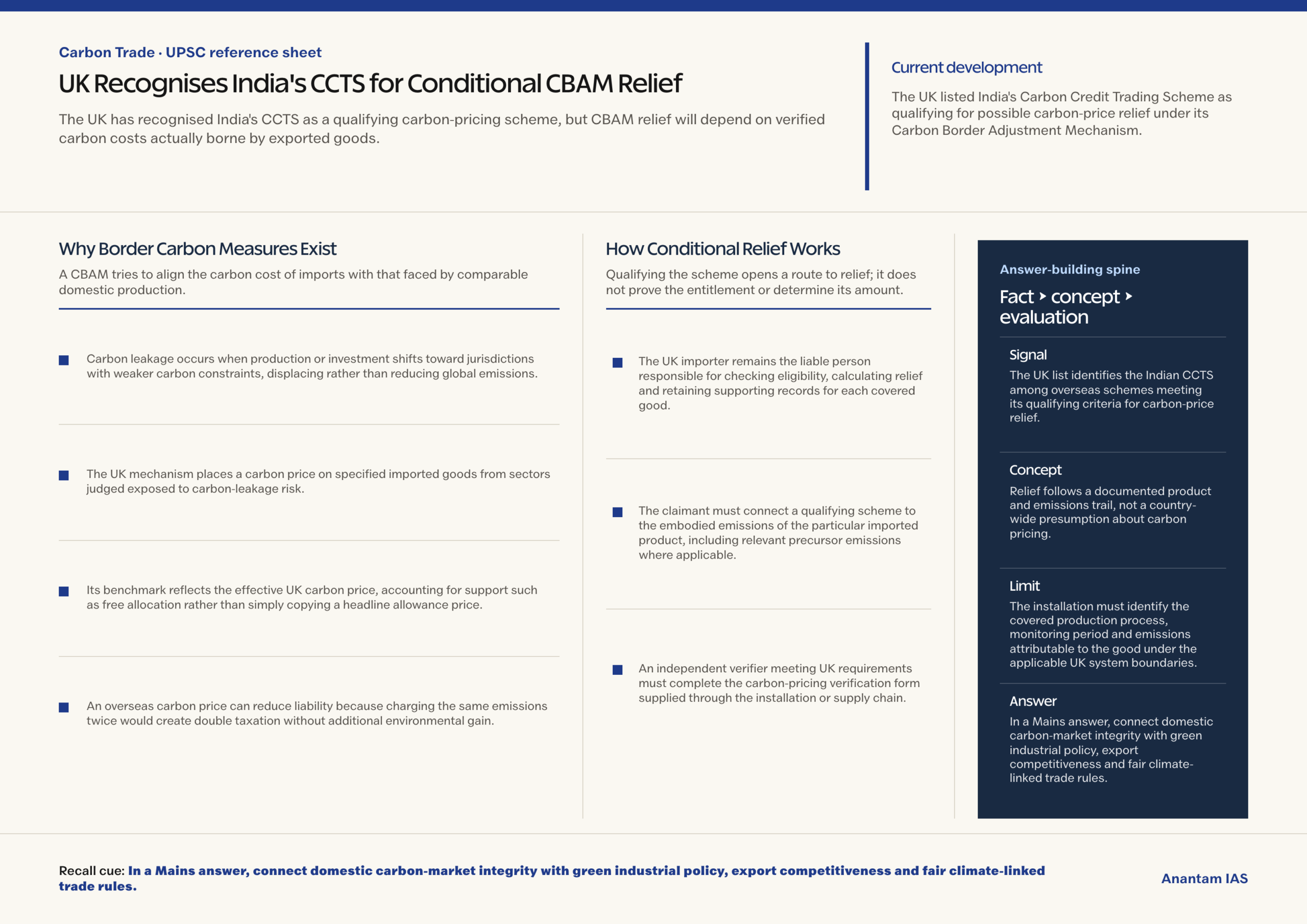
The UK listed India’s Carbon Credit Trading Scheme as qualifying for possible carbon-price relief under its Carbon Border Adjustment Mechanism.
- The UK list identifies the Indian CCTS among overseas schemes meeting its qualifying criteria for carbon-price relief.
- The list supports preparation for the UK CBAM, scheduled to take effect on 1 January 2027.
- Recognition does not create an automatic exemption; the importer must establish that relevant embodied emissions actually faced an eligible carbon price.
- Relief can fall to zero where free allowances, rebates or refunds eliminate the effective carbon cost borne by the goods.
- The decision links India’s domestic carbon-market architecture with the trade competitiveness of carbon-intensive exports to the UK.
- For policy, the central challenge is making Indian carbon-price data measurable, verifiable and traceable across installations and supply chains.
UPSC Relevance
Prelims Relevance
- The UK CBAM is a border carbon measure on specified imported goods, not a general customs duty on all imports.
- A qualifying carbon-pricing scheme may be an emissions trading scheme, carbon tax or a border measure pricing embodied emissions.
- India notified the CCTS in 2023 under the Energy Conservation Act, 2001.
- The CCTS contains compliance and offset mechanisms, which serve different participants and crediting purposes.
- Carbon-price relief depends on the effective price paid, rather than mere membership in a listed scheme.
Mains Relevance
GS Paper 3
- Carbon markets as instruments for industrial decarbonisation and export competitiveness
- Measurement, reporting and verification capacity in India’s carbon market
GS Paper 2
- Climate-linked trade rules and India’s economic diplomacy with developed markets
Essay
- Green trade rewards climate ambition only when domestic claims can survive international verification.
Background and Context
Why Border Carbon Measures Exist
A CBAM tries to align the carbon cost of imports with that faced by comparable domestic production.
- Carbon leakage occurs when production or investment shifts toward jurisdictions with weaker carbon constraints, displacing rather than reducing global emissions.
- The UK mechanism places a carbon price on specified imported goods from sectors judged exposed to carbon-leakage risk.
- Its benchmark reflects the effective UK carbon price, accounting for support such as free allocation rather than simply copying a headline allowance price.
- An overseas carbon price can reduce liability because charging the same emissions twice would create double taxation without additional environmental gain.
- CBAMs can protect decarbonising producers, but they can also become contentious when standards, data demands or default values burden developing-country exporters.
How Conditional Relief Works
Qualifying the scheme opens a route to relief; it does not prove the entitlement or determine its amount.
- The UK importer remains the liable person responsible for checking eligibility, calculating relief and retaining supporting records for each covered good.
- The claimant must connect a qualifying scheme to the embodied emissions of the particular imported product, including relevant precursor emissions where applicable.
- An independent verifier meeting UK requirements must complete the carbon-pricing verification form supplied through the installation or supply chain.
- The calculation uses the effective overseas carbon price; free allowances, rebates and refunds reduce the price treated as actually borne.
- Relief cannot exceed the product’s UK CBAM liability, so recognition can lower the charge but cannot produce a negative tax payment.
The Evidence Chain Behind a Claim
Relief follows a documented product and emissions trail, not a country-wide presumption about carbon pricing.
- The installation must identify the covered production process, monitoring period and emissions attributable to the good under the applicable UK system boundaries.
- The evidence must distinguish emissions that incurred a price from those covered by free allocation or relieved through refunds elsewhere in the supply chain.
- The importer calculates relief for each good, converts eligible foreign-currency amounts using prescribed rates and keeps records supporting the final claimed deduction.
What Recognition Means for India
The trade benefit will depend on whether India’s carbon-market implementation produces credible prices and installation-level evidence.
- India notified the CCTS under the Energy Conservation Act to develop an Indian carbon market through compliance and offset pathways.
- Under the compliance mechanism, obligated entities receive emissions-intensity targets; performance against targets can create a credit surplus or a surrender obligation.
- Recognition can improve export competitiveness when an Indian producer has paid a verifiable carbon cost that the UK calculation accepts against liability.
- Exporters still need interoperable measurement, reporting and verification, product-level emissions data and a documented chain from installation to imported good.
- The policy signal favours real decarbonisation over paper compliance because weak data or freely allocated credits may yield little or no relief.
Way Forward
Make Carbon Pricing Trade-Ready
India should turn formal recognition into usable, credible evidence for exporters.
- Align CCTS monitoring and verifier accreditation with internationally usable evidence while preserving India’s regulatory autonomy.
- Build sector-specific systems that trace embedded emissions and carbon payments from installations through precursor inputs to exported products.
- Support smaller exporters with common reporting tools, accredited verification access and clear guidance on UK claim documentation.
- Use trade diplomacy to seek transparent methodologies, proportional compliance costs and recognition of credible Indian decarbonisation.
Conclusion
- UK recognition is a gateway, not a waiver: relief follows only when a covered product’s embodied emissions faced a provable effective carbon price.
- In a Mains answer, connect domestic carbon-market integrity with green industrial policy, export competitiveness and fair climate-linked trade rules.
UPSC Practice Questions
Prelims MCQ 1
With reference to carbon-price relief under the UK CBAM, consider the following statements:
- Listing an overseas scheme automatically exempts every good covered by that scheme from UK CBAM liability.
- Free allowances and rebates can reduce the effective overseas carbon price recognised for relief.
- An independently completed carbon-pricing verification form is required to support a relief claim.
How many of the above statements are correct?
(a) Only one (b) Only two (c) All three (d) None
Answer: (b) Only two
Explanation:
Statements 2 and 3 are correct. Recognition of a scheme enables a claim route, but liability falls only for verified embodied emissions that actually faced an eligible effective carbon price.
Prelims MCQ 2
The Carbon Credit Trading Scheme in India was notified under which law?
(a) Environment (Protection) Act, 1986 (b) Air (Prevention and Control of Pollution) Act, 1981 (c) Energy Conservation Act, 2001 (d) Electricity Act, 2003
Answer: (c) Energy Conservation Act, 2001
Explanation:
The Central Government notified the CCTS in 2023 under powers provided by the Energy Conservation Act, 2001, as amended.
UPSC Mains Questions
- UK recognition of India’s Carbon Credit Trading Scheme is commercially useful only when backed by credible verification. Discuss in the context of carbon border measures.
- How can India design its carbon market to support both industrial decarbonisation and the competitiveness of exports in climate-regulated markets?
Sources: The Hindu and HM Revenue & Customs.
Frequently Asked Questions
What has the UK recognised?
The UK placed India’s Carbon Credit Trading Scheme on its list of qualifying carbon-pricing schemes that may support carbon-price relief under the UK CBAM.
Does recognition automatically remove the UK CBAM charge?
No. The importer must prove that the particular good’s embodied emissions faced an eligible effective carbon price and satisfy independent verification and record-keeping requirements.
Why can free allowances reduce relief?
Free allowances mean no carbon price was paid on the covered portion of emissions. UK rules calculate relief from the effective cost actually borne, not the headline scheme price.
Why does this matter for Indian exporters?
A verified Indian carbon payment may reduce UK border liability, but exporters need product-level emissions data, traceable carbon-cost records and acceptable independent verification.
When will the UK CBAM begin?
The UK government plans to introduce its Carbon Border Adjustment Mechanism on 1 January 2027 for specified imported goods in sectors exposed to carbon leakage.