UN CERD Review of India: Treaty Monitoring and Accountability
Why in News?
On 25 August 2026, CERD issued concluding observations after reviewing India’s combined twentieth and twenty-first periodic reports, its first dialogue with India since 2007.
- The review formed part of CERD’s 118th session, which also examined Finland, Honduras and Kuwait.
- The Committee expressed concern about reported abuses against protected groups and recommended prompt, impartial investigations and accountability.
- It also raised reported racial profiling and treatment of Rohingya, Bengali-speaking Muslims, migrants and asylum-seekers, including non-refoulement concerns.
- India highlighted its constitutional safeguards and maintained that engagement did not imply acceptance of an expanded treaty mandate or additional obligations.
- The episode shows how international monitoring can generate scrutiny and policy pressure without itself changing domestic law.
- For India, the review intersects international obligations with constitutional equality, anti-untouchability protections, remedies and federal implementation.
UPSC Relevance
Prelims Relevance
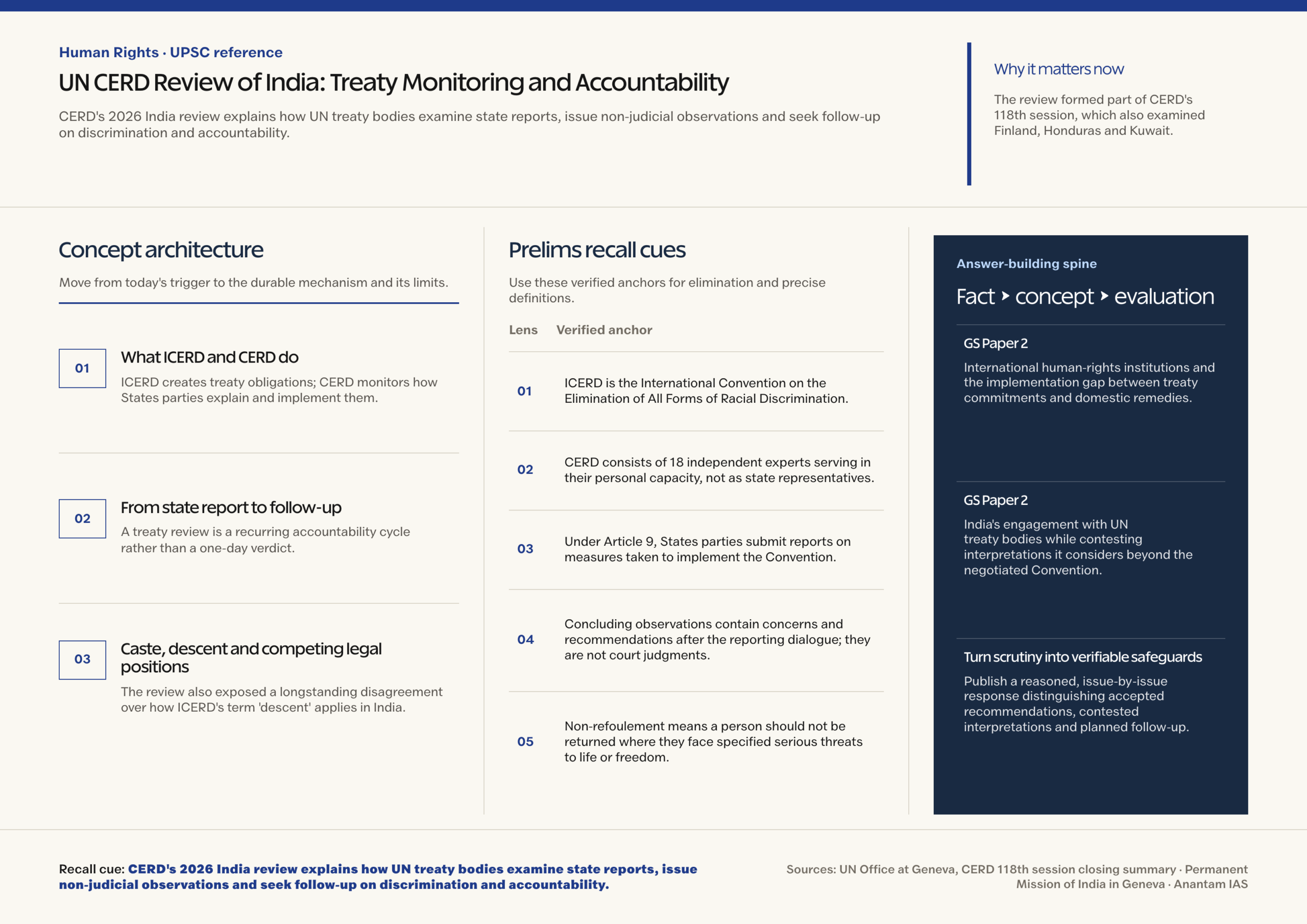
- ICERD is the International Convention on the Elimination of All Forms of Racial Discrimination.
- CERD consists of 18 independent experts serving in their personal capacity, not as state representatives.
- Under Article 9, States parties submit reports on measures taken to implement the Convention.
- Concluding observations contain concerns and recommendations after the reporting dialogue; they are not court judgments.
- Non-refoulement means a person should not be returned where they face specified serious threats to life or freedom.
Mains Relevance
GS Paper 2
- International human-rights institutions and the implementation gap between treaty commitments and domestic remedies.
- Constitutional equality, social justice and accountability for alleged discrimination against vulnerable groups.
GS Paper 2
- India’s engagement with UN treaty bodies while contesting interpretations it considers beyond the negotiated Convention.
Essay
- Accountability is strongest when international scrutiny, constitutional remedies and credible domestic investigation reinforce one another.
Background and Context
What ICERD and CERD do
ICERD creates treaty obligations; CERD monitors how States parties explain and implement them.
- The Convention prohibits distinctions based on race, colour, descent, or national or ethnic origin that impair equal enjoyment of rights across political, civil, economic, social and cultural life.
- CERD is a body of 18 independent experts drawn from different regions; it is neither a court nor a political organ representing governments.
- Under Article 9, a State submits periodic reports describing its legal, administrative and policy measures, practical results and the obstacles it faces.
- Committee experts question the delegation in a public dialogue, where the State can clarify contested claims, and may consider submissions from institutions and civil society.
- The review assesses treaty implementation; it does not replace Indian courts, criminal investigations or constitutional decision-making, or make allegations judicially proven.
From state report to follow-up
A treaty review is a recurring accountability cycle rather than a one-day verdict.
- India submitted its combined twentieth and twenty-first reports in 2023, responding to a prior list of issues that framed the information sought under simplified reporting.
- The dialogue on 11 and 12 August 2026 allowed India to present its constitutional framework, affirmative action, judicial remedies and policy measures directly to the Committee.
- After deliberation, CERD adopted concluding observations that record positive aspects, concerns, recommendations and priorities for later follow-up by the State party.
- The Committee’s India findings called for investigation of reported abuses and stronger protection against discrimination, hate speech, hate crime, racial profiling and collective expulsion.
- Follow-up depends on domestic choices: authorities may review law, enforcement, data, remedies and institutional practice, then report implementation through periodic or targeted follow-up.
Caste, descent and competing legal positions
The review also exposed a longstanding disagreement over how ICERD’s term ‘descent’ applies in India.
- CERD has treated discrimination based on descent as including caste and analogous inherited-status systems, including through General Recommendation No. 29 on descent.
- India maintains that caste is distinct from race and descent under ICERD, citing the treaty’s negotiating history, separate constitutional terminology and original scope.
- India nevertheless supplied information on Scheduled Castes and Scheduled Tribes, while saying this transparency was voluntary and did not create additional treaty obligations.
- An answer should present the disagreement, not convert the Committee’s interpretation into an uncontested rule, India’s objection into withdrawal, or shared concern about discrimination into consensus on scope.
- Domestic protection remains independently anchored in constitutional equality, non-discrimination and abolition of untouchability, alongside statutory remedies, commissions, judicial review and targeted protective legislation.
Way Forward
Turn scrutiny into verifiable safeguards
- Publish a reasoned, issue-by-issue response distinguishing accepted recommendations, existing safeguards and points of legal disagreement.
- Ensure independent investigation, due process and accessible remedies wherever credible allegations of discriminatory policing or abuse arise.
- Improve disaggregated, privacy-respecting data on complaints, investigations, prosecutions and remedies so implementation can be measured.
- Engage Parliament, states, commissions, courts and affected communities because treaty implementation crosses several institutions and levels of government.
Conclusion
- CERD’s observations are authoritative treaty-body scrutiny, but not a judicial conviction or automatic amendment to Indian law; their influence works through reporting, public reasoning and follow-through.
- A balanced answer should separate allegations, Committee recommendations and India’s legal position, then assess whether domestic institutions provide credible investigation, remedies and measurable follow-up.
- The durable lesson is that treaty monitoring matters most when dialogue produces transparent implementation without obscuring legitimate disputes over legal scope; answers should test both authority and implementation evidence.
UPSC Practice Questions
Prelims MCQ 1
With reference to the Committee on the Elimination of Racial Discrimination, consider the following statements:
- It monitors implementation of ICERD by States parties.
- Its 18 members serve as independent experts in their personal capacity.
- Its concluding observations automatically amend the domestic law of a reviewed State.
How many of the above statements are correct?
(a) Only one (b) Only two (c) All three (d) None
Answer: (b) Only two
Explanation:
Statements 1 and 2 are correct. Concluding observations communicate treaty-body concerns and recommendations; they do not automatically amend a State’s domestic law.
Prelims MCQ 2
In the ICERD reporting cycle, ‘concluding observations’ are best understood as:
(a) binding judgments delivered by an international criminal court (b) resolutions adopted by the UN Security Council (c) concerns and recommendations issued by the treaty-monitoring committee after review (d) reservations entered by a State when ratifying the treaty
Answer: (c) concerns and recommendations issued by the treaty-monitoring committee after review
Explanation:
CERD adopts concluding observations after considering a State report and dialogue. They guide follow-up but are not Security Council decisions or criminal judgments.
UPSC Mains Questions
- Explain the reporting and follow-up cycle under ICERD. Why should CERD’s concluding observations be distinguished from judicial findings?
- International treaty monitoring can strengthen domestic accountability even when the State contests parts of a committee’s interpretation. Discuss with reference to India’s 2026 CERD review.
Sources: UN Office at Geneva, CERD 118th session closing summary and Permanent Mission of India in Geneva.
Frequently Asked Questions
What is CERD?
CERD is the 18-member independent-expert committee that monitors how States parties implement the International Convention on the Elimination of All Forms of Racial Discrimination.
Are CERD concluding observations binding court judgments?
No. They are treaty-body concerns and recommendations adopted after review. They do not convict individuals or automatically alter domestic law, though States should engage with them in good faith.
Why is caste discussed under ICERD?
CERD interprets descent-based discrimination as covering caste-like inherited status. India disputes equating caste with race or descent under the Convention while separately applying constitutional and statutory protections.
What did CERD recommend after India’s 2026 review?
Among its recommendations, CERD sought impartial investigation of reported abuses, accountability, protection against discrimination and hate crimes, and safeguards for migrants, asylum-seekers and people needing international protection.
What is the main UPSC takeaway from the review?
Separate the treaty obligation, the Committee’s non-judicial interpretation, India’s stated legal position and the domestic institutions responsible for investigation, remedies and implementation.