UNCLOS remains the ‘Constitution of the Oceans’
Why in News?
Ramon Magsaysay Award winner Tommy Koh, who presided over the final negotiations of the Third UN Conference on the Law of the Sea, has reiterated that the UN Convention on the Law of the Sea (UNCLOS) remains the “constitution of the world’s oceans”.
His remarks assume significance amid disputes concerning the Strait of Hormuz, South China Sea, seabed resources and dark fleet shipping.
| UPSC Relevance: GS-2: International institutions and international law; GS-3: Maritime security and Blue economy Prelims: UNCLOS, transit passage, EEZ, and customary international law |
What is UNCLOS?
Adopted in 1982 and in force since 1994, UNCLOS establishes a comprehensive legal order governing the oceans. With 172 parties, it enjoys near-universal acceptance.
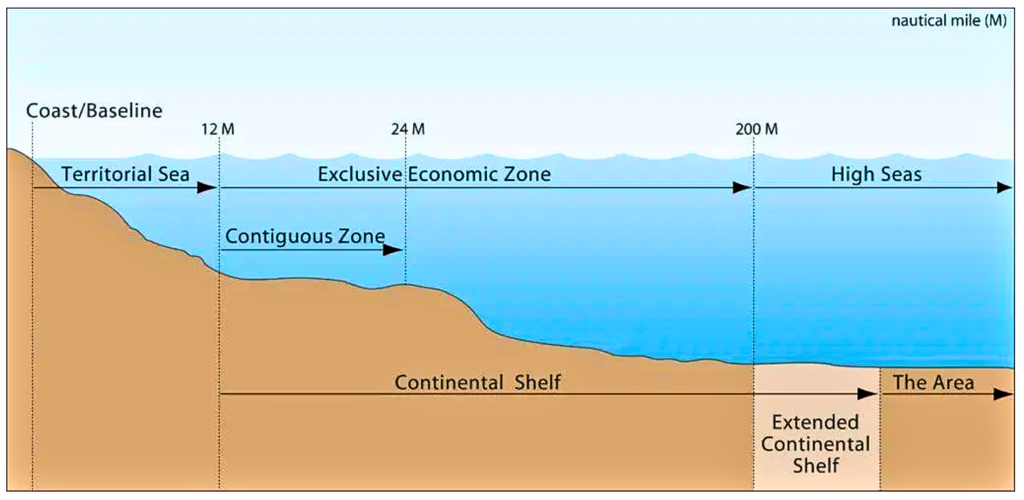
It defines maritime zones and balances coastal-State rights with navigational freedoms:
- Territorial Sea: Up to 12 nautical miles; the coastal State exercises sovereignty.
- Contiguous Zone: Up to 24 nautical miles; limited enforcement jurisdiction.
- Exclusive Economic Zone: Up to 200 nautical miles; sovereign rights over natural resources.
- Continental Shelf: Rights over seabed and subsoil resources.
- High Seas: Open to all States, subject to international law.
- The Area: Seabed beyond national jurisdiction, designated the common heritage of humankind.
UNCLOS also created the International Tribunal for the Law of the Sea (ITLOS), the International Seabed Authority (ISA) and the Commission on the Limits of the Continental Shelf (CLCS).
| The Strait of Hormuz and Transit Passage: The Strait of Hormuz is an international strait connecting two areas of high seas or EEZ and is vital for global oil and LNG transportation. Under UNCLOS, ships and aircraft enjoy transit passage through straits used for international navigation. Unlike innocent passage through ordinary territorial waters, transit passage includes navigation and overflight; generally extends to commercial vessels, warships and submarines operating in their normal mode; and cannot be suspended by States bordering the strait. Iran has signed but not ratified UNCLOS. Koh argues that transit passage has acquired the status of customary international law and is consequently binding even on non-parties. Customary law develops from widespread State practice followed out of a belief that such practice is legally obligatory. |
Why does UNCLOS retain its Authority?
- It provides a common framework for navigation, fishing, seabed mining, maritime boundaries, environmental protection and scientific research.
- Even the United States, which has not ratified UNCLOS, accepts many of its navigational provisions as authoritative customary law.
- It offers peaceful dispute-settlement mechanisms through ITLOS, the International Court of Justice and arbitral tribunals.
- Its architecture has evolved through supplementary agreements rather than reopening the entire Convention. The BBNJ or High Seas Treaty, which entered into force in January 2026, extends conservation rules for marine biodiversity beyond national jurisdiction.
Emerging Challenges:
- Excessive and overlapping maritime claims, especially in the South China Sea
- reluctance of powerful States to comply with adverse arbitral awards
- militarisation of international waters and strategic chokepoints
- disagreements over deep-seabed mining and benefit-sharing
- climate-induced sea-level rise affecting maritime baselines
- illegal fishing, autonomous vessels and undersea infrastructure; and
- dark or shadow fleets that conceal ownership, manipulate identification systems and evade sanctions, insurance and safety requirements.
The IMO has warned that such fleets increase risks of collision, oil spills, fraudulent registration and evasion of liability. These problems require coordinated flag-State, port-State and IMO action rather than legally questionable unilateral enforcement on the high seas.
Significance for India:
- India ratified UNCLOS in 1995 and regards it as the legal basis for maritime rights and obligations. It protects India’s interests in its EEZ, island territories, sea lanes, fisheries, offshore resources and deep-ocean exploration.
- India’s acceptance of the 2014 India-Bangladesh maritime boundary award also demonstrated its commitment to peaceful, rules-based dispute settlement.
UNCLOS remains indispensable because it replaces competing assertions of power with commonly accepted maritime rules.
Its principal weakness lies not in its architecture, but in selective compliance and inadequate enforcement. Strengthening multilateral institutions and respecting dispute-settlement outcomes are therefore essential to preserve a free, stable and sustainable ocean order.