UNEP sets out Overshoot Pathway to manage Global Warming Limit breach
Why in News?
The United Nations Environment Programme’s (UNEP) report, Limiting Overshoot, warns that long-term global warming is likely to cross 1.5°C above pre-industrial levels within the next few years.
It proposes an “overshoot, peak and decline” pathway to minimise the extent and duration of this breach and eventually return temperatures below 1.5°C.
| UPSC Relevance: GS-3 Environment: Climate Change; International Agreements Prelims: Nationally Determined Contribution; Paris Climate deal; India’s climate commitments. Mains: Managing Climate change (Techniques, Challenges, Policies) |
Key Findings by UNEP:
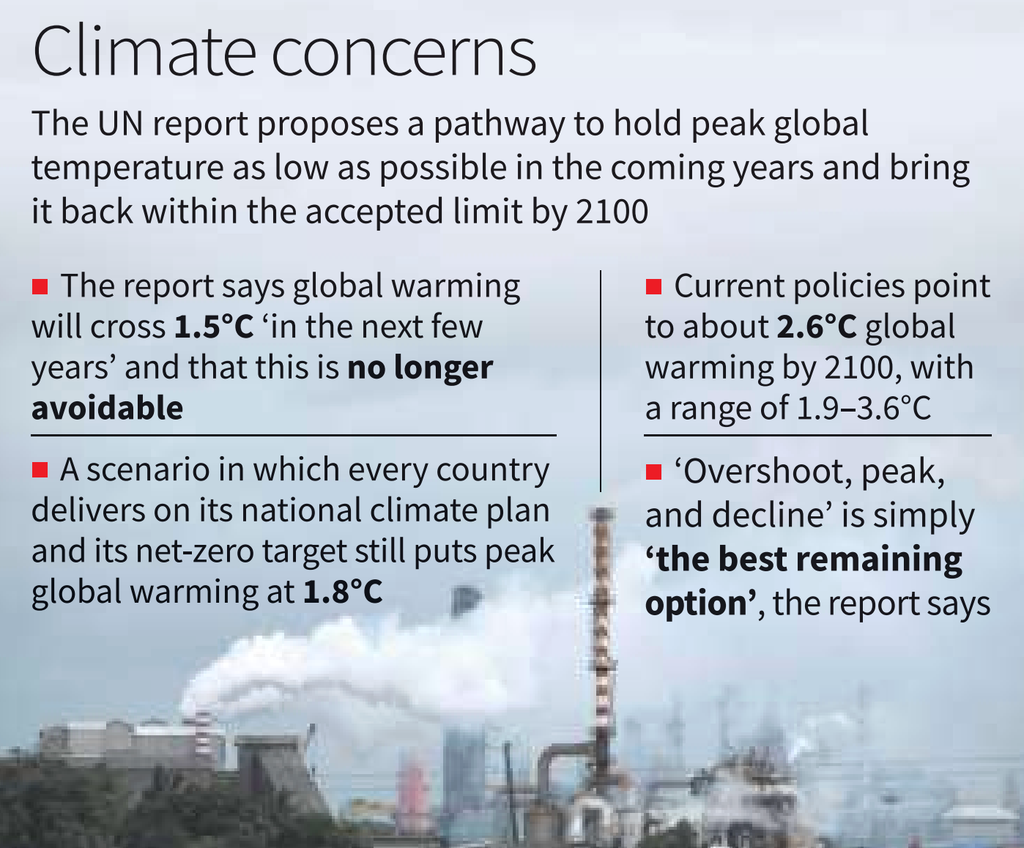
- 1.5°C overshoot is increasingly unavoidable: UNEP projects that global warming will cross 1.5°C in the coming years. However, the magnitude and duration of the overshoot remain policy-dependent.
- Best-case scenario: Even if countries fully implement their current climate plans and net-zero commitments, peak warming could reach around 1.8°C.
- Current policies: Existing policies point towards approximately 2.6°C warming by 2100.
- The Paris Agreement’s 1.5°C target refers to long-term global warming, not a single year temporarily exceeding 1.5°C.
| Understanding the 1.5°C Threshold: Under the Paris Agreement 2015, countries agreed to hold warming well below 2°C and pursue efforts to limit it to 1.5°C. The threshold refers to a long-term global average, generally assessed over decades. Therefore, a single year above 1.5°C (as occurred in 2024) does not by itself constitute a formal breach of the Paris goal. |
Understanding the Proposed Pathway:
UNEP proposes an “overshoot, peak and decline” pathway to minimise the extent and duration of this breach and eventually return temperatures below 1.5°C.
- Overshoot: Despite cutting emissions, the concentration of greenhouse gases already accumulated in the atmosphere means temperatures may temporarily rise above 1.5°C. This temporary period above 1.5°C is called overshoot.
- Peak: Once above 1.5°C, the next goal is to stop further warming as quickly as possible. The peak is the highest temperature reached. Immediate emission reductions keep the maximum temperature rise as low as possible (preferably well below 2°C).
- Decline: After reaching the peak, the world needs to achieve net-negative CO₂ emissions. This requires Carbon Dioxide Removal (CDR) along with continued emissions reductions.
Temperatures can be eventually brought back below 1.5°C. UNEP describes this not as a desirable pathway, but as the best remaining option.
Why does the Size and Duration of Overshoot Matter?
Every additional fraction of warming and every extra year above 1.5°C increases the risk of:
- accelerated sea-level rise and coastal inundation
- loss of glaciers and destabilisation of major ice sheets
- coral-reef collapse and irreversible biodiversity loss
- more intense heatwaves, floods, droughts and wildfires
- food and water insecurity
- displacement and loss of livelihoods
- climate tipping points involving the Amazon rainforest, Greenland, West Antarctica and Atlantic ocean circulation.
Without effective adaptation, global food production could decline by up to 14% by 2050. Some impacts (such as species extinction, glacier loss and long-term sea-level rise) will persist even if temperatures subsequently decline.
Four-Part Policy Response:
- Mitigation limits the peak: Rapidly reduce fossil-fuel dependence, expand renewables and storage, electrify transport and industry, improve energy efficiency and cut methane emissions.
- Adaptation limits the damage: Strengthen climate-resilient agriculture, heat action plans, early warning systems, coastal protection, water security and resilient infrastructure. However, adaptation cannot protect against every impact.
- Carbon removal enables the decline: Carbon Dioxide Removal (CDR) must supplement (not replace) deep emission reductions. Afforestation faces land, food security and biodiversity constraints, while technological removal remains expensive and inadequately proven.
- Loss-and-damage support addresses the irreversible: Vulnerable developing countries and Small Island Developing States require grants, technology and institutional support for losses that can neither be prevented nor adapted to.
COP30 and the shift towards Managing Overshoot:
- At COP30, Belém (2025), countries adopted the Global Mutirão decision, reaffirming the 1.5°C goal while recognising the need to limit both the magnitude and duration of any overshoot and close adaptation gaps.
- COP30 also launched initiatives such as the Global Implementation Accelerator and Belém Mission to 1.5 to accelerate the implementation of Nationally Determined Contributions (NDCs) and National Adaptation Plans.
Relevance for India:
- Overshoot would intensify India’s exposure to extreme heat, erratic monsoons, Himalayan glacier retreat, agricultural losses, water stress and coastal flooding.
- India’s NDC for 2031-2035 commits it to:
- reduce the emissions intensity of GDP by 47% from the 2005 level
- achieve about 60% of installed electricity capacity from non-fossil sources
- create a carbon sink of 3.5-4 billion tonnes of CO₂ equivalent through forest and tree cover
- strengthen adaptation in agriculture, water, health, coastal regions, the Himalayas and disaster management.
These commitments support India’s long-term objective of net-zero emissions by 2070.
Thus, every fraction of a degree avoided and every year by which the overshoot is shortened will save lives, ecosystems and adaptation costs.
UPSC Mains PYQs:
Q. Write a review on India’s climate commitments under the Paris Agreement (2015) and mention how these have been further strengthened in COP26 (2021). In this direction, how has the first Nationally Determined Contribution intended by India been updated in 2022? (2025)
Q. What is Carbon Capture, Utilization and Storage (CCUS)? What is the potential role of CCUS in tackling climate change? (2025)
Q. Describe the major outcomes of the 26th session of the Conference of the Parties (COP) to the United Nations Framework Convention on Climate Change (UNFCCC). What are the commitments made by India in this conference? (2021)