Universal Banking Access: 99.92% of Inhabited Villages Covered
Why in News?
The Ministry of Finance told the Lok Sabha on 3 August 2026 that 600,868 of 601,328 inhabited villages had a banking outlet within a 5 km radius, equivalent to 99.92% coverage.
- The reported denominator is 601,328 inhabited villages; 600,868 were covered and 460 remained outside the stated 5 km threshold.
- A village counts as covered when a bank branch, Business Correspondent or India Post Payments Bank centre is available within 5 km. The claim does not mean each village has a full-service branch.
- The figures were based on data uploaded by banks to the Jan Dhan Darshak App, a geographic-information platform used to map banking infrastructure.
- As on 17 July 2026, the supporting network included over 1.81 lakh bank branches, 17.36 lakh Business Correspondents and 1.65 lakh IPPB centres.
- On the same date, India had 58.77 crore PMJDY accounts with a total balance of ₹3,12,414 crore.
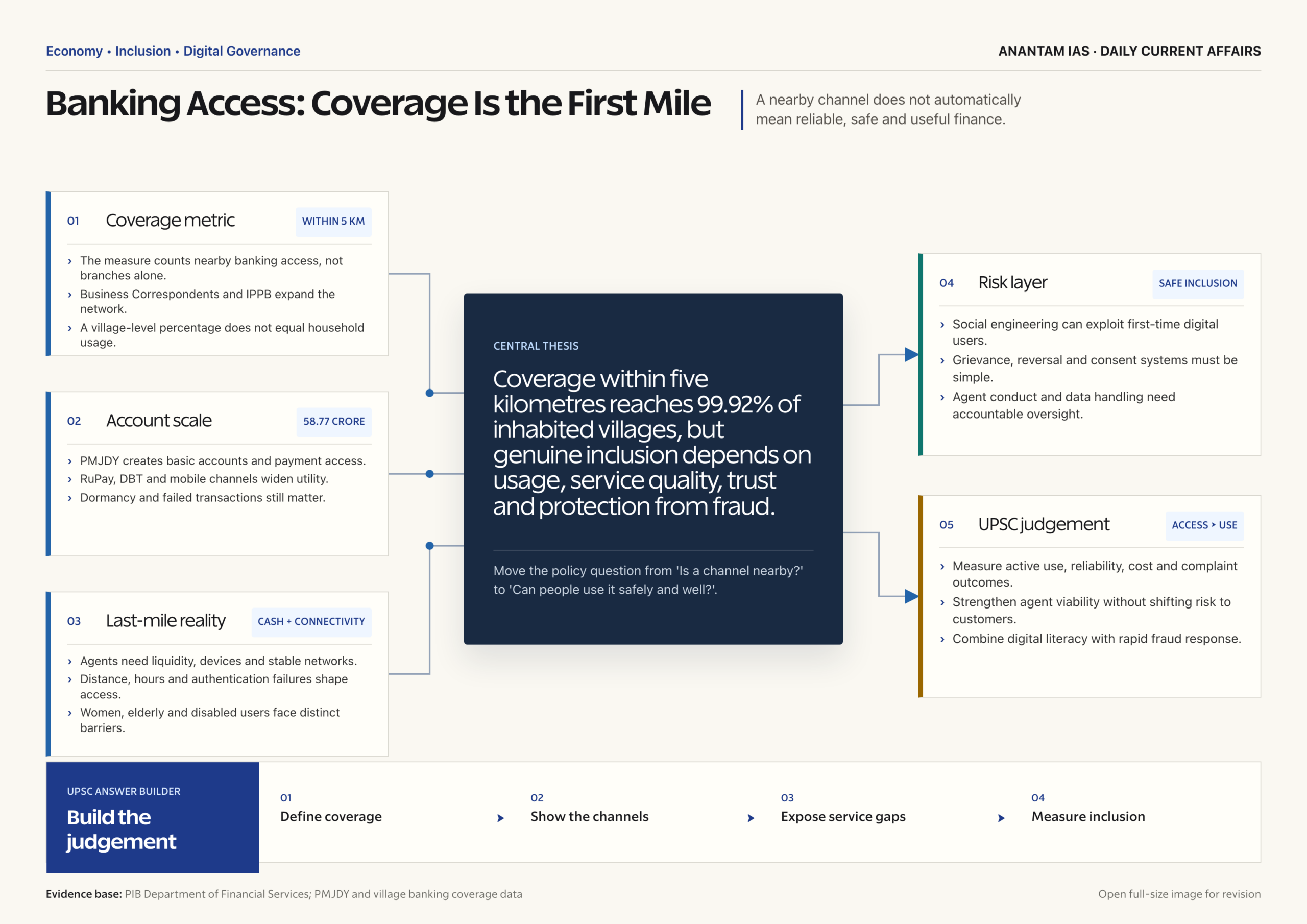
- The 99.92% figure measures geographic access. It does not directly measure outlet uptime, cash availability, transaction failure, waiting time, account dormancy, credit received, customer protection or user confidence.
- Financial inclusion has moved through three linked stages: opening accounts, building last-mile access channels, and encouraging meaningful use. The hardest stage is now quality with trust.
- For wider conceptual grounding, read the Anantam IAS notes on financial inclusion in India, Pradhan Mantri Jan Dhan Yojana and the RBI Financial Inclusion Index.
UPSC Relevance
Prelims Relevance
- Pradhan Mantri Jan Dhan Yojana was launched in August 2014 as the National Mission for Financial Inclusion.
- PMJDY seeks access to basic savings and deposit accounts, remittance, credit, insurance and pension in an affordable manner; it is not limited to opening a zero-balance account.
- A Business Correspondent is a bank-authorised intermediary that provides specified services closer to customers; a BC outlet is not the same as a brick-and-mortar bank branch.
- India Post Payments Bank is a payments bank and forms part of the last-mile network counted in the 5 km coverage measure.
- The Jan Dhan Darshak App maps service points such as branches, ATMs, Bank Mitras and other banking infrastructure and supports identification of coverage gaps.
- The RBI’s FI-Index is a composite index on a scale of 0 to 100; it captures access, usage and quality without a base year.
Mains Relevance
GS Paper 3
- Distinguish physical banking access from effective inclusion in savings, formal credit, insurance, pensions and digital payments.
- Assess how branches, Business Correspondents, IPPB, PMJDY and digital public infrastructure combine to reduce last-mile costs.
GS Paper 2
- Evaluate financial inclusion as a governance tool for direct benefit transfer, social protection and accountable service delivery.
- Discuss customer protection, accessible grievance redress and Centre-state-bank coordination for remote and vulnerable populations.
Essay
- Access becomes inclusion only when a citizen can use a service with dignity and trust.
Background and Context
What the 99.92% coverage figure actually measures
The figure is impressive, but its unit and denominator must remain precise.
- The Ministry’s statement covers inhabited villages, not the total population and not every household. Of 601,328 villages in the dataset, 600,868 had a qualifying outlet within 5 km.
- The calculation leaves 460 villages outside the threshold. Near-universal coverage is accurate; universal coverage would require the remaining locations to be served and the data to stay current.
- Coverage can come through a bank branch, a Business Correspondent or an IPPB centre. These channels differ in staffing, operating hours, cash capacity, product range and ability to resolve a complex problem.
- The data are uploaded by banks to Jan Dhan Darshak. A sound monitoring system should audit location accuracy, operational status and duplications, because a mapped point that is closed or frequently offline does not deliver practical.
- Distance is only one barrier. Terrain, transport cost, disability, working hours, network connectivity, language and social constraints can make a nominally nearby outlet hard to use.
The channel architecture behind near-universal access
India expanded reach through a layered model instead of relying only on conventional branches.
- Over 1.81 lakh bank branches provide the deepest service range, including account servicing, deposits, withdrawals, credit appraisal and grievance support, subject to the institution and branch mandate.
- The network of 17.36 lakh Business Correspondents brings services closer through bank-authorised agents. Typical last-mile functions include account opening support, deposits, withdrawals, remittances and Aadhaar Enabled Payment System transactions.
- Over 1.65 lakh IPPB centres add the postal network’s physical reach. Payments banks can accept deposits and facilitate payments and remittances, but their regulatory model is different from that of a universal commercial bank.
- RBI allows Commercial Banks, Small Finance Banks, Payments Banks, Local Area Banks and Regional Rural Banks to open branches without prior approval, subject to the requirement cited by the Ministry that 25% of new outlets be.
- SLBCs and UTLBCs review uncovered places with state or Union Territory governments and member banks. Banks also consider regulation, business plans and commercial viability, so public coordination remains necessary where private returns are weak.
PMJDY turned reach into an account platform
An outlet matters more when citizens have an account through which multiple services can flow.
- PMJDY was launched in August 2014 to provide universal access to banking services for unbanked households under the broader National Mission for Financial Inclusion.
- As on 17 July 2026, the official total was 58.77 crore accounts carrying ₹3,12,414 crore. These are accounts, not a count of unique persons, and the aggregate balance does not show the distribution across.
- The account layer supports deposits, remittances, Direct Benefit Transfer, RuPay-enabled payments and links to eligible credit, insurance and pension products. It forms the account component of the Jan Dhan-Aadhaar-Mobile architecture.
- A high account count can coexist with low or uneven use. Outcome tracking should examine active transactions, regular savings, failed payments, overdraft access, insurance continuity, pension participation and whether customers rely on informal credit despite having.
- The policy question has shifted from Can a person open an account? to Can the person use suitable services repeatedly, safely and at a reasonable cost?
Access, usage and quality are separate dimensions
The RBI framework prevents outlet counts from becoming the sole measure of success.
- The FI-Index combines Access, Usage and Quality. Their weights are 35%, 45% and 20%, which gives meaningful use more weight than physical access alone.
- The index reached 70.0 in March 2026, up from 67.0 a year earlier. RBI said all sub-indices improved and that the latest rise came mainly from usage.
- Access asks whether services and touchpoints exist. Usage asks whether people actually save, borrow, insure, invest or transact. Quality covers customer experience, financial literacy, consumer protection and inequality or deficiency in service.
- A BC point may be close yet unreliable because of poor connectivity, inadequate cash or biometric failure. An account may be active only because benefits arrive, while the customer still lacks formal productive credit. Such cases.
- Good district dashboards should track service uptime, transaction success, average grievance time, product use by gender and social group, and the share of customers using more than one suitable financial service.
Way Forward
Move from outlet mapping to service-level monitoring
- Add outlet uptime, cash availability, transaction-success rate, service range, accessibility and complaint contacts to Jan Dhan Darshak, with periodic field verification.
- Publish district-level access, usage and quality indicators instead of presenting one national proximity number as the complete result.
- Time-bound plans for the remaining 460 villages should identify terrain, connectivity, premises or viability barriers and the channel best suited to each location.
Conclusion
- India’s 99.92% village-coverage figure shows how branches, Business Correspondents and the postal network can close a vast physical-access gap.
- The strongest UPSC judgement is conditional: proximity is a necessary achievement, not the final definition of inclusion.
UPSC Practice Questions
Prelims MCQ 1
With reference to the recent official measure of banking coverage in inhabited villages, consider the following statements:
- A village is counted as covered only when it has a brick-and-mortar commercial-bank branch within its boundary.
- Business Correspondent and India Post Payments Bank outlets can satisfy the stated coverage measure when available within a 5 km radius.
- The reported 99.92% coverage was based on data uploaded by banks to the Jan Dhan Darshak App.
How many of the above statements are correct?
(a) Only one (b) Only two (c) All three (d) None
Answer: (b) Only two
Explanation:
Statements 2 and 3 are correct. The measure includes a branch, Business Correspondent or IPPB outlet within 5 km and uses bank-uploaded Jan Dhan Darshak data. It does not require a full branch inside every village.
Prelims MCQ 2
Which one of the following correctly describes the RBI’s Financial Inclusion Index?
(a) It measures only the number of bank accounts opened during a financial year (b) It gives equal weight to access, usage and quality (c) It combines access, usage and quality on a scale of 0 to 100 (d) It is compiled by the Ministry of Rural Development for inhabited villages only
Answer: (c) It combines access, usage and quality on a scale of 0 to 100
Explanation:
The RBI FI-Index is a composite measure on a 0-to-100 scale. Access, Usage and Quality carry weights of 35%, 45% and 20%, respectively; it covers the wider financial-inclusion system rather than inhabited villages alone.
UPSC Mains Questions
- India has nearly achieved universal geographic banking coverage, but proximity is not equivalent to meaningful financial inclusion. Examine. (250 words)
- Business Correspondents are central to rural banking access but remain a potential point of operational and consumer-protection weakness. Discuss the reforms needed in the BC model. (250 words)
Sources: PIB, Ministry of Finance and Reserve Bank of India.
Frequently Asked Questions
What does 99.92% village banking coverage mean?
It means 600,868 of 601,328 inhabited villages in the official dataset had a bank branch, Business Correspondent or India Post Payments Bank outlet within a 5 km radius. It does not mean every village has a full-service branch or that.
How many villages remained outside the 5 km coverage threshold?
The official figures leave 460 inhabited villages outside the stated threshold as of the reported date. These may include difficult locations facing connectivity, infrastructure, suitable-premises or commercial-viability constraints, which require location-specific solutions.
What is a Business Correspondent in banking?
A Business Correspondent is an intermediary authorised by a bank to deliver specified services closer to customers. Depending on the arrangement, a BC can support account opening, deposits, withdrawals, remittances and digital transactions. It is not automatically equivalent to a.
How large was PMJDY by July 2026?
The Ministry of Finance reported 58.77 crore PMJDY accounts with a total balance of ₹3,12,414 crore as on 17 July 2026. The figure counts accounts, not unique individuals, and the total balance does not show how deposits or account activity.
Why is access alone an incomplete measure of financial inclusion?
A nearby outlet may be offline, short of cash or unable to provide credit and grievance support. Meaningful inclusion also requires regular use, suitable products, affordable service, financial literacy, consumer protection and confidence that errors or fraud will be resolved.