UP Defence Corridor: Investment Push for Defence Manufacturing
Why in News?
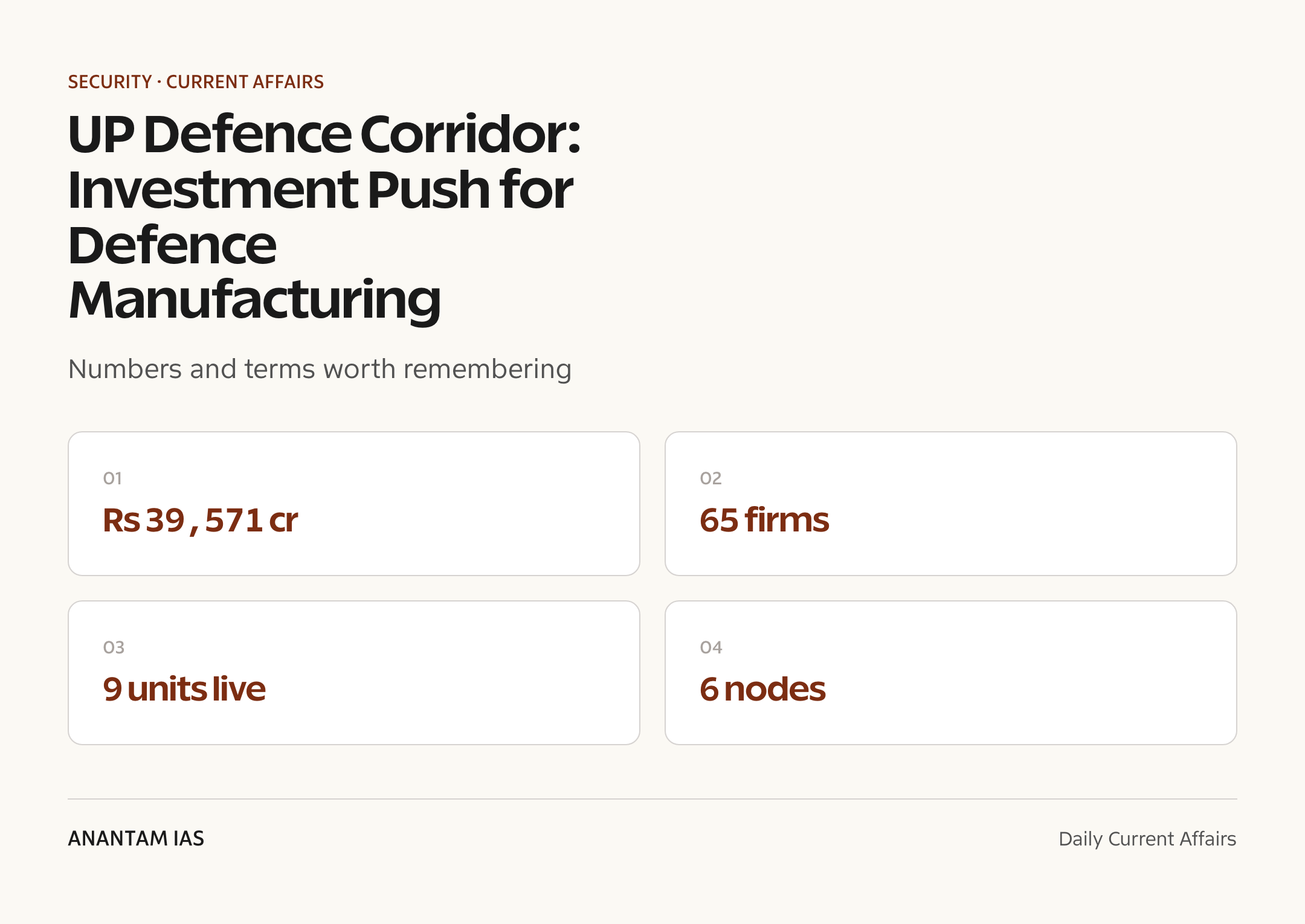
The Hindu reported on July 1, 2026 that the Uttar Pradesh Defence Industrial Corridor has attracted investment proposals worth Rs 39,571.09 crore, making it a major marker of India’s defence manufacturing push.
The report said 65 companies have secured land, nine manufacturing units are already functional, and projects worth nearly Rs 13,486 crore have been grounded with potential to generate about 15,300 jobs.
- UPDIC is spread across six nodes: Kanpur, Jhansi, Lucknow, Aligarh, Agra and Chitrakoot.
- 2,095 hectares of land have been acquired, of which 1,141.79 hectares have been allotted to industries.
- Kanpur leads the reported investment list with Rs 12,948 crore, followed by Jhansi at Rs 12,190 crore.
- Nine units are functional: three each in Kanpur, Lucknow and Aligarh.
- Adani Defence has begun operations at a Rs 1,500 crore ammunition facility in Kanpur, the largest reported corridor investment so far.
The development matters in the context of:
- Defence corridors connect internal security with industrial capacity: ammunition, small arms, ballistic protection, aerospace materials and missile assembly matter during crises.
- Regional industrial policy is central here because state land banks, expressway connectivity and incentives shape whether national defence plans convert into factory output.
- Private investment is an exam-relevant signal because India’s defence self-reliance cannot depend only on DPSUs and ordnance factories.
- MSME participation is important because defence supply chains need components, testing, tooling, electronics, textiles and precision manufacturing below the prime-contractor layer.
UPSC Relevance
Prelims Relevance
- Defence Industrial Corridors were announced in the Union Budget 2018-19 to build defence and aerospace manufacturing ecosystems.
- India has two Defence Industrial Corridors: one in Uttar Pradesh and one in Tamil Nadu.
- UPDIC was launched in August 2018 and is executed by UPEIDA as the nodal agency.
- UPDIC nodes are Aligarh, Agra, Chitrakoot, Jhansi, Kanpur and Lucknow.
- UPEIDA stands for Uttar Pradesh Expressways Industrial Development Authority.
- PIB has described the aim as catalysing indigenous production of defence and aerospace items, reducing import reliance and promoting exports.
- Offset policy has assigned a higher multiplier for investment in defence corridors, as noted in official Ministry of Defence replies.
- Defence FDI remains subject to national-security scrutiny and security clearance requirements.
Mains Relevance
GS Paper 3
- Internal security: domestic capacity in ammunition, missile systems, small arms and protective materials reduces dependence during conflict or supply-chain disruption.
- Science and technology: corridor output depends on testing, titanium casting, precision components, electronics, materials science and technology readiness.
- Industrial policy: state-led land acquisition, expressway connectivity and incentives show how infrastructure can support strategic sectors.
GS Paper 2
- Cooperative federalism: the Union sets the defence-manufacturing objective while the state handles land, local infrastructure and investment facilitation.
- Governance: procurement reform, clearances, quality certification and dispute-free land allotment affect implementation.
GS Paper 1
- Regional development: the corridor brings Bundelkhand, Kanpur, Lucknow, Aligarh and Agra into a wider industrial geography rather than keeping defence production concentrated in old centres.
Essay
- Self-reliance is not isolation: it means building trusted domestic capacity while still using global technology, capital and export markets.
- Security and development can reinforce each other when strategic manufacturing creates jobs, skills and industrial depth.
Background and Context
What the Corridor Is
The UP Defence Corridor is a state-led industrial geography built around the national goal of defence indigenisation.
- UPDIC is one of India’s two Defence Industrial Corridors, with the other located in Tamil Nadu.
- UPEIDA is the nodal state agency, which makes the corridor a case study in how expressway-led planning and defence manufacturing can be combined.
- Six nodes give the corridor a distributed structure: Aligarh, Agra, Chitrakoot, Jhansi, Kanpur and Lucknow.
- PIB has stated that the nodes were selected for their potential to create an end-to-end aerospace and defence ecosystem covering design, engineering and manufacturing.
- UP Defence and Aerospace Unit and Employment Promotion Policy provides the incentive layer through tools such as land-cost support, stamp-duty incentives and infrastructure support.
Why the Latest Numbers Matter
The current update matters because it shows a shift from announcement-heavy industrial policy to land allotment, grounded projects and operating factories.
- Rs 39,571.09 crore in investment proposals is the headline figure reported by The Hindu, well above the earlier Rs 10,000 crore per-corridor benchmark cited in official replies.
- 65 companies securing land signals investor confidence, but the exam issue is conversion: proposal, allotment, construction, production and export are different stages.
- Rs 13,486 crore in grounded projects matters because grounded investment is closer to production than MoUs or intent announcements.
- 15,300 jobs are projected, making the corridor relevant to both security and employment-led industrialisation.
- Nine operational units show early production depth, but the corridor still needs more vendors, testing labs, quality systems and skilled technicians.
Node-Wise Industrial Pattern
The node pattern shows that the corridor is not a single mega-park; it is a network of specialised manufacturing clusters.
- Kanpur leads with reported proposals of Rs 12,948 crore and hosts ammunition, ballistic materials, safety gear and defence textiles.
- Jhansi follows with Rs 12,190 crore, which keeps Bundelkhand in the corridor’s strategic geography.
- Lucknow has reported proposals of Rs 4,850.67 crore and is emerging around aerospace materials and missile-system assembly.
- Aligarh has reported proposals of Rs 4,581 crore and already has small-arms and precision-component activity.
- Chitrakoot and Agra extend the corridor beyond the biggest urban nodes, but they need logistics, skilling and supplier depth to avoid becoming only land-allotment locations.
Strategic Manufacturing Significance
For GS3, the corridor should be read as a strategic manufacturing instrument, not only as an investment story.
- Ammunition capacity is critical because wars and border crises can quickly expose stockpile and replenishment gaps.
- BrahMos Aerospace activity at Lucknow links the corridor to missile systems, an area where production quality and supply-chain security are both important.
- Titanium casting by Aerolloy Technologies shows the role of advanced materials in aircraft, engines and high-stress defence systems.
- Ballistic materials and defence textiles show why low-visibility manufacturing, not only tanks and aircraft, matters for soldier protection.
- DRDO reforms and technology-readiness systems should be read together with this corridor; revise the related notes on DRDO financial powers and TRL Compass for the wider R&D-to-production chain.
Economic and Federalism Dimensions
The corridor also tests whether defence production can become a driver of state-level industrial upgrading.
- Uttar Pradesh is using the corridor to support its broader $1 trillion economy ambition, as The Hindu noted.
- Expressway connectivity matters because heavy manufacturing needs predictable movement of components, workers, machinery and finished goods.
- MSMEs can benefit through machining, electronics, protective gear, packaging, maintenance and component supply if procurement standards are accessible.
- Skill development is a binding constraint because defence manufacturing needs welders, machinists, material specialists, quality engineers and compliance managers.
- Cooperative federalism is visible because the Union controls defence policy while the state builds industrial land, facilitation and local infrastructure.
Concerns and Governance Risks
The corridor’s success will depend on implementation quality, not only on investment announcements.
- MoU-heavy growth can overstate progress if signed proposals do not become factories, orders and exports.
- Land acquisition must remain transparent because industrial corridors often face litigation, compensation concerns and local livelihood anxieties.
- Quality certification is crucial: defence components need testing, traceability and safety standards far beyond ordinary industrial production.
- Import dependence can persist if domestic plants only assemble imported sub-systems without deep technology absorption.
- Security clearance and FDI screening are necessary because foreign capital in defence can raise national-security and supply-chain concerns.
- Operational learning from Army reforms such as Integrated Battle Groups should inform what the industry produces, not only what firms prefer to sell.
Way Forward
Move from MoUs to Production
- Track conversion ratios: proposals signed, land allotted, construction started, production begun, defence orders received and exports shipped.
- Publish node-wise dashboards so students, investors and citizens can see progress beyond headline investment totals.
- Link incentives to milestones rather than only land allotment, especially for firms that seek large plots but delay production.
Build a Supplier Ecosystem
- MSME vendor development should include standards training, design support, testing access and procurement handholding.
- Common Facility Centres and Centres of Excellence can reduce entry barriers for smaller firms that cannot afford expensive testing and prototyping infrastructure.
- Academic partnerships with IITs and technical institutes should focus on materials, electronics, propulsion, cyber-physical systems and quality assurance.
Tie Industry to Security Needs
- Armed forces feedback should shape product pipelines so the corridor supplies real capability gaps, not only showcase products.
- Technology readiness metrics should be used before scaling new systems, because premature procurement can create costly failures.
- Export controls and end-use monitoring must be built into the corridor’s growth model as firms enter sensitive global markets.
Conclusion
UP Defence Corridor is important because it joins three policy tracks: defence indigenisation, state industrial strategy and private-sector participation.
The headline investment of Rs 39,571.09 crore is encouraging, but the real test is whether the corridor produces reliable equipment, resilient supply chains, skilled jobs and export-capable firms.
For UPSC answers, use this example to show that internal security is not only about policing or border deployment; it also depends on manufacturing depth, technology absorption and governance capacity.
UPSC Practice Questions
Prelims MCQ 1
With reference to the Uttar Pradesh Defence Industrial Corridor, consider the following statements:
- It is one of the two Defence Industrial Corridors established in India.
- UPEIDA is the nodal agency for its execution.
- Its six nodes include Chennai and Hosur.
How many of the above statements are correct?
(a) Only one (b) Only two (c) All three (d) None
Answer: (b) Only two
Explanation:
Statements 1 and 2 are correct. India has Defence Industrial Corridors in Uttar Pradesh and Tamil Nadu, and UPEIDA is the nodal agency for UPDIC. Chennai and Hosur are Tamil Nadu corridor nodes, not UPDIC nodes.
Prelims MCQ 2
Which of the following best explains the strategic importance of defence industrial corridors?
(a) They replace all defence imports immediately. (b) They combine manufacturing clusters, infrastructure and private investment to deepen domestic defence capacity. (c) They are only export-promotion zones with no role in internal security. (d) They are created by state governments without any Union defence-policy link.
Answer: (b) They combine manufacturing clusters, infrastructure and private investment to deepen domestic defence capacity.
Explanation:
Defence corridors do not end imports overnight. Their importance lies in building domestic capacity through infrastructure, firms, suppliers, testing, skilling and procurement linkages.
UPSC Mains Questions
- The UP Defence Corridor shows how industrial policy can support India’s internal security architecture. Discuss with reference to defence indigenisation, private investment, regional development and supply-chain resilience.
- Investment proposals alone do not guarantee strategic autonomy. Examine the governance, technology and procurement conditions required for defence industrial corridors to become effective manufacturing ecosystems.
- Using the UP Defence Corridor as an example, analyse how cooperative federalism can help India build high-technology manufacturing capacity in strategic sectors.
Sources: PIB, Ministry of Defence and The Hindu.
Frequently Asked Questions
What is UPDIC?
UPDIC is the Uttar Pradesh Defence Industrial Corridor, a multi-node industrial corridor meant to attract defence and aerospace manufacturing. It is executed by UPEIDA and forms one of India’s two Defence Industrial Corridors.
Why is it in news?
The Hindu reported that UPDIC has attracted Rs 39,571.09 crore in investment proposals, with 65 companies securing land and nine manufacturing units already functional across Kanpur, Lucknow and Aligarh.
What are the six nodes?
UPDIC covers Aligarh, Agra, Chitrakoot, Jhansi, Kanpur and Lucknow. These nodes spread the corridor across different parts of Uttar Pradesh and connect with expressway-led industrial planning.
How does it help security?
Defence manufacturing supports security by strengthening domestic capacity in ammunition, small arms, missile systems, materials, protective gear and components. It reduces supply vulnerability during conflict or geopolitical disruption.
What is UPEIDA’s role?
UPEIDA, the Uttar Pradesh Expressways Industrial Development Authority, is the nodal agency for executing the corridor. It handles facilitation linked to land, nodes, infrastructure and investor coordination with other state agencies.
What should Mains answers stress?
Stress conversion from MoUs to production, MSME integration, testing and certification, technology absorption, procurement reform, land governance, and the link between strategic autonomy and regional industrial development.