Urban Heat Action Plans in India: Coverage, Responsibilities and Implementation Gaps
Why in News?
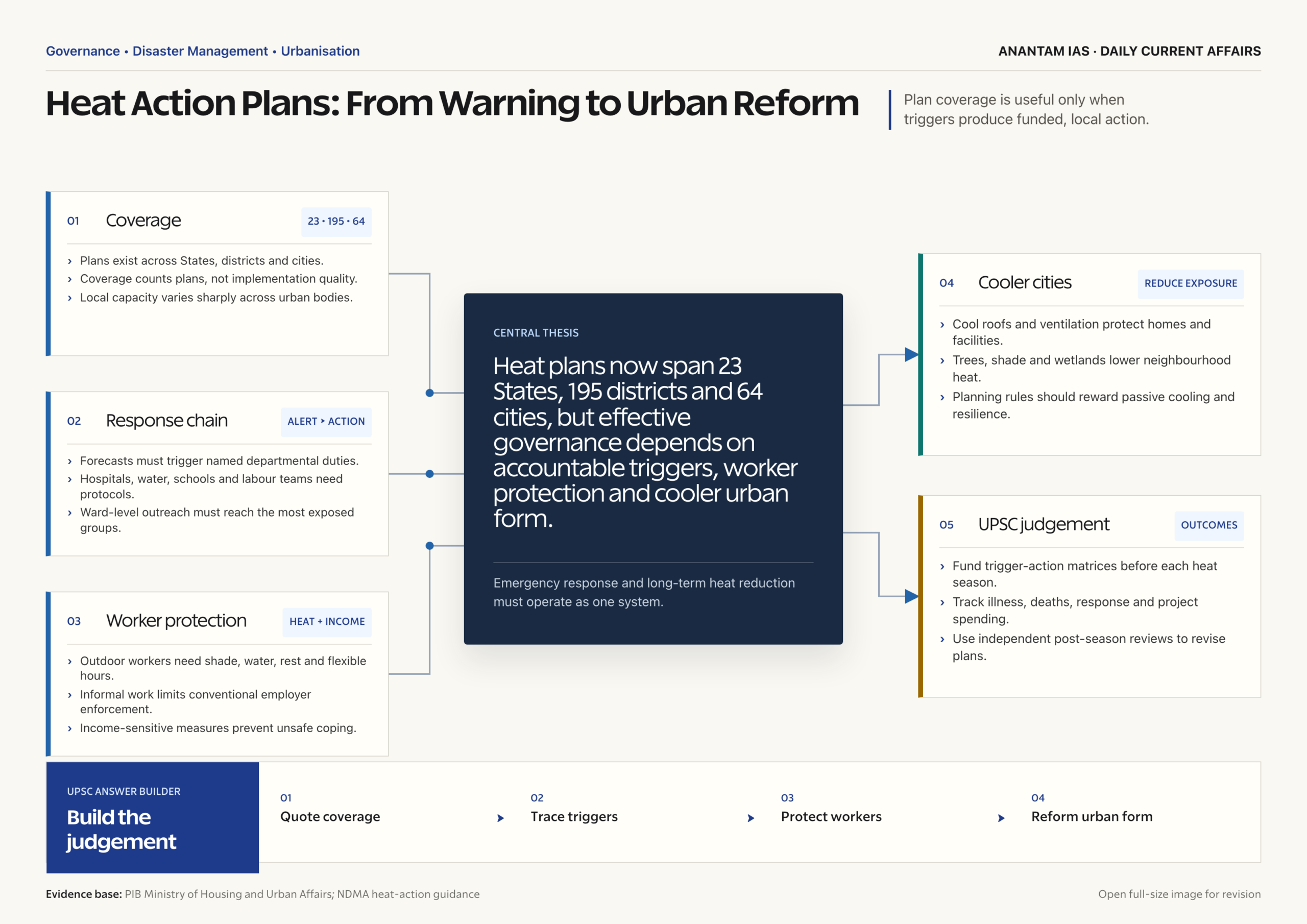
A July 20, 2026 reply by the Ministry of Housing and Urban Affairs stated that Heat Action Plans have been prepared by 23 States, 195 districts and 64 cities in India.
- The coverage numbers are three reported administrative categories: 23 States, 195 districts and 64 cities. They should not be read as a single count of mutually exclusive plans because city and district jurisdictions can overlap.
- The NDMA’s 2019 national guidelines ask cities to assess vulnerability, identify factors driving urban heat islands and include suitable mitigation measures in their Heat Action Plans.
- The NDMA advisory on informal workers asks States and Union Territories to include street vendors and outdoor workers through shaded vending areas, drinking-water access, cooling centres, flexible working hours and timely heat alerts.
- MoHUA has linked urban heat mitigation with green and blue infrastructure, cool roofs, passive cooling, water-sensitive planning and climate-responsive urban design.
- Under AMRUT 2.0, a strategic pilot is assessing heat drivers and priority vulnerable areas in 12 cities and preparing city-specific recommendations.
- A Heat Action Plan is not only a weather-warning document. It is an inter-departmental operating plan for forecasts, public communication, health-system readiness, protection of exposed groups and longer-term risk reduction.
- The central governance question is whether formal coverage becomes ward-level delivery: shaded public space, water, hospital protocols, worker safeguards, cooler housing and measurable reductions in illness and death.
- Urban heat is an equity issue. People in poorly ventilated housing and those who cannot avoid outdoor work face greater exposure while often having the least access to cooling.
UPSC Relevance
Prelims Relevance
- Heat Action Plan: a locally adapted plan combining early warning, preparedness, response and heat-risk mitigation.
- National Disaster Management Authority: established under the Disaster Management Act, 2005; it issues national guidance and advisories for disaster-risk management.
- India Meteorological Department: supplies forecasts, warnings and meteorological inputs used by local authorities to trigger heat-response actions.
- Twelfth Schedule: lists municipal functions under Article 243W; urban planning, land-use regulation, water supply, public health and urban forestry are relevant to heat resilience.
- Urban Heat Island: a condition in which built-up areas remain warmer than surrounding areas because of heat-absorbing materials, reduced vegetation, waste heat and altered air flow.
- India Cooling Action Plan: provides an integrated approach to sustainable cooling and thermal comfort while reducing cooling demand and improving efficiency.
Mains Relevance
GS Paper 3
- Heatwaves as a disaster-management and climate-adaptation challenge requiring early warning, vulnerability mapping and public-health preparedness.
- Urban heat-island mitigation through cool roofs, passive design, tree canopy, water bodies, shaded streets and heat-sensitive land-use planning.
GS Paper 2
- Division of responsibility among the Union government, NDMA, IMD, States, district authorities and ULBs in a decentralised governance system.
- Protection of informal workers and low-income households as questions of public health, social justice and accountable service delivery.
Essay
- A resilient city is measured not by the number of plans it writes, but by how safely its most exposed resident can work, travel and sleep during extreme.
Background and Context
What a Heat Action Plan Must Do
A credible HAP links an official forecast to pre-agreed local action before, during and after dangerous heat.
- The plan begins with a heat-risk and vulnerability assessment. It should identify exposed wards, dense built-up surfaces, low-green-cover areas, poorly ventilated settlements, high-risk occupations and people with health or mobility constraints.
- It defines heat-alert thresholds and communication chains so IMD information reaches departments, hospitals, schools, employers, markets and the public in time for preventive action.
- It assigns tasks for health preparedness: training staff, recognising heat illness, ensuring emergency cooling and supplies, preparing ambulances and monitoring cases and deaths.
- It provides for public protection through drinking water, shade, cooling spaces, modified school or work schedules, outreach in accessible languages and checks on high-exposure sites.
- A mature plan also contains long-term mitigation, such as cool roofs, tree canopy, shaded mobility routes, water-sensitive design, better building envelopes and preservation of water bodies.
Institutional Responsibilities from National Guidance to Ward Delivery
Heat governance is decentralised, but its institutions do not have interchangeable roles.
- The NDMA supplies national guidelines, advisories and a common disaster-risk framework. Its guidance supports State and local plans, but it does not replace local vulnerability assessment or city implementation.
- The IMD provides seasonal, extended-range and short-range forecasts, heatwave warnings and meteorological information. Local agencies use these inputs to activate response measures.
- Under the constitutional scheme and the Twelfth Schedule, urban planning is primarily a State and municipal domain. States provide legal, policy and financial backing; ULBs and urban development authorities translate it into land-use, building, water.
- District disaster-management authorities coordinate line departments across urban and peri-urban areas, align emergency response and ensure that warnings reach local institutions.
- Municipal health teams, public-health departments and hospitals handle surveillance, clinical preparedness and community outreach; labour, market, transport, water, education and power agencies act on sector-specific exposure.
Urban Heat Island, Housing and the Built Environment
Urban form can amplify heat exposure even when two places receive the same regional weather warning.
- Dark roofs and paving absorb solar radiation; dense construction can restrict air flow; loss of vegetation reduces shade and evapotranspiration; vehicles, industry and air conditioners add anthropogenic heat.
- Housing quality determines indoor exposure. A household may remain dangerously hot after sunset when a concrete or metal roof stores daytime heat and the dwelling lacks cross-ventilation, insulation or safe night-time cooling.
- MoHUA’s cooling guidance follows an avoid-shift-improve logic: reduce cooling demand through climate-responsive design, meet remaining demand with lower-carbon systems, and improve the efficiency of conventional cooling.
- Cool-roof options include reflective coatings, membranes, high-albedo tiles and context-appropriate alternatives. The choice must account for roof type, maintenance, water needs, affordability and local skills rather than impose one technology everywhere.
- For low-income households, cooler roofs and better ventilation are not merely energy measures. They can improve sleep, health and home-based work conditions while lowering dependence on unaffordable mechanical cooling.
Informal Workers and the Unequal Geography of Exposure
Heat risk is shaped by the ability to stop work, find shade, drink safe water and recover in a cool home.
- Street vendors, construction workers, sanitation workers, delivery workers, transport workers and other outdoor earners face direct solar exposure and physical exertion, often without secure rest breaks or nearby water.
- The NDMA advisory calls for shaded vending zones, hydration facilities, cooling centres, flexible working hours and timely alerts for street vendors and other outdoor workers.
- A gender-sensitive plan must examine differential access to water, sanitation, safe rest space, health care and income security. Pregnant workers and people with caregiving responsibilities can face compounded heat stress.
- Changing work hours without wage protection can shift risk rather than reduce it. Local plans should pair schedules and breaks with income-sensitive enforcement, employer duties and accessible grievance channels.
- Worker protection must extend beyond registered establishments. ULB databases, vendor associations, contractors, resident groups and community health networks can help reach people in informal and mobile occupations.
Way Forward
Turn Every Plan into a Funded Operating Protocol
- Publish a department-wise trigger-action matrix for each warning level, with named nodal officers, backup contacts, deadlines and proof-of-action fields.
- Create a dedicated budget line or clearly tagged expenditure for heat preparedness and mitigation, linked to annual municipal and district planning.
- Run pre-season simulation exercises for hospitals, schools, markets, water teams and emergency services; disclose gaps and corrective action.
Conclusion
- India’s spread of Heat Action Plans across 23 States, 195 districts and 64 cities is an important institutional base.
- The strongest heat policy joins early warning with public health, worker protection, cooler housing and climate-responsive urban design.
UPSC Practice Questions
Prelims MCQ 1
With reference to urban heat governance in India, consider the following statements:
- Urban planning is among the municipal functions associated with the Twelfth Schedule of the Constitution.
- The India Meteorological Department provides forecast and warning inputs used in Heat Action Plans.
- The National Disaster Management Authority directly performs all municipal land-use planning in heat-prone cities.
How many of the above statements are correct?
(a) Only one (b) Only two (c) All three (d) None
Answer: (b) Only two
Explanation:
Statements 1 and 2 are correct. Urban planning is a municipal function associated with the Twelfth Schedule, and IMD supplies meteorological forecasts and warnings. NDMA issues guidelines and advisories; it does not take over municipal land-use planning.
Prelims MCQ 2
Which one of the following best describes an urban heat-island mitigation measure?
(a) Replacing permeable ground with dark asphalt (b) Removing tree canopy to increase road width (c) Combining cool roofs, shaded streets and restored water bodies (d) Restricting heat alerts to hospital administrators
Answer: (c) Combining cool roofs, shaded streets and restored water bodies
Explanation:
Cool roofs reduce solar heat gain, shade lowers direct exposure, and water bodies can support evaporative cooling and local climate resilience. The other choices increase heat absorption or restrict protective communication.
UPSC Mains Questions
- Heat Action Plans must evolve from seasonal advisory documents into instruments of urban governance. Discuss with reference to institutional responsibility, public health and long-term heat mitigation. (250 words)
- Extreme urban heat exposes the intersection of climate risk, informal work and inadequate housing. Examine the measures needed to make Indian cities heat-resilient and socially just. (250 words)
Sources: PIB, Ministry of Housing and Urban Affairs and National Disaster Management Authority.
Frequently Asked Questions
What is a Heat Action Plan?
A Heat Action Plan is a locally adapted framework that connects heat forecasts with vulnerability mapping, public warnings, health-system readiness, protection of exposed groups and longer-term mitigation. A useful plan specifies triggers, responsible departments, resources, target populations and measurable actions.
How many States, districts and cities have Heat Action Plans in India?
A Ministry of Housing and Urban Affairs reply dated July 20, 2026 reported plans prepared by 23 States, 195 districts and 64 cities. These are administrative categories, not necessarily mutually exclusive units, and the figures do not by themselves measure.
Who is responsible for implementing urban Heat Action Plans?
States, district authorities and Urban Local Bodies carry the main implementation responsibility. NDMA provides national guidelines and advisories, IMD provides forecasts and warnings, MoHUA supports planning and urban programmes, and local departments translate alerts into health, water, labour, education and.
Why are informal workers central to heat planning?
Many informal workers face direct sun, physical exertion, limited rest, insecure wages and poor access to water or cooling. NDMA’s advisory recommends shaded vending zones, hydration facilities, cooling centres, flexible work hours and timely alerts, with health, safety and gender.
How do cool roofs help low-income households?
Cool roofs reduce solar heat absorbed by the roof and can lower indoor heat gain. In low-income housing, this can improve thermal comfort, sleep and conditions for home-based work while reducing cooling demand. Material, roof condition, maintenance, cost and local.