Urban Waste LCA: Comparing Pathways Across the Full System
Why in News?
On 17 September 2026, PIB reported the previous day’s release of an urban-waste life-cycle assessment report and launch of a greenhouse-gas calculator for comparing municipal waste-management scenarios.
- The PSA-supported consortium of IISc Bengaluru, IIT Madras and IIT BHU developed an India-specific framework for urban local bodies.
- The report’s cover is dated May 2026; the September development is its public release and application, not the beginning of the research.
- The framework compares collection, treatment and disposal pathways, including recycling, composting, anaerobic digestion, waste-to-energy and landfilling.
- A treatment plant’s direct emissions do not reveal the environmental performance of the entire municipal waste system.
- A useful comparison must connect actual waste flows with the emissions and resource substitutions assumed for each pathway.
UPSC Relevance
Prelims Relevance
- Life-cycle assessment: evaluation of environmental impacts across a defined system.
- Functional unit: common quantified service used for comparison.
- System boundary: processes and flows included in the assessment.
- Material flow analysis: accounting for material inputs, outputs and accumulation.
- Avoided burden: impacts credited as avoided through displacement of another product or process.
Mains Relevance
GS Paper 3
- Environment: comparing waste treatment, recovery and disposal options.
- Circular economy: actual substitution of primary resources and energy.
GS Paper 2
- Urban governance: municipal data quality and evidence-based project appraisal.
Essay
- What a city leaves outside its accounting can change what it considers a successful environmental policy.
Background and Context
Define the service before comparing technologies
Life-cycle assessment becomes useful when alternatives perform a comparable waste-management service and include the relevant processes, rather than reporting only what happens inside a plant.
- The functional unit provides the common comparison basis, such as treating a tonne of specified municipal waste. Comparing facilities handling different waste amounts or fractions without adjustment can confuse scale with better environmental performance.
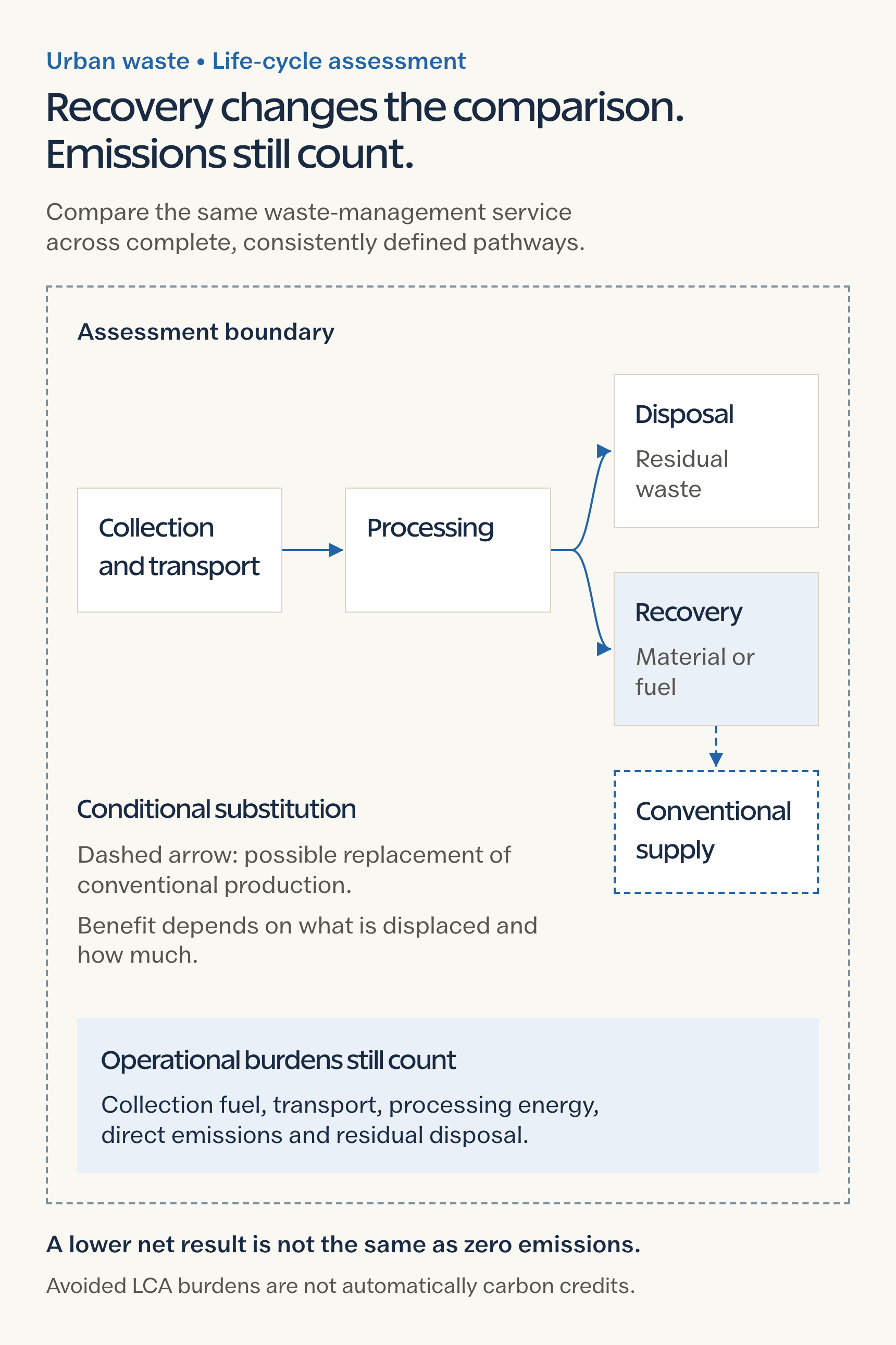
- The system boundary determines which stages count: collection, transport, processing, recovery and final disposal. A treatment option should not appear cleaner merely because its burdens have been shifted to a stage excluded from assessment.
- The inventory records material inputs, energy use and emissions within that boundary. The report’s methodology combines field information and secondary sources, with region-specific data intended to reflect different waste characteristics and operating conditions.
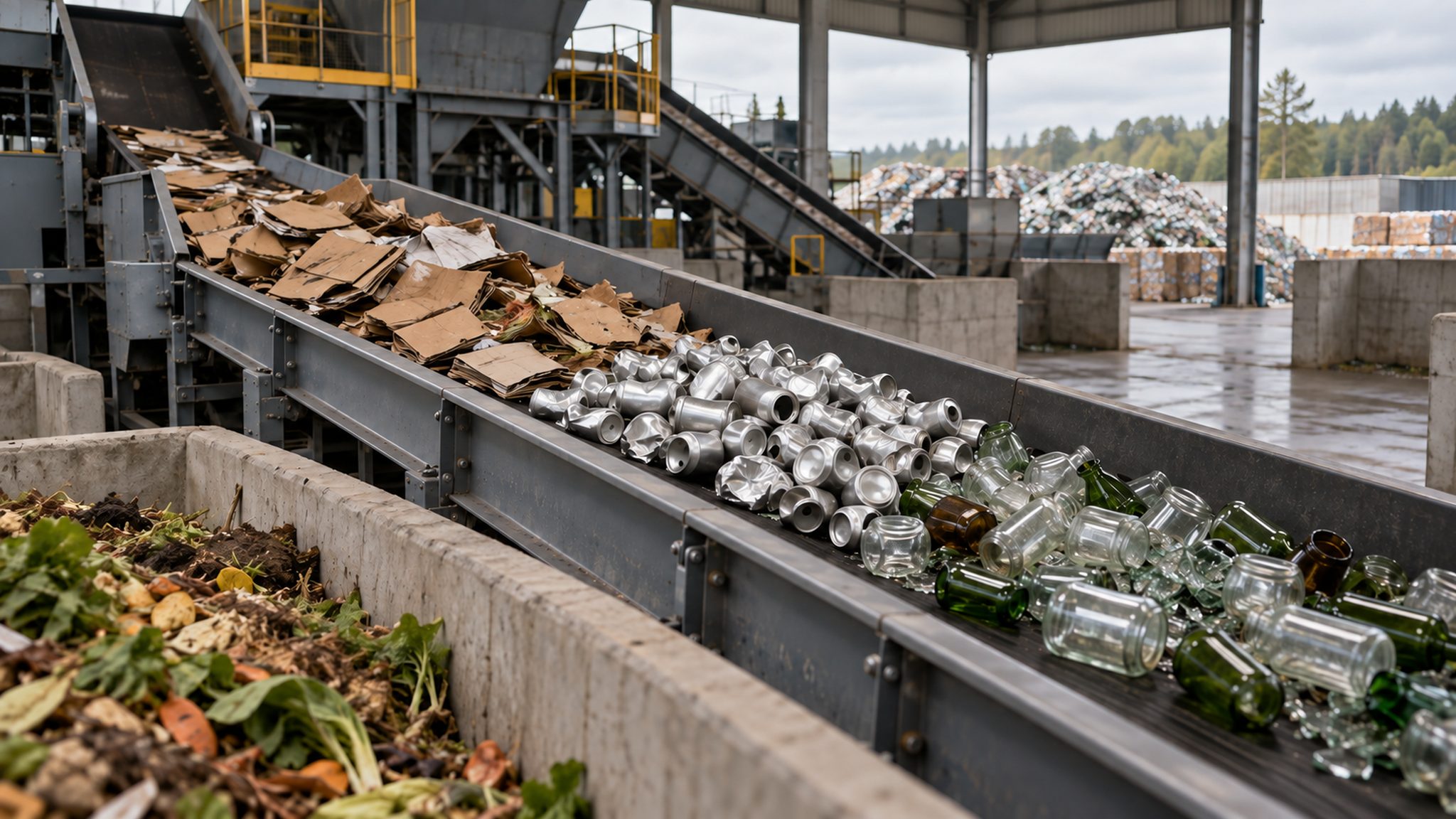
- Material flow analysis follows waste through collection, sorting, treatment and disposal using mass balance. It checks where material actually goes, including rejects and accumulated waste, rather than assuming everything entering a facility becomes a useful product.
- Impact assessment translates the inventory into environmental indicators. Climate impact is one indicator; the report also considers issues such as acidification and toxicity, so a favourable carbon result is not a complete environmental safety assessment.
Distinguish direct emissions from avoided burdens
Resource recovery can displace other production, but that benefit belongs to an explicit comparison with an alternative supply route, not to a claim that emissions disappear.
- Direct emissions arise from the waste-management operations themselves. Energy use and transport add further burdens across the system; evaluating only a treatment plant’s output misses these connected activities and can misstate the pathway’s overall footprint.
- Avoided burdens represent production displaced by recovered energy or materials. For example, useful biogas can substitute a conventional cooking fuel; the report accounts for emissions avoided along that fuel’s extraction, processing and use pathway.
- Net results combine assessed burdens with applicable avoided impacts. A lower or negative net result does not mean negative emissions from a chimney, and an accounting credit in LCA is not automatically a tradable carbon credit.
- Substitution assumptions determine the credited benefit: what product is displaced, in what quantity and with what production impacts? Material recovery, as illustrated by reuse in leather processing, must connect to a useful downstream application.
- Boundary consistency is essential when comparing scenarios. Crediting recovered energy in one pathway while ignoring comparable recovery in another can bias the result; the report explicitly examines configurations with and without resource-recovery benefits.
Use scenarios as conditional evidence
A scenario describes performance under specified conditions; the important question is whether those conditions match the city’s waste stream, infrastructure and ability to operate the system.
- Waste composition and segregation affect the material available for each treatment. The report identifies poor source segregation and limited processing capacity as constraints, meaning nominal recovery capacity cannot substitute for evidence about actual material throughput.
- Methane management can change disposal impacts substantially. The case studies identify landfilling as a major burden and discuss gas capture; a city must examine its actual operating conditions before borrowing the result of a better-controlled facility.
- Sensitivity analysis tests whether a preferred pathway stays preferable when influential assumptions change. Transport distances, recovery performance and displaced energy deserve examination; a narrow advantage dependent on optimistic inputs provides weaker support for a major investment.
- Data gaps can distort both waste quantities and recovery rates. The report notes undocumented informal-sector flows and inconsistent municipal reporting; excluding those pathways can misrepresent where materials go and how much disposal or recovery actually occurs.
- Climate and air quality need separate assessment. Methane and carbon dioxide are greenhouse gases; NOx and particulate black carbon are air pollutants. Complement carbon comparison with local air-quality evidence.
Way Forward
Make municipal comparisons auditable
- Publish the functional unit, boundary and assumptions alongside each scenario result, so consultants and municipalities compare equivalent services.
- Measure actual flows, including sorting rejects and informal recovery, and update operating data instead of relying only on installed capacity.
- Test plausible alternatives for transport, methane management and substitution before selecting a preferred pathway.
- Combine the climate comparison with cost, local pollution and operational feasibility; a calculator should support scrutiny of a project proposal.
Conclusion
- Urban waste LCA is a method for comparing complete, specified pathways. Its value depends on comparable boundaries, reliable flows and credible substitution assumptions, rather than declaring a technology universally clean because it recovers energy or materials.
- In an answer, connect waste segregation, material accounting and municipal decisions. Separate modelled net benefits from direct emissions, and explain why a scenario’s result must be tested against local conditions before it guides investment.
UPSC Practice Questions
Prelims MCQ 1
With reference to life-cycle assessment of municipal waste, consider the following statements:
- A common functional unit helps compare alternatives providing an equivalent service.
- Avoided burdens can arise when recovered materials displace virgin material production.
- A negative net result necessarily means the treatment plant physically removes greenhouse gases from the atmosphere.
How many of the above statements are correct?
(a) Only one (b) Only two (c) All three (d) None
Answer: (b) Only two
Explanation:
Statements 1 and 2 are correct. A negative net result may reflect credited avoided production impacts exceeding assessed burdens; it does not establish physical atmospheric removal by the treatment plant.
Prelims MCQ 2
A city finds one waste pathway performs better only when high recovery rates and long-distance fuel displacement are assumed. Which response best improves the comparison?
(a) Declare the pathway universally preferable. (b) Remove transport and recovery assumptions from the report. (c) Test locally plausible recovery and substitution assumptions through sensitivity analysis. (d) Treat the modelled advantage as carbon credits already issued.
Answer: (c) Test locally plausible recovery and substitution assumptions through sensitivity analysis.
Explanation:
The framework incorporates sensitivity and uncertainty analysis. Testing influential assumptions shows whether the preference remains robust under conditions the city can realistically achieve.
UPSC Mains Questions
- How can life-cycle assessment improve urban solid-waste decisions? Explain the importance of system boundaries, material flows and avoided burdens.
- A low modelled carbon footprint does not by itself establish the best municipal waste-management option. Discuss with reference to data quality and operational constraints.
Sources: PIB, Office of Principal Scientific Adviser and PSA-supported IISc, IIT Madras and IIT BHU LCA report.
Frequently Asked Questions
What is a functional unit in waste LCA?
It is the quantified service used as a common comparison basis, such as treating a tonne of a specified waste stream. It helps prevent differences in scale or waste type from misleading the comparison.
What are avoided emissions in resource recovery?
They are emissions assessed as avoided when recovered energy or materials replace another source of supply. Their size depends on what is displaced, how much is replaced and the chosen accounting assumptions.
Does a negative net LCA result mean a plant has no emissions?
No. Avoided production impacts may outweigh the assessed burdens in the model. Direct emissions can still occur, and the result does not automatically demonstrate atmospheric carbon removal or create tradable carbon credits.
Does this framework identify one best technology for every city?
No. Waste composition, segregation, transport, recovery performance and disposal conditions vary. Municipalities must compare scenarios using local evidence and test influential assumptions before adopting a result for their own waste system.
Was all the research completed in September 2026?
No. The report cover is dated May 2026 and describes earlier development work. The September news concerns its public release and the application intended to help urban local bodies compare waste-management scenarios.