U.S. Birthright Citizenship: New Executive Orders and Constitutional Limits
Why in News?
On August 6, 2026, the U.S.
- The birth-tourism order targets entry, visas and travel authorization. It defines birth tourism as entering on a nonimmigrant visa for the purpose of giving birth on U.S. soil, and also covers efforts to facilitate such.
- It delegates presidential authority under Section 215(a) of the Immigration and Nationality Act, codified at 8 U.S.C. 1185(a), to the Secretaries of State and Homeland Security for implementation.
- The order says contemplated measures may include preventing entry, denying or revoking a visa or travel authorization, removal, a permanent entry bar and action against facilitators, all within the Secretaries’ discretion and lawful authority.
- A separate citizenship-document order directs federal agencies not to recognize citizenship for specified categories when neither parent is a U.S. citizen. The categories include some foreign-government employees, designated terrorist-linked persons, commercial birth-tourism or surrogacy transactions.
- The companion order requires affected agencies to issue public implementation guidance within 30 days. Its categories and any later guidance remain subject to constitutional, statutory and judicial review.
- The dispute separates three legal questions: who may enter, whether an entrant misrepresented a visa purpose, and whether a U.S.-born child is a citizen. Each question has a different legal source and remedy.
- The case illustrates constitutional supremacy: an executive order can direct agencies within delegated authority but cannot amend the text of the Constitution or displace a binding judicial interpretation.
- It also shows how governments may pursue a policy goal through a narrower administrative route after a broader constitutional claim fails, while courts retain the power to test the new route’s legality.
UPSC Relevance
Prelims Relevance
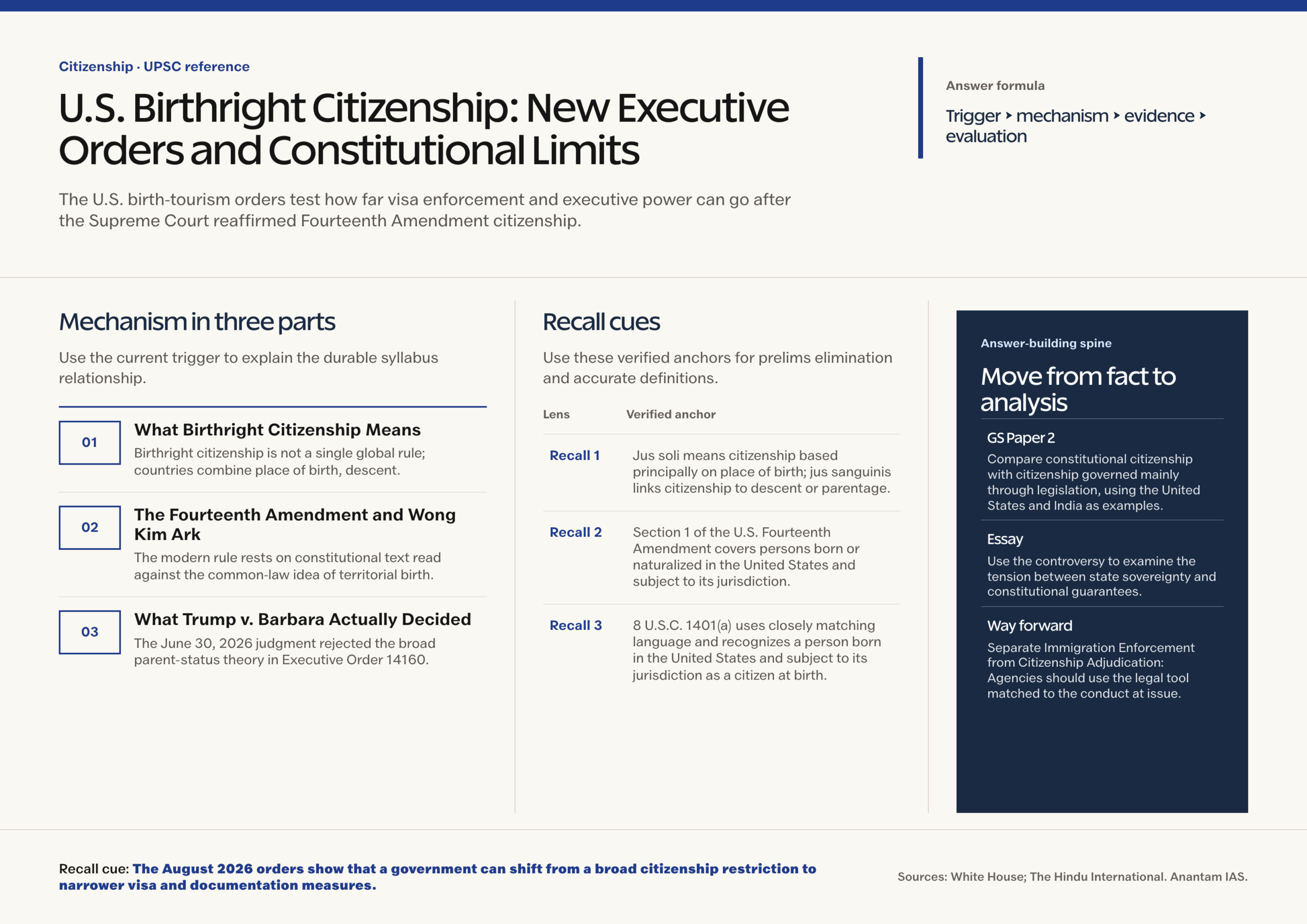
- Jus soli means citizenship based principally on place of birth; jus sanguinis links citizenship to descent or parentage.
- Section 1 of the U.S. Fourteenth Amendment covers persons born or naturalized in the United States and subject to its jurisdiction.
- 8 U.S.C. 1401(a) uses closely matching language and recognizes a person born in the United States and subject to its jurisdiction as a citizen at birth.
- In United States v. Wong Kim Ark (1898), the Supreme Court treated the Citizenship Clause as adopting the common-law rule of citizenship by birth, with narrow jurisdiction-based exceptions.
- In Trump v. Barbara (2026), the Court held that unlawful immigration status or temporary presence of the parents does not by itself remove a U.S.-born child from U.S. jurisdiction.
- The Court’s historical account recognized narrow exceptions associated with children of foreign ministers and births in territory outside the sovereign’s effective control, including hostile occupation.
Mains Relevance
GS Paper 2
- Compare constitutional citizenship with citizenship governed mainly through legislation, using the United States and India as examples.
- Explain the relationship among separation of powers, judicial review, executive implementation and legislative competence.
Essay
- Use the controversy to examine the tension between state sovereignty and constitutional guarantees.
- Discuss how citizenship law shapes belonging, equality, migration incentives and the risk of statelessness.
Essay
- A constitutional right is most seriously tested when a government seeks a popular policy objective through administrative power.
Background and Context
What Birthright Citizenship Means
Birthright citizenship is not a single global rule; countries combine place of birth, descent, residence and parental status in different ways.
- The U.S. rule is anchored in the Citizenship Clause: all persons born or naturalized in the United States and subject to its jurisdiction are citizens of the United States and the State where they reside.
- The phrase subject to the jurisdiction thereof does the limiting work. The central dispute is whether it refers to ordinary governing authority over people present in the territory or demands a stronger parental allegiance or domicile.
- Birthright citizenship concerns status acquired at birth. It is different from naturalization, through which an eligible non-citizen later acquires citizenship under statutory conditions.
- A parent’s breach of an immigration rule may trigger consequences for the parent. It does not, without a valid legal basis, erase an independently conferred constitutional status of the child.
The Fourteenth Amendment and Wong Kim Ark
The modern rule rests on constitutional text read against the common-law idea of territorial birth.
- The Fourteenth Amendment was ratified in 1868 after the Civil War and repudiated the exclusionary citizenship logic of Dred Scott v. Sandford.
- In Wong Kim Ark, the Court held that a U.S.-born child of Chinese parents who were subjects of China but domiciled in the United States was a citizen under the Fourteenth Amendment.
- The 2026 Court explained that Wong Kim Ark’s reasoning was not confined to children of lawful permanent residents. Foreign visitors entering for business or pleasure remain under U.S. law while present, so their children are generally.
- The traditional exception for a child of a foreign minister rests on immunity and an extraterritorial legal fiction, not simply on the parent’s foreign nationality or government employment.
What Trump v. Barbara Actually Decided
The June 30, 2026 judgment rejected the broad parent-status theory in Executive Order 14160, but the Justices did not all use the same reasoning.
- The Court affirmed the judgment 6-3. Chief Justice Roberts wrote a constitutional majority opinion joined by Justices Sotomayor, Kagan, Barrett and Jackson.
- That five-Justice majority held that children born in the United States to parents who are unlawfully or temporarily present are subject to U.S. jurisdiction and are citizens at birth under the Fourteenth Amendment.
- Justice Kavanaugh concurred in the judgment because Executive Order 14160 conflicted with 8 U.S.C. 1401(a), but he disagreed with the majority’s constitutional interpretation. This distinction matters when describing the decision.
- The ruling directly undermined a blanket attempt to exclude children based only on a parent’s unlawful or temporary status. It did not pre-approve every category in the August orders, nor did it settle every possible immunity.
What the Birth-Tourism Order Does
The narrower order focuses primarily on the temporary admission of foreign nationals rather than changing the Citizenship Clause.
- Its definition covers a foreign national entering through a nonimmigrant visa for the purpose of giving birth on U.S. soil, plus any foreign national who facilitates such entry.
- The State Department already stated in 2020 that a B-visa applicant may be denied where a consular officer has reason to believe the primary travel purpose is giving birth in the United States to obtain citizenship.
- Section 215(a) of the INA authorizes presidential rules, limitations and exceptions governing an alien’s departure from or entry into the United States. The August order delegates implementation authority under that provision to State and Homeland Security.
- The order allows humanitarian and national-interest exemptions. Its general clause also requires implementation consistent with applicable law and available appropriations.
- The order’s reference to a permanent bar does not make every suspected case automatically subject to that outcome. Agencies must act within delegated statutory authority, provide applicable procedure and withstand judicial review.
Way Forward
Separate Immigration Enforcement from Citizenship Adjudication
- Investigate proven visa misrepresentation, trafficking or commercial fraud through immigration and criminal law without presuming that parental wrongdoing changes a child’s constitutional status.
- Publish clear standards for purpose-of-travel findings, evidence, exemptions, notice and review so that pregnancy alone does not become a proxy for fraud.
- Record decisions and permit meaningful administrative and judicial review where law requires it.
Conclusion
- The August 2026 orders show that a government can shift from a broad citizenship restriction to narrower visa and documentation measures, but narrower drafting does not guarantee legality.
- The constitutional boundary remains clear after Trump v.
UPSC Practice Questions
Prelims MCQ 1
With reference to U.S. birthright citizenship, consider the following statements:
- The Citizenship Clause is part of the Fourteenth Amendment.
- Trump v. Barbara held that temporary presence of a child’s parents automatically removes the child from U.S. jurisdiction.
- 8 U.S.C. 1401(a) recognizes a person born in the United States and subject to its jurisdiction as a citizen at birth.
How many of the above statements are correct?
(a) Only one (b) Only two (c) All three (d) None
Answer: (b) Only two
Explanation:
Statements 1 and 3 are correct. Trump v. Barbara reached the opposite conclusion to Statement 2: children born in the United States to parents unlawfully or temporarily present are subject to U.S. jurisdiction and are citizens at birth.
Prelims MCQ 2
Which one of the following best distinguishes the August 2026 U.S. order titled Ending Birth Tourism from the Citizenship Clause question?
(a) It amends the Fourteenth Amendment through executive action. (b) It regulates nonimmigrant entry and visa use under delegated immigration authority. (c) It grants state governments exclusive power over nationality. (d) It abolishes judicial review of citizenship decisions.
Answer: (b) It regulates nonimmigrant entry and visa use under delegated immigration authority.
Explanation:
The order delegates authority linked to INA Section 215(a) to State and Homeland Security. Regulation of a parent’s admission is distinct from determining a U.S.-born child’s citizenship under the Fourteenth Amendment and 8 U.S.C. 1401(a).
UPSC Mains Questions
- The power to regulate immigration does not automatically include the power to redefine constitutional citizenship. Discuss with reference to the U.S. birth-tourism orders and Trump v. Barbara. (250 words)
- Compare citizenship by birth in the United States and India. How do constitutional entrenchment and statutory design affect the scope for executive and legislative change? (250 words)
Sources: White House and The Hindu International.
Frequently Asked Questions
What is birth tourism?
The August 2026 order defines birth tourism as entry into the United States on a nonimmigrant visa for the purpose of giving birth on U.S. soil. It also includes efforts by a foreign national to facilitate another foreign national’s entry.
Did Trump v. Barbara abolish all exceptions to U.S. birthright citizenship?
No. The Court held that unlawful or temporary parental presence does not defeat citizenship for a child born in the United States. Its historical analysis continued to recognize narrow jurisdiction-based exceptions, including foreign-minister immunity and births outside effective sovereign control.
Was Trump v. Barbara a 6-3 constitutional ruling?
The judgment was 6-3, but the constitutional majority comprised five Justices. Justice Kavanaugh supplied the sixth vote for the judgment on statutory grounds, concluding that Executive Order 14160 conflicted with 8 U.S.C. 1401(a), while disagreeing with the constitutional majority.
Can the U.S. executive deny a visa sought primarily for giving birth?
U.S. visitor-visa policy has treated travel whose primary purpose is giving birth to obtain citizenship for the child as an impermissible basis for a B visa. Any denial, revocation, removal or bar must still rest on applicable statutory and regulatory.
Does visa fraud by a parent automatically cancel a child’s birthright citizenship?
No. Immigration consequences for a parent and citizenship status of a child are separate legal questions. After Trump v. Barbara, a parent’s temporary or unlawful presence alone does not remove a U.S.-born child from the Fourteenth Amendment’s Citizenship Clause.