US-Iran Agreement: What the 14-point MoU Means for the Strait of Hormuz and India
Why in News?
Washington and Tehran have released the text of a concrete 14-point Memorandum of Understanding the so-called Islamabad MoU signed on 17 June 2026 that ends active hostilities, reopens the Strait of Hormuz to commercial shipping and opens a 60-day window to negotiate a final, UN-endorsed nuclear settlement. This is the detailed, clause-by-clause text that follows the broad peace framework announced earlier in June.
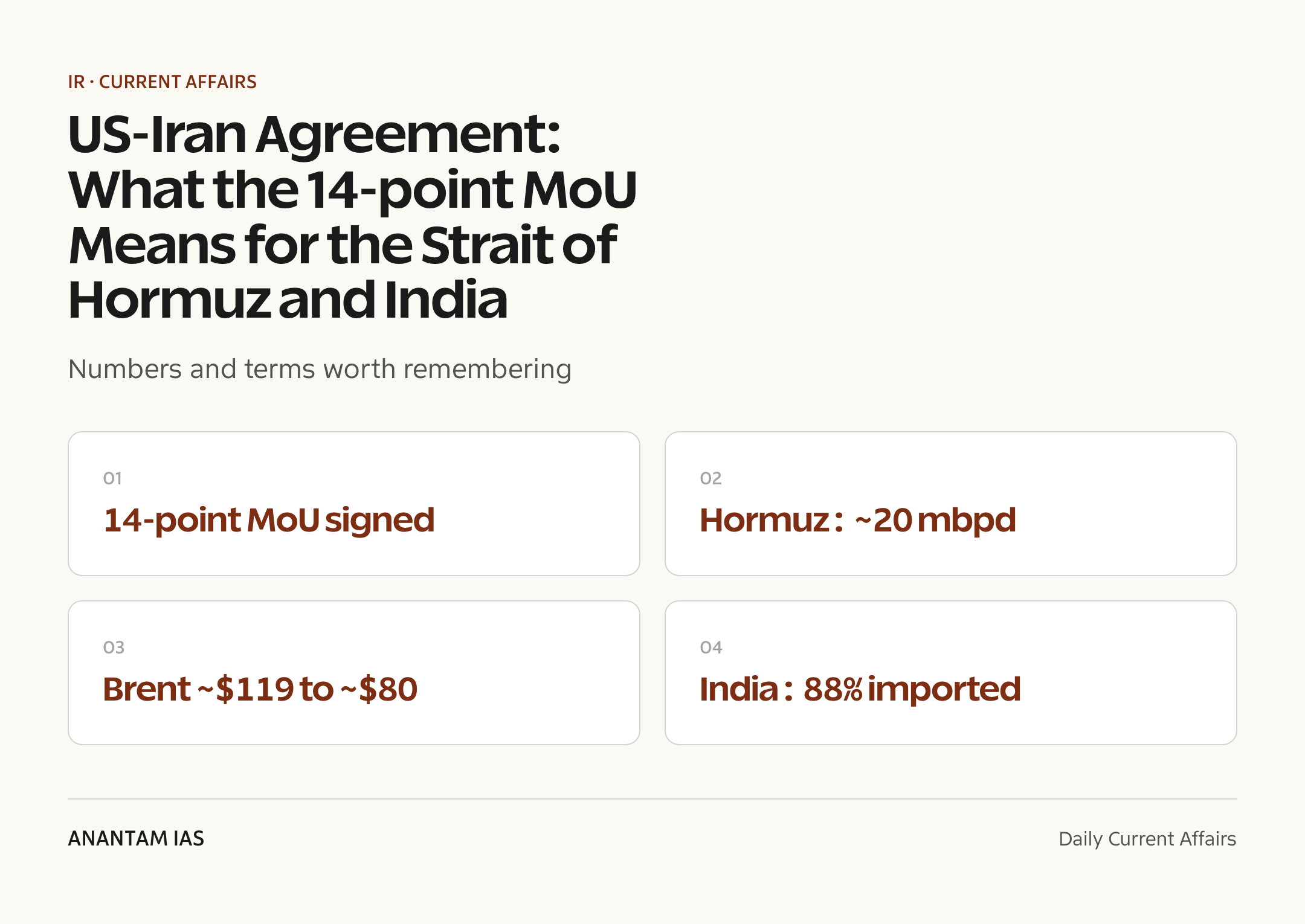
The agreement matters far beyond West Asia. The Strait of Hormuz carries roughly one-fifth of the world’s oil, and its reopening has already pulled Brent crude back from a wartime peak near $119 a barrel to around $80 directly easing the import bill of an India that buys nearly 88% of its crude from abroad.
- Iran agrees to let commercial vessels transit the Strait of Hormuz free of charge for 60 days, with safe passage ensured through demining and removal of technical obstacles.
- The United States begins removing its naval blockade immediately on signing, with full removal within 30 days and traffic expected back to pre-conflict levels.
- The US Treasury will issue waivers for the export of Iranian crude, petroleum products and derivatives, plus associated banking, insurance and transportation services.
- Both sides set a 60-day technical window to down-blend Iran’s near-bomb-grade highly enriched uranium under IAEA supervision, with Iran pledging never to acquire nuclear weapons.
- The MoU was signed at 17 June 2026 with facilitation credited across Pakistan, Oman, Qatar and Switzerland; follow-up talks to convert it into a lasting deal were slated for Switzerland.
The development matters in the context of:
- Why this matters for energy security: about 20 million barrels a day nearly 20% of global petroleum liquids and a quarter of seaborne oil pass through Hormuz, so any disruption transmits straight into Indian fuel and inflation.
- Why this matters for India’s diplomacy: New Delhi must balance ties with Iran (Chabahar, connectivity), the Gulf Arab states, Israel and the United States all at once a textbook test of strategic autonomy.
- Why this matters for the economy: each $10-a-barrel move in crude shifts India’s annual import cost by roughly $14-16 billion and feeds the current account deficit, the rupee and retail inflation.
UPSC Relevance
Prelims Relevance
- Islamabad Memorandum of Understanding (US-Iran), signed 17 June 2026
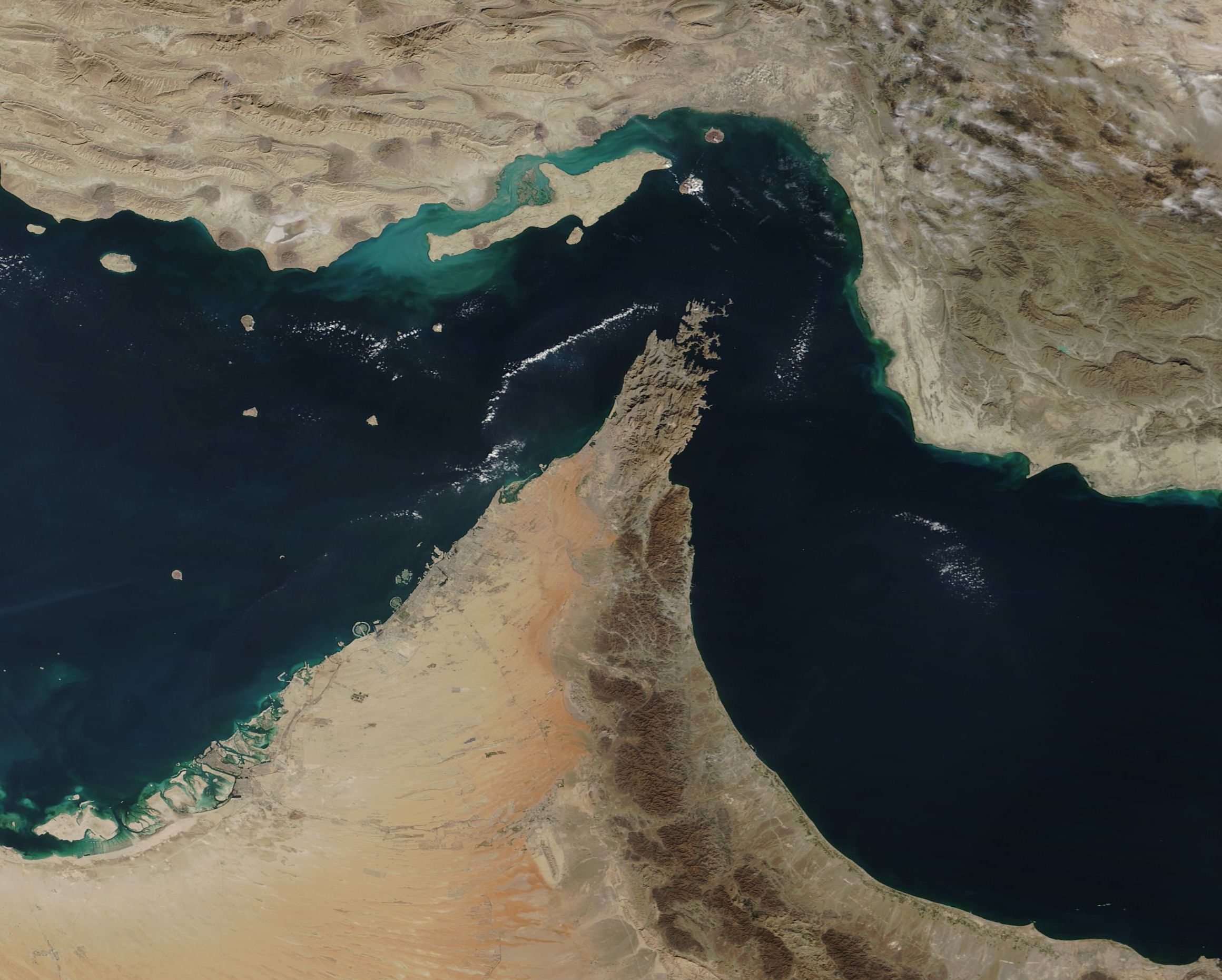
- Strait of Hormuz a chokepoint between Iran and Oman/UAE, linking the Persian Gulf to the Gulf of Oman
- Hormuz carries ~20 million barrels/day, ~20% of world petroleum liquids and ~25% of seaborne oil trade
- ~20% of global LNG (Qatar, UAE exports) transits the Strait
- Highly enriched uranium (HEU) and down-blending; IAEA as the UN nuclear watchdog
- India imports ~88% of its crude; about half comes from the Middle East
- Chabahar Port (Iran) and the International North-South Transport Corridor (INSTC)
- Brent and WTI as the two global crude benchmarks
- Force majeure clause invoked by Gulf exporters during the disruption
Mains Relevance
GS Paper 2
- Effect of a US-Iran detente on India’s West Asia policy and its balancing among Iran, the Gulf, Israel and the US.
- Role of regional mediators (Pakistan, Oman, Qatar, Switzerland) and the limits of the IAEA-led nuclear verification model.
GS Paper 3
- Energy security and chokepoint vulnerability: how Hormuz disruption transmits to India’s crude/LNG bill, rupee, current account deficit and inflation, and the case for supply diversification.
Essay
- Peace is not the absence of war but the management of dependence energy chokepoints and the fragility of globalisation.
- Strategic autonomy in a multipolar world: choosing partners without choosing sides.
Background and Context
From framework to fine print: what the 14-point MoU actually commits
The earlier announcement was a promise; the Islamabad MoU is the contract, with dated, conditional steps.
- It is a 14-point interim instrument an MoU, not a treaty governing an immediate halt to hostilities, interim economic measures and a structured negotiation path.
- The headline trade-off: Iran reopens Hormuz and accepts nuclear monitoring; the US lifts the blockade and grants sanctions waivers on oil and finance.
- Crucially, most reliefs are time-bound the free-transit and many waiver provisions run for 60 days, designed to expire unless a final deal is reached.
- A 60-day clock runs to convert the interim understanding into a final settlement to be endorsed by the UN; follow-up talks were set for Switzerland.
The Strait of Hormuz clauses
The navigation terms are the operational heart of the deal and the part markets watch.
- Iran will allow commercial vessels to transit Hormuz with no charge for 60 days, and undertakes to ensure safe passage.
- Safe passage includes active demining and the removal of technical obstacles so that traffic returns to pre-conflict levels.
- The US starts removing its naval blockade on signing, with full removal within 30 days.
- Even so, normalisation lags the text: major shipping lines were slow to resume transits and war-risk insurance premiums stayed elevated.
Sanctions relief and the nuclear bargain
The economic carrots and nuclear guardrails are explicitly linked and reversible.
- The US Treasury will issue waivers for Iranian crude, petroleum products and derivatives, plus banking, insurance and transportation a meaningful, if interim, return to oil markets.
- Reports point to phased access to frozen Iranian assets as an additional incentive tied to compliance.
- On the nuclear side, the agreed minimum methodology is to down-blend near-bomb-grade highly enriched uranium with lower-grade material under IAEA supervision.
- Iran reaffirms it will never acquire nuclear weapons; the 60-day technical talks must settle how to freeze, down-blend and verify its programme going forward.
Why Hormuz is a global jugular and India's most exposed artery
The geography explains the price swings: there is no easy alternative route.
- Roughly 20 million barrels a day about 20% of global petroleum liquids and a quarter of seaborne oil cross the Strait between Iran and Oman/UAE.
- Almost 20% of global LNG chiefly from Qatar and the UAE also transits Hormuz, with no spare bypass capacity.
- Asia is the destination: China and India together take about 44% of Hormuz crude exports, so the chokepoint sits on India’s lifeline.
- India imports nearly 88% of its crude and around half from the Middle East, leaving little buffer if the Strait closes.
The oil-price and import-bill arithmetic for India
The deal’s biggest near-term gift to India is a calmer crude market.
- Brent retreated from a wartime spike near $119 a barrel to about $80 roughly 36% off the peak as Hormuz reopened and force majeure declarations lifted.
- Every $10-a-barrel swing alters India’s annual import cost by an estimated $14-16 billion and nudges the current account deficit.
- A cheaper barrel eases pressure on the rupee, which had weakened toward the 95-to-a-dollar zone during the conflict, and on fuel-driven inflation.
- Iranian barrels returning to market add supply, but India had already leaned on discounted Russian crude to cushion the war shock.
India's diplomatic and connectivity stakes
Beyond oil, the deal reshapes corridors India has long invested in.
- Sanctions relief could revive momentum on the Chabahar Port and the INSTC, India’s bypass route to Afghanistan and Central Asia that avoids Pakistan.
- New Delhi must keep equilibrium across Iran, the Gulf, Israel and the United States a live test of strategic autonomy.
- A durable West Asia calm protects the roughly 9 million Indians in the Gulf and their remittances, plus energy and trade links.
- Persistent uncertainty the Switzerland follow-up talks reportedly stalled means India cannot treat the relief as permanent and must keep diversifying supply.
Way Forward
Diversify and store
- Deepen sourcing beyond Hormuz US, Latin American, West African and Russian grades and accelerate filling the Strategic Petroleum Reserves.
- Expand the domestic SPR footprint and crude shipping/insurance capacity to blunt the next chokepoint shock.
Hedge the price and the rupee
- Use oil hedging, rupee-settlement arrangements and refiner term contracts to smooth volatility in the import bill.
- Pair this with the structural cut in oil demand via biofuels, EVs and renewables to lower long-run exposure.
Bank the diplomatic opening
- Reactivate Chabahar and INSTC projects if Iran sanctions ease, while keeping Gulf and Israeli partnerships intact.
- Stay engaged with the IAEA verification track and back a UN-endorsed final deal that locks in freedom of navigation.
Conclusion
The Islamabad MoU is best read as a ceasefire with a price tag: Iran trades open sea lanes and nuclear transparency for oil and financial oxygen, and the world gets a calmer Strait of Hormuz. For India, the immediate dividend is a softer crude market, a steadier rupee and a lighter import bill all of which buy fiscal room.
But the deal’s reversibility its 60-day clocks, stalled follow-up talks and elevated insurance is the real lesson. India’s structural vulnerability to a single waterway does not disappear because diplomacy paused a war. The durable answer lies less in any one agreement and more in supply diversification, strategic reserves and a foreign policy supple enough to keep every West Asian partner onside.
UPSC Practice Questions
Prelims MCQ 1
With reference to the 2026 US-Iran Memorandum of Understanding, consider the following statements:
- It commits Iran to allow commercial vessels to transit the Strait of Hormuz free of charge for a fixed interim period.
- It provides for the down-blending of Iran’s highly enriched uranium under IAEA supervision.
- It is a legally binding treaty ratified by the UN Security Council before its signing.
How many of the above statements are correct?
(a) Only one (b) Only two (c) All three (d) None
Answer: (b) Only two
Explanation:
Statements 1 and 2 are correct: free 60-day transit and IAEA-supervised down-blending are core clauses. Statement 3 is wrong it is an interim MoU, not a UNSC-ratified treaty; a final deal is to be UN-endorsed later.
Prelims MCQ 2
The Strait of Hormuz connects which two water bodies?
(a) The Red Sea and the Gulf of Aden (b) The Persian Gulf and the Gulf of Oman (c) The Mediterranean Sea and the Red Sea (d) The Arabian Sea and the Bay of Bengal
Answer: (b) The Persian Gulf and the Gulf of Oman
Explanation:
The Strait of Hormuz links the Persian Gulf to the Gulf of Oman (and onward the Arabian Sea), lying between Iran to the north and Oman/UAE to the south. The Red Sea-Gulf of Aden link is the Bab-el-Mandeb.
UPSC Mains Questions
- The Strait of Hormuz is a single point of failure in India’s energy security. Examine how the 2026 US-Iran agreement affects India’s crude and LNG supply, and outline measures to reduce New Delhi’s exposure to maritime chokepoints. (250 words)
- A US-Iran detente forces India to balance Iran, the Gulf states, Israel and the United States simultaneously. Critically analyse how India can pursue strategic autonomy in West Asia while protecting its energy and diaspora interests. (250 words)
Sources: The Hindu and Indian Express Explained.
Frequently Asked Questions
What is the Islamabad MoU between the US and Iran?
It is a 14-point interim Memorandum of Understanding signed on 17 June 2026 that halts hostilities, reopens the Strait of Hormuz to commercial shipping, grants Iran oil and financial sanctions waivers, and places its highly enriched uranium under IAEA-supervised down-blending. It sets a 60-day window to negotiate a final, UN-endorsed deal.
Why is the Strait of Hormuz so important?
Around 20 million barrels of oil a day nearly 20% of global petroleum liquids and a quarter of seaborne oil trade pass through it, along with roughly 20% of world LNG. It is a narrow chokepoint between Iran and Oman/UAE with no easy bypass, so any disruption spikes global crude prices almost immediately.
How does the agreement affect India’s oil import bill?
By reopening Hormuz and easing supply fears, the deal helped pull Brent crude from a wartime peak near $119 to about $80 a barrel. Since each $10-a-barrel move shifts India’s annual import cost by roughly $14-16 billion, a calmer market eases the import bill, the current account deficit, rupee pressure and fuel inflation.
What does the deal mean for India’s nuclear-monitoring concerns?
The MoU’s nuclear core is the IAEA-supervised down-blending of Iran’s near-bomb-grade uranium and a pledge that Iran will never acquire nuclear weapons, with a 60-day technical talk to finalise verification. India, which backs non-proliferation and a peaceful West Asia, benefits from a verified freeze that lowers the risk of renewed conflict on its energy routes.
Could the agreement help the Chabahar Port and INSTC?
Yes. Sanctions relief on Iran could revive momentum on Chabahar Port and the International North-South Transport Corridor, India’s connectivity route to Afghanistan and Central Asia that bypasses Pakistan. But the relief is interim and reversible, so India must stay cautious about over-committing until a final deal is locked in.
Is the US-Iran deal permanent?
No. It is an interim MoU built on 60-day clocks for free transit, sanctions waivers and nuclear talks designed to expire unless a final settlement is reached. Follow-up negotiations in Switzerland reportedly stalled, war-risk insurance stayed high and shipping lines were slow to return, so India cannot treat the relief as durable.