US Strikes on Iran: Strait of Hormuz Closure and the West Asia Crisis
Why in News?
A fragile ceasefire in West Asia has collapsed again. After Iran struck a commercial vessel transiting the Strait of Hormuz in late June 2026, US Central Command launched fresh strikes on Iranian missile, drone and coastal-radar sites, and Tehran responded by hitting US-linked targets at Gulf bases — reopening a crisis that had only paused under a June 17 memorandum.
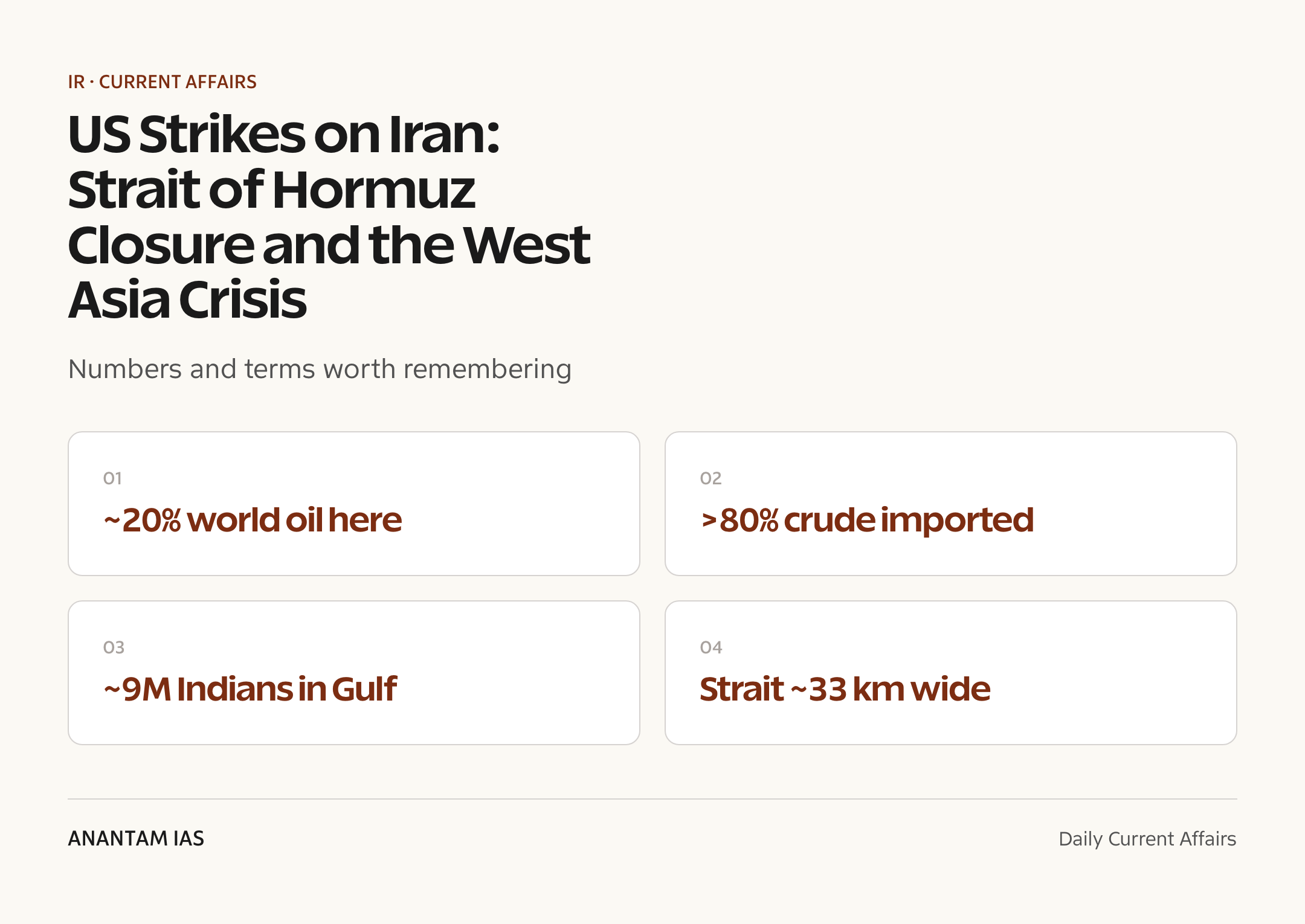
For India the stakes are direct and material. The renewed threat to close the Strait of Hormuz — the chokepoint through which roughly 20% of the world’s seaborne oil moves — endangers India’s crude and LPG import routes, the safety of about 9 million Indians living and working in the Gulf, and the price stability that underpins the domestic economy. As The Hindu’s international coverage has tracked, India is once again weighing energy-supply diversion, naval escorts and possible evacuation contingencies while protecting its strategic autonomy.
- Iran attacked a commercial cargo ship exiting the Strait of Hormuz along the Omani coast, breaching the truce signed days earlier.
- US Central Command (CENTCOM) struck Iranian missile and drone storage sites and coastal radar installations, accusing Tehran of violating the ceasefire.
- Iran retaliated against US-linked targets at Gulf bases (the region hosts major US installations such as Al Udeid in Qatar), prompting further American strikes.
- Iran again declared the Strait of Hormuz effectively closed; the US Navy announced a widened transit route to challenge that control.
- The flare-up undoes the June 17, 2026 memorandum under which the Strait was to reopen with 60 days of free, safe passage for commercial vessels.
The development matters in the context of:
- The Strait of Hormuz is the single most important oil chokepoint on earth; even the threat of closure pushes Brent crude sharply higher and feeds global inflation.
- India imports more than 80% of its crude oil and a large share of its LPG; West Asia remains a core supplier despite active diversification.
- India’s response template — naval escorts for Indian-flagged ships and diaspora-safety planning — echoes earlier missions like Operation Sankalp in the Persian Gulf.
UPSC Relevance
Prelims Relevance
- Strait of Hormuz connects the Persian Gulf with the Gulf of Oman and onward to the Arabian Sea; it is the world’s busiest oil chokepoint.
- The Strait lies between Iran (north) and Oman (the Musandam exclave, south); at its narrowest it is about 33 km wide.
- Roughly 20% of global seaborne oil (and a major share of LNG, much of it from Qatar) transits the Strait.
- OPEC Gulf producers Saudi Arabia, Iraq, the UAE, Kuwait and Iran all ship crude through or near Hormuz.
- India’s crude basket is import-heavy — over 80% import dependence; key Gulf suppliers include Iraq, Saudi Arabia and the UAE.
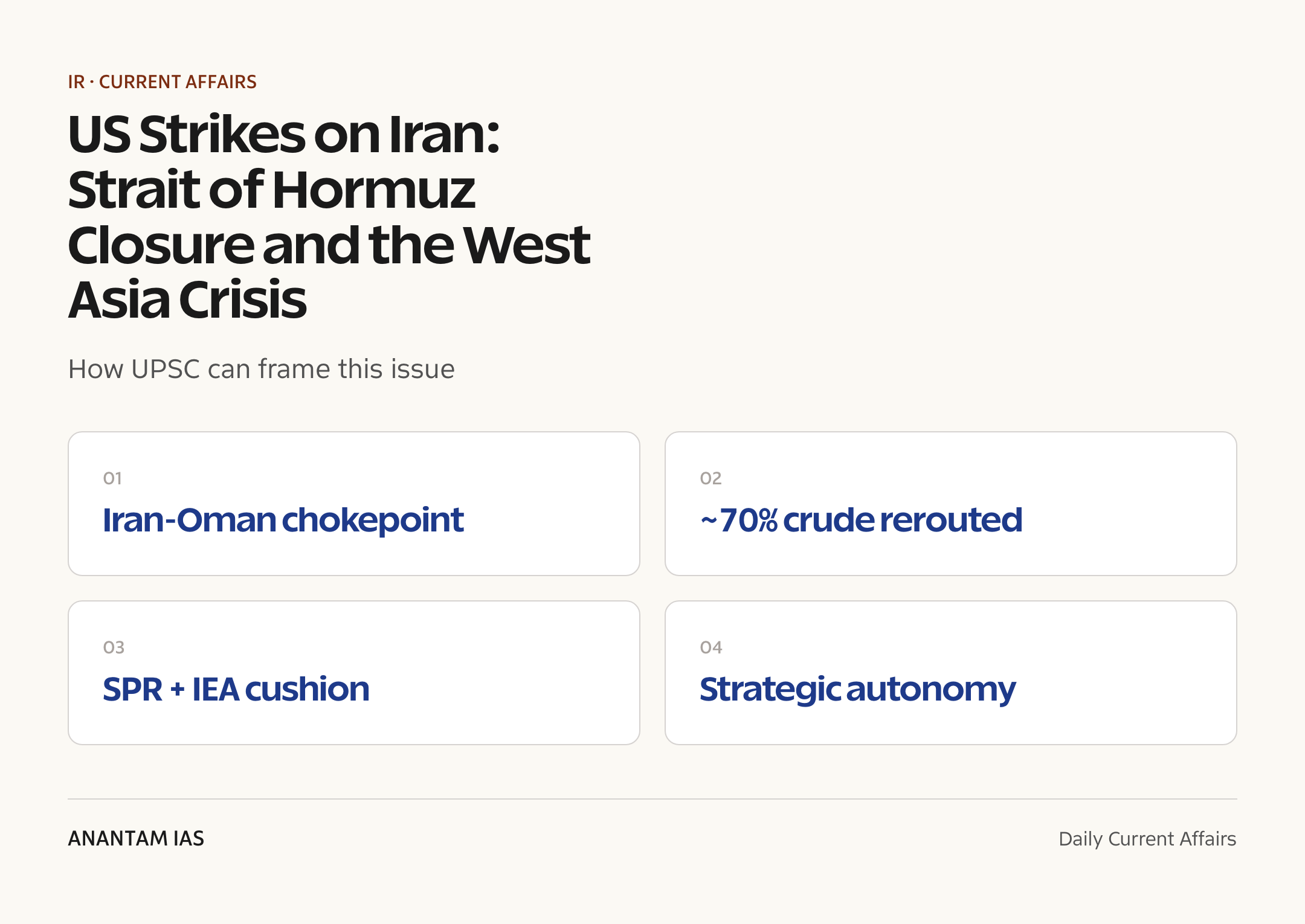
- India has reportedly rerouted about 70% of its crude imports to sources outside the Strait of Hormuz, reducing single-chokepoint exposure.
- India imports a large share of its LPG, and the bulk of those imports come via the Strait of Hormuz, a sharper vulnerability than for crude.
- India holds Strategic Petroleum Reserves (SPR) at Visakhapatnam, Mangaluru and Padur, managed by ISPRL.
- The International Energy Agency (IEA) coordinates emergency oil-stock releases among member countries during supply shocks.
- Bypass infrastructure exists — the UAE’s Fujairah pipeline and Saudi Arabia’s east-west Petroline can route some crude around Hormuz.
Mains Relevance
GS Paper 2
- India’s West Asia policy and the balancing act between Iran, Israel, the Gulf monarchies and the United States.
- Diaspora diplomacy: protecting and, if needed, evacuating roughly 9 million Indians in the Gulf, and the precedent of past evacuation operations.
- Strategic autonomy in a great-power crisis: how India calibrates its stance without aligning fully with any bloc.
GS Paper 3
- Energy security: chokepoint risk, import diversification, strategic petroleum reserves and the macroeconomic transmission of an oil-price spike to inflation and the rupee.
- Internal-security and maritime-security dimensions: protecting sea lanes of communication, naval escort operations and the safety of Indian seafarers.
Essay
- Energy security as the new frontier of national security
- Strategic autonomy in a fractured world order
Background and Context
What Happened: The Strikes and the Retaliation
A ceasefire signed only days earlier unravelled when an attack on shipping triggered a fresh US-Iran exchange.
- Iran struck a commercial cargo ship as it exited the Strait of Hormuz along the Omani coast, in violation of the truce.
- US Central Command responded with strikes on Iranian missile and drone storage and coastal radar sites, calling it a reply to ceasefire violations.
- Iran hit back at US-linked targets at Gulf bases — the region hosts large US installations including Al Udeid Air Base in Qatar, CENTCOM’s forward Gulf hub.
- Washington launched additional strikes hours after the Iranian retaliation, and Tehran again moved to shut the Strait of Hormuz.
- The escalation tears up the June 17, 2026 memorandum that had promised the Strait’s reopening and free passage for shipping.
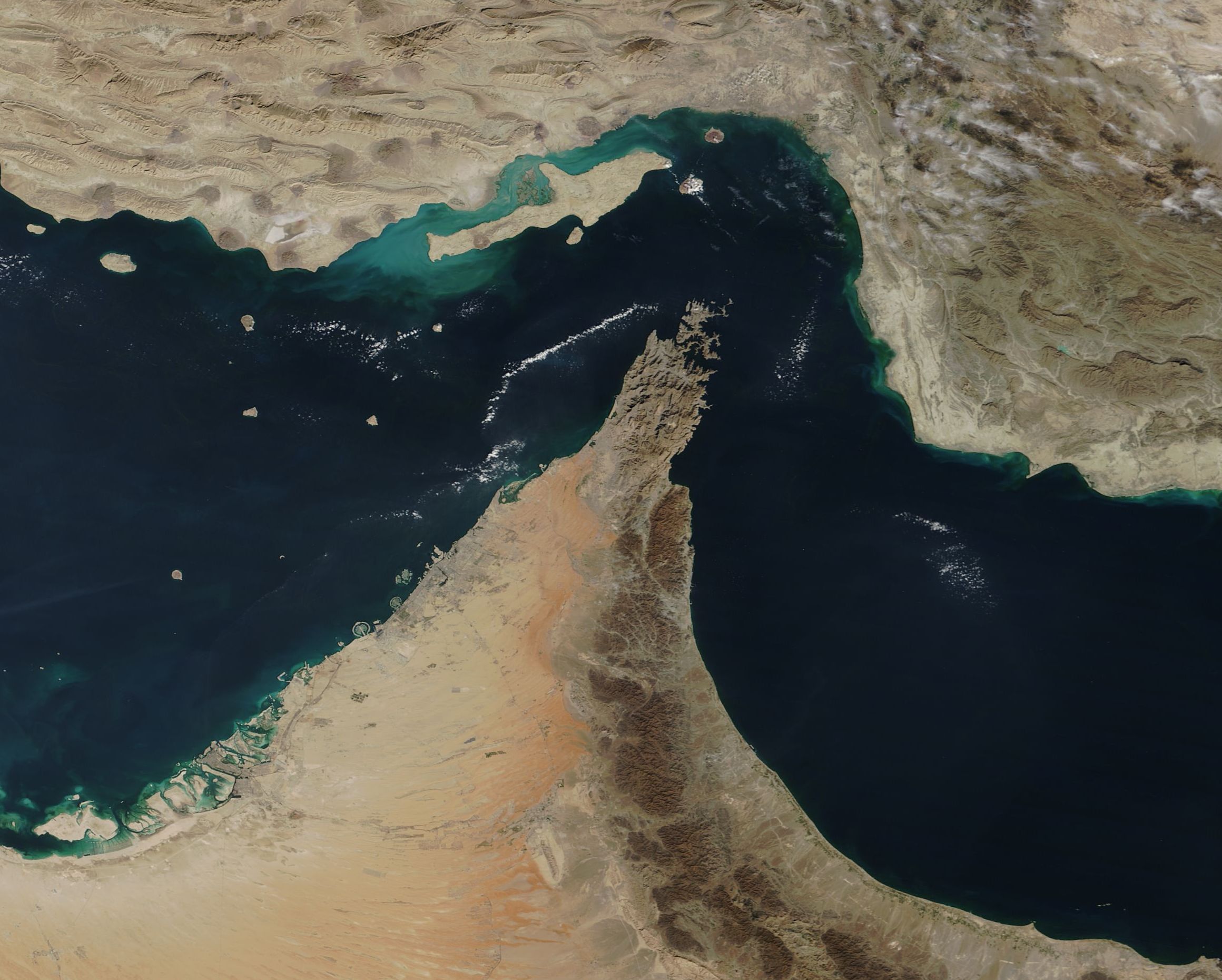
The Strait of Hormuz: Geography of a Chokepoint
A sliver of water decides the fate of a fifth of the world’s oil trade.
- The Strait links the Persian Gulf to the Gulf of Oman and the Arabian Sea, the only sea route out of the Gulf’s oil ports.
- It runs between Iran to the north and Oman’s Musandam peninsula to the south, narrowing to about 33 km.
- Shipping uses traffic-separation lanes only a few kilometres wide, much of it inside Omani and Iranian territorial waters — which is why Iran can credibly threaten passage.
- Roughly 20% of global seaborne oil and a large volume of LNG (notably Qatari exports) pass through daily.
- There is no full substitute: bypass pipelines like the UAE’s Fujairah line and Saudi Arabia’s Petroline can carry only a fraction of Gulf exports.
India's Energy and Diaspora Stakes
Hormuz sits at the intersection of India’s oil bill, its kitchens and its overseas citizens.
- India imports more than 80% of its crude oil; a Hormuz disruption raises the import bill, widens the current-account gap and pressures the rupee.
- LPG is the sharper exposure — a large share of cooking-gas imports moves through the Strait, with fewer easy alternatives than crude.
- About 9 million Indians live and work in the Gulf (the UAE, Saudi Arabia, Qatar, Kuwait, Oman, Bahrain), sending home a major slice of India’s remittances.
- Their safety and possible evacuation become live concerns the moment Gulf bases and waters come under fire.
- India has cushioned the blow over time by rerouting roughly 70% of crude imports outside Hormuz and by buying discounted Russian crude via non-Gulf routes.
India's Strategic Autonomy and Diplomatic Stance
India seeks to protect its interests without being drawn into either camp.
- India maintains working ties with Iran (Chabahar port, INSTC), with Israel (defence and technology) and with the Gulf monarchies (energy, labour, investment) simultaneously.
- Its consistent line is to call for de-escalation, dialogue and respect for international law, including freedom of navigation, rather than endorsing strikes.
- Strategic autonomy means New Delhi avoids automatic alignment with the United States even as the partnership deepens, and keeps channels open to Tehran.
- Protecting Indian seafarers and merchant shipping has emerged as a distinct strand of India’s consular and maritime diplomacy.
- The Indian Navy can mount escort and presence missions in the Gulf, building on the template of Operation Sankalp.
Global Oil Markets and Escalation Risk
Even short of a full closure, the fear premium reorders world energy markets.
- Threats to Hormuz reliably spike Brent crude and freight and insurance costs, feeding imported inflation in oil-importing economies.
- Coordinated strategic-reserve releases by the IEA and producers’ spare capacity are the main shock absorbers, but both are limited against a sustained blockade.
- A wider war risks dragging in Gulf monarchies, shipping insurers and global supply chains far beyond oil.
- Markets watch whether the US Navy’s widened transit route keeps traffic flowing or invites further Iranian interdiction.
- For India, the policy mix is to diversify suppliers, draw on SPR, manage fuel pricing and prepare diaspora contingencies.
Way Forward
Secure Energy Supply
- Accelerate supplier diversification (Americas, Africa, Russia) and lock in term contracts that avoid single-chokepoint dependence.
- Top up and operationalise Strategic Petroleum Reserves, and coordinate any release with the IEA to blunt a price spike.
Protect the Diaspora
- Activate embassy control rooms and contingency evacuation plans for Indians in the Gulf, with airlines and the Navy on standby.
- Keep advisories and registration channels open for the roughly 9 million Indians across the GCC.
Maritime and Diplomatic Leverage
- Deploy naval escorts for Indian-flagged vessels and coordinate at the IMO on civilian-shipping safety in chokepoints.
- Use India’s ties with both Iran and the Gulf to push back-channel de-escalation, consistent with strategic autonomy.
Conclusion
The renewed Hormuz crisis is a textbook reminder that India’s economic stability runs through a 33-km strait it does not control. Fresh US strikes, Iranian retaliation on Gulf bases and the threat to close the waterway put energy prices, the rupee and millions of Indian lives in the Gulf on the line at the same time. India’s years of quiet diversification — rerouting most crude away from Hormuz, building reserves, deepening non-Gulf suppliers — now show their value as shock absorbers.
The harder task is diplomatic. New Delhi must keep faith with Iran, Israel, the Gulf monarchies and Washington at once, press for de-escalation, and stand ready to escort ships and evacuate citizens — all without surrendering its strategic autonomy. For aspirants, this is a live case study in how energy security, diaspora welfare and great-power balancing fuse into a single foreign-policy test.
UPSC Practice Questions
Prelims MCQ 1
With reference to the Strait of Hormuz, consider the following statements:
- It connects the Persian Gulf with the Gulf of Oman.
- It lies between Iran and Saudi Arabia.
- Roughly one-fifth of the world’s seaborne oil trade passes through it.
How many of the above statements are correct?
(a) Only one (b) Only two (c) All three (d) None
Answer: (b) Only two
Explanation:
Statements 1 and 3 are correct. Statement 2 is wrong: the Strait lies between Iran and Oman (the Musandam exclave), not Saudi Arabia.
Prelims MCQ 2
Which one of the following pairs of countries borders the Strait of Hormuz?
(a) Iran and Saudi Arabia (b) Iran and Qatar (c) Iran and Oman (d) Iran and the United Arab Emirates
Answer: (c) Iran and Oman
Explanation:
The Strait of Hormuz is bordered by Iran to the north and Oman’s Musandam peninsula to the south; Oman’s northern tip controls the southern shipping lanes.
UPSC Mains Questions
- The Strait of Hormuz crisis shows that India’s energy security depends on a chokepoint it cannot control. Examine India’s vulnerabilities and the measures it has taken to reduce single-chokepoint dependence. (250 words)
- Discuss how India can protect its large Gulf diaspora and uphold its strategic autonomy during a US-Iran military escalation in West Asia. (250 words)
Source: The Hindu.
Frequently Asked Questions
Why is the Strait of Hormuz so important?
It is the only sea route out of the oil-rich Persian Gulf, connecting it to the Gulf of Oman and the Arabian Sea. Roughly 20% of the world’s seaborne oil and a large volume of LNG pass through it, so even a threat to close it can spike global oil prices and disrupt energy supplies worldwide.
Which countries border the Strait of Hormuz?
Iran lies to the north and Oman, through its Musandam exclave, controls the southern shore. The main shipping lanes pass through Omani and Iranian territorial waters, which is why Iran can credibly threaten to interfere with passage during a crisis.
How does a Hormuz closure affect India?
India imports over 80% of its crude oil and a large share of its LPG, much of it from the Gulf. A closure or a fear premium raises the oil-import bill, pressures the rupee, and stokes inflation. LPG is especially exposed because most of India’s imports route through the Strait.
How many Indians live in the Gulf and why does it matter?
About 9 million Indians live and work across the GCC countries, sending home a major share of India’s remittances. When Gulf bases and waters come under attack, their safety becomes a priority and the government may activate advisories, contingency planning and evacuation arrangements.
What is India’s diplomatic stance in the crisis?
India calls for de-escalation, dialogue and respect for international law, including freedom of navigation, without taking sides. It maintains ties with Iran, Israel and the Gulf monarchies at once, reflecting its policy of strategic autonomy and refusal to align fully with any bloc.
How has India reduced its dependence on the Strait of Hormuz?
Over time India has rerouted a large share of its crude imports — reportedly around 70% — to suppliers outside Hormuz, expanded purchases of discounted Russian crude via non-Gulf routes, and maintained Strategic Petroleum Reserves. These steps cushion, though do not eliminate, the chokepoint risk, especially for LPG.