US-Venezuela Oil Deal: Why Heavy Sour Crude Still Matters
Why in News?
On 28 August 2026, the US administration announced an oil arrangement with Venezuela, but its binding legal and commercial terms weren’t publicly established.
- The US announcement described access to fields containing 65 billion barrels; this was an announced reserve estimate, not proof that the United States owns underground Venezuelan oil.
- Venezuela’s government presented the arrangement as development of 17 fields that could attract investment and public revenue; those outcomes remain projections.
- An unnamed US official cited in reporting described 55% effective output for a new venture. Without published contracts, this shouldn’t be treated as settled ownership or control.
- The commercial logic centres on heavy sour crude, a feedstock suited to complex US Gulf Coast refineries but harder to extract, move and process than light sweet oil.
- The announcement sits within an evolving OFAC licensing framework, so sanctions authorization and the oil agreement must be analysed as related but separate instruments.
- A large reserve figure says little about near-term supply unless fields have investment, diluent, electricity, transport, upgrading capacity and legally secure operating arrangements.
- The case links energy security with resource sovereignty: refinery demand can create interdependence without transferring a state’s ownership of subsoil resources.
- For India, the durable lesson is that import diversification must consider crude quality and refinery fit, not only supplier country or headline price.
UPSC Relevance
Prelims Relevance
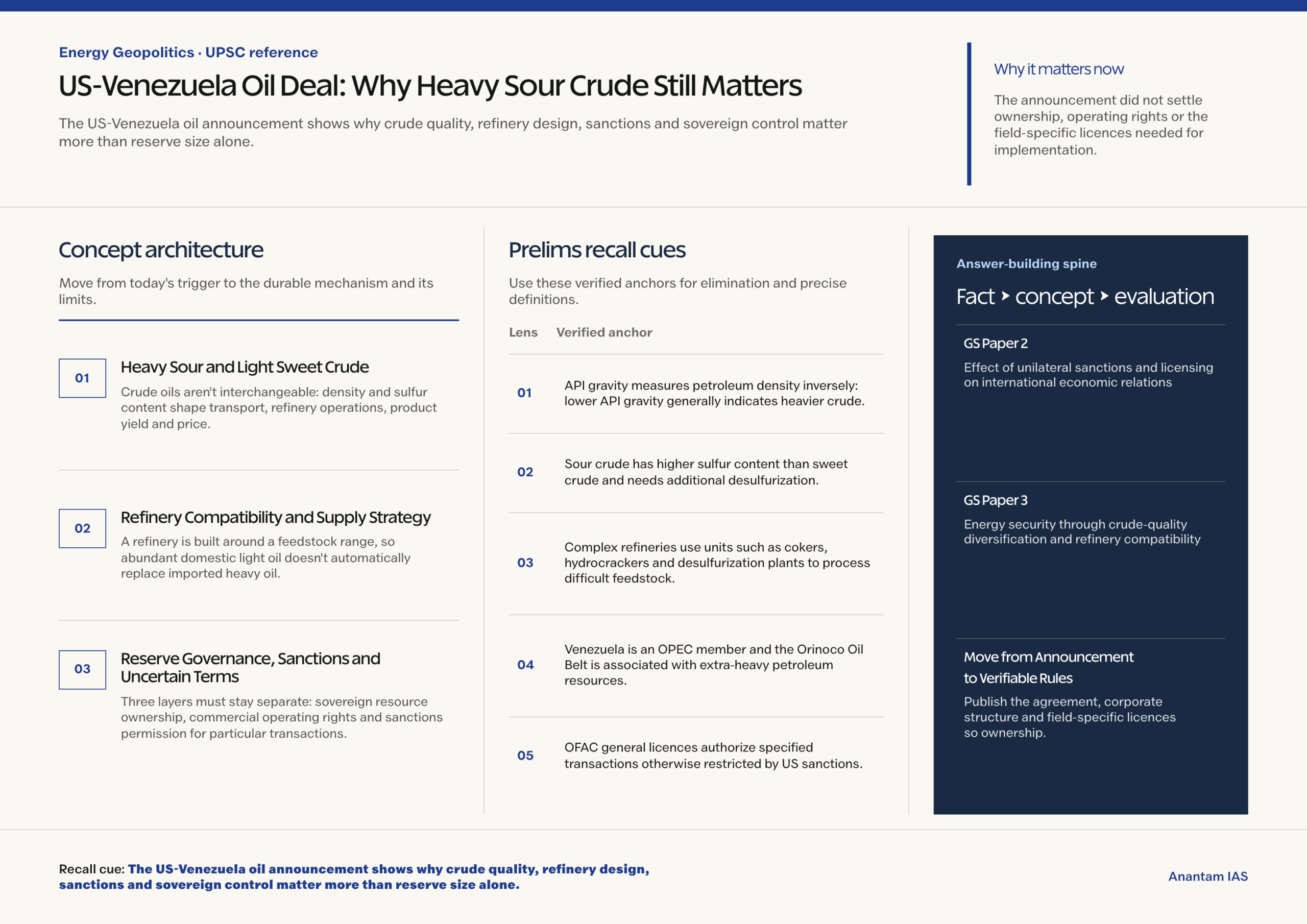
- API gravity measures petroleum density inversely: lower API gravity generally indicates heavier crude.
- Sour crude has higher sulfur content than sweet crude and needs additional desulfurization.
- Complex refineries use units such as cokers, hydrocrackers and desulfurization plants to process difficult feedstock.
- Venezuela is an OPEC member and the Orinoco Oil Belt is associated with extra-heavy petroleum resources.
- OFAC general licences authorize specified transactions otherwise restricted by US sanctions; they aren’t the same as removing the sanctions programme.
Mains Relevance
GS Paper 2
- Effect of unilateral sanctions and licensing on international economic relations
- Resource sovereignty, contractual transparency and asymmetry between states
GS Paper 3
- Energy security through crude-quality diversification and refinery compatibility
- Infrastructure, technology and investment constraints on converting reserves into production
Essay
- Natural-resource abundance becomes strategic power only when institutions, infrastructure and technology can convert geological wealth into accountable production.
Background and Context
Heavy Sour and Light Sweet Crude
Crude oils aren’t interchangeable: density and sulfur content shape transport, refinery operations, product yield and price.
- API gravity is an inverse density scale. Lower readings indicate heavier oil containing more large hydrocarbon molecules, while higher readings indicate lighter oil that generally flows and distils more easily.
- Sour crude contains more sulfur compounds. Refiners must remove sulfur to meet product standards and protect equipment, adding hydrogen demand, processing stages, energy use and operating cost.
- Light sweet oil yields a larger share of valuable products through simpler distillation. Heavy sour oil leaves more residue unless a refinery has equipment that can break or upgrade large molecules.
- Venezuelan production is predominantly medium, heavy or extra-heavy and sour. Some streams need diluent, a lighter petroleum mixed in to make very dense crude easier to transport.
- The common trap is to equate poor quality with useless oil. Heavy sour grades can be valuable when discounted enough and matched with a refinery designed to convert them efficiently.
Refinery Compatibility and Supply Strategy
A refinery is built around a feedstock range, so abundant domestic light oil doesn’t automatically replace imported heavy oil.
- US shale production is largely light crude, while several Gulf Coast plants invested in cokers, hydrocrackers and sulfur-removal units to process heavier imported barrels from the Americas.
- A coker converts low-value residual material into lighter products and petroleum coke. Without such conversion capacity, a refinery gets less high-value output from a heavy barrel.
- Running a complex plant mainly on light sweet crude can leave expensive conversion units underused. The refinery may prefer discounted heavy feedstock even when the country produces plenty of lighter oil.
- Venezuelan barrels can complement rather than simply displace US output. Their strategic value comes from matching installed machinery, geography and product demand, not from reserve volume alone.
- But refinery fit doesn’t guarantee quick supply. Field decline, unreliable power, damaged infrastructure, financing limits and the need for diluent can delay production long after a political announcement.
Reserve Governance, Sanctions and Uncertain Terms
Three layers must stay separate: sovereign resource ownership, commercial operating rights and sanctions permission for particular transactions.
- A reserve is oil judged recoverable under stated economic and technical conditions. It isn’t a stockpile ready for shipment, and a development right isn’t automatically ownership of petroleum underground.
- The announced 65-billion-barrel scope and reported majority role came from US accounts. Venezuela framed the same arrangement around field development, investment and national fiscal gains.
- Those descriptions may coexist, but they don’t settle who owns assets, bears costs, appoints managers, markets output, resolves disputes or absorbs losses. Published legal instruments would be needed.
- OFAC general licences are conditional regulatory permissions for defined dealings involving Venezuelan oil, services or PdVSA. Their amendment doesn’t by itself validate every contract or erase all sanctions restrictions.
- The governance test is whether future contracts disclose authority, revenue allocation, environmental duties, audit rights and dispute settlement while remaining consistent with Venezuelan law and credible public oversight.
Way Forward
Move from Announcement to Verifiable Rules
- Publish the agreement, corporate structure and field-specific licences so ownership, operating control and purchase rights can be assessed separately.
- Align each transaction with current OFAC authorizations, due-diligence duties and anti-corruption safeguards instead of treating political approval as blanket sanctions clearance.
- Use independent reserve audits, costed infrastructure plans and realistic production schedules before converting resources into supply or revenue forecasts.
- Protect Venezuela’s public interest through transparent revenue reporting, environmental liabilities, legislative scrutiny and enforceable dispute-resolution provisions.
Conclusion
- The durable energy lesson is compatibility before quantity: heavy sour crude remains valuable because complex refineries are configured to convert it, even when light oil is abundant.
- In a Mains answer, separate geological reserves, sovereign ownership, operating rights and sanctions licences. The announced US-Venezuela arrangement remains a case of strategic potential with unsettled terms.
UPSC Practice Questions
Prelims MCQ 1
With reference to crude-oil quality and refining, consider the following statements:
- Lower API gravity generally indicates heavier crude oil.
- Sour crude requires additional sulfur-removal processing.
- A coker helps convert heavy residual material into lighter products.
How many of the above statements are correct?
(a) Only one (b) Only two (c) All three (d) None
Answer: (c) All three
Explanation:
All three are correct. API gravity indicates density inversely, sour crude has more sulfur-processing needs, and cokers upgrade heavy refinery residue.
Prelims MCQ 2
Why can a complex US Gulf Coast refinery prefer imported heavy sour crude despite abundant domestic light crude?
(a) Heavy crude needs no sulfur treatment (b) Its installed conversion units can profitably process discounted heavy feedstock (c) Light crude cannot produce transport fuels (d) Heavy crude is always cheaper to extract
Answer: (b) Its installed conversion units can profitably process discounted heavy feedstock
Explanation:
Complex refineries have cokers, hydrocrackers and desulfurization capacity designed to extract value from heavier, higher-sulfur feedstock.
UPSC Mains Questions
- Crude-oil quality and refinery configuration are as important as reserve volume in shaping energy security. Discuss with reference to heavy sour and light sweet crude.
- Resource agreements involving sanctioned states sit at the intersection of sovereignty, commercial law and geopolitical power. Critically examine with reference to the announced US-Venezuela oil arrangement.
Sources: Indian Express Explained and U.S. Energy Information Administration.
Frequently Asked Questions
What is heavy sour crude oil?
It is dense petroleum with relatively high sulfur content. It flows and refines less easily than light sweet crude, but complex refineries can convert it into valuable fuels and products.
Why do some US refineries want Venezuelan crude?
Several Gulf Coast refineries have cokers, hydrocrackers and sulfur-removal units built for heavy feedstock. Venezuelan grades can match this equipment better than abundant domestic light crude.
Does the announced deal mean the United States owns Venezuelan reserves?
No published agreement establishes that conclusion. US accounts described majority control or output rights, while Venezuela emphasized development and investment. Underground ownership and commercial rights must be assessed separately.
What role do US sanctions play in Venezuelan oil trade?
OFAC general licences authorize defined transactions that sanctions would otherwise restrict. The scope, conditions and counterparties matter; a licence isn’t blanket removal of the Venezuela sanctions programme.
Can the deal quickly increase global oil supply?
Not necessarily. Heavy-oil production needs capital, diluent, power, functioning fields, transport and refinery access. Unpublished commercial terms and legal uncertainty can slow investment further.