Vande Mataram and the Right to Dissent
Why in News?
The Prevention of Insults to National Honour (Amendment) Act, 2026 amends Section 3 of the Prevention of Insults to National Honour Act, 1971. It extends the same legal protection to the National Song (Vande Mataram) that is currently afforded to the National Anthem (Jana Gana Mana).
| UPSC Relevance: GS-2 Polity and Governance: Fundamental Rights, Fundamental Duties, Secularism Prelims: Vande Mataram; National Song and National Anthem, Prevention of Insults to National Honour Act, 1971; Articles 19, 25, 26 and 51A Mains: Freedom of conscience; limits of compelled patriotism; national symbols versus individual liberty; constitutional secularism |
About Vande Mataram:
- Vande Mataram was composed by Bankim Chandra Chattopadhyay, also known as Bankim Chandra Chatterjee.
- It was first published in the literary journal Bangadarshan in 1875 and later incorporated into his novel Anandamath in 1882.
- Rabindranath Tagore first sang it at the 1896 Calcutta Session of the Indian National Congress.
- It emerged as a powerful nationalist slogan during the Swadeshi Movement of 1905.
- The words Vande Mataram broadly mean “I bow to thee, Mother”.
First two and later stanzas:
- The first two stanzas portray the motherland through predominantly natural imagery: fertile fields, rivers, fruit, cool breezes, moonlight and prosperity.
- The later stanzas adopt a more explicitly devotional register. They identify the motherland through imagery associated with:
- Durga: power and protection;
- Kamala or Lakshmi: prosperity; and
- Vani or Saraswati: knowledge and learning.
While many understand these references as cultural metaphors for the nation, some religious communities may regard their vocal recitation as participation in a devotional invocation.
Constitutional Status of Vande Mataram:
- In 1937, against the backdrop of objections to the devotional content of the later verses, the Congress Working Committee accepted the practice of singing the first two stanzas at Congress gatherings.
- On 24 January 1950, Constituent Assembly President Dr Rajendra Prasad announced that:
- The composition known as Jana Gana Mana would be the National Anthem of India; and
- Vande Mataram, having played a historic role in the freedom struggle, would be honoured equally and accorded equal status.
The declaration was made through a presidential statement, not through a formally voted constitutional resolution. It also did not specify whether Vande Mataram meant the first two stanzas or the complete composition.
However, after the 2026 amendment, Vande Mataram also enjoys specific statutory protection. Statutory protection, however, does not transform the National Song into a constitutional provision or a second National Anthem.
Prevention of Insults to National Honour Act, 1971:
- The original Act protected the Indian National Flag, the Constitution of India, and the National Anthem.
- Section 2 criminalises specified forms of disrespect to the National Flag and the Constitution in a public place or within public view.
- Section 3 punishes anyone who intentionally prevents the singing of the National Anthem; or causes disturbance to an assembly engaged in singing it.
Prevention of Insults to National Honour (Amendment) Act, 2026:
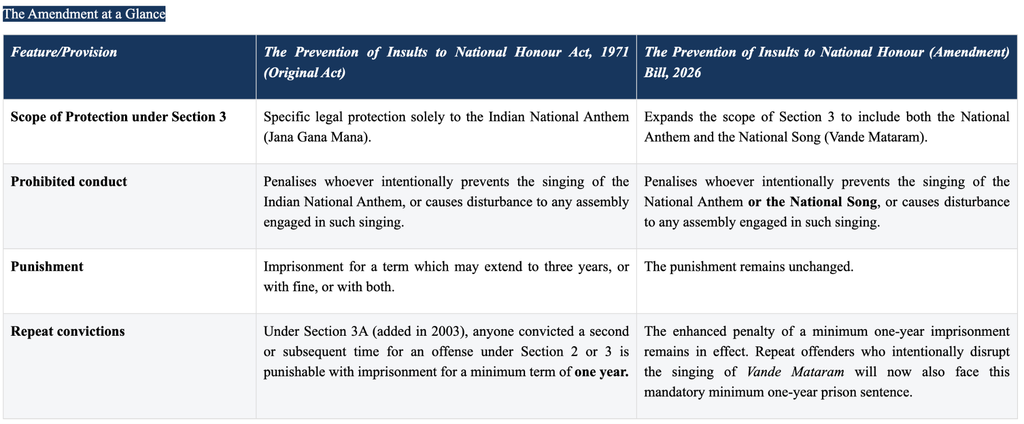
- The Prevention of Insults to National Honour (Amendment) Act, 2026 amended Section 3 to cover both the National Anthem and the National Song.
- Amended Section 3: A person is punishable if they intentionally:
- Prevent the singing of the National Anthem or the National Song; or
- Cause disturbance to an assembly engaged in such singing.
- Punishment: Imprisonment extending up to three years; fine; or both. Under Section 3A, a second or subsequent conviction under Sections 2 or 3 attracts a minimum imprisonment of one year.
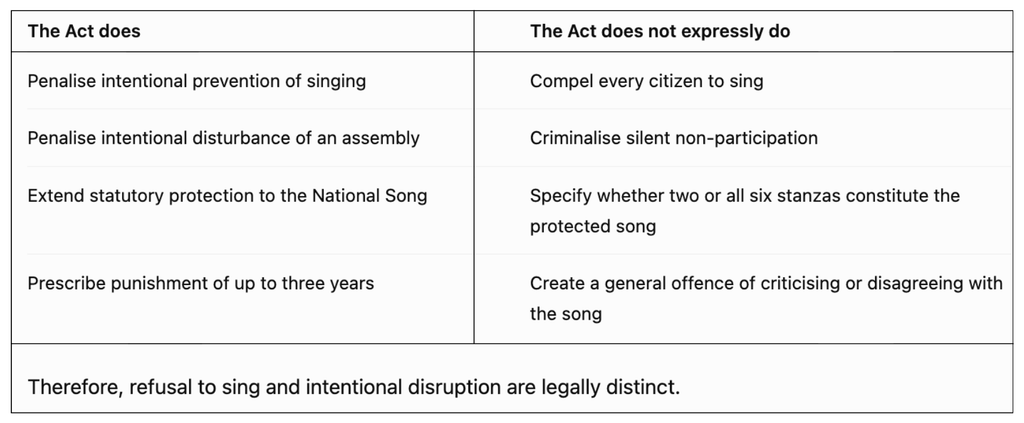
What the Amended Act Does and Does Not Do?
Constitutional Dimensions:
(i) Freedom of Conscience:
India’s constitutional order is founded on the coexistence of Hindus, Muslims, Christians, Sikhs, Buddhists, Jains, Parsis and numerous other belief systems.
- Article 25: Article 25(1) guarantees every person:
- Freedom of conscience; and
- The right freely to profess, practise and propagate religion. These rights are subject to public order, morality, health and other provisions of Part III.
Freedom of conscience protects the inner domain of belief as well as the right not to be compelled to affirm or participate in an expression contrary to a sincerely held conviction.
- Article 26 protects the collective autonomy of religious denominations to manage their religious affairs. The individual right not to sing primarily arises under Article 25, read with Article 19(1)(a). Article 26 may become relevant where State action interferes with the institutional practices of a religious denomination.
For adherents of some monotheistic faiths, vocal recitation of the last stanzas may be understood as participation in the invocation or worship of deities outside their faith. Such an objection cannot automatically be dismissed as eccentric, disrespectful or unpatriotic. Constitutional rights are especially important when they protect beliefs held by a minority.
At the same time, freedom of conscience does not include a right to prevent other citizens from singing. The Constitution protects peaceful non-participation, not intentional obstruction. This distinction allows the State to protect both collective expression and individual conscience.
(ii) Freedom of Expression and the Right to Remain Silent:
- Article 19(1)(a) protects freedom of speech and expression. Judicial interpretation has recognised that the guarantee includes: right to speak; right not to speak; right not to adopt a State-prescribed belief; and right to remain silent.
- Any restriction must: be imposed by law; fall within one of the grounds enumerated in Article 19(2); and satisfy the constitutional test of proportionality.
Therefore, refusing to sing is legally different from preventing others from singing.
(iii) Fundamental Rights and Fundamental Duties:
- Article 51A(a) imposes a fundamental duty on every citizen to respect: The Constitution; Its ideals and institutions; the National Flag; and the National Anthem. Notably, Article 51A(a) does not expressly mention the National Song.
- Fundamental Duties are non-justiciable, although they may guide legislation and judicial interpretation. They cannot automatically override Fundamental Rights.
- Respect for a national symbol also cannot invariably be equated with vocal participation. A citizen may show respect by maintaining silence and allowing others to participate.
(iv) Secularism and Constitutional Patriotism:
- Secularism is part of the Constitution’s basic structure, as recognised in S.R. Bommai v. Union of India.
- The State must therefore balance:
- Recognition of India’s civilisational heritage;
- Respect for the song’s role in the freedom struggle;
- Equal citizenship irrespective of religion;
- Freedom from compelled religious affirmation; and
- Maintenance of public order during national ceremonies.
- Constitutional patriotism is rooted not merely in common symbols but also in shared commitment to liberty, equality, fraternity, dignity and tolerance.
Bijoe Emmanuel v. State of Kerala, 1986:
This is the leading Supreme Court judgment on compelled patriotic expression.
- Background: Three schoolchildren belonging to the Jehovah’s Witnesses stood respectfully while the National Anthem was sung during their school assembly. They did not sing because their religious beliefs prohibited participation in such rituals. The school authorities expelled them.
- Supreme Court’s judgment: The Court ordered their readmission and held that:
- No law obligated them to sing the National Anthem;
- Standing respectfully without singing did not amount to disrespect;
- They neither prevented the singing nor disturbed the assembly;
- Compelling them to sing violated Articles 19(1)(a) and 25(1); and
- A genuine conscientious belief deserves protection even if it appears unusual to others.
The Court emphasised that India’s Constitution and civilisational tradition require the practice of tolerance.
Application to Vande Mataram:
The principle applies with considerable force to the National Song:
- A citizen cannot be compelled to vocalise words contrary to a genuine conscientious belief.
- Respectful silence does not prevent the rendition.
- Silent non-participation cannot ordinarily be treated as a disturbance.
- Protection of conscience does not authorise obstruction of others.
However, the Supreme Court has not yet finally adjudicated the scope or constitutionality of the amended 2026 provision.
Thus, respect for national symbols and respect for individual liberty are not competing visions of India; together, they constitute the democratic and plural character of the Republic.