VB-G RAM G: July Person-Days Fall 49.94% in First Month
Why in News?
Official data available on 9 August showed that 7.67 crore person-days were generated under VB-G RAM G in July 2026, its first month of nationwide operation.
- The comparison is year-on-year for the same calendar month: July 2026 against July 2025, which limits distortion from the strong seasonality of rural public works.
- The decline equals about 7.66 crore fewer person-days, but it does not by itself reveal how many households sought work, how many were offered it, or how many days each household completed.
- VB-G RAM G came into force on 1 July 2026, replacing the Mahatma Gandhi National Rural Employment Guarantee Act framework and increasing the statutory guarantee from 100 to 125 days per eligible rural household.
- The Ministry of Rural Development said in a 24 July parliamentary reply that a comprehensive online Management Information System had been established for real-time monitoring and that officers had been deputed to States for handholding.
- The first-month fall must be treated as an implementation outcome requiring diagnosis, not automatic proof either that rural demand collapsed or that every missing person-day represents denial of work.
- A person-day is one person working for one day. Total person-days combine the number of workers employed with the duration of employment and are not the same as the number of jobs or households.
- A demand-driven employment guarantee must be evaluated as a chain: demand registered, work offered, work opened, attendance recorded, person-days generated and wages paid.
- July 2026 was also a legal and administrative transition month. Existing e-KYC-verified job cards were to remain valid while new Gramin Rozgar Guarantee Cards were issued, and ongoing works were officially expected to continue without interruption.
UPSC Relevance
Prelims Relevance
- The VB-G RAM G Act, 2025 is administered by the Ministry of Rural Development and came into force across rural India on 1 July 2026.
- It provides a statutory guarantee of up to 125 days of wage employment in a financial year to every eligible rural household whose adult members volunteer for unskilled manual work.
- The guarantee is expressed per rural household, not as 125 days for every individual adult member.
- A person-day means one person’s work for one day; ten people working for six days generate 60 person-days.
- The Act contains provisions on wage employment, peak agricultural seasons, unemployment allowance, Gram Panchayat responsibilities, social audits, technology-enabled accountability and grievance redressal.
- The Ministry said the programme uses NeFMS and Direct Benefit Transfer for wage disbursal and an online MIS for monitoring implementation and payment pendency.
Mains Relevance
GS Paper 2
- Evaluate welfare delivery through the distinction between legal entitlement and effective access for vulnerable rural households.
- Examine transparency, social audit, grievance redressal and the responsibilities of Gram Panchayats and States during a nationwide scheme transition.
GS Paper 3
- Analyse rural public employment as a consumption-smoothing and counter-cyclical safety net, especially during agrarian stress or weak local labour demand.
- Assess how Centre-State financing, administrative capacity and the timely opening of productive works affect actual employment generation.
Essay
- The strength of a right is measured not only by the promise written in law, but by the ease with which the least powerful person can claim it.
Background and Context
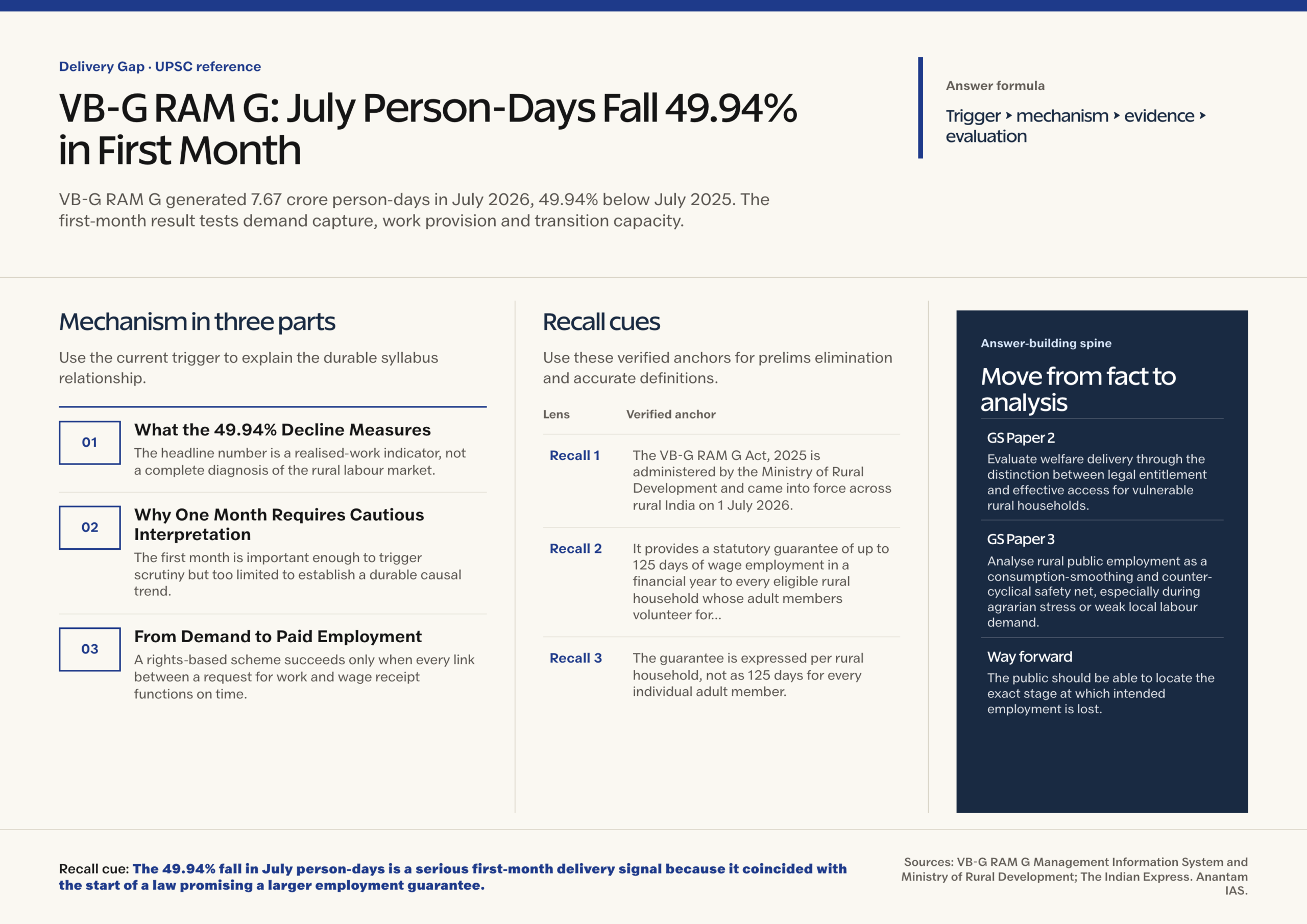
What the 49.94% Decline Measures
The headline number is a realised-work indicator, not a complete diagnosis of the rural labour market.
- July 2026 generated 7.67 crore person-days, compared with 15.33 crore in July 2025 under MG-NREGS.
- The arithmetic decline is about 7.66 crore person-days, or 49.94% relative to the previous July.
- Person-days can fall because fewer households demand work, fewer applicants receive or join work, fewer worksites operate, workers complete fewer days, or records enter the MIS late.
- National totals can conceal large State and district differences; the aggregate should be decomposed by geography, gender, social category and stage of delivery.
- Two States may record the same person-day total through very different combinations of participating households and average days worked, so both measures are essential for judging the depth and reach of support.
Why One Month Requires Cautious Interpretation
The first month is important enough to trigger scrutiny but too limited to establish a durable causal trend.
- Using the same month a year earlier controls partly for seasonality, yet rainfall, crop operations, local wage opportunities and the timing of public works may still differ.
- The changeover began on 1 July 2026, so administrative migration, work approvals, staff readiness and reporting practices may have affected measured output.
- A lower person-day total could reflect lower genuine demand, constrained access, implementation friction or a mixture of these; the aggregate alone cannot separate them.
- The correct policy response is to test competing explanations against granular data rather than present either demand collapse or administrative denial as established fact.
- Because July overlaps agricultural operations in many regions, district-level rainfall and crop calendars should accompany the administrative indicators when analysts compare demand and work generation.
From Demand to Paid Employment
A rights-based scheme succeeds only when every link between a request for work and wage receipt functions on time.
- The first measure is the number of households and persons who registered demand, including written and digitally recorded requests at Gram Panchayat level.
- The next measures are demand accepted, employment offered, worksite opened, worker attendance and muster roll completion; each can expose a different bottleneck.
- Generated person-days should then be connected with wage orders, payment timeliness, rejected transactions and pending liabilities through the public MIS.
- An offer rate can look high even when recorded demand is artificially low, so both the denominator and the conversion rate need public examination.
Transition Commitments and First-Month Reality
The Union government had explicitly promised continuity, making July delivery a measurable administrative test.
- PIB stated before rollout that ongoing works would continue without interruption and existing e-KYC-verified job cards would remain valid until new cards were issued.
- The Ministry reported that a comprehensive online MIS, NeFMS, DBT and standard operating procedures were available for monitoring and timely wage processing.
- It also said officers were sent to States to review implementation and provide handholding, recognising that a national transition needs intensive field support.
- The July decline should lead to a State-wise transition audit covering card continuity, staff access, work sanctions, muster rolls, payment systems and grievance desks.
Way Forward
Publish the Complete Employment Funnel
- Release daily and monthly State, district and Gram Panchayat data on demands, offers, work starts, attendance, person-days, wage orders and payments.
- Show unique households and workers alongside person-days so that participation and duration are not collapsed into one total.
- Identify districts with the sharpest year-on-year declines and audit job-card validity, work sanctions, staffing, MIS access, muster rolls and fund availability.
- Publish causes and corrective deadlines, while preserving an offline route to demand work wherever connectivity or authentication fails.
Conclusion
- The 49.94% fall in July person-days is a serious first-month delivery signal because it coincided with the start of a law promising a larger employment guarantee.
- The strongest response is transparent diagnosis: publish the demand-to-payment funnel, repair transition bottlenecks, protect workers’ ability to claim employment and judge the programme by access, timeliness and livelihood outcomes , not entitlement size alone.
UPSC Practice Questions
Prelims MCQ 1
With reference to the VB-G RAM G rural employment framework, consider the following statements:
- It guarantees up to 125 days of wage employment in a financial year to every eligible rural household.
- A person-day means one household receiving employment for one day, irrespective of the number of members working.
- The Ministry of Rural Development uses an online MIS for monitoring implementation.
How many of the above statements are correct?
(a) Only one (b) Only two (c) All three (d) None
Answer: (b) Only two
Explanation:
Statements 1 and 3 are correct. The guarantee is up to 125 days per eligible rural household, and the Ministry has established an online MIS. Statement 2 is incorrect because a person-day is one person working for one day; two members working for one day generate two person-days.
Prelims MCQ 2
Which one of the following is the most valid inference from a decline in total person-days under a demand-driven public employment programme?
(a) Rural unemployment has necessarily declined by the same percentage (b) Every missing person-day necessarily represents a rejected work demand (c) Realised work fell, but demand, access and execution data are needed to identify the cause (d) The statutory employment guarantee has automatically ceased to apply
Answer: (c) Realised work fell, but demand, access and execution data are needed to identify the cause
Explanation:
Person-days measure realised work. They can change with demand, the number of workers, days completed, work availability, attendance and reporting. The aggregate does not independently prove a fall in unemployment, denial of every missing day or suspension of the legal guarantee.
UPSC Mains Questions
- A larger statutory employment guarantee does not automatically produce more employment. Analyse with reference to the 49.94% year-on-year fall in person-days during the first month of VB-G RAM G.
- What indicators should be publicly disclosed to distinguish weak demand from implementation failure in a demand-driven rural employment programme?
Sources: VB-G RAM G Management Information System and Ministry of Rural Development and The Indian Express.
Frequently Asked Questions
What happened to rural employment person-days in July 2026?
Official data available on 9 August showed 7.67 crore person-days under VB-G RAM G in July 2026. July 2025 had recorded 15.33 crore person-days under MG-NREGS. The year-on-year decline was 49.94%, equal to roughly 7.66 crore fewer days of realised.
What is a person-day in a rural employment scheme?
One person working for one day generates one person-day. If 20 workers each work for five days, they generate 100 person-days. The measure combines participation and duration, so it is different from the number of households, workers, worksites or work.
Does the 49.94% fall prove that rural demand for work halved?
No. The fall proves that recorded, realised work was lower. Identifying the cause requires separate data on demands registered, employment offered, worksites opened, attendance, days completed and MIS timing. Genuine demand, implementation constraints and transition effects may all influence the.
Why is July 2026 a special comparison month?
VB-G RAM G came into force on 1 July 2026, making July its first nationwide month. Existing verified job cards and ongoing works were officially meant to continue, but a legal, financial and digital transition can still create administrative friction.
How many days of work does VB-G RAM G guarantee?
The Act provides up to 125 days of guaranteed wage employment in a financial year to every eligible rural household whose adult members volunteer for unskilled manual work. The entitlement belongs to the household, not separately to every adult member.