VB-G RAM G Works: Linking Employment to Durable Rural Assets
Why in News?
The Ministry of Rural Development announced a newly notified Schedule of Permissible Works under VB-G RAM G on 6 October 2026, widening the rural asset planning framework.
- The Schedule covers 375 permissible works under the existing Viksit Bharat–Guarantee for Rozgar and Ajeevika Mission (Gramin) Act, 2025.
- Works are to originate in Viksit Gram Panchayat Plans, based on local needs and approved by the Gram Sabha.
- The Ministry links digital asset tracking with convergence across Central, State and local schemes and avoiding duplication.
- An expanded eligible works list gives villages more choices; selecting useful assets still requires identifying local constraints and feasible solutions.
- The key governance question is whether wage employment creates assets that remain usable after construction, rather than merely expanding the range of approved categories.
UPSC Relevance
Prelims Relevance
- Permissible works: categories allowed under the notified Schedule.
- Gram Sabha: approves the locally prepared Viksit Gram Panchayat Plan.
- Convergence: coordinating investments across schemes around related local needs.
- Asset tracking: records intended to help identify works and avoid duplication.
Mains Relevance
GS Paper 2
- Decentralised planning and accountability in rural development.
- Distinguishing policy eligibility from implementation and service delivery.
GS Paper 3
- Connecting employment with water security, rural productivity and disaster preparedness.
Essay
- Local participation can improve public investment when community choices are matched with technical feasibility.
Background and Context
What Does a Permissible Work Mean?
The new development concerns the scope of eligible works under an existing law, rather than the enactment of a new employment law.
- The Ministry’s announcement identifies permissible works as the activities included in the Schedule. Inclusion establishes a planning option; it does not establish that a particular village has selected or completed that work.
- Permissible, sanctioned and completed describe different stages. An eligible category is not the same as approval of a specific project, and project approval is not evidence that construction or service delivery has occurred.
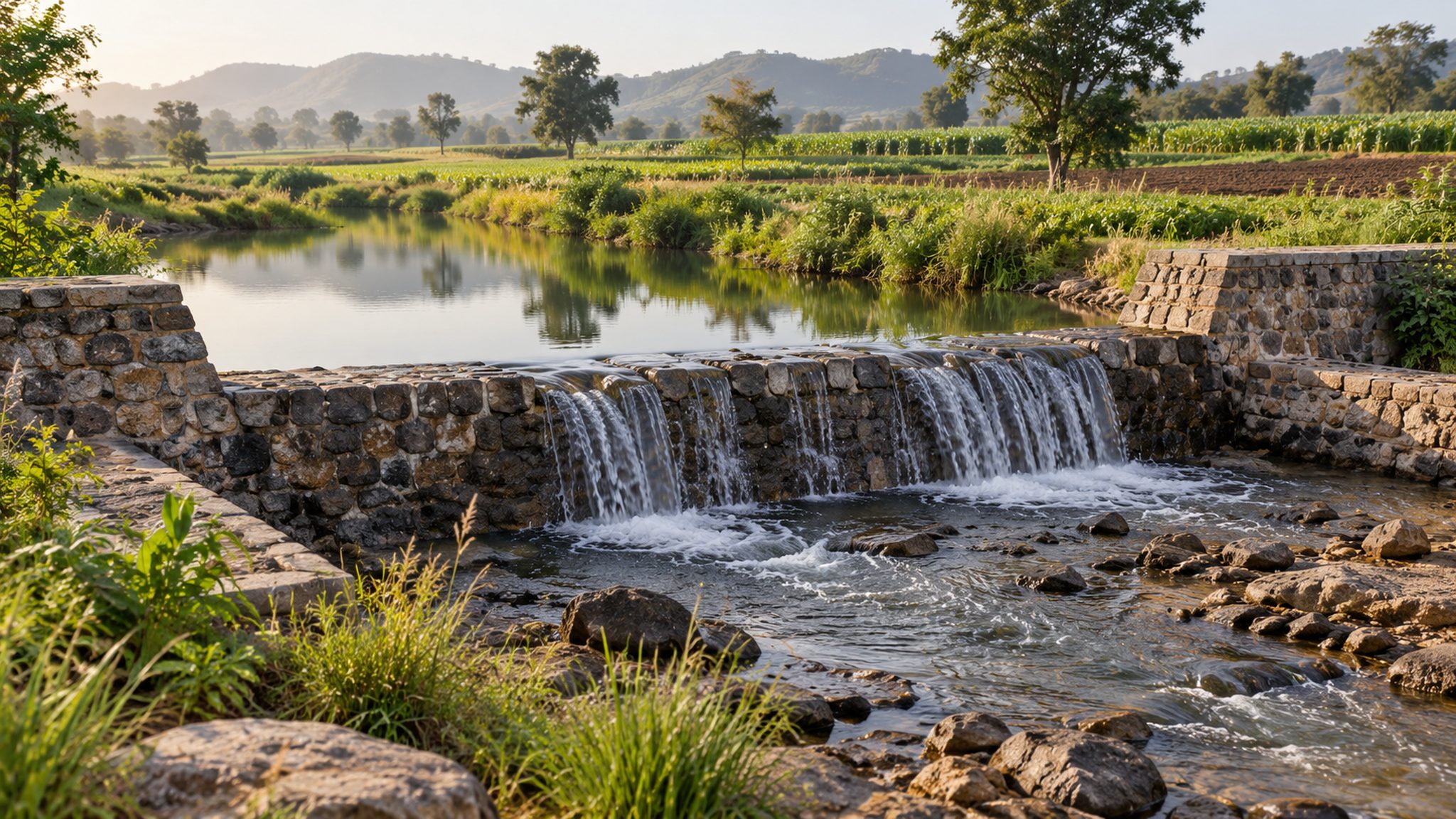
- A check dam, for example, is among the listed water works. Its eligibility alone says nothing about a proposed site’s suitability, the structure’s eventual condition or water availability for households and farms downstream.
- The Ministry’s stated objective connects wage employment with durable assets. These are related but separate results: labour creates the structure, while continued usability determines whether that structure provides an enduring public benefit.
- The announcement reports a notified framework, not measured development outcomes. Claims that the change has already raised incomes, prevented floods or improved groundwater would require separate evidence from implementation and subsequent local observation.
How Local Priorities Shape the Asset Choice
The announced planning route starts with local needs and a Gram Sabha-approved village plan, making selection as consequential as the expanded list.
- The Viksit Gram Panchayat Plan provides the stated route for originating works. Gram Sabha approval links the plan to village deliberation; it should not be confused with automatic approval of every eligible project everywhere.
- Useful needs assessment asks what prevents an existing service from working. A village with a damaged water-distribution channel may need restoration more urgently than another new structure chosen simply because it is now permissible.
- The Schedule includes repair and maintenance of Jal Jeevan Mission infrastructure. This matters because asset planning can address deteriorating services alongside new construction; a larger stock of structures alone does not demonstrate better access.
- For livelihood infrastructure, the announcement includes processing and storage facilities. Their value depends on a local production need and usable connections to the surrounding economy, rather than the existence of a building in isolation.
- Inclusive selection should consider who can actually use the proposed asset. The Ministry identifies accessibility provisions and infrastructure for women’s collectives; evaluating usability is more informative than treating all residents as equally served by construction.
What Convergence and Tracking Can Establish
Coordinating schemes can make investments complement one another, but records and intentions must be distinguished from verified results on the ground.
- The Ministry says digital tracking will support convergence across Central, State and local schemes. The practical purpose is to relate investments to the same local needs while reducing the risk of duplicating existing works.
- Convergence is useful when related investments address different constraints. For example, restoring a water asset and repairing its distribution channel can be complementary; this illustrates planning logic, not an announced project or guaranteed funding arrangement.
- Duplication means repeating investment without a justified additional function. Two similar assets are not necessarily wasteful if they serve different settlements; reviewers need location, purpose and existing capacity before judging whether proposals overlap.
- An asset record can show what has been entered and tracked. It cannot, by itself, establish construction quality, equitable access or lasting usefulness; those questions require checking the physical asset and the service it provides.
- The distinction between outputs and outcomes is central. Completing a structure is an output; dependable use is an outcome. Assessing employment generation and asset performance separately prevents one achievement from being presented as proof of both.
Way Forward
Make Project Selection Reviewable
- Record the local problem, intended users and existing assets before selecting a permissible work.
- Match each proposal with site suitability and a practical maintenance responsibility, especially for water and shared livelihood assets.
- Review overlapping investments across schemes, then assess completed structures for actual usability rather than relying only on digital entries.
Conclusion
- The expanded Schedule creates more planning options; its value depends on selecting works that solve identifiable village problems and remain useful after construction, with the Gram Sabha-approved plan connecting local choices to public investment.
- For policy analysis, keep eligibility, approval, completion and outcomes distinct. Use convergence to explain complementary investments, and demand separate evidence before claiming that a notified works framework has already improved livelihoods or resilience.
UPSC Practice Questions
Prelims MCQ 1
With reference to the newly announced VB-G RAM G works framework, consider the following statements:
- Works are to originate through Viksit Gram Panchayat Plans approved by the Gram Sabha.
- Inclusion in the permissible works Schedule establishes that every village has completed that work.
- Digital tracking is intended to support convergence and avoid duplication.
How many of the above statements are correct?
(a) Only one (b) Only two (c) All three (d) None
Answer: (b) Only two
Explanation:
Statements 1 and 3 reflect the Ministry’s announcement. Permissibility identifies an eligible category; it does not establish project completion.
Prelims MCQ 2
Which example best illustrates convergence in rural asset planning?
(a) Counting a listed work as already completed (b) Repeating the same investment without checking existing assets (c) Coordinating related investments to address connected local service needs (d) Treating digital registration as proof of increased household income
Answer: (c) Coordinating related investments to address connected local service needs
Explanation:
Convergence coordinates investments around related needs. It is distinct from automatic completion, duplication or an unverified outcome claim.
UPSC Mains Questions
- How can Gram Sabha-approved local planning improve the connection between wage employment and durable rural assets? Discuss the implementation challenges.
- Distinguish permissible works, project completion and development outcomes. Explain how convergence and asset tracking can strengthen rural investment without replacing field verification.
Source: PIB, Ministry of Rural Development.
Frequently Asked Questions
What changed in the VB-G RAM G works framework?
The Ministry announced a new Schedule of Permissible Works under the existing Act. It expands planning options and links locally selected works with durable assets, convergence and digital tracking.
Does a permissible work automatically become a completed project?
No. Permissibility concerns an eligible category. Selection and project approval are separate from completion, while evidence of a useful, functioning asset requires checking what has actually been delivered.
What role does the Gram Sabha have?
The Ministry states that works will originate through Viksit Gram Panchayat Plans based on local needs and approved by the Gram Sabha. This places village deliberation within the planning process.
What does convergence mean in this context?
Convergence coordinates investments across Central, State and local schemes so related works address local needs together. Tracking is intended to help identify existing investments and avoid unnecessary duplication.
Does the notification prove better livelihoods or disaster resilience?
No. Those are intended benefits of the framework. Establishing results requires evidence about implemented works, their condition, who uses them and whether they provide useful services over time.