VB-G RAM G: Wage Floor and State Rollout
Why in News?
PIB said the Union Government notified revised wage rates under the VB-G RAM G Act, 2025 with effect from July 1, 2026, coinciding with the nationwide commencement of the new rural employment framework.
The Hindu reported that West Bengal also began implementation on July 1, 2026, making the wage notification a live test of rural job delivery, State capacity and the shift from the older MGNREGA system.
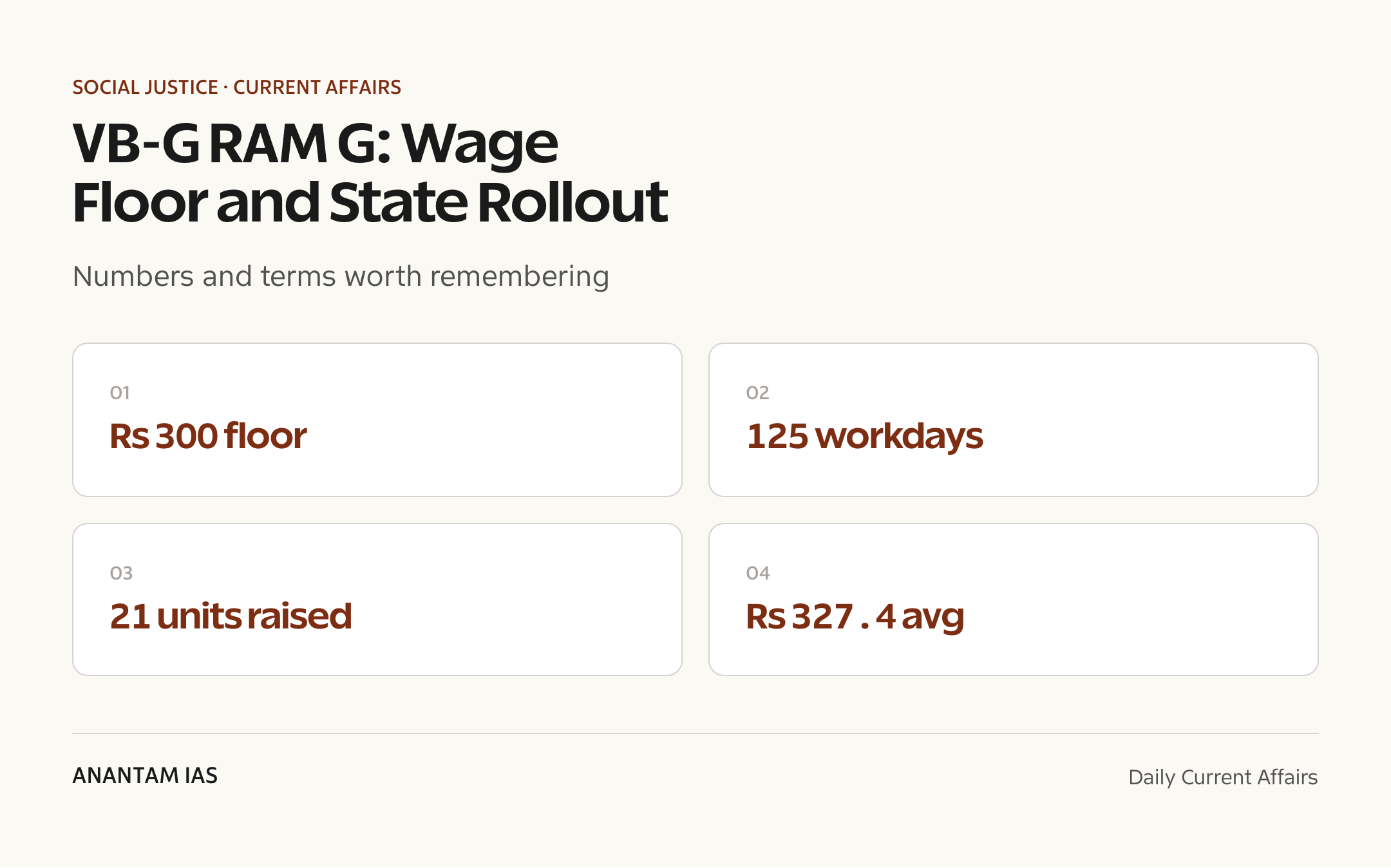
- Rs 300 interim base wage has been introduced, so no notified wage under the programme is below Rs 300 per day.
- 34 States, UTs and wage regions saw revised rates under the notification, according to PIB.
- 21 States and administrative units were brought up to the Rs 300 wage floor.
- National average notified wage rose from Rs 298.8 per day under MGNREGA to Rs 327.4 under VB-G RAM G, an increase of Rs 28.6 per day.
- West Bengal now has a notified rate of Rs 300 per day, compared with the last MGNREGA rate of Rs 260 for 2025-26 reported by Indian Express.
- State rollout is not only about wages; it also tests funding shares, panchayat capacity, unemployment allowance and compensation for delayed payments.
The development matters in the context of:
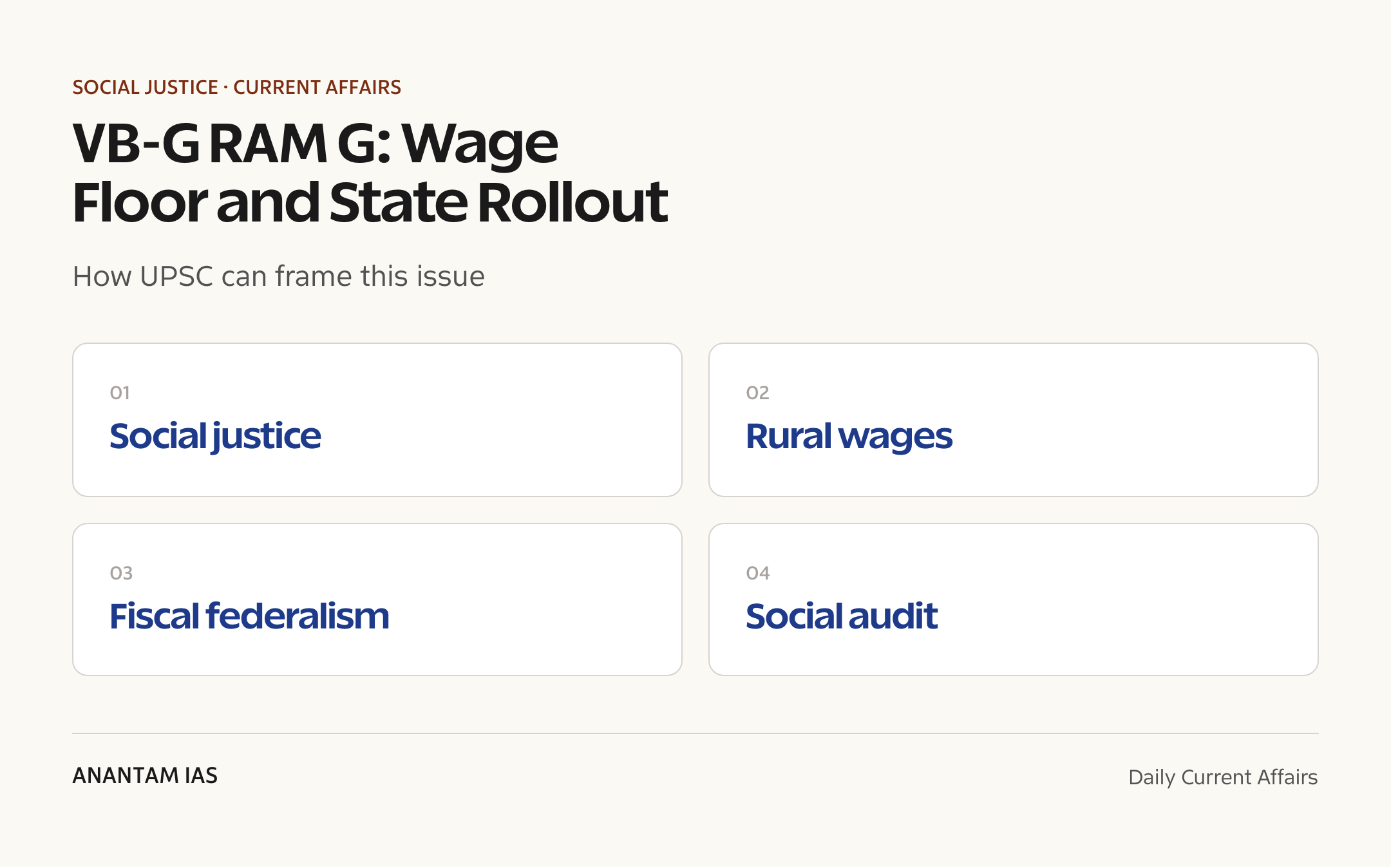
- Rural employment guarantee sits at the intersection of social justice, local governance, fiscal federalism and livelihood security.
- VB-G RAM G replaces the rights-based MGNREGA architecture with a revised statutory framework promising 125 days of work per eligible rural household.
- Wage floors affect purchasing power, inter-State equity and the credibility of welfare delivery in low-wage regions.
- West Bengal rollout is important because central MGNREGA fund releases to the State had stopped in 2022 after allegations of irregularities.
UPSC Relevance
Prelims Relevance
- VB-G RAM G Act, 2025: Viksit Bharat-Guarantee for Rozgar and Ajeevika Mission (Gramin), the new rural employment law replacing MGNREGA.
- July 1, 2026: commencement date of the Act and effective date of the revised wage notification.
- 125 days: statutory wage employment guarantee per eligible rural household under the new law.
- Rs 300 wage floor: interim base wage under the national rural employment programme.
- Section 10: empowers the Central Government to notify wage rates for unskilled manual work under the scheme.
- Section 11: links failure to provide work within 15 days with unemployment allowance, subject to statutory conditions.
- Section 22(8): unemployment allowance and delay compensation are to be borne by the State Government as prescribed.
- Viksit Gram Panchayat Plans: local planning instrument linked to works and infrastructure priorities.
- Social audit: accountability mechanism for works, payments and public disclosure.
Mains Relevance
GS Paper 2
- Social justice: rural wage employment as a livelihood safety net for poor and vulnerable households.
- Governance: transition from MGNREGA to VB-G RAM G, panchayat capacity, grievance redress and social audits.
- Federalism: 60:40 cost sharing, State budget preparedness and accountability for unemployment allowance.
GS Paper 3
- Rural economy: wage floors, purchasing power, rural demand and distress migration.
- Infrastructure creation: water security, core rural infrastructure, livelihood assets and climate-resilience works.
- Public finance: normative allocations, delayed payments and State-level fiscal capacity.
Essay
- Rights and delivery: a legal guarantee is only as strong as the funding and institutions behind it.
- Federal welfare: national promises need State capacity to become village-level outcomes.
- Dignity of labour: wage policy is also a statement about social justice.
Background and Context
What the Wage Notification Does
The notification converts the commencement of VB-G RAM G into payable wage rates across India.
- PIB confirmed that the revised rates are payable from July 1, 2026 under the VB-G RAM G Act, 2025.
- Rs 300 floor is the defining feature; States that earlier had lower notified rates have been moved to this minimum level.
- Average daily wage has risen to Rs 327.4, compared with Rs 298.8 under the earlier MGNREGA wage structure.
- Average increase exceeds 10%, according to the Ministry of Rural Development’s release.
- Low-wage States such as Uttar Pradesh, Bihar, Jharkhand, West Bengal, Assam, Arunachal Pradesh and Himachal Pradesh received larger percentage gains.
- Higher-wage regions also got revisions, with Haryana at Rs 409, Goa at Rs 406, Kerala at Rs 401 and special high-altitude gram panchayats in Sikkim at Rs 450.
Why Rs 300 Matters
A wage floor is a simple number, but it carries major social-justice and rural-demand implications.
- Income security improves most in regions where earlier rural employment wages were below Rs 300.
- Regional disparity narrows because historically lower-wage States receive larger percentage increases.
- West Bengal moves from a reported 2025-26 MGNREGA rate of Rs 260 to Rs 300 under the new framework.
- Uttar Pradesh saw a reported Rs 48 increase, while Bihar saw Rs 45 and Madhya Pradesh Rs 39 over the last MGNREGA rates.
- Purchasing power depends on real wages, local inflation and number of days actually provided, not only the notified daily rate.
- Minimum wage debate remains open because critics cited the Anoop Satpathy expert committee’s 2019 recommendation of a Rs 375 national minimum wage floor.
From MGNREGA to VB-G RAM G
The policy shift is bigger than a wage revision because the legal and fiscal design has changed.
- MGNREGA guaranteed 100 days of unskilled wage employment to rural households and became the reference point for India’s rights-based welfare model; revise the base through MGNREGA.
- VB-G RAM G promises 125 days of wage employment in a financial year to every eligible rural household whose adult members volunteer for unskilled manual work.
- Section 10 lets the Centre notify different wage rates for different areas, but the notified rate cannot be below the prevailing MGNREGA wage rate.
- Section 11 keeps an unemployment-allowance link when work is not provided within 15 days of application, subject to the Act and State rules.
- Viksit Gram Panchayat Plans connect work demand to local infrastructure planning, digital systems and aggregation at block, district and State levels.
- Policy question for Mains is whether the new design preserves a demand-based guarantee in practice or makes work more dependent on approved plans and allocations.
West Bengal as the Implementation Test
West Bengal turns the national notification into a field-level test of finance, administration and trust.
- The Hindu reported that VB-G RAM G was rolled out in West Bengal on July 1, 2026, resuming a central rural job guarantee in the State after almost four years.
- March 2022 is the key background date, when the Union Government stopped releasing MGNREGA funds to West Bengal after alleging financial irregularities under the earlier State government.
- Rs 14,000 crore was allocated in the 2026-27 West Bengal Budget for employment under VB-G RAM G.
- 60:40 sharing applies in the State, with the Union share reported at Rs 8,508 crore and the State share at Rs 5,672 crore.
- Administrative hurdles include about 2,000 non-functioning panchayats, according to the State Panchayat and Rural Development Minister cited by The Hindu.
- Implementation lesson: a statutory wage guarantee needs active panchayats, timely measurement, payment systems, grievance channels and audit capacity.
Funding and Federalism Questions
The biggest governance debate is whether States can fund and deliver the expanded guarantee without weakening entitlement quality.
- Centrally Sponsored Scheme design means the Centre and States share both cost and responsibility.
- 60:40 ratio applies for most States, while official PIB material describes enhanced support for North-Eastern and Himalayan States and full central funding for UTs without legislatures.
- State liability becomes crucial because unemployment allowance and delayed-payment compensation rest with States under the Act’s framework.
- Normative allocation can improve budget predictability, but it may create pressure if labour demand exceeds the approved financial envelope.
- PBKMS estimate in West Bengal warned that available funds may generate only about 60 days of work per active job card, against the legal promise of 125 days.
- Fiscal federalism is the exam hook: national welfare laws work only when money, rules and accountability are aligned across Union, State and local bodies.
Accountability and Worker Rights
For workers, the real guarantee is measured through work availability, wage payment, compensation and local accountability.
- Work demand must remain easy to register orally, in writing or through authorised digital channels for poor households.
- Fifteen-day rule matters because delay in providing work can trigger unemployment allowance under the statutory framework.
- Wage delay should lead to compensation where rules prescribe it, otherwise higher notified wages may not reach workers on time.
- Social audit is central to detecting fake works, poor measurement, non-payment and exclusion; revise the mechanism through Social Audit in India.
- Gram Sabha oversight links rural employment with local democracy and transparency; connect this with Panchayati Raj.
- Digital monitoring can reduce leakage, but it must not exclude workers through authentication failure, weak connectivity or poor grievance handling.
UPSC Governance Lens
The topic is useful because it combines welfare design with constitutional values and field administration.
- Article 41 directs the State to make effective provision for the right to work, education and public assistance within economic capacity; revise Part IV through Directive Principles.
- Article 43 links workers with a living wage, decent conditions and a decent standard of life.
- Antyodaya is the stated government frame, but the field test is whether the poorest households get work when they demand it.
- Durable assets under water security, rural infrastructure, livelihood infrastructure and climate-resilience works can create long-term public value.
- Rights-based welfare cannot be judged only by scheme launch; it must be judged by access, accountability, payment regularity and remedies.
- Mains answer should balance both sides: higher wage floor and 125-day promise on one side, and funding adequacy, State burden and local capacity risks on the other.
Way Forward
Protect the entitlement character
- Demand registration should remain simple, documented and accessible through Gram Panchayats and authorised digital channels.
- Work allocation must follow the statutory 15-day standard, with written reasons and remedies where work is not provided.
- Unemployment allowance should have a separate State budget line so workers are not punished for administrative failure.
Align money with the 125-day promise
- Normative allocations should be transparently calculated and revised when actual labour demand is higher than estimated.
- State shares must be provided before peak implementation periods, especially in States with large active job-card bases.
- Payment timelines need public dashboards that show work demand, work provided, wage payments, delays and compensation.
Strengthen local accountability
- Gram Panchayats need staff, technical support and functioning elected bodies to prepare realistic Viksit Gram Panchayat Plans.
- Social audits should be independent, regular and linked to recovery, correction and grievance redress.
- Digital tools should supplement field verification, not replace worker-facing accountability at the worksite and panchayat office.
Use wages as a social-justice instrument
- Wage indexation should keep pace with rural inflation so nominal gains do not shrink in real terms.
- Low-wage regions need targeted monitoring because they receive the largest relative gains and often have weaker administrative capacity.
- Worker organisations, SHGs and civil-society groups can help track whether the Rs 300 floor converts into actual paid workdays.
Conclusion
VB-G RAM G is now moving from statute to implementation. The Rs 300 wage floor is important because it gives workers in low-wage regions an immediate income anchor.
But the real test is not the headline wage. It is whether 125 days of work, timely wages, unemployment allowance and social audit remedies reach households through functioning panchayats and funded State systems.
For UPSC, read this as a classic GS2 Social Justice issue: the policy promise is national, the implementation is local, and the accountability burden is shared across levels of government.
UPSC Practice Questions
Prelims MCQ 1
With reference to the VB-G RAM G Act, 2025, consider the following statements:
- It provides for 125 days of wage employment in a financial year to eligible rural households under the scheme.
- The Central Government may notify different wage rates for different areas under the Act.
- The revised wage notification introduced an interim base wage rate of Rs 300 per day.
How many of the above statements are correct?
(a) Only one (b) Only two (c) All three (d) None
Answer: (c) All three
Explanation:
All three statements are correct. The Act expands the guarantee to 125 days, allows area-specific notified wage rates, and the 2026 wage notification introduced a Rs 300 interim base wage.
Prelims MCQ 2
Which one of the following best explains the main governance concern in the West Bengal rollout of VB-G RAM G?
(a) The scheme has no connection with rural employment. (b) The issue is limited only to the spelling of the scheme name. (c) Funding adequacy, State share, panchayat capacity and statutory compensation will affect actual delivery. (d) The wage notification applies only to urban workers.
Answer: (c) Funding adequacy, State share, panchayat capacity and statutory compensation will affect actual delivery.
Explanation:
The Bengal rollout shows that the legal guarantee depends on budget provision, functioning local institutions, timely wages and remedies for non-provision of work or delayed payments.
UPSC Mains Questions
- The VB-G RAM G wage notification introduces a national wage floor, but the success of the rural employment guarantee will depend on State capacity and local accountability. Discuss with reference to social justice and fiscal federalism.
- Compare the governance logic of MGNREGA and VB-G RAM G in terms of demand for work, wage payment, State liability, social audit and creation of durable rural assets.
- A higher notified wage does not automatically ensure livelihood security. Examine the institutional safeguards needed to convert rural employment guarantees into real workdays and timely payments.
Sources: PIB, Ministry of Rural Development and The Hindu, Indian Express.
Frequently Asked Questions
What is VB-G RAM G?
VB-G RAM G stands for Viksit Bharat-Guarantee for Rozgar and Ajeevika Mission (Gramin). It is the new rural employment law that replaces MGNREGA and promises 125 days of wage employment in a financial year to eligible rural households whose adult members volunteer for unskilled manual work.
What did the wage notification change?
The Union Government notified revised wages effective July 1, 2026. The key change is a Rs 300 interim base wage, so no notified wage under the programme is below Rs 300 per day. PIB said the national average notified wage rose from Rs 298.8 to Rs 327.4 per day.
Why is West Bengal important here?
West Bengal is a major implementation test because a central rural job guarantee resumed there after almost four years. The State has budgeted Rs 14,000 crore for VB-G RAM G, but worker groups have questioned whether the available funds can support the full 125-day promise.
How is VB-G RAM G different from MGNREGA?
VB-G RAM G raises the statutory employment guarantee from 100 to 125 days and links works with Viksit Gram Panchayat Plans, rural infrastructure and digital monitoring. The debated shift is the move toward a revised cost-sharing and allocation framework, which critics compare with MGNREGA’s demand-driven design.
Who pays unemployment allowance?
Under the Act’s framework, unemployment allowance and delayed-payment compensation are State responsibilities as prescribed. This matters because the guarantee becomes meaningful only when States budget for remedies and workers receive compensation if work or wages are delayed.
Why is this relevant for UPSC?
The issue combines GS2 themes of social justice, governance, welfare delivery, Panchayati Raj and fiscal federalism. It also helps in Mains answers on rights-based welfare, rural livelihoods, State capacity, social audit and the gap between legal entitlement and actual delivery.