Vice-President Election(Part v- The Union)
Article 63: The Vice-President of India.—There shall be a Vice-President of India.

Why in news:
Maharashtra Governor C.P. Radhakrishnan was chosen as the National Democratic Alliance’s Vice Presidential candidate, after a meeting of the BJP Parliamentary Board.
UPSC Relevance:
Parliament and State legislatures—structure, functioning, conduct of business, powers & privileges and issues arising out of these.
UPSC PYQ:
Consider the following statements
- The Chairmen and the Deputy Chairman of the Rajya Sabha are not the members of that House.
- While the nominated members of the two Houses of the Parliament have no voting right in the presidential election, they have the right to vote in the election of the Vice President.
Which of the statements given above is/are correct?
A) 1 only
B) 2 only
C) Both 1 and 2
D) Neither 1 nor 2
Vice President election process:
Article 66: Election of Vice-President.
- The Vice-President shall be elected by the members of an electoral college consisting of the members of both Houses of Parliament in accordance with the system of proportional representation by means of the single transferable vote and the voting at such election shall be by secret ballot.
- The Vice-President shall not be a member of either House of Parliament or of a House of the Legislature of any State, and if a member of either House of Parliament or of a House of the Legislature of any State be elected Vice-President, he shall be deemed to have vacated his seat in that house on the date on which he enters upon his office as Vice-President.
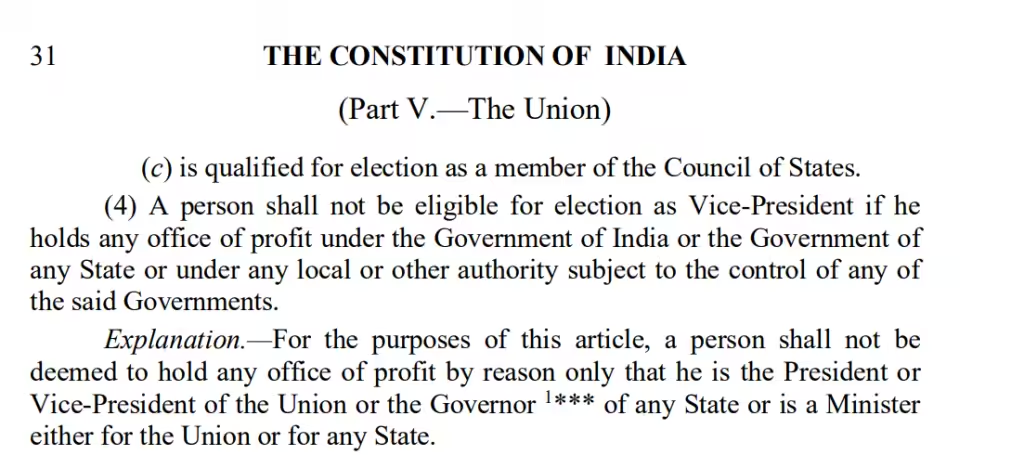
- A person shall not be eligible for election as Vice-President if he holds any office of profit under the Government of India or the Government of any State or under any local or other authority subject to the control of any of the said Governments.
Eligibility:
- is a citizen of India
- has completed the age of thirty-five years
- is qualified for election as a member of the Council of States
Term of office of Vice-President: Article 67
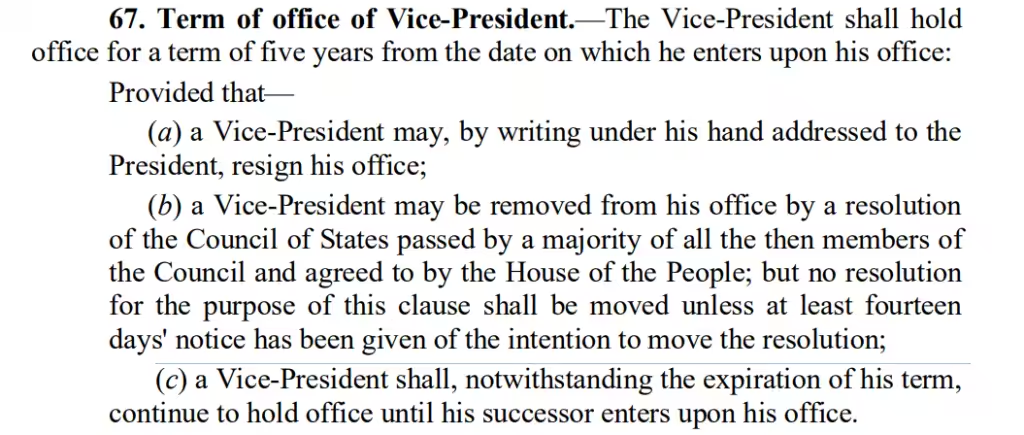
The Vice-President shall hold office for a term of five years from the date on which he enters upon his office: Provided that—
(a) a Vice-President may, by writing under his hand addressed to the President, resign his office
(b) a Vice-President may be removed from his office by a resolution of the Council of States passed by a majority of all the then members of the Council and agreed to by the House of the People; but no resolution for the purpose of this clause shall be moved unless at least fourteen days’ notice has been given of the intention to move the resolution;
(c) a Vice-President shall, notwithstanding the expiration of his term, continue to hold office until his successor enters upon his office.
Oath or affirmation by the Vice-President: Article 69
Every Vice President shall, before entering upon his office, make and subscribe before the President, or some person appointed in that behalf by him, an oath or affirmation in the following form, that is to say—

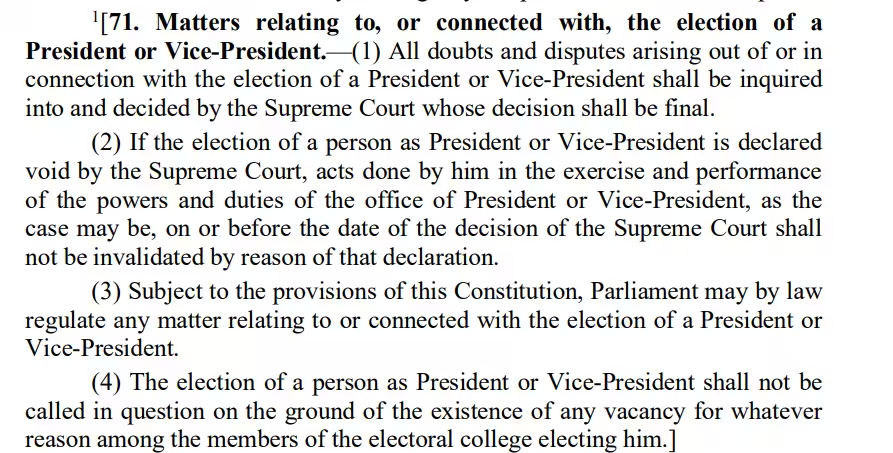
Article 71:
Vice-President’s role as Chairman of the Rajya Sabha:
- As Chairman of Rajya Sabha, the Vice President is the final authority on the interpretation of the Constitution and the Rules of Procedure for all house-related matters. His rulings constitute binding precedent. He also determines whether a Rajya Sabha member stands to be disqualified on grounds of defection. Such powers make him an important stakeholder in the functioning of our parliamentary democracy.
- The Vice President is also vested with powers to improve the functioning of the Upper House. There have been several instances where the current Vice President has used his powers to address issues ranging from improving the productivity of question hour, reducing prolonged disruptions, maintaining decorum in the House, to facilitating discussion on issues of national importance.
Role in Parliamentary Committees and other institutions
Parliamentary committees review proposed laws, oversee activities of the executive, and scrutinise government’s expenditure. The Vice President nominates members to various Parliamentary Committees, appoints their Chairmen and issues directions to them. The Vice President also nominates members of the Rajya Sabha on various bodies such as the Haj Committee, the Institute of Constitutional and Parliamentary Studies, Courts of several universities such as JNU, etc. He is also on the three-member Committee which nominates the Chairman of the Press Council of India.