Viksit Bharat Young Leaders Dialogue 2026: Youth Participation and Governance
Viksit Bharat Young Leaders Dialogue 2026 concluded around National Youth Day with the government highlighting large-scale participation, youth ideas and thematic tracks linked to India’s 2047 development vision.
For UPSC, the event should not be treated as a slogan. It is useful because it raises a real governance question: how can a young country convert demographic weight into civic capability, innovation, accountability and public problem-solving?
This article reads the Dialogue as a case study in youth participation, democratic consultation and the institutional challenge of turning ideas into policy feedback.
Quick Facts
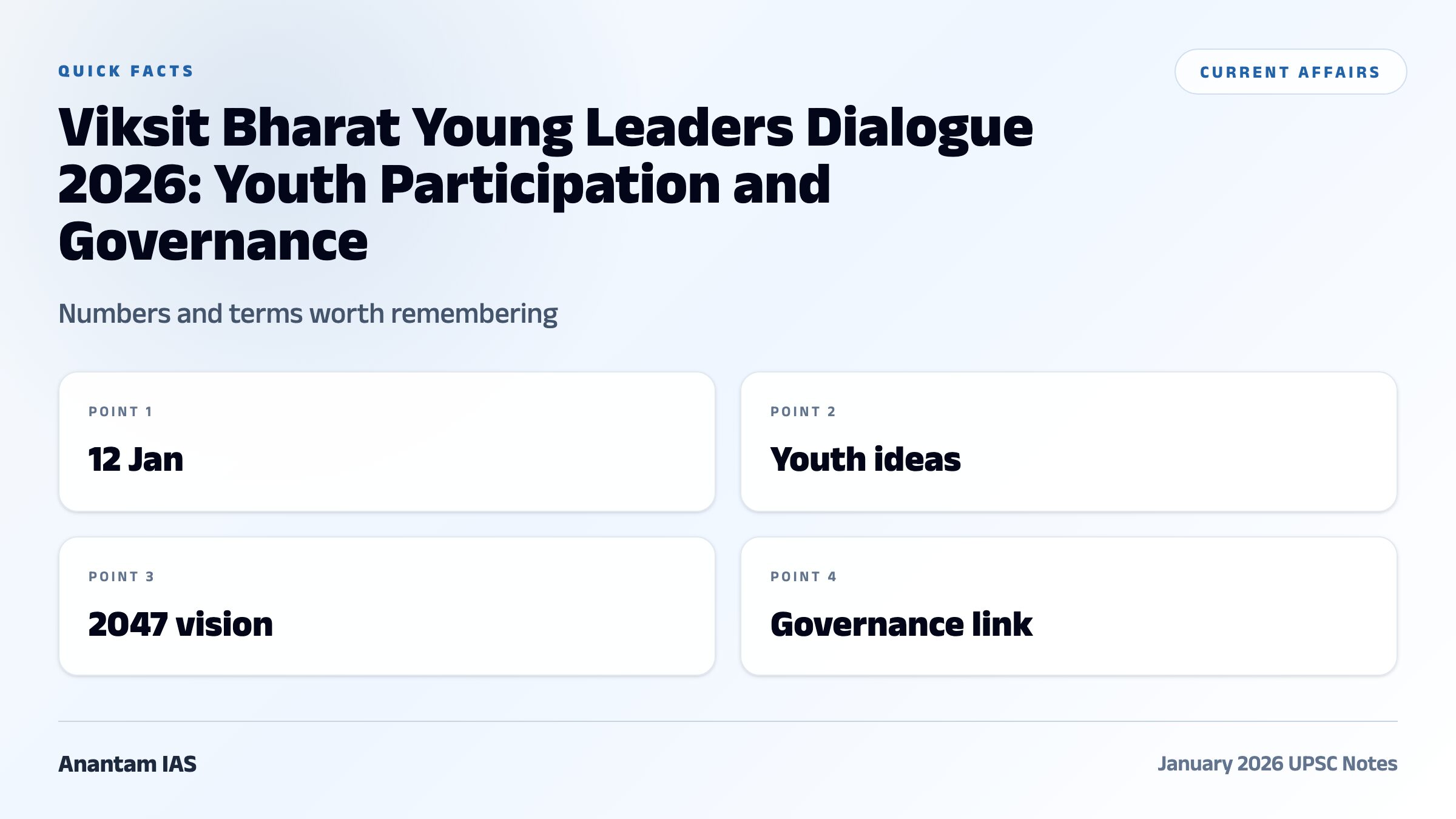
- The event was linked to National Youth Day, observed on 12 January, Swami Vivekananda’s birth anniversary.
- The 2026 Dialogue used the Viksit Bharat 2047 frame.
- Government releases highlighted mass youth participation before the final dialogue.
- The platform included thematic tracks, presentations and interactions with national leadership.
- Youth policy connects to education, skills, entrepreneurship, civic service and health.
- The topic is relevant for GS-II governance and social justice.
- Official source: PIB, Ministry of Youth Affairs and Sports.
What Just Happened
The government conducted the Viksit Bharat Young Leaders Dialogue 2026 as a youth-engagement platform around National Youth Day. Participants were invited to present ideas connected to India’s long-term development goals.
The event fits into a broader trend of consultative governance: competitions, innovation challenges, youth parliaments, hackathons and digital idea platforms. The promise is participation. The risk is tokenism if feedback does not move into policy.
For aspirants, the issue is a bridge between demographic dividend and governance capacity. India does not gain from youth numbers automatically. It gains when young people are educated, skilled, healthy, employable and civically engaged.
Background and Historical Context
National Youth Day commemorates Swami Vivekananda, whose ideas on service, strength and character have long been used in youth mobilisation. In contemporary policy, youth development is tied to skills, entrepreneurship, sports, health and national service.
India’s demographic dividend is time-bound. The working-age share of the population is high, but employability, female labour-force participation, mental health, regional inequality and digital access determine whether the dividend becomes growth or frustration.
The Viksit Bharat 2047 frame attempts to turn the centenary of independence into a planning and mobilisation horizon. Youth engagement is one part of that narrative.
Key Features of the Dialogue Model
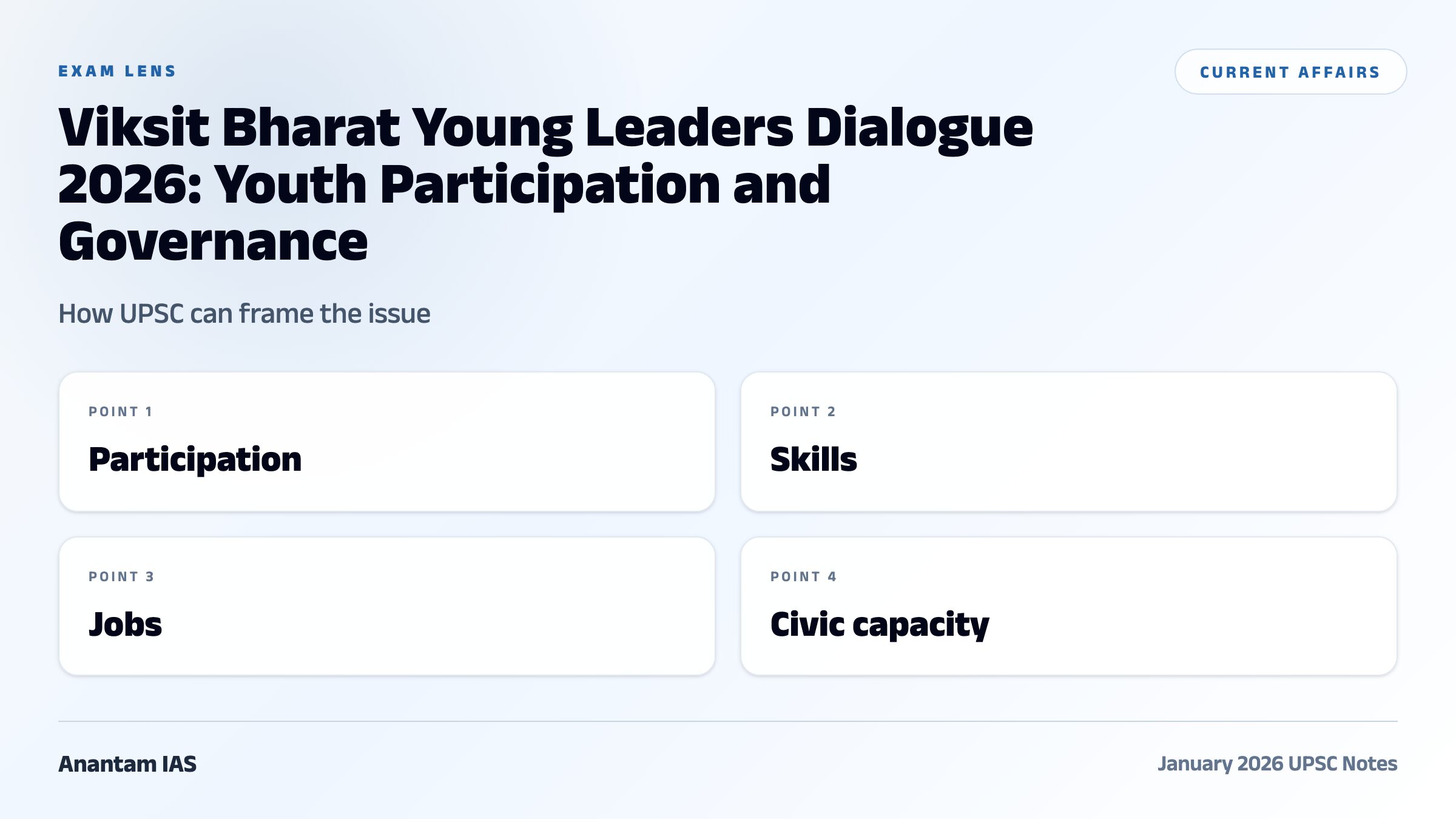
The core policy architecture can be read through these features.
- Mass participation: the process sought ideas from a large youth base before selecting final participants.
- Thematic tracks: young participants worked on development themes rather than generic speeches.
- Leadership interaction: the event connected youth delegates with national leadership.
- Viksit Bharat frame: ideas were tied to the 2047 development horizon.
- Civic learning: the model introduces participants to problem framing and public communication.
- Policy challenge: the real test is whether ideas are evaluated and followed up.
Why It Matters
This is a high-yield UPSC topic because it joins current news with durable syllabus themes.
- It gives GS-II content on participatory governance and citizen engagement.
- It links with GS-I and GS-II themes on youth, society, education and social capital.
- It provides Essay material on demographic dividend and nation-building.
- It helps candidates distinguish symbolic participation from institutionalised consultation.
Detailed Analysis: Governance Lens
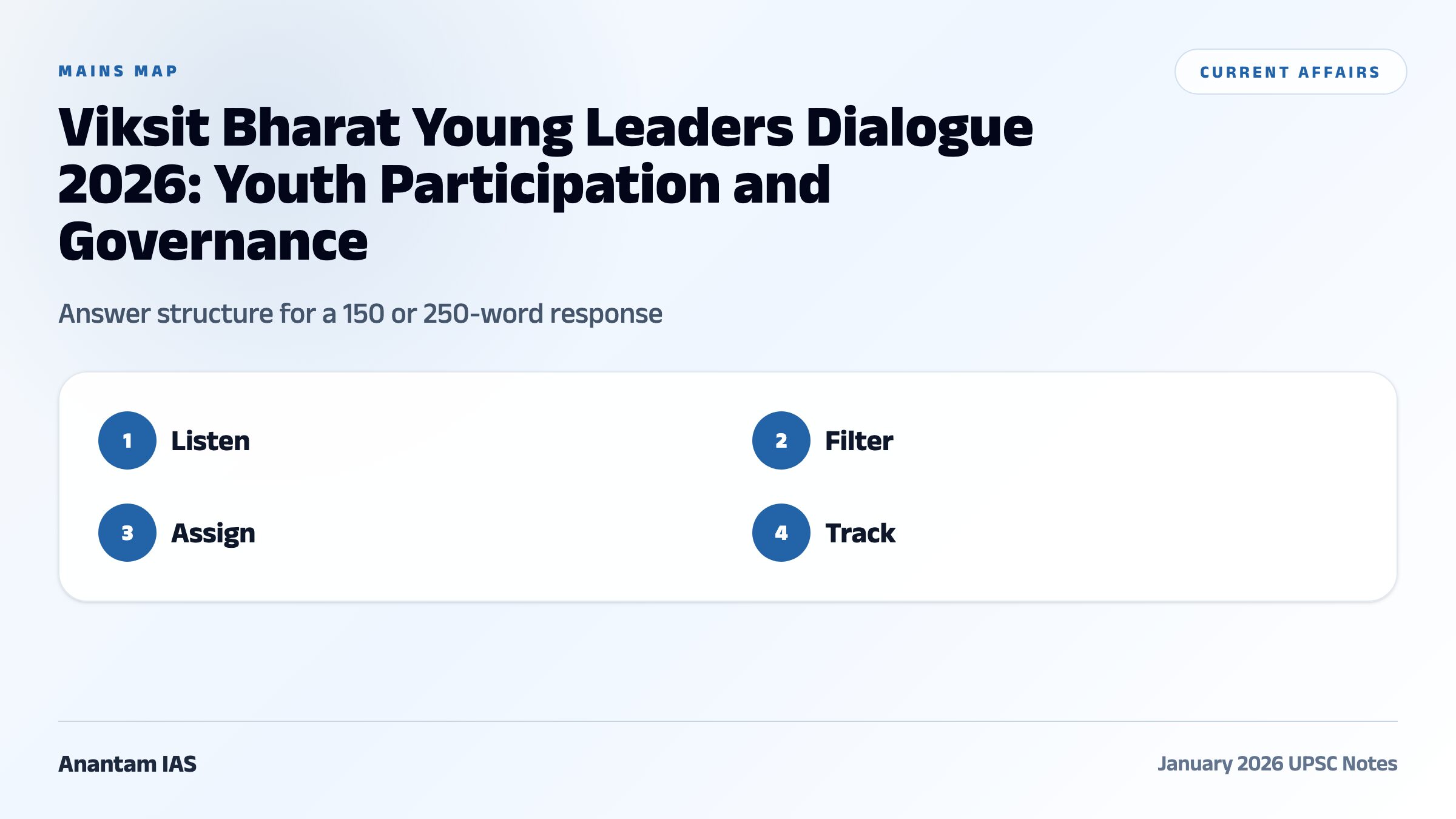
Participation is not the same as policy influence. A dialogue becomes governance only when ideas are filtered, documented, assigned to institutions and tracked.
Youth policy must be intersectional. Urban graduates, rural women, apprentices, sportspersons, tribal youth and gig workers face different constraints. One national platform cannot substitute for targeted policy.
The demographic dividend is a governance project. Education, health, skilling, local-government participation and employment markets must work together. Youth inspiration alone is not enough.
Comparative Perspective
A comparison helps prevent the answer from becoming a one-dimensional news summary.
- Youth Parliament: builds deliberation and constitutional awareness.
- Hackathons: generate technical solutions but may not address institutional adoption.
- National service models: build civic capacity through sustained field engagement.
- VBYLD: focuses on idea generation and leadership interaction around a long-term development vision.
Challenges
The policy or institutional promise runs into recurring constraints.
- Consultations can become event-driven without implementation tracking.
- Participation may be skewed toward English-speaking, urban or already-networked youth.
- Digital platforms can exclude young people with weaker internet access.
- Youth ideas need mentoring and policy translation before adoption.
- Employment outcomes remain the central test of youth policy.
Prelims Pointers
- National Youth Day is observed on 12 January.
- It marks Swami Vivekananda’s birth anniversary.
- Viksit Bharat 2047 refers to India’s centenary development vision.
- Youth Affairs and Sports is the nodal ministry for many youth programs.
- Demographic dividend depends on working-age population, health, education and employment.
- Citizen participation can occur through consultations, parliaments, digital platforms and local institutions.
Mains Questions
- Youth participation in governance must move from symbolic consultation to institutional feedback. Discuss. (GS Paper II, 250 words)
- What conditions are necessary for India to convert its demographic dividend into development capability? (GS Paper I, 250 words)
- Evaluate the role of civic education and youth platforms in strengthening democracy. (GS Paper II, 150 words)
- Viksit Bharat 2047 requires young citizens as problem-solvers, not only beneficiaries. Analyse. (GS Paper II, 250 words)
Way Forward
The Dialogue should publish theme-wise idea summaries, route workable proposals to ministries and create a public tracking mechanism. That would turn participation into accountability.
Future editions should deliberately include rural, tribal, women, disabled and non-English-speaking youth through offline routes, universities, ITIs, panchayats and civil-society networks.
Aspirants should use the topic to write balanced answers: youth mobilisation is useful, but jobs, skills, health and institutional follow-up decide whether it becomes governance.
The examiner is unlikely to reward a bare fact dump here. The better answer connects the January 2026 event to institutional design, implementation capacity and India’s long-term development priorities.
Frequently Asked Questions
What is Viksit Bharat Young Leaders Dialogue?
It is a youth-engagement platform linked to India’s Viksit Bharat 2047 vision, where young participants present ideas on national development themes.
When is National Youth Day observed?
National Youth Day is observed on 12 January, the birth anniversary of Swami Vivekananda.
Why is this topic important for UPSC?
It connects participatory governance with demographic dividend, youth policy, skills, civic education and employment.
What is Viksit Bharat 2047?
It is the official development vision for India at 100 years of independence.
What is the main limitation of youth dialogues?
They risk becoming symbolic unless ideas are documented, evaluated, assigned and tracked.
Which GS paper is most relevant?
GS-II governance is the main paper, with links to GS-I society and Essay.