Vizhinjam port stake sale: why Kerala opposes the Adani-MSC deal
Why in News?
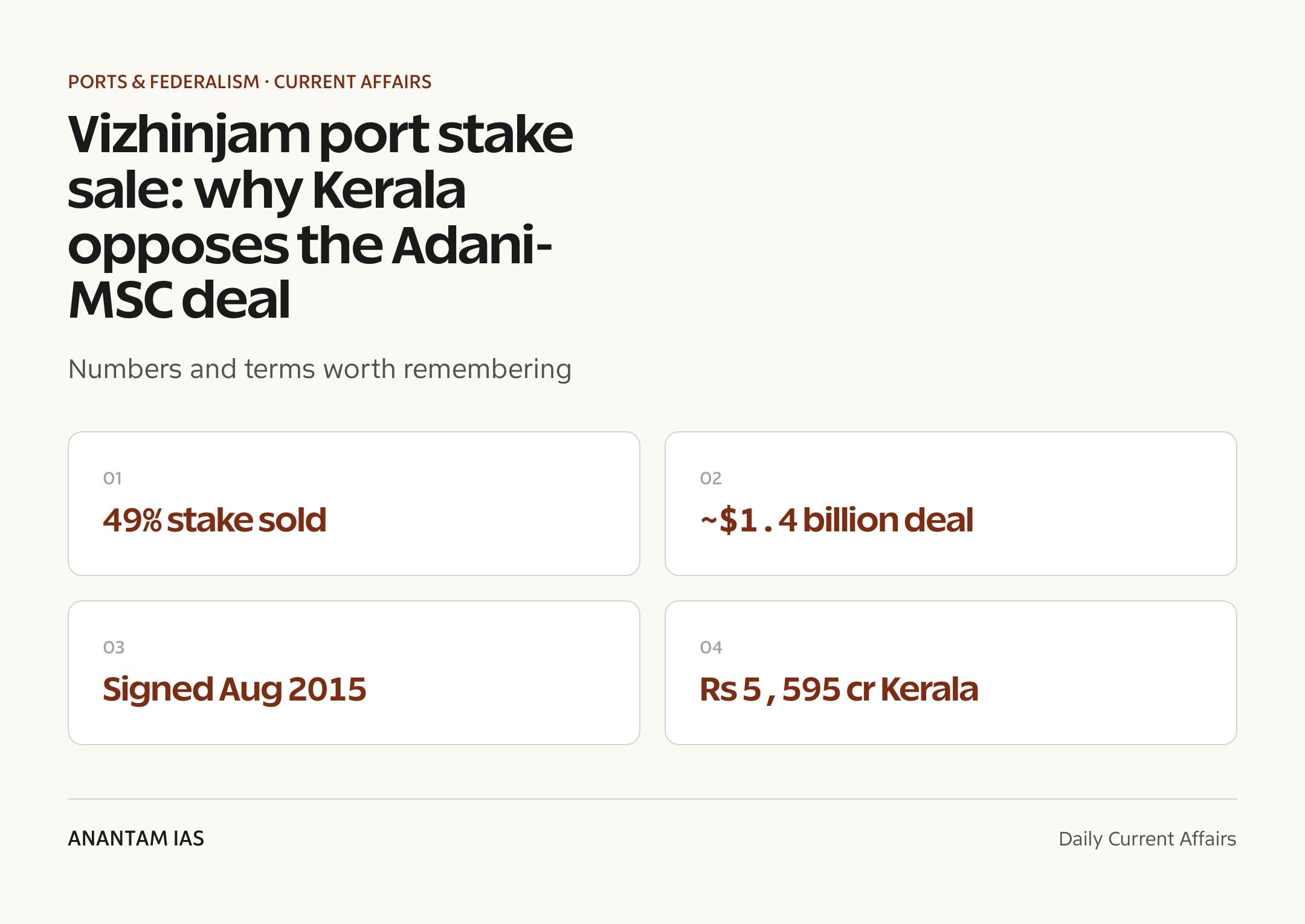
Adani Ports and SEZ (APSEZ) is moving to sell a 49% stake in Kerala’s Vizhinjam port, India’s first deep-water container transshipment port, to a subsidiary of Switzerland-based shipping giant MSC Group for around $1.4 billion (more than Rs 13,000 crore). The Kerala government has objected, saying the concession agreement makes its approval mandatory for such a change in ownership.
The Indian Express reported that the buyer is Mundi Ltd, a subsidiary of Terminal Investment Ltd (TiL), the terminal-operating arm of MSC, the world’s biggest container shipping line. APSEZ disclosed the deal to SEBI and then informed the state ports department on July 1, 2026.
- APSEZ to divest a 49% stake in the port’s concessionaire for about $1.4 billion (over Rs 13,000 crore).
- Buyer is Mundi Ltd, a subsidiary of Terminal Investment Ltd (TiL), MSC’s terminal arm.
- Kerala’s Congress-led government and the Opposition CPI(M) both say the state was not consulted.
- The concession agreement was signed with Adani Vizhinjam Port Pvt Ltd (AVPPL) on 17 August 2015.
- APSEZ disclosed the deal to SEBI and then informed the state on 1 July 2026.
The development matters in the context of:
- Tests PPP infrastructure governance when a concessionaire changes ownership mid-project.
- Raises Centre-State questions on who controls strategic port assets and foreign entry.
- Flags market-concentration risk if the world’s largest liner controls India’s flagship transshipment hub.
UPSC Relevance
Prelims Relevance
- Vizhinjam is India’s first deep-water container transshipment port, near Thiruvananthapuram, Kerala.
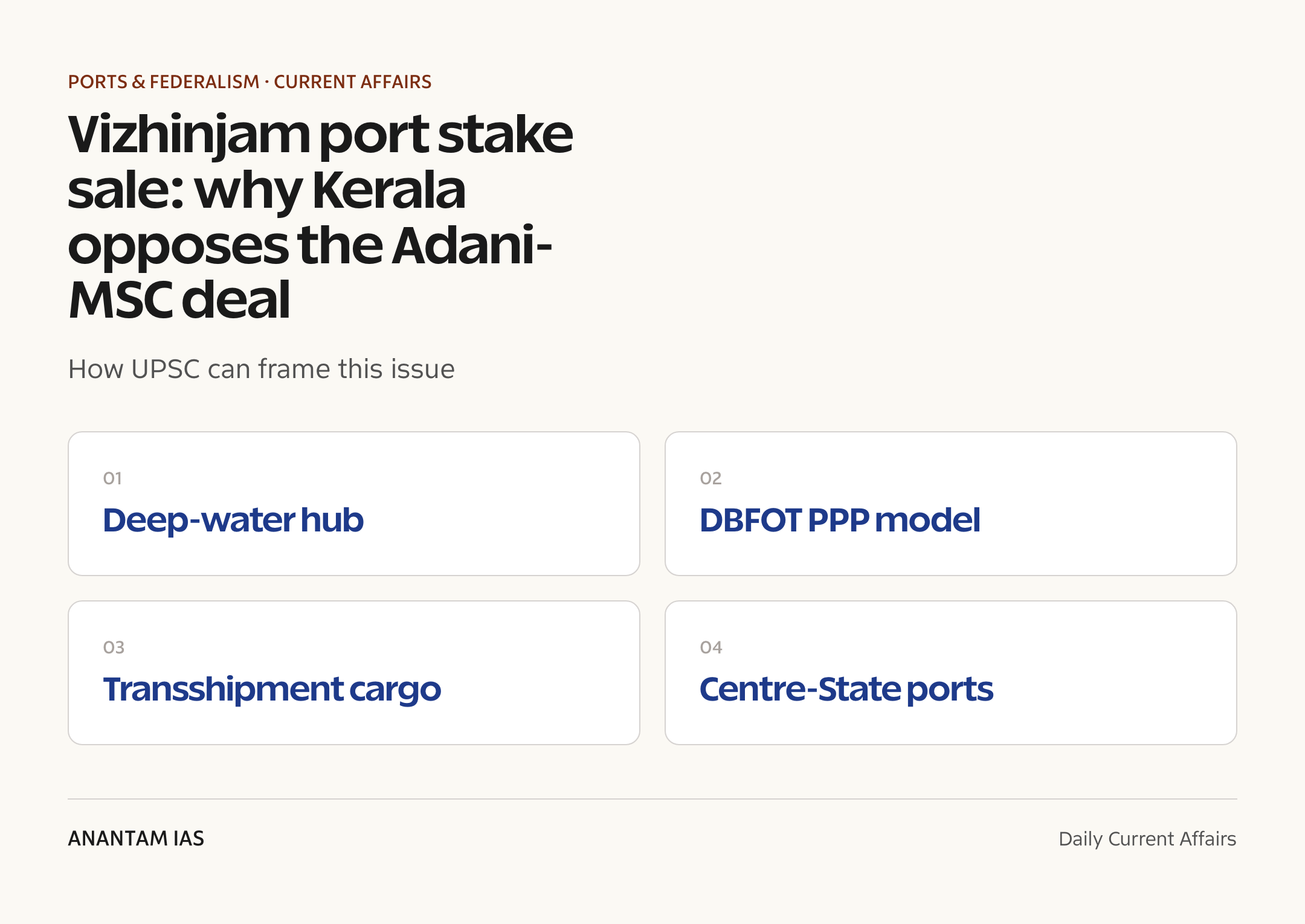
- Developed on the DBFOT (Design, Build, Finance, Operate, Transfer) PPP model.
- Concessionaire: Adani Vizhinjam Port Pvt Ltd (AVPPL); concession agreement signed 2015.
- Buyer’s chain: Mundi Ltd → TiL → MSC Group (Mediterranean Shipping Company).
- Transshipment: cargo transferred between ships at a hub port before onward voyage.
- Historically Indian cargo was transshipped via Colombo, Salalah and Singapore.
- Sagarmala is the Union port-led development programme (Ministry of Ports, Shipping and Waterways).
- Major ports are a Union subject; minor/intermediate ports sit on the Concurrent List.
- Kerala invested Rs 5,595 crore in phase 1; Adani put in Rs 2,454 crore.
Mains Relevance
GS Paper 3
- PPP models in infrastructure and the risks of ownership change in long-gestation concessions.
- Port-led growth, transshipment self-reliance, and reducing dependence on foreign hubs.
GS Paper 2
- Centre-State roles in ports and the friction between a private concessionaire’s commercial freedom and a state’s consent rights.
- Regulation of monopoly/market concentration and FDI in strategic infrastructure.
Essay
- Nation-building on private capital: who owns strategic infrastructure?
- Self-reliance and the sea: India’s quest to keep its cargo at home.
Background and Context
What Vizhinjam is and why it matters
Vizhinjam is India’s first purpose-built deep-water transshipment hub, meant to keep Indian cargo out of foreign ports.
- Located near Thiruvananthapuram on Kerala’s southern coast, it is India’s first deep-water container transshipment port.
- Its natural draft of about 18-20 metres lets it berth the largest mother vessels without heavy dredging or reclamation.
- It sits close to the busy east-west international shipping lane connecting Europe, West Asia and the Far East, needing only a short deviation for calling ships.
- A transshipment hub aggregates cargo from smaller feeder ships onto large mother vessels, so scale and location, not just hinterland demand, decide its viability.
- In June 2025 the MSC IRINA, then the world’s largest container ship, called at Vizhinjam, signalling its big-ship readiness.
Transshipment and why India relied on Colombo
For decades most Indian container cargo was routed through foreign hubs because Indian ports could not handle the largest ships.
- Transshipment is the transfer of cargo from one ship to another at a hub port before its onward journey.
- A large share of India’s transshipment cargo has historically moved via Colombo, Singapore and Salalah (Oman), by many estimates around three-quarters.
- Indian ports long lacked the deep draft needed for the biggest ships, so lines used foreign hubs as their pivot points.
- Routing through foreign hubs adds freight cost and transit time and exports value, revenue and jobs to overseas ports.
- It also leaves Indian trade exposed to congestion or disruption at a hub outside national control, as seen during past crises at Colombo.
- A domestic deep-water hub like Vizhinjam is meant to reclaim this cargo, build port-led jobs and cut logistics costs.
The landlord-port and PPP structure
Vizhinjam follows a landlord-port, public-private partnership design that split money and control between the state and Adani.
- It is built on the DBFOT (Design, Build, Finance, Operate, Transfer) model, a variant of the landlord-port framework.
- In a landlord port, the public authority owns the land and basic infrastructure while a private operator builds superstructure and runs the terminal on a long concession.
- The Kerala government owns the land and core assets; the private concessionaire builds and runs operations before eventual transfer back to the state.
- The concessionaire is Adani Vizhinjam Port Pvt Ltd (AVPPL), an APSEZ entity.
- Kerala invested Rs 5,595 crore in phase 1 against Adani’s Rs 2,454 crore, so the state is the larger financial stakeholder despite being the public partner.
- The concession agreement between the state and AVPPL was signed on 17 August 2015 under a Congress government, and it governs equity, ownership and dispute rules.
The deal and the disputed consent clause
The clash centres on whether selling 49% counts as a change in ownership needing the state’s prior approval.
- APSEZ is selling a 49% stake in AVPPL to Mundi Ltd (a TiL/MSC subsidiary) for about $1.4 billion.
- Kerala says a transfer of 25% or more of the concessionaire’s equity is a change in ownership needing prior approval on national-security and public-interest grounds.
- Adani argues it must hold 51% only during construction and the first year of commercial operations.
- APSEZ says the port is now in its second year of operations, letting it dilute up to 74% of its stake.
- The dispute would be tested against the concession agreement’s ownership and arbitration clauses.
Why Kerala fears an MSC monopoly
The state’s core worry is that the world’s biggest liner gaining control could distort the hub’s neutrality.
- MSC is the world’s largest container shipping company, so its control raises competition concerns.
- Kerala fears the hub could tilt toward MSC’s own traffic, hurting its status as a common-user port open to all lines on equal terms.
- A liner that both ships cargo and controls the terminal has an incentive to favour its own boxes, a vertical-integration worry regulators watch closely.
- The state also flags lost bargaining power over a strategic asset it heavily co-funded with public money.
- In 2023, TiL had already acquired a 49% equity stake in the Adani Ports Ennore container terminal, a precedent Kerala cites for creeping consolidation.
Centre-State roles and ports governance
Vizhinjam also surfaces the constitutional split between Union major ports and state-handled minor ports.
- Major ports fall under the Union List and the Major Port Authorities Act, 2021.
- Minor and intermediate ports like Vizhinjam sit on the Concurrent List, giving states an operational role.
- The Union’s Sagarmala programme drives port-led development, coastal shipping and hinterland connectivity.
- As a state-anchored PPP, Vizhinjam gives Kerala consent rights that a purely Union project would not.
FDI, capital and the wider infrastructure question
The deal also sits within India’s push to draw foreign capital into long-gestation infrastructure without ceding control of strategic assets.
- India allows 100% FDI under the automatic route in port construction and maintenance, so foreign entry is not itself barred.
- Foreign strategic investors bring capital, cargo commitments and global networks that can raise a hub’s throughput.
- The tension is that a concessionaire’s freedom to raise capital by diluting equity can clash with a host state’s control and consent rights.
- A liner-owned terminal can guarantee base volumes, but it also risks tying the hub’s fortunes to one shipping alliance.
- How the concession’s ownership clause is read will signal to future investors how predictable India’s PPP contracts are.
Way Forward
Settle the consent question
- Read the concession agreement clauses transparently and, if disputed, refer to the agreed arbitration forum rather than litigate publicly.
- Ensure any equity transfer meets the national-security and public-interest review the agreement contemplates.
Protect competition and neutrality
- Bind the hub to common-user, non-discriminatory access so no single liner is favoured.
- Involve the Competition Commission of India where market-concentration risk is material.
Strengthen PPP governance
- Write clearer change-of-ownership triggers and state-consent rules into future concessions.
- Balance a private partner’s need to raise capital with the state’s stake as a large public co-investor.
Conclusion
Vizhinjam’s promise is strategic: a home-grown deep-water hub that keeps Indian cargo out of Colombo and Salalah and cuts logistics costs. The stake sale to MSC’s arm could bring capital and traffic, but it also concentrates control of a flagship asset in the world’s largest liner.
The real test is governance, not the headline price. How India reads consent clauses, guards competition and honours a state’s stake in a PPP will shape investor confidence and Centre-State trust in the next wave of port infrastructure.
UPSC Practice Questions
Prelims MCQ 1
With reference to the Vizhinjam port project, consider the following statements:
- It is India’s first deep-water container transshipment port.
- It is being developed on the Design, Build, Finance, Operate and Transfer (DBFOT) public-private partnership model.
- The concessionaire is a subsidiary of Adani Ports and SEZ.
How many of the above statements are correct?
(a) Only one (b) Only two (c) All three (d) None
Answer: (c) All three
Explanation:
Vizhinjam is India’s first deep-water transshipment port, built on the DBFOT PPP model, with Adani Vizhinjam Port Pvt Ltd (an APSEZ entity) as the concessionaire. All three are correct.
Prelims MCQ 2
The buyer in the proposed Vizhinjam stake sale, Mundi Ltd, is ultimately linked to which shipping group?
(a) Maersk (b) CMA CGM (c) MSC (Mediterranean Shipping Company) (d) Hapag-Lloyd
Answer: (c) MSC (Mediterranean Shipping Company)
Explanation:
Mundi Ltd is a subsidiary of Terminal Investment Ltd (TiL), the terminal-operating arm of MSC, the world’s largest container shipping company.
UPSC Mains Questions
- Vizhinjam is India’s first deep-water transshipment port, yet its ownership is contested. Discuss how the public-private partnership model handles change of control in long-gestation infrastructure, and what safeguards a host state should retain.
- Foreign entry into strategic port assets promises capital and traffic but raises competition and sovereignty concerns. Examine this trade-off with reference to the proposed Adani-MSC deal at Vizhinjam.
- Explain why India’s containers were long transshipped through foreign hubs, and assess how ports like Vizhinjam and the Sagarmala programme aim to change that.
Sources: The Indian Express (Explained) and SEBI disclosure by Adani Ports and SEZ (APSEZ).
Frequently Asked Questions
What is the Vizhinjam port deal about?
Adani Ports and SEZ (APSEZ) is selling a 49% stake in Vizhinjam port’s concessionaire to Mundi Ltd, a subsidiary of MSC’s terminal arm TiL, for about $1.4 billion (over Rs 13,000 crore). Kerala has objected, saying the concession agreement makes the state’s prior approval mandatory for such a change in ownership.
Why is Vizhinjam port strategically important?
It is India’s first deep-water container transshipment port, near Thiruvananthapuram, with a deep natural draft that can handle the largest ships. It aims to keep Indian transshipment cargo at home instead of routing it through Colombo, Singapore or Salalah, cutting costs and building port-led growth.
What is transshipment and why did India rely on foreign ports?
Transshipment is transferring cargo between ships at a hub before onward carriage. Most Indian container transshipment moved via foreign hubs because Indian ports lacked the depth for the largest vessels, adding cost and time. A deep-water hub like Vizhinjam is meant to reclaim this traffic.
Why does Kerala oppose the Adani-MSC deal?
Kerala says a transfer of 25% or more of the concessionaire’s equity is a change in ownership needing the state’s prior approval on national-security and public-interest grounds. It also fears a monopoly, since MSC is the world’s largest liner, and notes it invested Rs 5,595 crore in phase one.
What is the DBFOT model at Vizhinjam?
DBFOT stands for Design, Build, Finance, Operate and Transfer, a public-private partnership form of the landlord-port model. The Kerala government owns the land and core assets while the private concessionaire, Adani Vizhinjam Port Pvt Ltd, builds and operates the port before eventual transfer.
How are ports divided between the Centre and states?
Major ports fall under the Union List and the Major Port Authorities Act, 2021. Minor and intermediate ports such as Vizhinjam sit on the Concurrent List, giving states an operational and consent role. The Union’s Sagarmala programme drives port-led development nationally.