Voyager 1 and Voyager 2
Why in News?
Voyager 1 approaches a distance of one light-day from Earth, approximately 25.9 billion km, implying roughly 24 hours for a radio signal to travel one way.
| UPSC Relevance: GS-3 Science and Technology: Astronomy and Space Technology Prelims: Voyager 1 and Voyager 2 space missions |
About the Missions:
- Agency: NASA; managed by its Jet Propulsion Laboratory (JPL).
- Launch: Voyager 2 (August 1977); Voyager 1 (September 1977). Despite launching later, Voyager 1 followed a faster trajectory.
- Voyager 1: Flew past Jupiter (1979) and Saturn (1980); remains the most distant human-made object.
- Voyager 2: Visited Jupiter, Saturn, Uranus and Neptune; remains the only spacecraft to have visited Uranus and Neptune.
- Technology: Used planetary gravity assists to alter speed and direction while conserving propellant. Electricity comes from radioisotope thermoelectric generators (RTGs), which convert heat from radioactive decay into electricity.
Key Findings:
- Jupiter and its moons: Discovered active volcanoes on Io, the first observed beyond Earth, and Jupiter’s faint rings. Images of Europa’s fractured icy surface provided early clues supporting the possibility of a subsurface ocean.
- Saturn and Titan: Revealed intricate ring structures, including spokes and shepherd-moon interactions; established that Titan’s thick atmosphere is predominantly nitrogen, with methane and complex organic chemistry.
- Uranus (Voyager 2): Discovered new moons and rings, revealed Miranda’s dramatically varied terrain, and measured Uranus’s strongly tilted, off-centre magnetic field.
- Neptune (Voyager 2): Observed the Great Dark Spot, powerful winds and rings; detected geyser-like plumes on Triton, demonstrating activity on a frigid, distant moon.
- Interstellar environment: Their measurements of particles, plasma and magnetic fields revealed how the solar wind interacts with the interstellar medium.
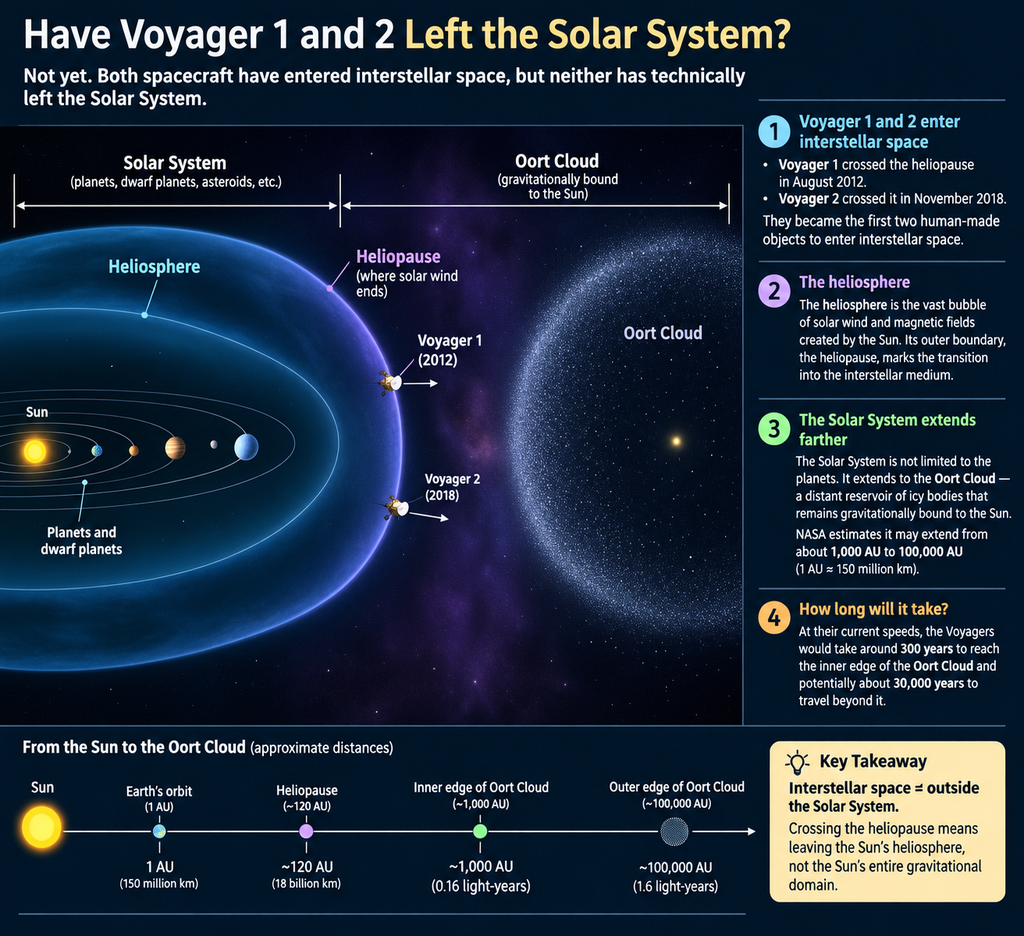
Have Voyager 1 and 2 Left the Solar System?
- Not yet. Both spacecraft have entered interstellar space, but neither has technically left the Solar System.
- Voyager 1 crossed the heliopause in August 2012, while Voyager 2 crossed it in November 2018, becoming the first two human-made objects to enter interstellar space.
- The heliosphere is the vast bubble of solar wind and magnetic fields created by the Sun. Its outer boundary, the heliopause, marks the transition into the interstellar medium.
- However, the Solar System extends much farther to the Oort Cloud. Oort Cloud is a distant reservoir of icy bodies that remains gravitationally bound to the Sun. NASA estimates it may extend from about 1,000 AU to 100,000 AU from the Sun.
At their present speeds, the Voyagers would take around 300 years to reach the inner edge of the Oort Cloud and potentially about 30,000 years to travel beyond it.
Scientific Significance:
- Changed planetary science: Demonstrated that distant moons can be geologically active, helping shape later investigations of ocean worlds and habitability.
- Provided direct measurements: Spacecraft can sample local particles and fields that telescopic images alone cannot reveal.
- Pale Blue Dot: Voyager 1’s 1990 photograph of Earth, taken from about 6 billion km, became a powerful reminder of Earth’s fragility and humanity’s shared home.
Practice MCQ:
Q. With reference to the Voyager missions, consider the following statements:
- Voyager 2 is the only spacecraft to have visited both Uranus and Neptune.
- Crossing the heliopause means that a spacecraft has also crossed the Oort Cloud.
Which of the statements given above are correct?
(a) 1 only
(b) 2 only
(c) Both 1 and 2
(d) Neither 1 nor 2
Answer: (a) Statement 2 is incorrect because the Oort Cloud extends far beyond the heliopause.