Water governance in peri-urban areas
Why in News?
India has made significant progress in expanding access to water through initiatives such as the Jal Jeevan Mission and urban water infrastructure programmes. However, a large but neglected zone between villages and cities — peri-urban areas — continues to face serious challenges of water supply, sanitation, groundwater contamination and governance gaps. As India urbanises rapidly, these regions are emerging as critical spaces that require dedicated policy attention.
UPSC Relevance
Prelims: Jal Jeevan Mission, 73rd and 74th Constitutional Amendments, Swachh Bharat Mission, Census Towns, urbanisation and sanitation initiatives.
Mains:
GS-II (Governance, Local Governance, Public Service Delivery),
GS-III (Urbanisation, Water Resource Management, Infrastructure, Sustainable Development, Environment).
Background and Context
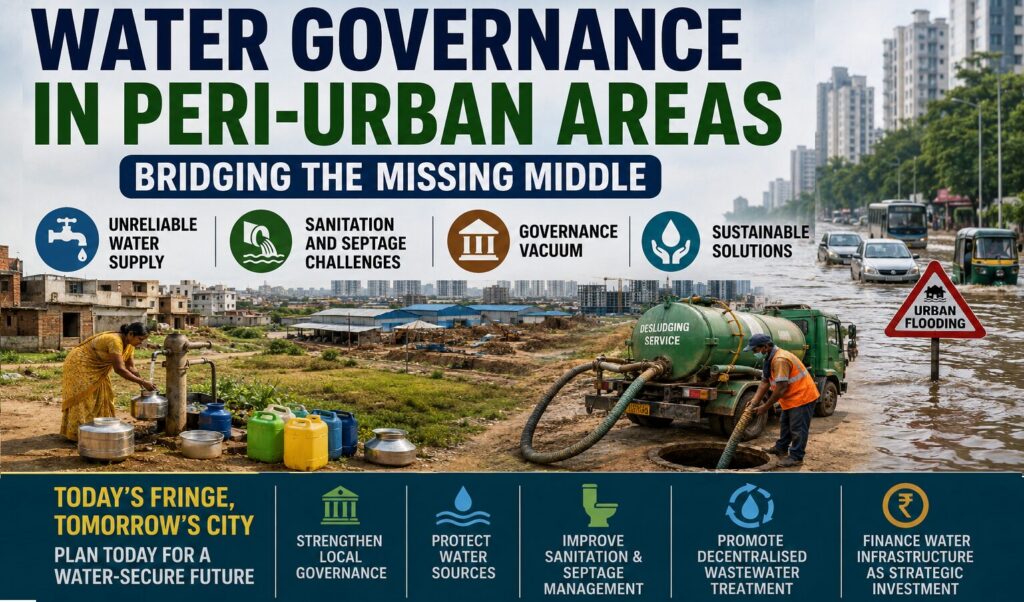
India’s water discourse has traditionally focused on two images: rural areas waiting for access to drinking water and cities struggling with water scarcity or flooding. Yet between these two lies a rapidly expanding “missing middle” — peri-urban India.
These are transitional spaces where villages gradually transform into urban settlements. They are characterised by mixed land use, changing demographics and weak institutional structures. Though economically dynamic, they often remain trapped in an administrative vacuum.
Over the last two decades, the number of Census towns in India increased from approximately 1,362 to 3,784, representing an increase of around 178%. This indicates rapid urbanisation occurring outside formally recognised urban areas.
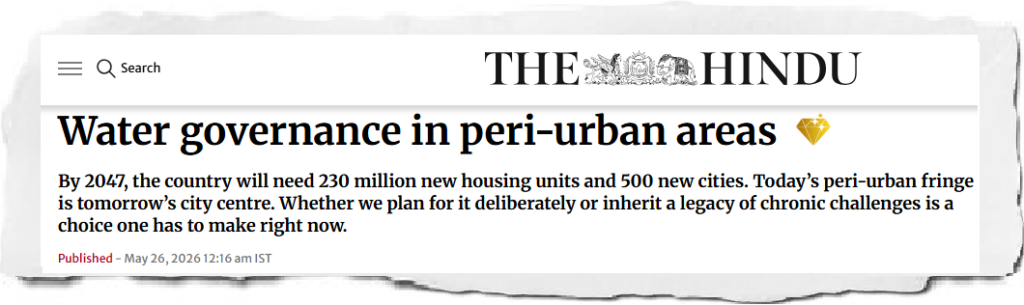
By 2047, India is projected to require approximately 230 million additional housing units and nearly 500 new cities. Therefore, today’s peri-urban regions may become tomorrow’s urban centres.
What is Peri-Urban Areas?
Peri-urban regions occupy a transitional position between rural and urban spaces. They possess characteristics of both areas but often enjoy the benefits of neither.
Some common features include:
- Agricultural lands gradually convert into industrial areas, housing colonies and commercial establishments, creating intense pressure on local resources.
- Population growth often exceeds infrastructure development, leading to shortages in basic services such as drinking water and sanitation.
- Administrative responsibilities frequently overlap among Panchayats, municipal bodies and development authorities.
- Environmental degradation accelerates because land-use regulation remains weak.
What are the Major Water Governance Challenges in Peri-Urban India?
Governance Vacuum and Institutional Confusion
The biggest challenge in peri-urban regions is institutional ambiguity.
For example, some areas remain legally classified as villages despite displaying urban characteristics. Others are transferred to municipal jurisdictions without corresponding administrative capacity.
This creates situations where residents face urban costs without receiving urban services.
For instance, in Gurugram, several peri-urban areas were absorbed under municipal administration, but governance inefficiencies continue to affect service delivery.
Inadequate Water Supply
Water supply in these regions often remains unreliable and irregular.
Rawta village on Delhi’s outskirts demonstrates this challenge. Water is supplied through common collection points on alternate days and only during late-night hours. Residents often sacrifice sleep to collect water, while private vendors exploit shortages by charging high prices.
Such situations create inequality in access to an essential resource.
Groundwater Degradation and Pollution
Peri-urban regions increasingly experience groundwater contamination due to waste disposal and industrial activities.
In peri-urban Hyderabad, toxic leachate generated from waste dumping sites contaminated groundwater resources, affecting local communities.
Since many households depend heavily on groundwater extraction, contamination directly affects public health.
Urban Expansion Creating Rural Sacrifice Zones
Cities often satisfy growing water requirements by diverting resources from surrounding regions.
The Bisalpur Dam in Rajasthan illustrates this issue. Originally designed to support irrigation needs of Tonk and Sawai Madhopur districts, increasing urban demand from Jaipur has altered water allocation patterns.
As urban demand expands, peri-urban and rural communities frequently bear disproportionate costs.
Sanitation and Septage Management Challenges
Sanitation systems in peri-urban regions face serious deficiencies.
Nearly 40 million urban households depend upon septic tanks and on-site sanitation systems. However:
- Desludging frequently occurs only after tanks overflow rather than through periodic maintenance.
- Illegal dumping of untreated faecal sludge into rivers, open lands and agricultural fields remains widespread.
- One untreated tanker discharge can significantly undermine sanitation gains achieved under national programmes.
Thus, sanitation challenges extend beyond toilet construction to the management of waste after collection.
Existing Government Initiatives
Jal Jeevan Mission (JJM)
The mission seeks to provide functional household tap connections to rural households while ensuring sustainable water supply systems.
Although the programme significantly expanded water access, source sustainability remains an important concern.
Swachh Bharat Mission
The mission improved sanitation coverage and toilet construction across India. However, peri-urban areas continue to face challenges related to faecal sludge and wastewater management.
Constitutional Framework for Urban Governance
The Seventy-fourth Constitutional Amendment Act sought to strengthen urban local governance through municipal institutions and Nagar Panchayats.
However, implementation remains uneven, particularly in transitional regions.
Way Forward
Strengthening Governance Structures
State governments should establish Nagar Panchayats in all eligible Census towns as envisioned under constitutional provisions.
Experiments such as multi-stakeholder coordination platforms involving engineers, Panchayat representatives and local communities can improve accountability.
Ensuring Source Sustainability
Providing water connections alone is insufficient unless water sources remain protected.
Measures should include:
- Preventing encroachments around catchment areas.
- Restricting dumping of solid waste.
- Encouraging community-based sanitary inspections of local water sources.
Launching a Peri-Urban Focused Swachh Bharat Mission 3.0
Future sanitation initiatives should explicitly focus on peri-urban requirements.
Key measures may include:
- Establishing faecal sludge treatment plants where central sewage infrastructure is not viable.
- Introducing GPS-enabled desludging systems to prevent illegal disposal.
- Using mini-desludging vehicles for narrow roads and congested settlements.
- Integrating sanitation costs within monthly utility payments through small service charges.
Promoting Decentralised Wastewater Treatment
Innovative modular treatment systems can recycle wastewater close to the source.
These systems reduce land requirements and can recover substantial quantities of reusable water.
Government support through procurement policies, incentives and regulatory simplification can accelerate adoption.
Innovative Financing Mechanisms
Peri-urban water infrastructure should be treated as strategic national investment.
Blended financing approaches combining public support, concessional loans and performance-linked funding may provide sustainable solutions.
Challenges in Implementation
Administrative Fragmentation: Multiple agencies with overlapping responsibilities often create delays and weak accountability mechanisms.
Financial Constraints: Smaller urban local bodies frequently lack adequate resources to invest in water and sanitation infrastructure.
Rapid Urbanisation: Population growth often exceeds infrastructure expansion.
Environmental Pressures: Groundwater depletion, pollution and climate variability add further stress.
Conclusion
India’s future water security may be determined not only in villages or metropolitan cities but in the vast peri-urban spaces connecting them. These regions already possess substantial economic significance and demographic weight. If governance reforms, infrastructure investment and sustainable water management are pursued together, peri-urban India can transform from a neglected transition zone into a resilient and water-secure growth centre.
Practice Questions
Prelims Question 1 (Inference-based)
Consider the following statements regarding peri-urban water governance in India:
I. Expansion of water supply infrastructure alone may not ensure long-term water security in peri-urban regions.
II. Institutional ambiguity in peri-urban regions affects both service delivery and accountability.
III. Rapid urbanisation automatically results in improved access to water and sanitation services.
Which of the following relationships among the above statements is/are correct?
- Statement II explains one of the structural reasons behind concerns highlighted in Statement I.
- Statement III strengthens the argument presented in Statement I.
- Statement I and Statement II together imply the need for governance reforms alongside infrastructure expansion.
(a) 1 only
(b) 1 and 3 only
(c) 2 and 3 only
(d) 1, 2 and 3
Answer: (b)
Explanation: Infrastructure alone cannot ensure water security without institutional support. Governance gaps contribute directly to service deficiencies. Statement III is incorrect because rapid urbanisation often creates additional stress.
Prelims Question 2
Match the following initiatives with their primary objectives:
| Initiative | Objective |
|---|---|
| A. Jal Jeevan Mission | 1. Constitutional recognition of urban local bodies |
| B. Swachh Bharat Mission | 2. Household tap water connections |
| C. 74th Constitutional Amendment | 3. Improvement in sanitation |
Select the correct answer:
(a) A–2, B–3, C–1
(b) A–1, B–2, C–3
(c) A–3, B–2, C–1
(d) A–2, B–1, C–3
Answer: (a)
Explanation: Jal Jeevan Mission focuses on tap water access; Swachh Bharat Mission addresses sanitation; the 74th Amendment strengthened urban local bodies.
Mains Questions
- “Peri-urban regions represent the missing middle in India’s water governance framework.” Examine the statement.
- Discuss how rapid urbanisation and institutional gaps create challenges for sustainable water and sanitation management in peri-urban India.