‘We condemn attacks on UAE’, says PM Modi, signs defence cooperation pact
Why in News?
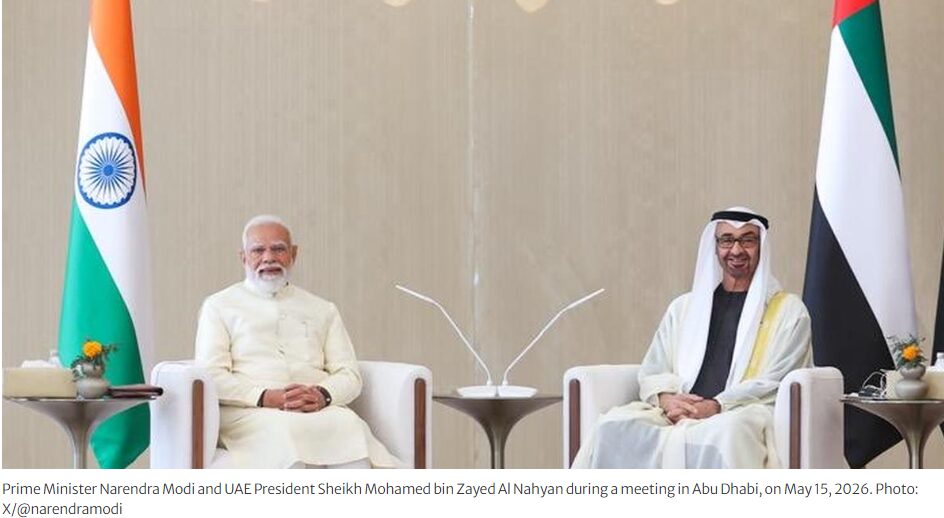
Prime Minister Narendra Modi visited the United Arab Emirates and held talks with UAE President Mohamed bin Zayed Al Nahyan during a brief stopover in Abu Dhabi. India and the UAE signed a Strategic Defence Cooperation Framework and several agreements related to energy security, strategic petroleum reserves, LNG supplies, ship-building and supercomputing cooperation amid rising instability in West Asia following the Iran conflict.
UPSC Relevance
Prelims: India-UAE relations, Strategic Petroleum Reserves, ADNOC, LNG, West Asia, energy security, Chabahar, Indian Ocean geopolitics
Mains:
GS Paper 2 – India and neighbourhood relations, bilateral agreements, West Asia diplomacy, strategic partnerships;
GS Paper 3 – energy security, defence cooperation, critical infrastructure, maritime security;
Essay – strategic autonomy, multipolarity, energy geopolitics
Background and Context
India’s engagement with the United Arab Emirates has evolved significantly over the past decade from a traditional energy-based relationship into a comprehensive strategic partnership.
The UAE is among India’s:
- Largest trading partners
- Major energy suppliers
- Important investment sources
- Key strategic partners in West Asia
The relationship has gained greater geopolitical importance because:
- Nearly 9 million Indians live and work in the Gulf region
- West Asia remains central to India’s energy imports
- Maritime trade routes through the Persian Gulf are critical for India’s economy
- Growing regional instability directly affects India’s strategic interests
The visit also occurred amid escalating tensions in West Asia following the Iran conflict and concerns regarding disruptions in global energy supply chains.
Evolution of India-UAE Relations
From Energy Partnership to Comprehensive Strategic Partnership
India-UAE relations historically revolved around:
- Oil imports
- Indian diaspora
- Remittances
- Trade links
However, since 2015, ties have expanded into:
- Defence cooperation
- Counter-terrorism
- Maritime security
- Technology
- Infrastructure
- Renewable energy
- Investment partnerships
In 2017, the relationship was elevated to a Comprehensive Strategic Partnership.
Growing Economic Engagement
The UAE is one of India’s top trading partners.
Key features include:
- Bilateral trade exceeding $80 billion in recent years
- UAE among major investors in Indian infrastructure
- Strong cooperation in ports, logistics and renewable energy
The India-UAE Comprehensive Economic Partnership Agreement further accelerated trade integration between the two countries.
Strategic Defence Cooperation Framework
Defence Cooperation Expands
The newly concluded Strategic Defence Cooperation Framework marks a major development in India-UAE security relations.
The agreement covers cooperation in:
- Defence manufacturing
- Defence technology
- Military exercises
- Maritime security
- Cybersecurity
- Special operations
- Information sharing
- Secure communications
This reflects the broadening strategic convergence between the two countries.
Importance for India
The agreement strengthens India’s:
- Defence diplomacy in West Asia
- Maritime presence in the Indian Ocean region
- Security cooperation against terrorism and piracy
- Strategic partnerships beyond traditional allies
It also aligns with India’s:
- ‘Make in India’ initiative
- Defence indigenisation goals
- Vision of becoming a defence manufacturing hub
Maritime Security Dimension
The maritime component is particularly important because:
- UAE lies near critical shipping lanes in the Persian Gulf
- India imports a majority of its crude oil through these routes
- West Asian instability can threaten energy transportation
India seeks to strengthen naval interoperability and maritime domain awareness in the Indian Ocean and Arabian Sea region.
Strategic Shift in Gulf Security Dynamics
Traditionally, the UAE military maintained close security cooperation with Pakistan.
The agreement indicates:
- Growing trust in India’s strategic role
- Diversification of Gulf security partnerships
- Changing geopolitical equations in West Asia
This also reflects India’s increasing diplomatic and strategic influence in the Gulf region.
Energy Security and Strategic Petroleum Reserves
Strategic Petroleum Reserves (SPR)
One of the most significant outcomes of the visit was the agreement on expanding India’s Strategic Petroleum Reserves.
The UAE’s Abu Dhabi National Oil Company signed agreements with Indian Strategic Petroleum Reserves Limited for:
- Storage of crude oil in India
- Cooperation on additional storage infrastructure
- Potential oil storage facilities in Fujairah, UAE
What are Strategic Petroleum Reserves?
Strategic Petroleum Reserves are emergency stockpiles of crude oil maintained by governments to:
- Ensure energy security
- Manage supply disruptions
- Stabilise domestic markets during crises
India currently maintains reserves at:
- Visakhapatnam
- Mangaluru
- Padur
Additional facilities are planned in:
- Andhra Pradesh
- Odisha
Importance for India
India imports over 85% of its crude oil requirements, making it highly vulnerable to:
- Geopolitical conflicts
- Supply disruptions
- Oil price volatility
The Iran conflict has reinforced the importance of:
- Diversified energy partnerships
- Long-term supply contracts
- Emergency reserves
LNG and LPG Cooperation
The agreement also includes:
- Long-term LNG supply arrangements
- Cooperation on gas storage infrastructure
Natural gas is increasingly important for India’s:
- Energy transition
- Industrial growth
- Cleaner fuel strategy
India aims to increase the share of natural gas in its energy mix from around 6% to 15%.
India’s Energy Security Challenges
Dependence on West Asia
West Asia remains India’s principal energy supplier.
Major suppliers include:
- Iraq
- Saudi Arabia
- UAE
- Kuwait
Instability in the region can directly affect:
- Inflation
- Trade balance
- Fiscal stability
- Industrial production
Geopolitical Vulnerabilities
Conflicts involving:
- Iran
- Israel
- United States
- Gulf monarchies
can disrupt:
- Strait of Hormuz shipping routes
- Oil supplies
- Insurance costs
- Freight rates
The Strait of Hormuz handles nearly one-fifth of global oil trade, making it strategically critical.
Need for Energy Diversification
India has increasingly pursued:
- Renewable energy expansion
- Diversified import sources
- LNG infrastructure
- Strategic reserves
- International energy partnerships
The UAE partnership fits into this broader strategy.
India’s Strategic Autonomy in West Asia
Balancing Multiple Relationships
India maintains relations simultaneously with:
- Israel
- Iran
- UAE
- Saudi Arabia
- United States
This balancing strategy reflects India’s policy of strategic autonomy.
India seeks to:
- Avoid entanglement in regional rivalries
- Protect energy interests
- Safeguard diaspora welfare
- Maintain independent foreign policy choices
Diplomatic Significance of Modi’s Statement
Prime Minister Modi’s condemnation of attacks on the UAE reflects:
- India’s concern regarding regional escalation
- Support for stability in Gulf monarchies
- Desire to prevent wider conflict affecting energy markets
At the same time, India has historically maintained relations with Iran due to:
- Chabahar Port
- Connectivity to Central Asia
- Energy cooperation
Balancing these competing relationships remains a major foreign policy challenge.
Technology and Infrastructure Cooperation
Ship-Building Cooperation
India and the UAE also signed agreements related to ship-building cooperation.
This aligns with India’s goals of:
- Expanding maritime infrastructure
- Developing domestic ship-building capacity
- Enhancing blue economy initiatives
Supercomputer and Technology Collaboration
The agreement on supercomputer hubs reflects emerging cooperation in:
- Digital infrastructure
- Artificial intelligence
- High-performance computing
- Technology partnerships
Such collaboration is increasingly important in:
- Defence systems
- Climate modelling
- Data processing
- Cybersecurity
Challenges and Concerns
Geopolitical Instability
Escalating tensions in West Asia pose risks to:
- Energy imports
- Maritime trade
- Indian diaspora safety
Dependence on Imported Energy
Despite diversification efforts, India remains heavily dependent on imported hydrocarbons.
This creates long-term strategic vulnerabilities.
Strategic Competition in West Asia
The region remains a theatre of competition involving:
- United States
- China
- Russia
- Regional powers
India must carefully navigate these rivalries without compromising strategic autonomy.
Technology Dependence
Defence and energy partnerships may still involve dependence on foreign technologies and supply chains.
Regional Security Risks
Any prolonged conflict in the Gulf could:
- Raise oil prices sharply
- Trigger inflation
- Slow economic growth globally
Way Forward
Strengthening Energy Security
India should continue:
- Expanding strategic petroleum reserves
- Diversifying energy suppliers
- Investing in renewable energy
- Increasing domestic energy resilience
Deepening Strategic Partnerships
India must strengthen strategic ties with Gulf countries while preserving balanced relations across West Asia.
Enhancing Maritime Security
India should expand:
- Naval cooperation
- Maritime domain awareness
- Anti-piracy operations
- Indian Ocean partnerships
Accelerating Clean Energy Transition
Reducing excessive hydrocarbon dependence requires:
- Solar energy expansion
- Green hydrogen development
- Natural gas infrastructure
- Electric mobility
Building Technological Capacity
Technology cooperation should prioritise:
- Indigenous manufacturing
- Cybersecurity capabilities
- AI infrastructure
- Strategic digital resilience
Protecting Indian Diaspora
Given the large Indian population in the Gulf, contingency planning for:
- Evacuation
- Labour security
- Consular support
remains essential during regional crises.
Conclusion
The India-UAE agreements signify the growing strategic depth of bilateral relations extending far beyond traditional energy trade. Defence cooperation, maritime security, technology partnerships and strategic petroleum reserves now form key pillars of the relationship.
The visit also underscores the centrality of West Asia to India’s energy security and foreign policy. As geopolitical instability intensifies in the region, India faces the complex challenge of balancing strategic autonomy, energy dependence and security partnerships. Strengthening diversified partnerships while building domestic resilience will remain essential for safeguarding India’s long-term national interests.
UPSC Practice Questions
- Consider the following statements regarding Strategic Petroleum Reserves (SPR):
I. Strategic Petroleum Reserves are emergency stockpiles maintained to manage supply disruptions.
II. India imports more than 80% of its crude oil requirements.
III. The Strait of Hormuz is strategically important for India’s energy security.
Which of the statements given above are correct?
(a) I and II only
(b) II and III only
(c) I and III only
(d) I, II and III
Correct Answer: (d) I, II and III
Explanation:
All three statements are correct. India is heavily dependent on imported crude oil, much of which passes through the Strait of Hormuz. Strategic Petroleum Reserves help mitigate supply disruptions during geopolitical crises.
- With reference to India-UAE relations, consider the following statements:
I. India and the UAE signed a Comprehensive Economic Partnership Agreement (CEPA) in 2022.
II. The UAE is among India’s major energy suppliers and trading partners.
III. India’s engagement with the UAE is limited only to energy cooperation.
Which of the statements given above are correct?
(a) I and II only
(b) II and III only
(c) I and III only
(d) I, II and III
Correct Answer: (a) I and II only
Explanation:
Statements I and II are correct. India and the UAE signed CEPA in 2022 and maintain strong trade and energy ties.
Statement III is incorrect because bilateral relations also include defence, maritime security, technology and investment cooperation.
Mains Questions:
- “Strategic autonomy in foreign policy is becoming increasingly difficult in a geopolitically polarised world.” Discuss in the context of India’s engagement with West Asia.
- Examine the significance of the India-UAE strategic partnership in the context of India’s energy security and West Asia policy.