West Bank Annexation: UN Warning and Third-State Duties
Why in News?
On 29 July 2026, the UN Human Rights Office warned that settler violence , settlement expansion and the widening annexation of Palestinian territory in the occupied West Bank were worsening, two years after the International Court of Justice’s 2024 advisory.
- The UN statement reported that, since the preceding Thursday, eight Palestinians, including a boy, and two members of the Israeli military had been killed in the occupied West Bank.
- It alleged attacks by settlers and Israeli security forces on communities, including assaults on families, destruction or confiscation of property, burning of mosques and tighter movement restrictions that obstruct access to essential services.
- The Office also expressed alarm over an Israeli government announcement to increase the number of settlements and outposts, alongside calls by Israeli leaders for revenge and collective punishment.
- The immediate UN appeal was directed not only at Israel. It called on third states to act urgently and collectively to halt killing and dispossession and help bring the occupation to an end.
- The warning should be read as an allegation and legal assessment by a UN human-rights body. Accountability for particular violent incidents still requires credible investigation, individual attribution and due process.
- Settlement growth can create facts on the ground that fragment territory, alter its demographic character and make a viable two-state settlement harder to implement.
- The issue connects international humanitarian law, human rights law, the right to self-determination and the law of state responsibility; it cannot be reduced to a bilateral political dispute alone.
- For India, the case raises a practical diplomatic question: how to support a negotiated two-state solution while ensuring that trade, investment, official dealings and public positions distinguish Israel from territory occupied since 1967.
UPSC Relevance
Prelims Relevance
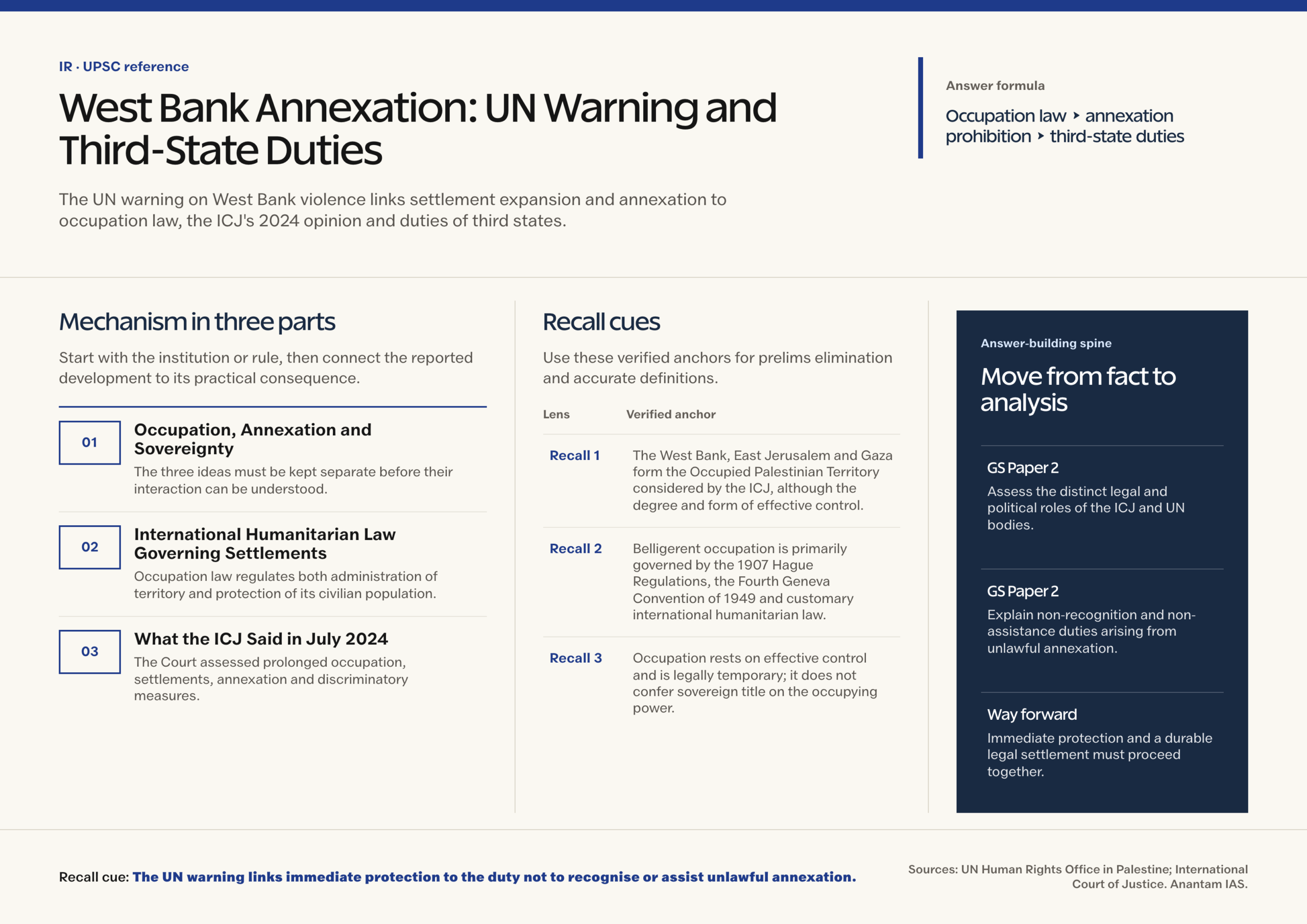
- The West Bank, East Jerusalem and Gaza form the Occupied Palestinian Territory considered by the ICJ, although the degree and form of effective control differ across them.
- Belligerent occupation is primarily governed by the 1907 Hague Regulations, the Fourth Geneva Convention of 1949 and customary international humanitarian law.
- Occupation rests on effective control and is legally temporary; it does not confer sovereign title on the occupying power.
- Article 49(6) of the Fourth Geneva Convention prohibits an occupying power from deporting or transferring parts of its own civilian population into occupied territory.
- Article 47 of the Fourth Geneva Convention protects occupied persons from losing Convention safeguards because of annexation or institutional changes introduced by the occupier.
- UN Security Council Resolution 2334 (2016) states that Israeli settlements in Palestinian territory occupied since 1967, including East Jerusalem, have no legal validity and are a flagrant violation under international law.
Mains Relevance
GS Paper 2
- Assess how the ICJ, Security Council, General Assembly and UN human-rights mechanisms perform different legal and political functions in the Israel-Palestine question.
- Explain India’s interest in a rules-based order, Palestinian self-determination, Israeli security and a negotiated two-state solution without treating these concerns as mutually exclusive.
Essay
- A prolonged temporary arrangement can become a method of permanent control when law is not matched by enforcement.
Background and Context
Occupation, Annexation and Sovereignty
The three ideas must be kept separate before their interaction can be understood.
- Occupation is the factual exercise of authority by a hostile army over foreign territory. It can trigger duties even without a lawful claim to sovereignty and even when control is exercised through a combination of military.
- De jure annexation is a formal claim to absorb territory. De facto annexation describes measures that permanently integrate territory without a single formal declaration, such as extending domestic law, transferring civilian population, appropriating land and building.
- The law of occupation permits temporary administration for security and the welfare of the local population; it does not allow the occupier to convert control into territorial title. The prohibition on acquisition of territory by force.
International Humanitarian Law Governing Settlements
Occupation law regulates both administration of territory and protection of its civilian population.
- Under the Fourth Geneva Convention, protected civilians must be treated humanely. Collective penalties, pillage, unlawful destruction and forcible transfers are prohibited subject to the precise elements and exceptions in the Convention.
- Article 49(6) bars the occupying power from transferring parts of its own civilian population into occupied territory. The ICJ and Security Council have treated Israeli settlement policy as contrary to this rule.
- Private perpetrators remain individually responsible for violence. State responsibility may also arise where officials participate, direct, support, fail to exercise due diligence or leave serious abuses uninvestigated, depending on the applicable attribution and human-rights standards.
What the ICJ Said in July 2024
The Court assessed the legal consequences of prolonged occupation, settlements, annexation and discriminatory measures across the Occupied Palestinian Territory.
- The ICJ found that Israel’s continued presence in the Occupied Palestinian Territory was unlawful because policies and practices violated the prohibition on acquiring territory by force and obstructed the Palestinian people’s right to self-determination.
- It stated that Israel must end that unlawful presence as rapidly as possible, cease all new settlement activity, evacuate settlers and make reparation for damage caused by internationally wrongful acts.
- The opinion was advisory, not a directly enforceable damages judgment. Its legal reasoning still carries major authority, while implementation depends on states, UN organs, domestic institutions and political processes.
Third-State Duties: Non-Recognition and Non-Assistance
The legal consequences do not stop with the state directly responsible for the unlawful situation.
- The ICJ said all states must not recognize as legal the situation arising from Israel’s unlawful presence and must not render aid or assistance in maintaining it. These duties reflect the special consequences attached to serious.
- States must distinguish, in their dealings with Israel, between Israeli territory and the Palestinian territory occupied since 1967. Security Council Resolution 2334 had already called on states to make this distinction.
- Non-recognition does not require denying Israel’s statehood or ending every bilateral relationship. Its focus is avoiding conduct that treats sovereignty over occupied territory or the resulting settlement situation as lawful.
Way Forward
Protect Civilians and Establish Accountability
- Israeli authorities should prevent attacks, protect all civilians without discrimination, investigate alleged settler and security-force abuses independently, prosecute where evidence supports charges and provide effective remedies.
- Palestinian armed actors and individuals must also comply with international law; attacks on civilians cannot be justified as retaliation for occupation or settlement violence.
- Freeze new settlement and outpost activity, prevent seizure or destruction of property, and address unlawful settlement structures in line with the ICJ opinion and applicable international law.
- Reject formal annexation and administrative measures that amount to permanent integration, including discriminatory land, planning and legal systems that fragment Palestinian territory.
Conclusion
- The UN warning is not only a report about another spike in West Bank violence.
- The 2024 ICJ opinion places responsibility at three levels: Israel must end unlawful policies and protect civilians; perpetrators must face lawful accountability; and third states must avoid recognition or assistance.
UPSC Practice Questions
Prelims MCQ 1
With reference to the law of belligerent occupation, consider the following statements:
- Occupation by itself transfers sovereignty over the territory to the occupying power.
- The Fourth Geneva Convention prohibits an occupying power from transferring parts of its own civilian population into occupied territory.
- Annexation does not deprive protected persons in occupied territory of the Convention’s protections.
How many of the above statements are correct?
(a) Only one (b) Only two (c) All three (d) None
Answer: (b) Only two
Explanation:
Statements 2 and 3 are correct. Article 49(6) governs transfer of the occupier’s civilian population, while Article 47 preserves Convention protection despite annexation or institutional change. Occupation does not transfer sovereign title.
Prelims MCQ 2
Which one of the following best describes a duty of third states identified by the ICJ’s 2024 advisory opinion on the Occupied Palestinian Territory?
(a) To recognize every administrative act of the occupying power until a peace treaty is signed (b) To terminate all diplomatic relations with Israel regardless of their territorial scope (c) To distinguish in their dealings between Israel and the Palestinian territory occupied since 1967 (d) To enforce individual criminal liability through the International Court of Justice
Answer: (c) To distinguish in their dealings between Israel and the Palestinian territory occupied since 1967
Explanation:
The Court identified non-recognition, non-assistance and territorial differentiation duties. It did not require universal termination of relations, and the ICJ is not a criminal court.
UPSC Mains Questions
- The distinction between occupation and annexation is central to preserving the prohibition on acquisition of territory by force. Explain with reference to the occupied West Bank and the ICJ’s 2024 advisory opinion. (250 words)
- What do the duties of non-recognition and non-assistance require from third states in an unlawful territorial situation? Discuss their practical relevance for diplomacy and economic relations. (250 words)
Sources: UN Human Rights Office in Palestine and International Court of Justice.
Frequently Asked Questions
What did the UN say about West Bank violence in July 2026?
The UN Human Rights Office said settler violence, settlement and outpost creation, property destruction and movement restrictions were worsening. It reported recent deaths of Palestinians and Israeli soldiers and urged third states to act collectively. Allegations concerning particular attacks still.
What is the difference between occupation and annexation?
Occupation is effective control of foreign territory during armed conflict and is legally temporary. It does not transfer sovereignty. Annexation is the claimed permanent incorporation of territory, either formally or through measures that integrate land, law, infrastructure and population. Territory.
Why are Israeli settlements considered illegal under international law?
Article 49(6) of the Fourth Geneva Convention prohibits an occupying power from transferring parts of its civilian population into occupied territory. The ICJ and UN Security Council Resolution 2334 have applied this rule to Israeli settlements in territory occupied since.
Is the ICJ’s 2024 advisory opinion legally binding?
An advisory opinion is not binding in the same manner as a judgment between states in a contentious case. It remains an authoritative judicial statement of international law. Its implementation relies on states, UN organs, domestic institutions and other lawful.
What are third-state duties in this context?
Third states must not recognize as lawful the situation arising from the unlawful presence, must not aid or assist its maintenance, and must distinguish between Israel and the territories occupied since 1967 in their dealings. The application to trade, finance.