Western Dedicated Freight Corridor
Why in News?
Recently, the remaining three sections of the Western Dedicated Freight Corridor (WDFC) were inaugurated, marking its completion. These sections cover 326 route kilometres, developed at over ₹20,700 crore. They include-
- New Sanand North (Gujarat)- New Makarpura (Gujarat)
- New Umbergaon (Gujarat)- New Saphale (Maharashtra)
- New Saphale (Maharashtra) -New JNPT (Maharashtra)
| UPSC Relevance: GS-3 Economy: Infrastructure Prelims: Western Dedicated Freight Corridor, Eastern Dedicated Freight Corridor Mains: Dedicated Freight Corridor: Significance and Policy Measures |
Together, the 1,506-km Western Dedicated Freight Corridor (WDFC) and 1,337-km Eastern Dedicated Freight Corridor (EDFC) constitute the completed 2,843-km network. Further corridors remain proposed or under development.
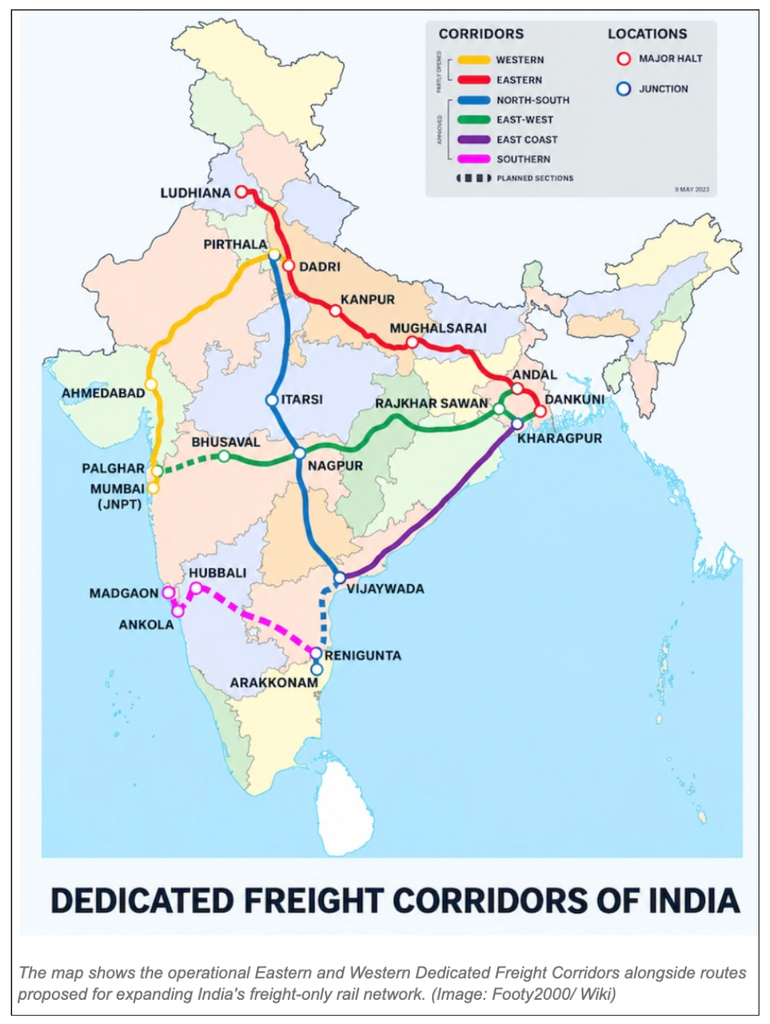
What is a Dedicated Freight Corridor?
- A Dedicated Freight Corridor is a railway line built specifically to transport goods, with infrastructure suited to heavier loads, longer trains, and reliable freight movement.
- On conventional railway lines, passenger and freight trains share tracks. Differences in their speeds, frequent passenger stops and scheduling priorities constrain capacity. Separating freight traffic allows both networks to operate more efficiently.
- The implementing agency is the Dedicated Freight Corridor Corporation of India Limited (DFCCIL), under the Ministry of Railways.
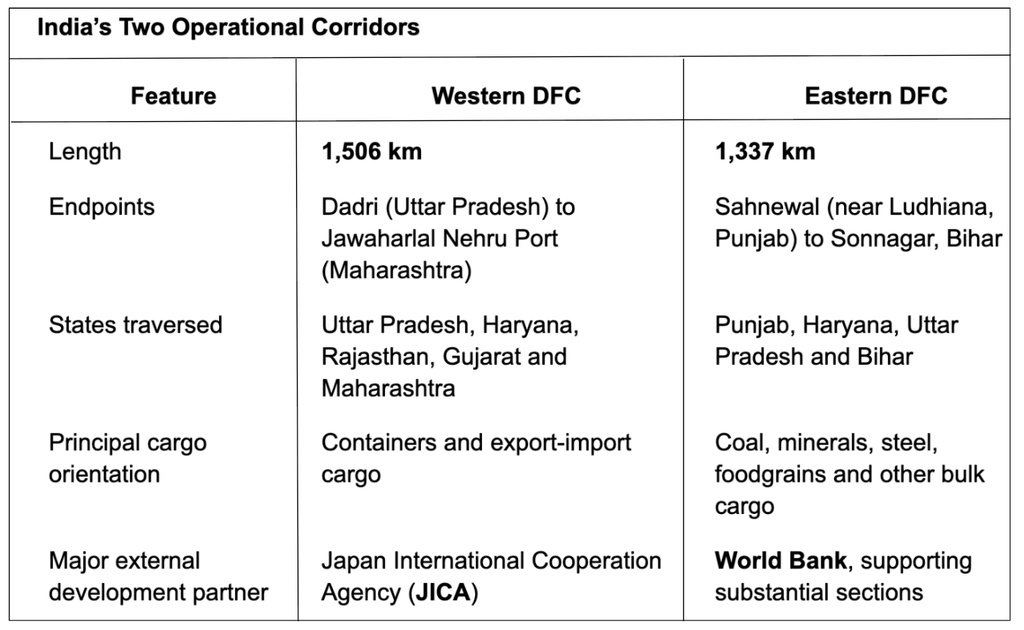
The corridors connect northern industrial and consumption centres with western ports and eastern resource-producing regions.
Note: The original EDFC proposal extended to Dankuni, West Bengal, but the completed 1,337-km corridor terminates at Sonnagar, Bihar.
What makes the WDFC technologically significant?
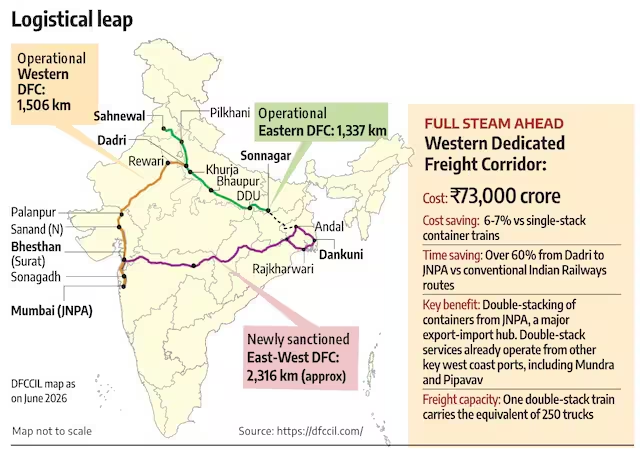
WDFC is the world’s first high-capacity railway corridor designed and built for routine, heavy-haul, double-stack container train operations at speeds up to 100 km/h.
- Electrified double-stack operations: Two containers are stacked vertically on a wagon, increasing carrying capacity without proportionately increasing train length.
- High-rise overhead equipment: Wires approximately 7.5 metres above the track, together with high-reach pantographs, provide clearance for stacked containers while supplying electricity.
- Heavy-haul infrastructure: Provision for 25-tonne axle loads, with infrastructure designed for higher loads, enables more cargo per wagon.
- Longer and faster trains: Infrastructure accommodates trains up to 1.5 km long, with a maximum freight operating speed of 100 km/h.
- Powerful locomotives: The 12,000-HP WAG-12B, manufactured at Madhepura, Bihar, supports heavy freight movement and uses regenerative braking to recover energy.
The completion of the WDFC makes India the world’s only country with a fully electrified dedicated freight corridor built for routine double-stack container operations.
Why Dedicated Freight Corridors Matter?
- Lower logistics and inventory costs: Faster, predictable deliveries can reduce warehouse holding, demurrage and the working capital tied up in goods in transit. Reliability helps manufacturers plan production and meet shipping schedules. India’s estimated logistics cost is 7.97% of GDP for 2023-24.
- Stronger export competitiveness: Direct connectivity to Jawaharlal Nehru Port improves movement between industrial centres and international shipping networks, particularly for containerised exports and imports.
- Industrial development along corridors: Freight access can attract manufacturing, warehouses and logistics parks. Integration with the Delhi-Mumbai Industrial Corridor and Amritsar-Kolkata Industrial Corridor connects transport investment with industrial development.
- Capacity for passenger services: Moving freight onto dedicated tracks releases capacity on existing lines. Actual improvements in passenger frequency and punctuality depend on subsequent scheduling and investment decisions.
- Cleaner freight movement: Shifting suitable long-distance cargo from trucks to electrified rail can reduce emissions and dependence on diesel. The World Bank estimates that rail freight emits approximately one-fifth of trucks’ greenhouse-gas emissions, although outcomes vary with operating conditions and electricity sources.
- Agricultural market access: Reliable transport can support foodgrain movement and processed-food distribution. Perishable produce additionally requires refrigerated containers, cold storage and efficient loading facilities.
- Regional integration: Improved connectivity can help inland firms access ports and larger markets, while generating opportunities in warehousing, maintenance and cargo handling.
Indian Railways’ freight loading reached 1,670 million tonnes in 2025-26.
Policy Linkages and Way Forward
- Integrate infrastructure through PM GatiShakti: Coordinate corridor links with ports, highways, warehouses and industrial areas; complete terminal connections alongside main railway infrastructure.
- Implement the National Logistics Policy, 2022: Use the Unified Logistics Interface Platform (ULIP) and coordinated procedures to improve cargo visibility and reduce documentation friction.
- Expand accessible cargo terminals: Develop Gati Shakti Multi-Modal Cargo Terminals, common-user warehouses and aggregation facilities that allow smaller firms to access rail logistics.
- Build dependable door-to-door services: Offer scheduled departures, transparent tariffs and coordinated road-rail delivery, with performance measured by total delivery time.
- Strengthen sustainability and resilience: Combine cleaner electricity, efficient locomotives and higher wagon utilisation with flood-resilient drainage and heat-resilient infrastructure.
- Expand on demonstrated demand: Budget 2026-27 announced a 2,052-km Dankuni-Surat DFC, intended to connect eastern production centres with western ports through integration with the WDFC. Its benefits depend on sound appraisal and timely terminal development.
The next policy priority is to translate completed tracks into affordable, reliable and accessible door-to-door logistics, particularly for manufacturers, farmers and smaller enterprises.
UPSC Mains Practice Question:
Q. Dedicated Freight Corridors can strengthen India’s industrial competitiveness, but their benefits depend on integration with the wider logistics ecosystem. Discuss.
UPSC Prelims Practice MCQ:
Q. With reference to the Western Dedicated Freight Corridor (WDFC), consider the following statements:
1. It connects Dadri in Uttar Pradesh with Jawaharlal Nehru Port in Maharashtra.
2. It facilitates double-stack container train operations using electric traction.
3. The World Bank is its principal external financing partner of WDFC.
Which of the statements given above are correct?
(a) 1 and 2 only
(b) 2 and 3 only
(c) 1 and 3 only
(d) 1, 2 and 3
Answer: (a) 1 and 2 only
Explanation:
- Statement 1 is correct: The 1,506-km WDFC connects Dadri with Jawaharlal Nehru Port. It traverses Uttar Pradesh, Haryana, Rajasthan, Gujarat and Maharashtra.
- Statement 2 is correct: High-rise overhead wires and high-reach pantographs enable electrically hauled trains to carry containers stacked one above another.
- Statement 3 is incorrect: JICA (Japan) is the WDFC’s major external financing partner. The World Bank has supported substantial sections of the Eastern Dedicated Freight Corridor.