Western Disturbance linked to Nepal Flash Flood
Why in News?
A western disturbance (WD) that brought rainfall to northern India and subsequently moved eastwards towards the Himalayas may have contributed to the weather conditions preceding the devastating flash flood along the Trishuli River in Nepal’s Nuwakot district.
However, the India Meteorological Department (IMD) has cautioned that the WD should be treated only as a possible contributor to the broader rainfall environment, not as the established direct cause of the disaster.
Nepal and China are investigating whether an earthquake, landslide or ice avalanche triggered the sudden release of water.
| UPSC Relevance: GS-1 Physical Geography: Western Disturbances and Himalayan Climate; GS-3 Disaster Management Prelims: Western disturbances, subtropical westerly jet, flash floods Mains: Weather-system interaction and cascading disaster risks in the Himalayas |
What may have caused the Flood?
The precise sequence of events remains under investigation. Several interacting factors may have produced a cascading disaster:
- Persistent rainfall: The World Meteorological Centre, Beijing, reported nearly 10 days of continuous rainfall along Nepal’s southern Himalayan foothills.
- Upstream rainfall: Southern Tibet, located upstream of northern Nepal, received moderate to heavy rainfall with localised intense downpours.
- Western disturbance: The eastward-moving WD enhanced rainfall over the Himalayan and northeastern regions.
- Monsoon depression: A depression over northern India supplied additional moisture and was expected to sustain rainfall over Nepal.
- Earthquake or slope failure: Preliminary reports suggested that an earthquake may have triggered a landslide or ice avalanche.
- Temporary river blockage: An avalanche may have dammed the river, causing water to accumulate before the natural barrier suddenly breached, producing a flash flood and debris flow downstream.
The region’s steep slopes, narrow valleys and unstable geology could have amplified the impact. There is presently insufficient evidence to classify the event as a cloudburst.
What is a Western Disturbance?
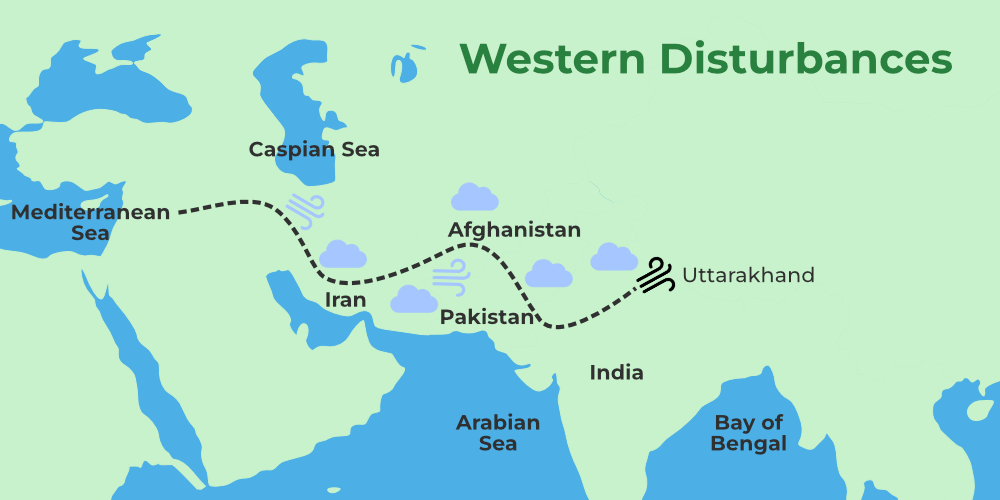
Western disturbances are eastward-moving extra-tropical weather systems that originate largely over the Mediterranean-West Asian region and travel towards the Indian subcontinent.
- They generally appear as upper-air troughs or cyclonic circulations.
- They form through interactions between cold polar and relatively warm tropical air masses.
- They are steered eastwards by the subtropical westerly jet stream.
- They collect moisture from the Mediterranean, Black and Caspian seas and, occasionally, the Arabian Sea.
- They are most frequent and influential over India between December and March, though they can occur in other seasons as well.
They are called western disturbances because they approach India from the west and disturb the prevailing weather conditions.
Interaction with other weather systems & Importance:
- A Western Disturbance may interact with Arabian Sea moisture, easterly winds, monsoon depressions, local convection, and Himalayan topography. Such interactions may produce rainfall far more intense than that generated by either system independently.
- Importance for India: WD provide-
- Essential winter rainfall to Punjab, Haryana, Rajasthan, western Uttar Pradesh and adjoining areas which benefits rabi crops.
- Principal source of winter snow over the western Himalayas which supports glaciers, seasonal snowpack, spring and summer river flows.
- Temperature regulation: Cloud cover and rainfall may reduce daytime temperatures, while the passage of a WD is often followed by cold north-westerly winds, cold waves and fog.
Western Disturbances as Disaster Triggers:
- Although agriculturally beneficial, strong or interacting WDs can generate serious hazards:
- intense rainfall and flash floods
- landslides and debris flows
- heavy snowfall and avalanches
- hailstorms and crop damage
- cloudbursts under favourable local conditions
- urban flooding; and
- disruption of roads, power and communication networks.
- The risks become particularly acute when a WD interacts with a monsoon system. Moisture convergence, unstable slopes and saturated catchments can transform prolonged rainfall into a compound or cascading disaster.
Western Disturbances & Climate-Change Dimension:
- The relationship between climate change and the frequency of WDs remains scientifically complex. However, a warmer atmosphere can hold more moisture, increasing the potential for intense precipitation when favourable weather systems interact.
- Even where a WD is not the immediate cause, it can contribute to the environmental conditions that make floods, landslides or avalanches more likely.
The Nepal flood demonstrates how western disturbances, monsoon systems, upstream rainfall and unstable Himalayan terrain may interact to produce cascading disasters.
It also underlines the need to avoid simplistic attribution: the WD may have created favourable rainfall conditions, while the immediate trigger could have been an earthquake, avalanche, landslide or temporary river blockage.
Hence, Climate-resilient Himalayan development requires stronger scientific monitoring, transboundary cooperation and multi-hazard early-warning systems.
Practice Question:
Q. Western disturbances are both climatic lifelines and potential triggers of cascading disasters in the Himalayan region. Explain their origin and movement, and examine how their interaction with monsoon systems and mountain topography can intensify disaster risks. (10 Marks)