Western Ghats ESA: Sixth Draft Notification and the States’ Standoff
Why in News?
The Union Ministry of Environment, Forest and Climate Change has issued a fresh draft notification proposing to declare over 56,800 sq km of the Western Ghats as an Ecologically Sensitive Area (ESA) across six states, inviting public suggestions and objections within 60 days. As reported by News on AIR (Akashvani), the area spans Gujarat, Maharashtra, Goa, Karnataka, Kerala and Tamil Nadu.
This is the sixth draft in a saga that began in 2014, repeatedly stalled by state objections. The Indian Express notes that the protected area, classifying roughly 37% of the Western Ghats as ESA, rests on the diluted Kasturirangan (HLWG) formula rather than the wider Gadgil panel proposal, keeping the conservation-versus-livelihood debate alive.
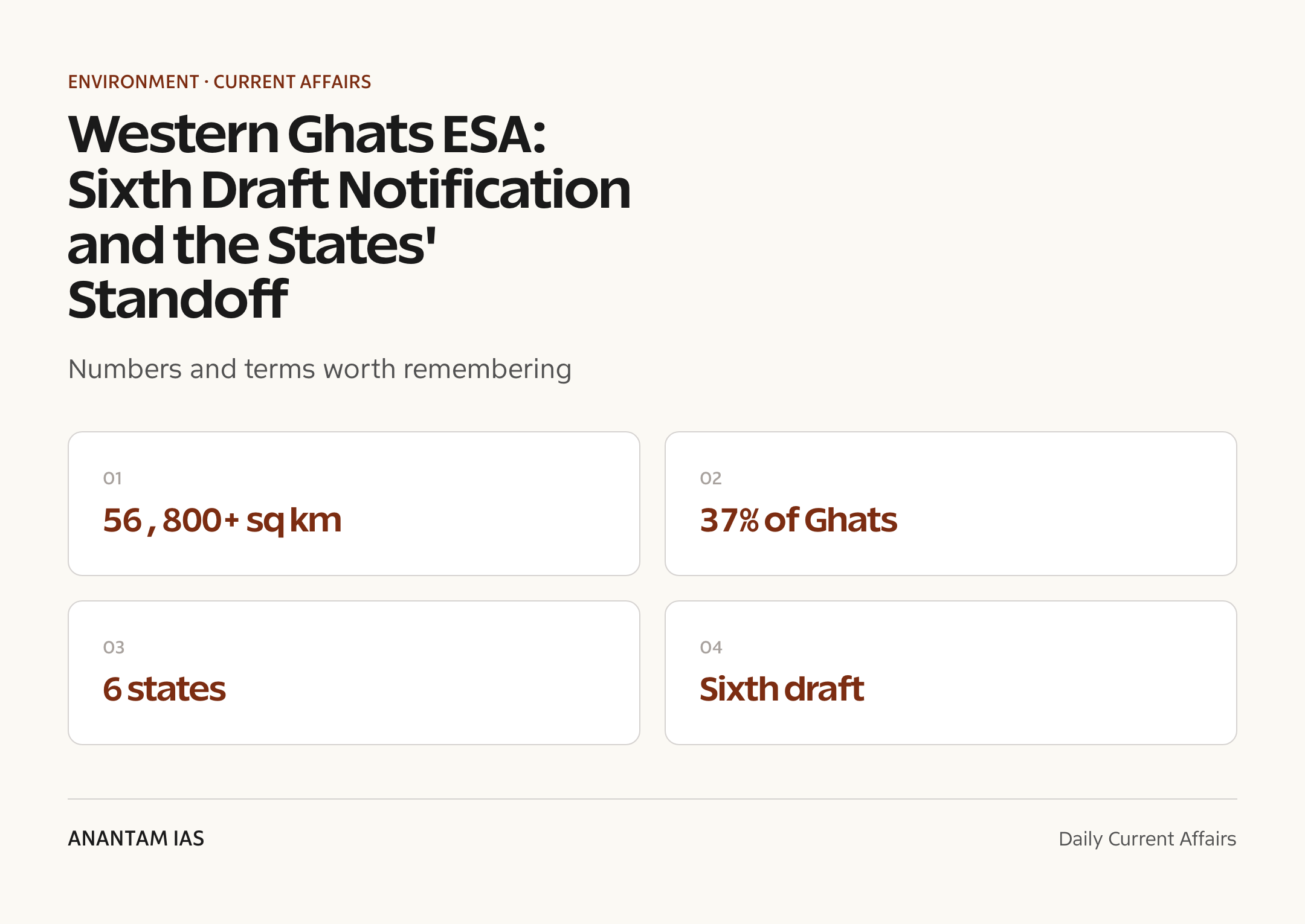
- Sixth draft ESA notification covers over 56,800 sq km (about 37% of the Western Ghats) across six states.
- Issued under the Environment (Protection) Act, 1986; public objections invited within a 60-day window.
- Rests on the Kasturirangan (HLWG) formula, not the broader Gadgil (WGEEP) recommendations.
- Gujarat is the only state to grant final consent; other states have raised reservations or opposed.
- ESA status restricts mining, quarrying and large-scale infrastructure in the demarcated zone.
The development matters in the context of:
- The trigger for the original review was the 2018 Kerala floods and recurring landslides, which sharpened the ecological case for protection.
- Previous drafts repeatedly lapsed without final notification, forcing the Centre to re-issue the proposal.
UPSC Relevance
Prelims Relevance
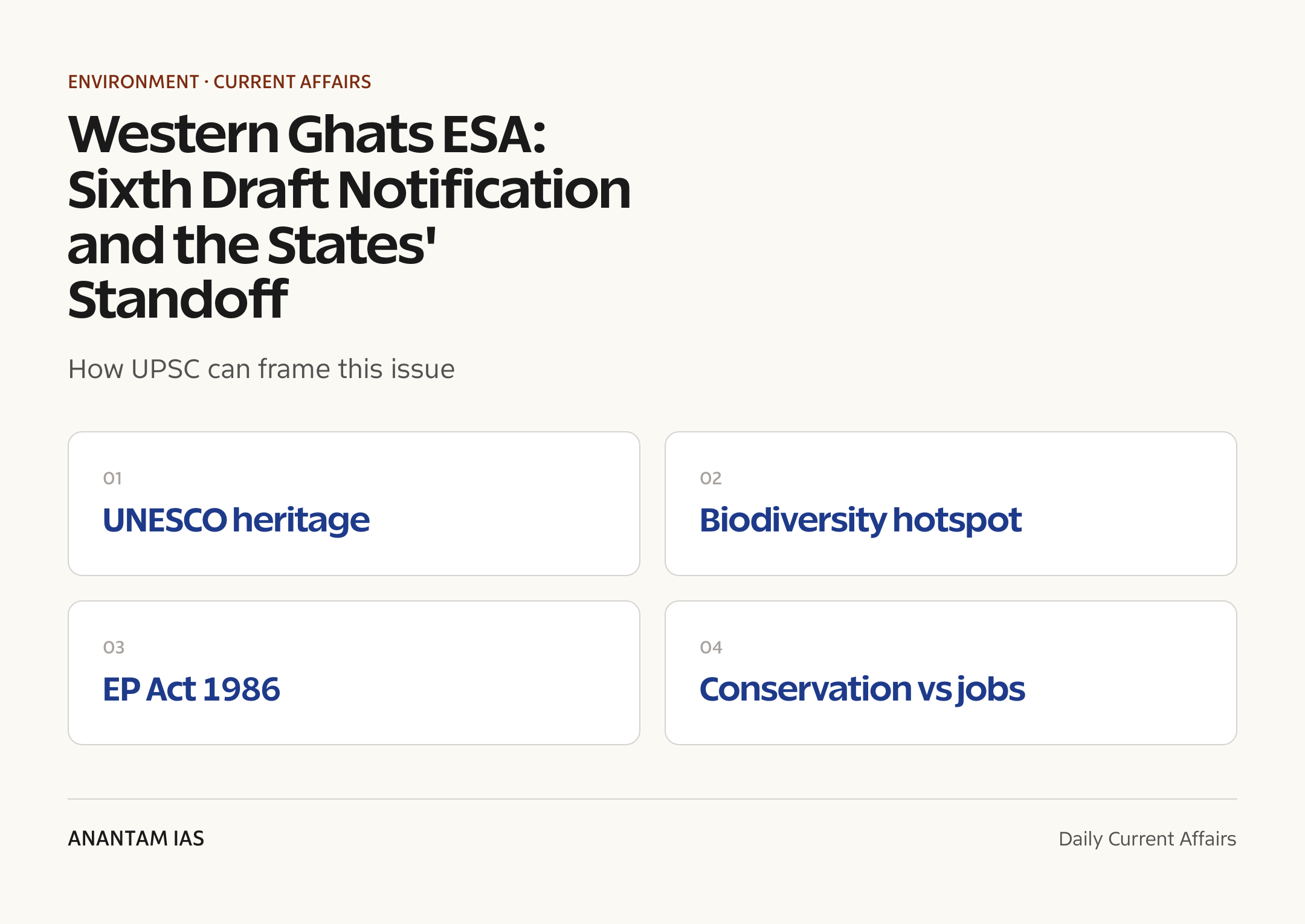
- The Western Ghats is one of India’s two mainland biodiversity hotspots (the other being the Himalaya) and a UNESCO World Heritage natural site.
- The range runs across six states: Gujarat, Maharashtra, Goa, Karnataka, Kerala and Tamil Nadu.
- Ecologically Sensitive Areas (ESAs) are notified under the Environment (Protection) Act, 1986.
- The Gadgil Committee (WGEEP, 2011) recommended treating a large share (about two-thirds) of the Ghats as ecologically sensitive in graded zones.
- The Kasturirangan Committee (HLWG, 2013) diluted this to roughly 37% of the Ghats as a single ESA.
- The current draft proposes about 56,800 sq km as ESA, based on the Kasturirangan formula.
- The Western Ghats predate the Himalaya and are older than the formation of the present land mass of the subcontinent.
- Key rivers such as the Godavari, Krishna, Kaveri and others originate in the Western Ghats.
Mains Relevance
GS Paper 3
- ESA notification as a tool of conservation under the Environment (Protection) Act, 1986, and its limits.
- Conservation-versus-livelihood trade-offs in ecologically fragile regions.
- Disaster vulnerability: how ecological degradation in the Ghats links to floods and landslides.
GS Paper 2
- Centre-state friction in environmental governance and the working of cooperative federalism.
- Role of expert committees and public consultation in environmental policymaking.
Essay
- Sustainable development and the ecology-versus-economy balance
- “Development must be in harmony with nature”
- Conservation, federalism and the rights of local communities
Background and Context
The Western Ghats: why they matter
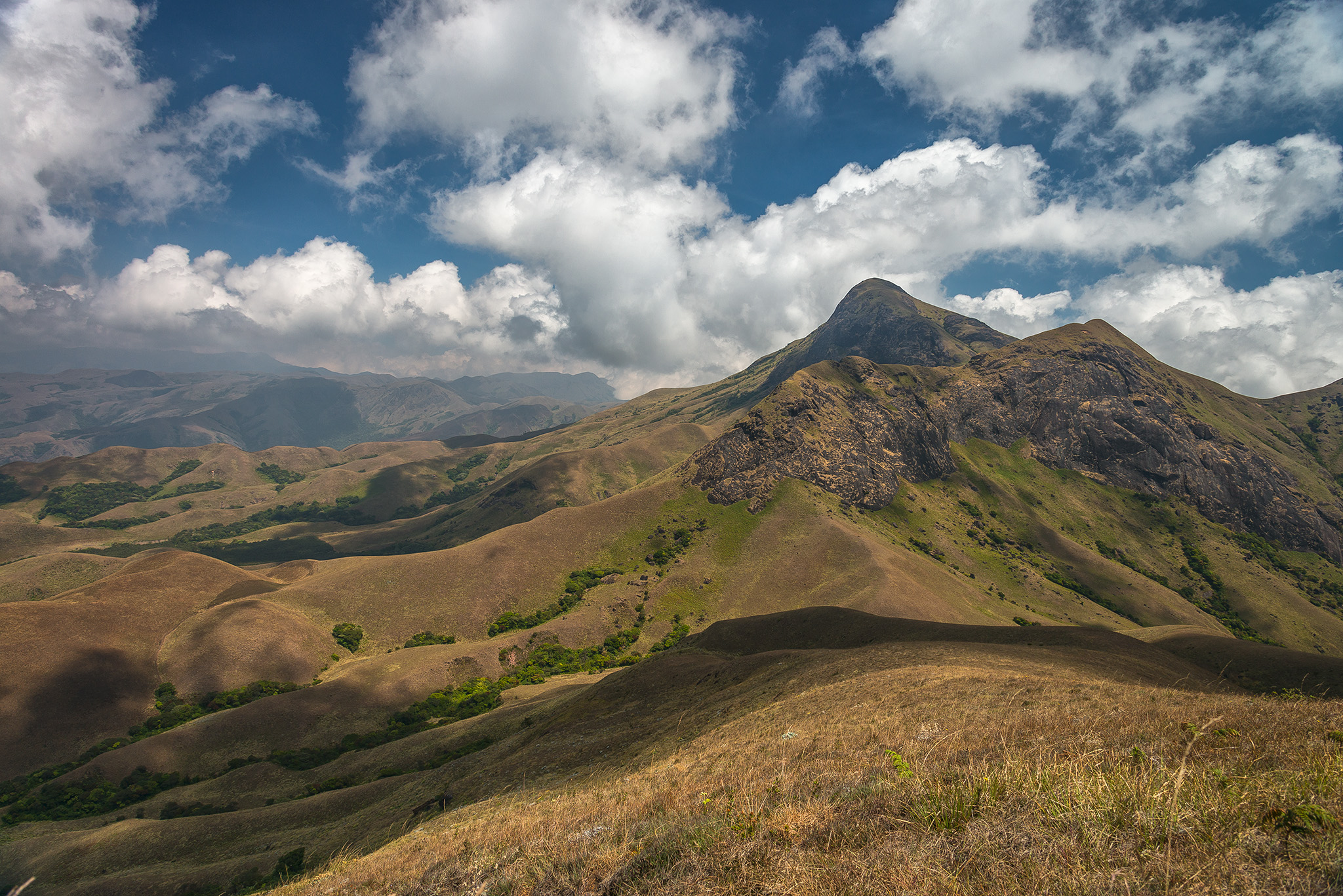
A narrow, ancient mountain chain that anchors peninsular India’s ecology and water security.
- Stretch roughly 1,600 km along the western coast across six states, recognised as a UNESCO World Heritage site.
- One of the world’s biodiversity hotspots, with very high endemism in plants, amphibians and freshwater fish.
- Source of major peninsular rivers feeding agriculture and drinking water for millions.
- Influence the southwest monsoon by intercepting rain-bearing winds along the coast.
Gadgil (WGEEP) versus Kasturirangan (HLWG)
Two expert panels reached very different conclusions on how much of the Ghats to protect.
- The Western Ghats Ecology Expert Panel under Madhav Gadgil (2011) recommended treating a large share of the Ghats as ecologically sensitive, with graded ESZ-1, ESZ-2 and ESZ-3 zones and strong local-body (gram sabha) say.
- States and industry called the Gadgil report too restrictive, fearing curbs on farming, plantations and development.
- The High Level Working Group under K. Kasturirangan (2013) diluted this, proposing roughly 37% of the Ghats (largely natural landscape) as a single ESA while leaving cultural landscapes out.
- Critics argue the Kasturirangan approach weakened protection; many states still found even this version unacceptable.
The draft-notification saga
A demarcation exercise that has been re-issued repeatedly without ever being finalised.
- The first draft ESA notification was issued in 2014 on the Kasturirangan basis.
- It has since gone through several revisions as successive drafts lapsed without final notification, the latest being the sixth.
- The current draft proposes over 56,800 sq km as ESA and reopens a 60-day window for public objections.
- Inside the ESA, activities such as mining, quarrying and large infrastructure face restrictions, while existing villages and farming are largely accommodated.
The states' standoff
Consensus across six states has proved elusive for more than a decade.
- Gujarat is the only state to have granted final consent to the ESA within its jurisdiction.
- Other states have raised reservations or opposition, seeking exclusion of inhabited and plantation areas.
- Opposition is rooted in fears over livelihoods, mining and quarrying revenue, and local development.
- The Indian Express reports that states have at times called both the Gadgil and Kasturirangan reports ‘unscientific’.
Federalism and the livelihood question
The dispute is a textbook case of central environmental authority meeting state-level economic anxiety.
- Environment is on the Concurrent List, but land and local development are largely state subjects, creating friction.
- Communities in the Ghats depend on agriculture, plantations, tourism and small-scale extraction.
- Ecologists warn that unchecked construction and quarrying worsen landslides and flash floods, as seen in Kerala.
- The core challenge is designing protection that secures the ecosystem without pushing local livelihoods into crisis.
Way Forward
Resolve the standoff through genuine cooperative federalism: ground-truthed, village-level demarcation done jointly with state governments rather than imposed from above.
Pair restrictions with livelihood support for affected communities, such as eco-tourism, sustainable plantation practices and payments for ecosystem services, so conservation is not seen as anti-people.
Conclusion
The sixth draft notification underlines a hard truth: protecting the Western Ghats is less a scientific problem than a problem of trust and federal bargaining. The ecology is unambiguous, yet a workable map has eluded the Centre and six states for over a decade.
A durable settlement will rest on transparent demarcation, credible compensation for those who bear the cost of conservation, and the recognition that the Ghats’ rivers, rains and resilience underpin the very livelihoods the dispute is meant to protect.
UPSC Practice Questions
Prelims MCQ 1
With reference to the Western Ghats, consider the following statements: 1. The Western Ghats run across six Indian states. 2. The Western Ghats are recognised as a UNESCO World Heritage natural site. 3. They are one of India’s biodiversity hotspots. Which of the statements given above are correct?
1 and 2 only 2 and 3 only 1 and 3 only 1, 2 and 3
Answer: 1, 2 and 3
Explanation:
The Western Ghats span Gujarat, Maharashtra, Goa, Karnataka, Kerala and Tamil Nadu, are a UNESCO World Heritage site, and are a recognised global biodiversity hotspot. All three statements are correct.
Prelims MCQ 2
Consider the following statements about the Ecologically Sensitive Area (ESA) proposal for the Western Ghats: 1. The current draft notification is based on the recommendations of the Kasturirangan (High Level Working Group). 2. ESAs are notified under the Environment (Protection) Act, 1986. 3. The Gadgil Committee recommended a smaller protected area than the Kasturirangan Committee. Which of the statements given above are correct?
1 and 2 only 2 and 3 only 1 and 3 only 1, 2 and 3
Answer: 1 and 2 only
Explanation:
The draft rests on the Kasturirangan formula (about 37% of the Ghats) and ESAs are notified under the Environment (Protection) Act, 1986. Statement 3 is wrong: the Gadgil panel recommended a far larger protected area than Kasturirangan, not a smaller one.
UPSC Mains Questions
- The repeated failure to notify the Western Ghats Ecologically Sensitive Area reflects a deeper crisis in India’s environmental federalism. Critically examine. (250 words)
- Compare the recommendations of the Gadgil and Kasturirangan committees on the Western Ghats. Which approach better balances conservation with livelihoods? (250 words)
- ‘Protecting ecologically fragile regions cannot succeed without securing the livelihoods of those who live there.’ Discuss in the context of the Western Ghats ESA. (150 words)
Sources: DD News / Akashvani (News on AIR) and The Indian Express (Explained).
Frequently Asked Questions
What is the Western Ghats ESA notification about?
It is a draft notification by the Union environment ministry proposing to declare over 56,800 sq km of the Western Ghats across six states as an Ecologically Sensitive Area, restricting activities like mining and quarrying. It is the sixth such draft.
Which six states are covered?
Gujarat, Maharashtra, Goa, Karnataka, Kerala and Tamil Nadu.
What is the difference between the Gadgil and Kasturirangan reports?
The Gadgil panel (2011) recommended protecting a large share of the Ghats in graded zones with strong local-body powers. The Kasturirangan panel (2013) diluted this to roughly 37% of the Ghats as a single ESA, which states still found hard to accept.
Why are states opposing the ESA?
States fear that restrictions on mining, quarrying, construction and development will hurt local livelihoods and revenue. So far, only Gujarat has given final consent within its jurisdiction.
Under which law are ESAs notified?
Ecologically Sensitive Areas are notified under the Environment (Protection) Act, 1986.
What restrictions apply inside an ESA?
Activities such as mining, quarrying and large-scale infrastructure or construction are restricted, while existing villages, farming and plantations are generally accommodated.