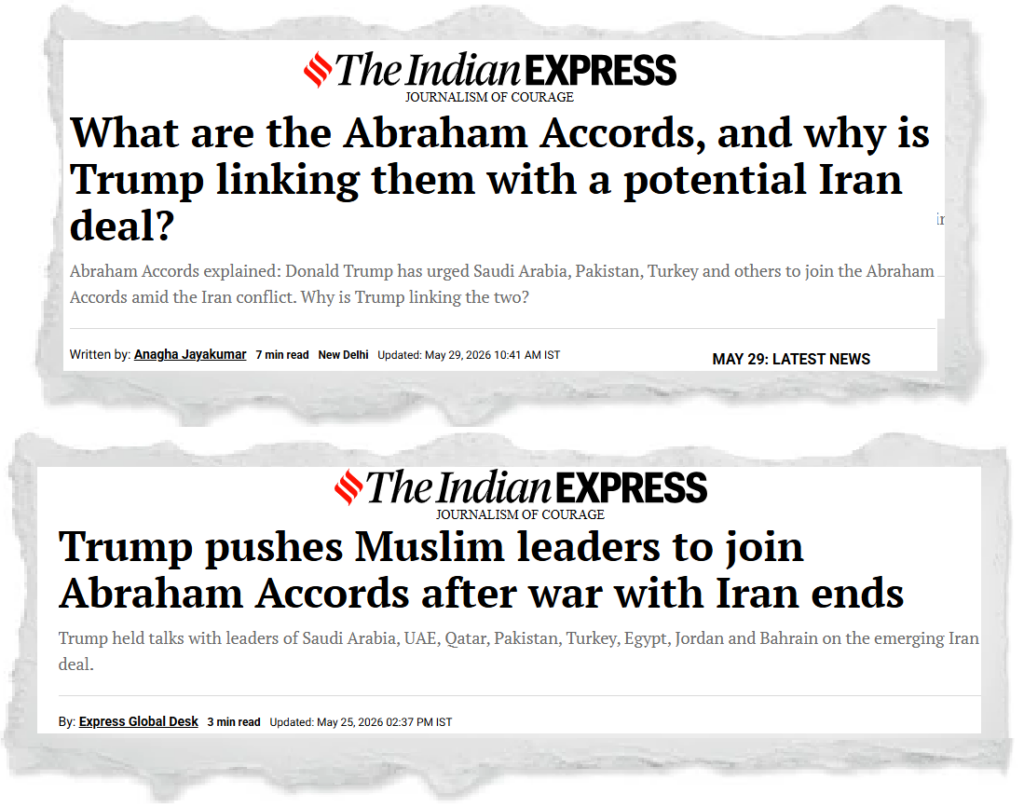
What are the Abraham Accords, and why is Trump linking them with a potential Iran deal?
Trump pushes Muslim leaders to join Abraham Accords after war with Iran ends
Why in News?
Donald Trump recently urged several Arab and Muslim-majority countries to normalise relations with Israel and join the Abraham Accords if a negotiated settlement to the ongoing Iran conflict is achieved.
The issue has revived debates regarding regional realignment in West Asia, the Palestinian question, Iran’s strategic role, and the future of U.S.-led diplomatic architecture in the region.
UPSC Relevance
Prelims: Abraham Accords, West Asia, Strait of Hormuz, Gulf Cooperation Council, two-state solution, Iran-Israel tensions.
Mains:
GS II – India’s relations with West Asia, geopolitical developments, international groupings, regional security; GS III – Energy security, global trade disruptions.
Background/Context
The Abraham Accords were introduced during Donald Trump’s first presidential term in 2020 as a diplomatic framework for normalisation of relations between Israel and several Arab states.
The accords represented a major geopolitical shift because many Arab nations had historically refused to formally recognise Israel after its establishment in 1948, primarily due to the unresolved Palestinian issue.
Recent attempts by the United States to expand the accords have emerged in the backdrop of:
- escalating tensions involving Iran,
- Israel’s continuing military operations in Gaza,
- instability across Lebanon and Syria,
- and growing concerns over regional security architecture.
What are the Abraham Accords?
Abraham Accords are a series of diplomatic normalisation agreements between Israel and certain Muslim-majority countries brokered by the United States.
The agreements are named after Abraham, a patriarch revered in Islam, Christianity and Judaism.
Objectives of the Accords
The accords aimed to:
- establish diplomatic relations between Israel and Arab states,
- promote economic and technological cooperation,
- strengthen regional security partnerships,
- and deepen U.S.-backed strategic alignment in West Asia.
Countries that joined the Accords
Countries that formally normalised relations with Israel include:
- United Arab Emirates
- Bahrain
- Morocco
Subsequently, additional countries such as Somaliland and Kazakhstan were also reported to have joined related frameworks.
Why is Saudi Arabia Important?
Saudi Arabia remains the most significant regional power yet to formally join the Abraham Accords.
Saudi Arabia has maintained that normalisation with Israel depends upon:
- ending the Gaza conflict,
- and establishing a credible pathway toward an independent Palestinian state under the two-state solution framework.
Thus, Saudi Arabia’s position has become central to any future regional diplomatic settlement.
Why is Trump Linking the Iran Conflict with the Abraham Accords?
Diplomatic consolidation strategy
The United States seeks to create a broader regional coalition integrating Israel more deeply into West Asia while counterbalancing Iranian influence.
Expanding the accords after a potential Iran settlement would strengthen this regional bloc.
Projection of diplomatic success
The Abraham Accords are widely viewed as one of Trump’s major foreign policy achievements during his first term. Reviving and expanding them allows him to project an image of strategic control and diplomatic success.
Managing domestic political pressures
The Iran conflict has generated domestic political concerns within the United States because of:
- rising fuel prices,
- inflationary pressures,
- fears of prolonged military involvement,
- and declining public approval ratings.
A diplomatic breakthrough through regional normalisation could politically offset these concerns.
Iran’s Central Role in West Asian Geopolitics
Iran plays a major strategic role in West Asia due to:
- its opposition to Israel,
- influence over regional non-state actors,
- energy geography,
- and its position near the Strait of Hormuz.
The Strait of Hormuz is critical because a substantial share of global oil and gas trade passes through it. Any disruption affects global energy prices and economic stability.
Palestinian Question and Criticism of the Accords
Bypassing Palestinian statehood
One of the major criticisms of the Abraham Accords is that they largely normalised relations with Israel without resolving the Palestinian issue.
Critics argue that this weakens the long-standing Arab consensus supporting Palestinian statehood before recognition of Israel.
Public anger in the Arab world
Israel’s military operations in Gaza, Lebanon and Syria have intensified public resentment across several Arab and Muslim-majority societies.
This makes overt normalisation politically difficult for many governments despite strategic ties with the United States.
Pakistan’s position
Pakistan rejected joining the accords, arguing that recognition of Israel without an independent Palestinian state conflicts with its stated foreign policy principles.
What are the Strategic Implications of Expanding the Accords?
Greater regional integration of Israel
Expansion of the accords would deepen Israel’s diplomatic, economic and security integration within West Asia.
Containment of Iranian influence
The framework effectively creates a strategic alignment among U.S.-allied countries aimed at balancing Iran’s regional influence.
Security and defence cooperation
The accords may facilitate:
- intelligence sharing, defence cooperation, technological partnerships and maritime security coordination.
Impact on regional power balance
If countries such as Saudi Arabia or Turkey eventually join, it could significantly reshape the geopolitical architecture of West Asia.
What are the Implications for India?
Energy security concerns
India depends heavily on energy imports from West Asia. Instability involving Iran or disruptions near the Strait of Hormuz directly affect India’s energy security and inflation levels.
Balancing regional partnerships
India maintains strong ties simultaneously with:
- Israel, Gulf countries, and Iran.
Therefore, India must carefully balance its diplomatic engagements amid evolving regional alignments.
Connectivity and trade implications
Regional stability influences:
- maritime trade routes, investment flows, and projects such as the India-Middle East-Europe Economic Corridor (IMEC).
Challenges to Expansion of the Abraham Accords
Palestinian issue remains unresolved
The absence of meaningful progress toward Palestinian statehood continues to limit wider regional acceptance.
Domestic political pressures in Arab countries
Public opinion in many Arab societies remains strongly sympathetic toward the Palestinian cause.
Regional instability
Conflicts in Gaza, Lebanon, Syria and tensions with Iran complicate diplomatic normalisation efforts.
Divergent strategic priorities
Countries in West Asia have differing security concerns and geopolitical calculations, making uniform alignment difficult.
Way Forward
Revive two-state negotiations
Long-term regional peace requires credible progress toward a viable Palestinian state alongside Israel.
Promote inclusive regional diplomacy
Security frameworks should incorporate broader regional interests rather than purely bloc-based alignments.
Reduce militarisation
Diplomatic engagement and de-escalation mechanisms are essential to prevent prolonged instability in West Asia.
Strengthen multilateral dialogue
Regional organisations and international actors must facilitate sustained negotiations involving all stakeholders.
Conclusion
The renewed push to expand the Abraham Accords reflects the rapidly evolving geopolitical landscape of West Asia where diplomacy, security and strategic alignments are becoming deeply interconnected. While the accords have strengthened Israel’s integration into parts of the Arab world, unresolved issues surrounding Palestine, Iran and regional security continue to limit broader acceptance. The future trajectory of the accords will significantly influence regional stability, global energy markets and the geopolitical balance of West Asia.
Practice Questions
Prelims Question 1 (Inference-based)
Consider the following statements with reference to the Abraham Accords:
I. The Abraham Accords seek to normalise diplomatic and strategic relations between Israel and certain Muslim-majority countries.
II. Expansion of the Abraham Accords is viewed by the United States as a means to strengthen a regional alignment involving Israel and U.S.-allied countries.
III. Continued instability surrounding the Palestinian issue complicates broader acceptance of the accords across West Asia.
Which of the following relationships among the above statements is/are correct?
- Statement II extends the geopolitical implications of Statement I by linking normalisation with regional strategic realignment.
- Statement III highlights a limitation affecting the broader implementation of the objectives reflected in Statement I.
- Statement I contradicts Statement III because diplomatic normalisation automatically resolves the Palestinian issue.
(a) 1 only
(b) 1 and 2
(c) 2 and 3
(d) 3 only
Answer: (b)
Explanation: Statement II expands upon the strategic implications of diplomatic normalisation mentioned in Statement I. Statement III identifies the unresolved Palestinian issue as a challenge to wider regional acceptance. Statement 3 is incorrect because normalisation has not automatically resolved Palestinian concerns.
Prelims Question 2 (Pairs-based)
Consider the following pairs:
| Entity | Significance |
|---|---|
| 1. Strait of Hormuz | Strategic maritime route for global oil trade |
| 2. Abraham Accords | Agreements aimed at normalisation between Israel and Arab states |
| 3. Two-state solution | Proposal for merger of Israel and Palestine into a single federal state |
Which of the pairs given above are correctly matched?
(a) 1 and 2 only
(b) 2 and 3 only
(c) 1 and 3 only
(d) 1, 2 and 3
Answer: (a)
Explanation: Pair 3 is incorrect because the two-state solution refers to the creation of an independent Palestinian state alongside Israel, not a single merged federal state.
Mains Questions
- Discuss the challenges faced in expanding the Abraham Accords in the context of the Palestinian issue and regional instability.
- Examine the geopolitical significance of the Abraham Accords in reshaping power dynamics in West Asia.