What is Keytruda and how does it work?
Why in News?
A major investigation has uncovered a widespread counterfeit market for Keytruda (a high-cost immunotherapy cancer drug) in India.
| UPSC Relevance: GS-3 Science and Technology: Biology and Biotechnology Prelims: Cancer treatment- key terminologies. |
| Back to Basics: Key Concepts |
| Cancer:Cancer is defined as a group of diseases involving abnormal, uncontrolled cell growth and division. This occurs due to DNA damage or mutations that interfere with the cell’s ability to regulate cell division. |
| Immunotherapy: A type of cancer treatment (or biological therapy) that empowers a person’s own immune system to recognise, target, and destroy cancer cells. While chemotherapy and radiotherapy directly kill cancer cells (and some healthy cells too), immunotherapy pushes the body’s own immune system to recognise and kill cancer cells. As immunotherapy is highly targeted, it spares healthy cells. |
| Antibody: Proteins produced by the immune system to neutralise any foreign substance entering the human body.An antibody attaches itself to an antigen (a foreign substance- usually a disease-causing molecule) and helps the immune system eliminate it from the body. |
| T-cells: T-cells are special cells (type of White Blood Cells) whose primary function is to attack and kill pathogens and foreign cells. |
| Monoclonal Antibodies: Laboratory-made molecules designed to bind with specific targets. |
What is Keytruda?
- Keytruda (pembrolizumab) is an immunotherapy drug manufactured by a US-based global pharma major for treating several cancers. It is used globally for skin cancer, lung cancer, cervical cancer, renal cell cancer and aggressive breast cancer.
- It belongs to the category of monoclonal antibodies, enabling the immune system to identify and destroy cancerous cells.
Working Mechanism:
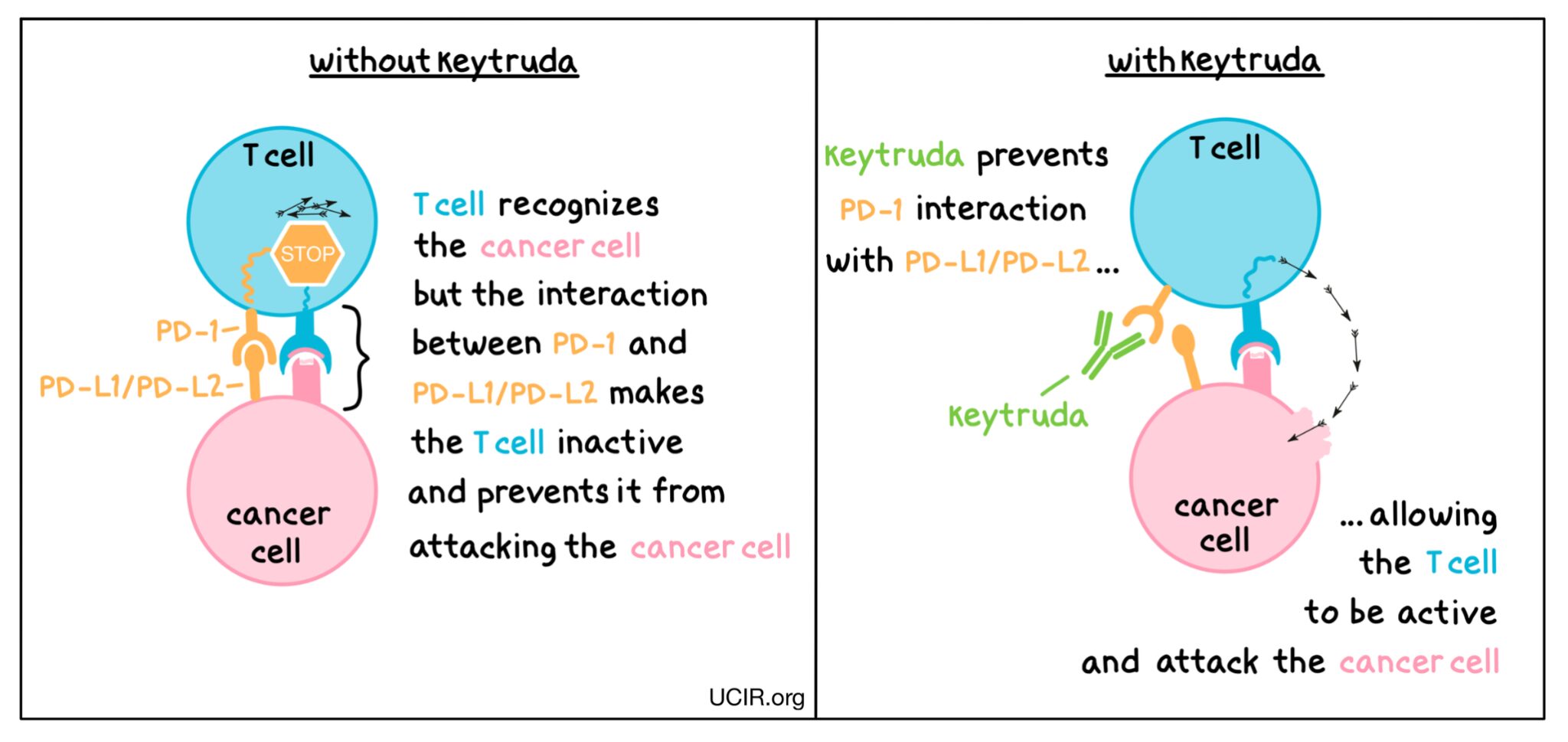
- It belongs to a class called checkpoint inhibitors — drugs that remove the brakes which were preventing the body’s T-cells from attacking cancerous cells.
- Pembrolizumab works by attaching to receptors called PD-1 on T-cells. This prevents the T-cells from binding to corresponding PD-L1 receptors on cancer cells. This lets the T-cells identify the abnormal cells and trigger an immune response.
Important Immunotherapy-based Cancer treatments:
- CAR-T cell therapy: Involves collecting a patient’s own T cells, engineering them to create chimeric receptors, multiplying these modified cells, and returning them to the patient. These engineered T-cells can then identify, attach to, and destroy cancer cells that would normally evade immune detection.
- mRNA vaccines for cancer are currently under development. Unlike vaccines for infections given to healthy individuals, cancer vaccines are administered to patients who already have certain cancers to prevent relapse. These vaccines train the immune system to identify proteins called neoantigens found only in cancer cells. Once recognised, the immune system remembers these markers for years, continuing to fight cancer and prevent recurrence.
UPSC PYQ 2022
Q. Which one of the following statements best describes the role of B-cells and T-cells in the human body?
(a) They protect the body from environmental allergens.
(b) They alleviate the body’s pain and inflammation.
(c) They act as immunosuppressants in the body.
(d) They protect the body from the diseases caused by pathogens.
Answer: (d)