What is Lost and Gained in NFHS-6?
Why in News?
The Union Ministry of Health and Family Welfare recently released the National Family Health Survey-6 (NFHS-6), 2023-24. The survey was conducted by the Ministry with the International Institute for Population Sciences (IIPS), Mumbai, as the nodal agency and covered nearly 6.79 lakh households across 715 districts.
NFHS-6 has sparked debate because the preliminary fact sheet lists 101 indicators, compared with 131 in NFHS-5, and several important indicators are absent.
| UPSC Relevance: GS-2 Social Justice: Health, Governance, Women and Child Development Prelims: National Family Health Survey-6: Key data & indicators |
What is NFHS?
- The National Family Health Survey is a large-scale, multi-round household survey that provides data on fertility, family planning, maternal and child health, nutrition, anaemia, mortality, women’s empowerment and other health indicators.
- Importance of NFHS: NFHS is a key survey for policy and programme purposes, as it provides:
- National, State and district-level estimates
- Comparable data across survey rounds
- Evidence for schemes such as Poshan Abhiyaan, Ayushman Bharat, Janani Suraksha Yojana, Mission Parivar Vikas and Anaemia Mukt Bharat
- Data for SDG monitoring, especially SDG 2, SDG 3, SDG 5 and SDG 6.
Key Gains recorded in NFHS-6:
- Progress in Maternal and Child Health: Pregnant women receiving antenatal care rose to 95.9%. Institutional deliveries increased from 88.6% to 90.6%, while births attended by skilled health personnel rose from 89.4% to 91.3%. This reflects the impact of schemes such as:
- Janani Suraksha Yojana
- Janani Shishu Suraksha Karyakram
- Pradhan Mantri Surakshit Matritva Abhiyan
- SUMAN
- PM Matru Vandana Yojana
- Improvement in Child Nutrition: Stunting among children under five declined from 35.5% to 29.3%, severe wasting declined from 7.7% to 5.2%, and underweight prevalence saw a marginal decline from 32.1% to 31.8%. Children aged 6-8 months receiving solid or semi-solid food with breastmilk increased from 45.9% to 59.5%.
- Immunisation: Full vaccination coverage among children aged 12-23 months increased from 83.8% to 87.1%. 95.6% of children received most vaccinations through public health facilities.
- Health Insurance and Financial Protection: Household-level health insurance or financing scheme coverage increased from 41.0% to 60.2%. The government has linked this improvement to Ayushman Bharat-PMJAY and other health protection initiatives.
- Women’s Digital and Financial Inclusion: Women who had ever used the internet nearly doubled from 33.3% to 64.3%. Women having a bank or savings account increased from 78.6% to 89.0%, while women owning a mobile phone rose from 53.9% to 63.6%. This connects NFHS-6 with:
- Digital India
- Jan Dhan-Aadhaar-Mobile architecture
- Direct Benefit Transfers
- Women-led development
- Financial inclusion
What is Lost in NFHS-6?
The main concern is not that NFHS-6 shows poor performance, but that the preliminary fact sheet reports fewer indicators than NFHS-5. A comparison cited by media reports shows 43 indicators dropped and 13 added, leading to a net reduction from 131 to 101 indicators.
Major Indicators Missing from the NFHS-6 Fact Sheet:
Key indicators such as anaemia, mortality, sex ratio at birth, sanitation, and clean cooking fuel have been removed from the survey.
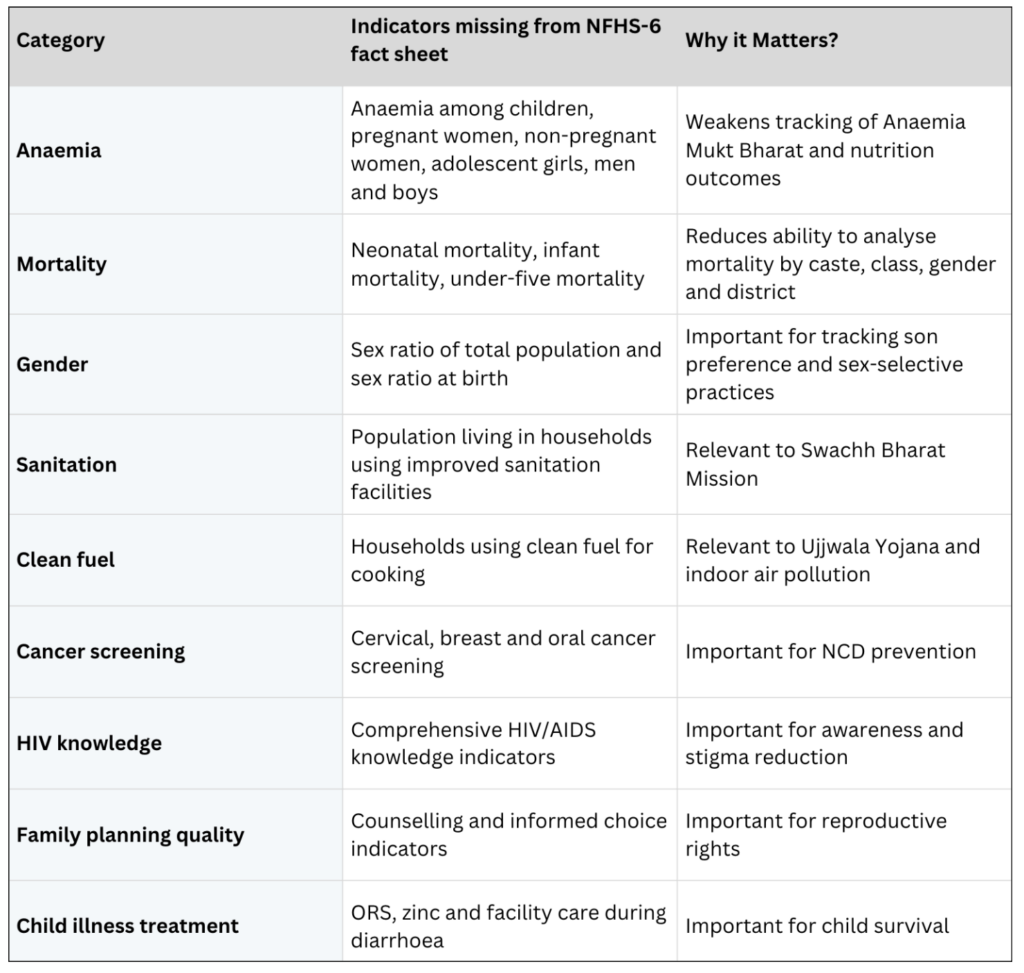
Why was Anaemia dropped?
- Anaemia is the most debated omission. NFHS-5 had shown worsening anaemia: anaemia among children aged 6-59 months increased to 67.1%, among women aged 15-49 to 57%, and among pregnant women to 52.2%.
- The official/technical justification is linked to methodology. NFHS used a finger-prick capillary blood sample. Anaemia prevalence is now expected to be reported through a separate Diet and Biomarker Survey by the National Institute of Nutrition, using venous blood samples.
- The concern is not only methodological. If anaemia is measured through a new survey using a different method, comparison with NFHS-4 and NFHS-5 may become difficult. This creates a break in the time series, making it harder to assess whether Anaemia Mukt Bharat is improving outcomes.
New Additions in NFHS-6:
- Newer Policy-Relevant Themes: NFHS-6 has added or emphasised indicators related to:
- Direct Benefit Transfers
- Self-help group membership
- Digital literacy
- Financial transactions
- Household bank/post office account ownership
- Population aged 60 years and above
- Birth-dose Hepatitis-B vaccination
These additions reflect India’s changing policy landscape: ageing, digital governance, women’s financial inclusion and health system digitisation.
- Digital Welfare Indicators: Inclusion of digital literacy and DBT-related indicators is important because India’s welfare delivery increasingly depends on digital access. However, digital access should not be reduced to internet use alone. It must also include the ability to use digital payments, access government portals, detect fraud and exercise consent.
- Expanded Biomarker Focus: NFHS-6 includes greater attention to non-communicable disease indicators such as blood sugar and obesity. High blood sugar increased among both women and men, even as high blood pressure declined.
NFHS-6 presents a mixed picture. India has gained evidence of progress in maternal care, child nutrition, immunisation, financial protection and women’s digital inclusion. But it has lost visibility on several foundational public health and social indicators in the preliminary fact sheet.
The gains of NFHS-6 will be fully meaningful only if the missing indicators are transparently explained, released through reliable alternative sources, and made comparable across time.