When El Niño becomes an Economic Crisis
Why in News?
Developing El Niño conditions in the equatorial Pacific has renewed concerns about India’s monsoon, agricultural output, food inflation, water security, and labour productivity.
The India Meteorological Department (IMD) has projected a below-normal southwest monsoon, forecasting seasonal rainfall at just 90% of the Long Period Average (LPA).
| UPSC Relevance: GS-1 Geography: Physical Geography; GS-3 Environment: Climate Change Prelims & Mains: ENSO, El Niño: Mechanism & Consequences |
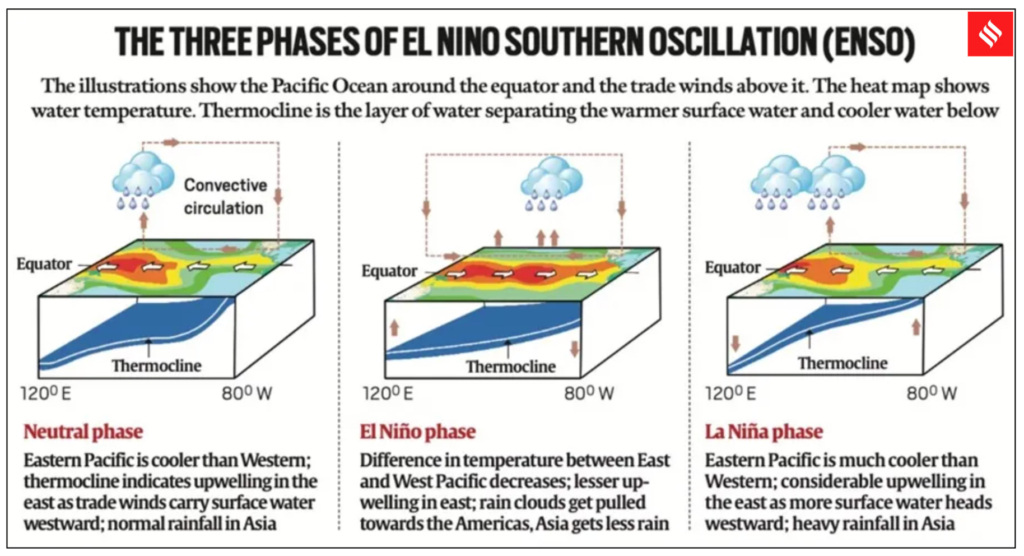
Understanding El Niño:
- El Niño refers to the abnormal warming of sea surface temperatures in the central and eastern equatorial Pacific Ocean. This weakens the movement of moisture-bearing winds towards India and disrupts the southwest monsoon.
- While every El Niño year does not necessarily result in drought, it increases the probability of rainfall deficiency, heat stress, delayed sowing, and agricultural uncertainty.
- For India, this matters because the southwest monsoon remains central to the economy. It provides nearly 70% of the country’s annual rainfall, supports kharif agriculture, recharges reservoirs and aquifers, and sustains rural incomes. Therefore, a weak monsoon can transmit climate stress into the wider economy.
Climate Risk as Economic Risk:
Heat Stress and Labour Productivity:
- Extreme heat reduces the ability of people to work safely and productively, especially in outdoor and physically demanding occupations. Heat stress reduces working hours, increases fatigue, raises health risks, and lowers daily income.
- Construction labourers, street vendors, delivery workers, sanitation workers, agricultural labourers, and gig workers face prolonged exposure to high temperatures.A large proportion of workers are in informal employment and do not have access to paid leave, cooling facilities, health insurance, or workplace protections.
Agriculture and Rural Incomes:
- The southwest monsoon determines sowing decisions, soil moisture, reservoir levels, groundwater recharge, and crop yields. When rainfall is delayed or deficient, farmers face higher irrigation costs and greater uncertainty over crop selection.
- Small and marginal farmers are the most vulnerable because they have limited savings, fragmented landholdings, weak bargaining power, and inadequate access to irrigation. A weak monsoon can reduce kharif output, increase dependence on groundwater, and deepen rural distress.
- This also affects the non-farm rural economy. Lower farm incomes reduce demand for local goods and services, affecting small traders, transporters, rural artisans, and labourers.
Food Inflation and Household Budgets:
- Climate shocks become visible to ordinary citizens through food prices. Vegetables, pulses, cereals, edible oils, and milk are highly sensitive to weather conditions, supply disruptions, and storage constraints.
- If monsoon rainfall weakens, crop stress can push up food prices. This creates a difficult situation for policymakers because the same climate shock can weaken growth while raising inflation.
Water Scarcity and Urban Stress:
- El Niño can also intensify water stress. Weak rainfall affects reservoirs, groundwater recharge, drinking water supplies, hydropower generation, and irrigation availability. Cities dependent on distant water sources may face shortages, while rural areas may experience deeper groundwater extraction.
- Urban India is becoming more vulnerable because of concretisation, shrinking green cover, poor drainage, and the urban heat island effect. Poor households living in congested settlements face higher heat exposure, limited access to safe drinking water, and inadequate cooling.
Macroeconomic and Fiscal Pressures:
- A weak monsoon can affect the macroeconomy through multiple routes. Agricultural growth may slow, rural consumption may weaken, food imports or export restrictions may become necessary, and inflation management may become more complicated.
- The government may also face higher fiscal pressure through drought relief, food subsidies, irrigation support, crop insurance payouts, and public health expenditure. Therefore, El Niño is not a temporary weather disturbance; it can become a stress test for India’s economic resilience.
Why is India especially Vulnerable?
India’s vulnerability arises from the interaction of climate exposure and socio-economic inequality.
- Nearly half of India’s net sown area still depends on rainfall, making agriculture sensitive to monsoon variation.
- A large share of India’s workforce is informal and lacks social security.
- Many Indian cities are poorly prepared for extreme heat.
- Groundwater extraction is already unsustainable in several regions.
- Food inflation has direct political and welfare implications because it affects every household.
This makes El Niño a development challenge rather than only a meteorological event.
Policy Measures Needed:
- Climate-sensitive urban planning: Cities should increase tree cover, protect wetlands and water bodies, create shaded public spaces, promote cool roofs, improve ventilation in low-income housing, and reduce heat-trapping surfaces.
- Heat Action Plans should move beyond advisories and include ward-level heat maps, drinking water points, public cooling shelters, emergency health services, and protection for outdoor workers.
- Worker Protection: Labour regulations must recognise heat as an occupational hazard. Work schedules should be adjusted during heatwaves, especially in construction, delivery, sanitation, mining, and agriculture. Employers should provide rest breaks, drinking water, shade, protective gear, and emergency medical support.
- Social Protection for Gig workers and informal workers, including heat-linked wage compensation, health insurance, and access to public cooling infrastructure.
- Climate-Smart Agriculture: Incorporating drought-tolerant crop varieties, micro-irrigation, crop diversification, better weather advisories, soil moisture conservation, and local water harvesting. Pulses, millets, and less water-intensive crops should be promoted in vulnerable regions.
- Crop insurance must become faster, simpler, and more transparent. Farmers need timely payouts based on weather and satellite-based crop loss assessments.
- Water management must shift from crisis response to long-term resilience. India needs aquifer mapping, groundwater budgeting, rainwater harvesting, wastewater reuse, tank restoration, watershed development, and demand-side water management.
- Inflation Management: The government should strengthen buffer stocks, improve cold chains, reduce wastage, monitor price-sensitive commodities, and use a calibrated trade policy. Sudden export bans or import dependence should be avoided unless necessary, because they can create uncertainty for farmers and markets.
- Early Warning and Data Systems: India should integrate IMD forecasts, satellite data, crop monitoring, reservoir levels, mandi prices, and health alerts into a real-time climate risk dashboard.
Challenges in Implementation:
India faces several constraints.
- Adaptation finance remains inadequate.
- Local governments often lack technical capacity.
- Heat Action Plans are uneven across cities.
- Groundwater governance is fragmented.
- Crop diversification is difficult because procurement incentives still favour rice and wheat in many regions.
Informal workers are hard to reach through formal policy channels.
Therefore, adaptation must be decentralised, well-funded, and linked to livelihoods.
Way Forward:
India needs to treat El Niño as an economic early warning signal. The policy response should combine climate adaptation, social protection, inflation management, and water security.
A resilient India will require heat-resilient cities, climate-smart agriculture, protected workers, better groundwater governance, and stronger public health systems. The objective should not be only to survive a bad monsoon, but to reduce the economy’s dependence on climatic luck.