WHO Emergency Use Listing: First Molecular Test for Bundibugyo Virus
Why in News?
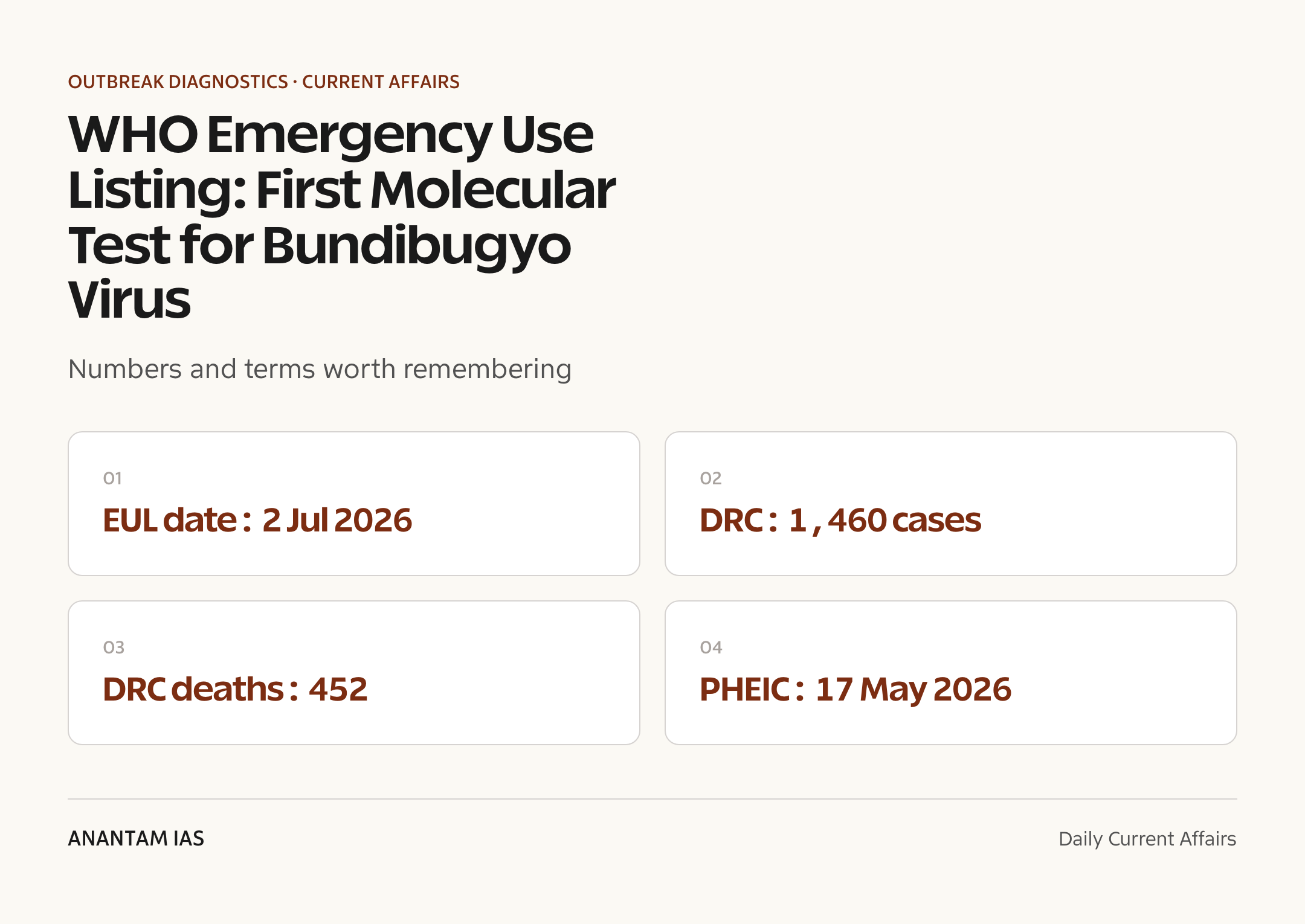
On July 2, 2026, the World Health Organization (WHO) added the first molecular diagnostic test for the Bundibugyo virus (BDBV) to its Emergency Use Listing (EUL). The test confirms infection by detecting the virus’s genetic material in blood samples, a step meant to speed up case confirmation during the ongoing Ebola-family outbreak in Central Africa.
The listing follows the Public Health Emergency of International Concern (PHEIC) the WHO declared on May 17, 2026 over the Bundibugyo strain outbreak in the Democratic Republic of Congo (DRC), with cases spilling into Uganda.
- This is the first-ever EUL for a Bundibugyo virus test, giving countries a quality-assured, emergency-cleared molecular assay.
- The test works by identifying viral RNA (genetic material) in blood, the basis of RT-PCR molecular diagnosis.
- As of July 1, the DRC had reported 1,460 confirmed cases and 452 deaths; Uganda reported 20 cases and 2 deaths by July 2.
- The WHO called this the largest and possibly most brutal Bundibugyo outbreak in the region.
- No approved vaccine or specific treatment currently exists for Bundibugyo virus disease.
The development matters in the context of:
- Rapid, accurate diagnosis is central to isolation, contact tracing and surveillance that break outbreak transmission chains.
- The EUL pathway was earlier used to fast-track COVID-19 vaccine candidates, showing its role in global health emergencies.
- For India, the episode reinforces ICMR-NIV diagnostic readiness and the value of a domestic in-vitro diagnostics base.
UPSC Relevance
Prelims Relevance
- Bundibugyo virus (BDBV) — a species of Orthoebolavirus in the Ebola family (Filoviridae)
- Emergency Use Listing (EUL) — WHO risk-based procedure for unlicensed vaccines, therapeutics and diagnostics
- EUL differs from WHO Prequalification (PQ), which applies to licensed products in non-emergency times
- PHEIC — declared by the WHO Director-General under the International Health Regulations (IHR) 2005
- RT-PCR / molecular test — detects viral genetic material (RNA) rather than antibodies
- In-vitro diagnostics (IVDs) — tests run on samples outside the body
- Outbreak epicentre: Democratic Republic of Congo (DRC), with spread to Uganda
- Africa CDC — African Union’s continental public-health agency, WHO’s response partner
- Experimental treatments named: MBP134 antibody and the antiviral remdesivir
Mains Relevance
GS Paper 3
- Diagnostic preparedness and the role of molecular testing in outbreak control.
- Biotechnology and in-vitro diagnostics manufacturing as a strategic capability.
GS Paper 2
- WHO’s global health governance role and instruments (EUL, PHEIC, IHR 2005).
- Equitable access to health products for low- and middle-income countries.
Essay
- Preparedness over panic: building institutions before the next pandemic.
- Science and cooperation as the frontline against borderless threats.
Background and Context
What Bundibugyo virus is
Bundibugyo is a rare but lethal member of the Ebola family, not a new pathogen.
- BDBV is one of the species in the genus Orthoebolavirus (family Filoviridae), which also includes Zaire ebolavirus, the strain behind most large Ebola epidemics.
- It was first identified in 2007 in the Bundibugyo district of western Uganda, which gave the strain its name.
- Bundibugyo virus disease (BVD) is comparatively rare — before 2026 it had caused only two recorded outbreaks.
- Symptoms overlap with common febrile illnesses like malaria, so the WHO stresses that BVD cannot be told apart without laboratory confirmation.
Why diagnosis is the bottleneck
In a filovirus outbreak, testing is the hinge on which the whole response turns.
- A molecular test detects the virus’s genetic material (RNA) directly, confirming infection rapidly and accurately.
- RT-PCR (reverse-transcription polymerase chain reaction) converts viral RNA to DNA and amplifies it, the gold standard for filoviruses.
- Fast confirmation drives isolation of cases, targeted contact tracing, safe burials and treatment decisions.
- Until now, control relied on case identification, isolation, contact tracing, safe burials and community engagement — all weaker without a validated Bundibugyo-specific test.
- Molecular tests are prized for their specificity and early detection, catching the virus before antibodies (used in serological tests) appear.
- Alongside lab-based assays, the response is scaling near-point-of-care molecular tests and antigen rapid diagnostic tests to widen reach beyond central labs.
What the WHO listing actually did
The EUL puts an emergency-cleared, quality-assured test into the hands of responders.
- Less than two weeks after the PHEIC, the WHO invited makers of in-vitro diagnostics to submit Expressions of Interest for the EUL.
- The listed test is the first quality-assured molecular assay cleared specifically for the Bundibugyo virus.
- WHO’s Yukiko Nakatani said timely access to quality-assured tests can make a critical difference in containing transmission.
- Further Bundibugyo IVD applications submitted through the EUL are under review, signalling a pipeline of additional tests.
- By vouching for a test’s quality and performance, the WHO lowers the risk for procurers and speeds deployment to the outbreak front line.
EUL versus Prequalification
The EUL is an emergency shortcut; prequalification is the peacetime standard.
- EUL is a risk-based procedure to assess and list unlicensed vaccines, therapeutics and diagnostics, to expedite availability during a public-health emergency.
- It checks quality, safety and performance on available evidence, ensuring minimum international standards and the needs of low- and middle-income countries.
- Prequalification (PQ), by contrast, is the WHO’s fuller, non-emergency assessment of licensed products used for routine procurement by UN agencies.
- In short, EUL trades some evidentiary certainty for speed in a crisis; prequalification prioritises a complete evidence base in normal times.
- The EUL was previously used to enlist COVID-19 vaccine candidates during the pandemic, its most familiar precedent.
The outbreak and the response network
The 2026 outbreak is the region’s largest, met by a multi-partner testing push.
- The PHEIC was declared on May 17, 2026 for the DRC outbreak, under the IHR 2005 framework.
- The WHO has called the 2026 episode the largest and possibly most brutal Bundibugyo outbreak the region has seen.
- The WHO and Africa CDC expanded testing to a network of 10 laboratories across affected provinces, with capacity of over 2,000 tests per day.
- Partners PATH, FIND and CHAI, with Unitaid support, are building a joint validation platform to evaluate lab-based, near-point-of-care and antigen rapid tests in real outbreak settings.
- A treatment trial enrolled its first patient on July 2, testing the MBP134 antibody alone and in combination with the antiviral remdesivir across more than 1,000 patients.
- No licensed vaccine or specific therapy exists for Bundibugyo, so validated diagnostics and supportive care remain the core response.
Governance and the India angle
The listing is a case study in global health governance with lessons for India.
- A PHEIC is the WHO’s highest alarm under the IHR 2005, triggering coordinated surveillance and response duties.
- The episode reflects One Health thinking — filoviruses have animal reservoirs and cross the human-animal-environment interface.
- For India, the ICMR and the National Institute of Virology (NIV), Pune anchor high-containment diagnostics and outbreak surveillance.
- A strong domestic IVD manufacturing base lets India both protect itself and supply affordable tests to the Global South.
- India’s earlier experience scaling RT-PCR capacity during COVID-19 is a template for rapid diagnostic ramp-ups in future emergencies.
Way Forward
Shorten the diagnostics lag
- Sustain EUL-style fast tracks so validated tests reach outbreak zones within weeks, not months.
- Scale near-point-of-care and antigen rapid tests to push confirmation closer to patients.
Fix the market failure
- Fund R&D for rare, neglected pathogens where commercial incentives are thin.
- Use pooled mechanisms like Unitaid and validation platforms to de-risk product development.
Build India's readiness
- Deepen ICMR-NIV reference-lab capacity and an assured domestic IVD supply chain.
- Embed One Health surveillance across health, animal-husbandry and environment agencies.
Conclusion
The WHO’s first Emergency Use Listing for a Bundibugyo virus test is a small technical act with an outsized message — in a fast-moving filovirus outbreak, a trusted diagnostic is the first line of defence.
For aspirants, the story ties together the durable machinery of global health governance: the IHR 2005 and PHEIC, the EUL-versus-prequalification distinction, and the One Health logic behind outbreak preparedness. For India, the lesson is to keep building diagnostic capacity and a resilient IVD base before the next emergency arrives.
UPSC Practice Questions
Prelims MCQ 1
With reference to the WHO’s Emergency Use Listing (EUL), consider the following statements:
- It is a risk-based procedure for unlicensed vaccines, therapeutics and in-vitro diagnostics.
- It is meant to expedite availability of products during a public health emergency.
- It was used to enlist COVID-19 vaccine candidates during the pandemic.
How many of the above statements are correct?
(a) Only one (b) Only two (c) All three (d) None
Answer: (c) All three
Explanation:
The EUL is a risk-based, emergency procedure for unlicensed vaccines, therapeutics and diagnostics; it was earlier used for COVID-19 vaccine candidates. All three statements are correct.
Prelims MCQ 2
The Bundibugyo virus, in news recently, is best described as:
(a) A mosquito-borne flavivirus (b) A species in the Ebola family (genus Orthoebolavirus) (c) A bacterial cause of haemorrhagic fever (d) A novel coronavirus variant
Answer: (b) A species in the Ebola family (genus Orthoebolavirus)
Explanation:
Bundibugyo virus (BDBV) is one of the species of the genus Orthoebolavirus in the Filoviridae family, causing Bundibugyo virus disease, an Ebola-type illness.
UPSC Mains Questions
- Rapid, quality-assured diagnostics are the first line of defence in an outbreak. In this light, examine the significance of the WHO’s Emergency Use Listing mechanism for global health preparedness.
- Distinguish between the WHO’s Emergency Use Listing and Prequalification procedures. How do these instruments, together with the IHR 2005 and PHEIC, shape global responses to outbreak-prone pathogens?
- Discuss how strengthening India’s in-vitro diagnostics manufacturing and ICMR-NIV capacity contributes to both national and global outbreak preparedness.
Sources: World Health Organization (WHO) and The Hindu.
Frequently Asked Questions
What is the Bundibugyo virus?
Bundibugyo virus (BDBV) is a species in the genus Orthoebolavirus, part of the Ebola family (Filoviridae). First identified in Uganda’s Bundibugyo district in 2007, it causes Bundibugyo virus disease, a rare but often deadly haemorrhagic illness. It is one of the strains that can cause Ebola-type disease.
What did the WHO actually list in July 2026?
On July 2, 2026, the WHO added the first molecular diagnostic test for the Bundibugyo virus to its Emergency Use Listing. The test detects the virus by identifying its genetic material in blood samples, allowing rapid, accurate confirmation of infection during the outbreak in Central Africa.
What is the WHO’s Emergency Use Listing (EUL)?
The EUL is a risk-based procedure the WHO uses to assess and list unlicensed vaccines, therapeutics and in-vitro diagnostics during a public health emergency. It checks quality, safety and performance on available evidence, aiming to speed up access, especially for low- and middle-income countries.
How is EUL different from WHO Prequalification?
The EUL is an emergency pathway for unlicensed products, cleared quickly on available evidence during a crisis. Prequalification is the WHO’s fuller, non-emergency assessment of licensed products for routine procurement by UN agencies. EUL trades some certainty for speed; prequalification prioritises full evidence.
Why does rapid diagnosis matter in an Ebola-type outbreak?
Because Bundibugyo disease looks like malaria and other fevers, it cannot be identified without lab confirmation. A validated molecular test lets responders quickly isolate cases, trace contacts, guide treatment and improve surveillance, breaking the chains of transmission that let an outbreak spread.
What is the relevance for India?
India has no cases, but the episode underlines the value of diagnostic preparedness. Institutions like the ICMR and the National Institute of Virology, Pune, anchor high-containment testing, while a strong domestic in-vitro diagnostics base lets India protect itself and supply affordable tests to other countries.