Why Iran War, Monsoon worries could make 2026 India’s Year of Millets
Why in News?
A geopolitical supply shock from the Iran conflict and a below-normal monsoon season forecast are accelerating a structural shift in India’s kharif cropping pattern. Farmers across Northwest India are pivoting from input-intensive crops such as cotton, paddy, and maize towards millets like bajra (pearl millet) and pulses such as moong (green gram).
| UPSC Relevance: GS-3 Economy: Agriculture, Food Security, Cropping Pattern Mains: Millets Production: Advantages, Govt schemes, Associated Challenges. |
The Catalyst for Change in Cropping Pattern
1. The Geopolitical Trigger:
The US-Iran conflict escalated to the effective closure of the Strait of Hormuz. The Strait facilitates the movement of approximately one-fifth of the world’s petroleum and a significant portion of global LNG. For India, the disruption is not merely an energy problem but has triggered an acute agricultural input crisis.
- Fertiliser Price Shock: The conflict has significantly choked global fertilizer supply chains, causing prices of synthetic inputs to spike. E.g., Urea prices have nearly doubled from February 2026 to April 2026. Similarly, the prices of DAP (di-ammonium phosphate), Sulphur and Ammonia have substantially risen.
- Domestic Production Disruptions: India typically produces around 2.5 million tonnes of urea per month domestically. Output fell to 1.5 million tonnes in March 2026 due to LNG feedstock shortages, as Gulf Cooperation Council (GCC) countries account for over 60% of India’s LNG imports. Domestic urea plants are now running at only 60-70% capacity as a consequence.
For the Kharif 2026 season, India’s urea requirement is estimated at 19.4 million tonnes, against opening stocks of only 5.5 million tonnes. As Millets thrive with minimal fertiliser, it allows farmers to bypass these supply constraints.
2. The Climatic Trigger:
- The India Meteorological Department (IMD), in its Long Range Forecast, has forecast the 2026 southwest monsoon (June-September) to be below normal at 92% of the Long Period Average (LPA) of 87 cm, with a model error of ±5%.
- The primary driver is the expected development of El Niño conditions in the equatorial Pacific Ocean during the second half of the monsoon season.
Approximately 60% of India’s farmers remain entirely rain-fed and thus directly exposed to monsoon variability. Water-intensive crops such as rice require 5-7 irrigations per season. In contrast, bajra requires only 1-2 irrigations to complete its 90-95 day growth cycle.
A below-normal monsoon, therefore, raises the relative agronomic competitiveness of drought-tolerant millets and short-duration pulses substantially.
3. Ground-Level Dynamics:
The theoretical advantages of millets are translating into measurable crop-area shifts, particularly in Northwest India’s cotton-growing belt spanning Haryana, Punjab, and Rajasthan.
- Abandonment of Cotton: Pink bollworm has devastated cotton yields in various districts of Haryana and Punjab. Average raw cotton yields have fallen from 10-12 quintals per acre to 3.5 quintals in recent years. Cotton’s 180-185 day growing cycle demands 5-10 pesticide spray cycles and significant doses of urea, DAP, MOP, and SSP, all of which are subject to the current input price shock. Labour costs for cotton picking, ranging from Rs. 12 to Rs. 25 per kg, further erode margins.
- Bajra’s Competitive Advantages: Bajra’s short maturity window of 90-95 days, irrigation requirement of 1-2 per season, and low fertiliser requirement give it a competitive edge over cotton. A farmer who harvests bajra by September-October can still sow rabi mustard (130-140 days) by mid-October, followed by a summer (zaid) moong crop from mid-March to mid-April. This triple-cropping possibility is structurally unavailable with cotton.
Policy Architecture Supporting Millets:
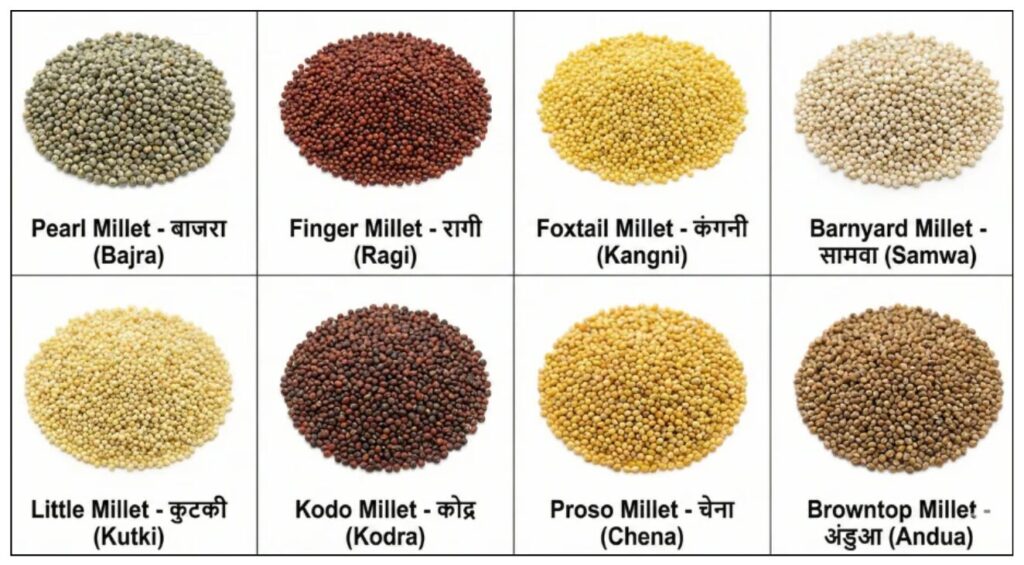
- Shree Anna Mission: Sub-Mission on Nutri-Cereals under the National Food Security and Nutrition Mission (NFSNM), covers bajra, jowar, ragi, and small millets across 28 states and 2 Union Territories. India produced 180.15 lakh tonnes of millets in FY25, an increase of 4.43 lakh tonnes over FY24. Among all millet types, bajra contributes the largest share.
- Minimum Support Price (MSP): The MSP for bajra has been raised to Rs. 2,900 per quintal for Kharif 2026. However, effective market realisation remains a persistent gap. Farmers have demanded that MSP be backed by actual government procurement rather than remaining a notional price signal.
- Public Distribution System Integration: The Ministry of Food and Public Distribution has revised guidelines to increase procurement of Shree Anna under the Targeted Public Distribution System (TPDS), Integrated Child Development Services (ICDS), and the Mid-Day Meal scheme.
- Export and Value Chain: An Export Promotion Forum dedicated to Shree Anna has been established to facilitate international marketing. The Ministry of Food Processing Industries (MoFPI) has implemented the Production Linked Incentive Scheme for Millet-Based Products (PLISMBP) with a financial outlay covering FY23 to FY27 to build a processed millet foods industry.
Associated Concerns & Way Forward:
- MSP-to-Market Linkage: An MSP without procurement infrastructure is a policy half-measure. Price difference compensation model (E.g., Bhavantar Bharpai model of Haryana) of compensating for the price difference between market rates and MSP is a step forward. But effective procurement through FCI or state agencies is necessary to make the price signal credible for farmers planning acreage decisions.
- Seed System Strengthening: The rapid uptake of hybrid bajra varieties demonstrates farmer responsiveness to technological innovation. Scaling up public-sector millet breeding through ICAR’s All India Coordinated Research Project on Pearl Millet, and ensuring certified seed availability at the district level before kharif sowing windows, is critical.
- Integrating Millets in Food Safety Net: Systematically substituting a portion of the Public Distribution System (PDS) rice and wheat allocations with millets, using the existing provision under the National Food Security Act (NFSA).
- Diversifying Import Dependence: India has begun redirecting fertiliser procurement to Morocco, Jordan, Indonesia, and Malaysia. Bilateral agreements for long-term fertiliser supply contracts with non-Gulf producers, acceleration of domestic green ammonia production capacity, Transition to nano urea, nano DAP, biofertilisers, and phosphate-solubilising bacteria are structurally important for food security.
Millets offer significant nutritional advantages over rice and wheat. Bajra is rich in iron, zinc, magnesium, and B-vitamins, making it particularly relevant for addressing anaemia and micronutrient deficiencies prevalent in India’s rural population.
FSSAI’s Eat Right campaign is creating consumer awareness around millets as part of a healthy diet. Integrating millets more substantially into the PDS would represent a transition from calorie-focused food security towards nutrition-sensitive food security, addressing hidden hunger.