Why is Buxa bringing Tigers back?
Why in News?
A three-year-old tigress, T138, was translocated from Valmiki Tiger Reserve, Bihar, and introduced into Buxa Tiger Reserve, West Bengal. This initiates a phased programme to establish a viable, self-sustaining tiger population. Buxa had experienced a prolonged absence of a stable resident tiger population.
| UPSC Relevance: GS-3 Environment and Biodiversity: Conservation, Protected Areas, Species in News Prelims: Tiger, Keystone species, Buxa Tiger Reserve Mains: Conservation of Keystone species |
About Buxa Tiger Reserve:
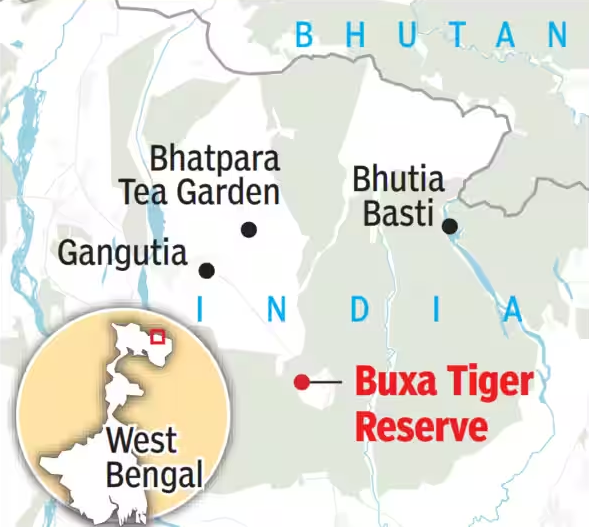
- Location: Alipurduar district of West Bengal, in the eastern Himalayan foothills and the Dooars landscape.
- Establishment: Established under Project Tiger in 1983.
- Extent: Approximately 760 sq. km, encompassing Buxa National Park, Buxa Wildlife Sanctuary and adjoining forests.
- Habitats: A mosaic of moist deciduous and semi-evergreen forests, sal forests, subtropical wet hill forests and riverine grasslands.
- Major rivers: Sankosh, Raidak and Jayanti
- Historical association: The reserve derives its name from Buxa Fort, associated with the detention of freedom fighters during British rule.
- Important fauna: Asian elephant, leopard, clouded leopard, dhole, gaur, sambar, chital and barking deer, besides tigers.
- Landscape connectivity:
- North: Forests of Bhutan, including the Phibsoo landscape.
- East: Ripu-Kochugaon forests of Assam, linking towards Manas landscape.
- West: Jaldapara through the intervening forest and corridor network, including Chilapata.
These connections make Buxa significant for tiger dispersal and elephant movement across State and international boundaries.
Tiger- a Keystone Species:
- A keystone species has an ecological influence disproportionately large relative to its abundance. Its disappearance can substantially alter the ecosystem’s structure, food web and functioning.
- It need not be the most abundant or largest species. It need not be a predator; some species exert their influence by modifying habitats.
- Its loss can transform an ecosystem, but does not invariably make the entire ecosystem cease to exist.
- Conservation status of Tiger:
- IUCN Red List: Endangered
- Wildlife (Protection) Act, 1972: Schedule I
- CITES: Appendix I
- In 2022, the last census estimated a total of 3682 tigers across the country, with Madhya Pradesh topping the list with 785 tigers.
Significance of Keystone Species Conservation:
- Maintains Food-Web Balance: Top predators regulate prey abundance and behaviour. This triggers trophic cascades (effects that spread across different levels of a food web) that keep the entire food web healthy and stable.
- Prevents Biodiversity Loss: They stop single species from dominating. E.g., Sea otters eat sea urchins, which prevents the overgrazing and destruction of kelp forests.
- Restores Ecological Processes: Conservation brings back natural predation and habitat engineering. However, reintroduction alone is not enough; the root causes of ecosystem decay must also be fixed.
- Safeguards Ecosystem Services: Protecting these species and their habitats secures vital natural benefits like water regulation, soil fertility, carbon storage, and genetic diversity.
- Supports Local Economies: Sustainable wildlife tourism creates jobs for guides, transport, and homestays. Success requires fair revenue sharing and strict limits on ecological disturbance.
Why was Valmiki Tiger Reserve selected?
- Valmiki Tiger Reserve lies at the eastern end of the Terai Arc Landscape and offers terrain and habitat conditions more comparable to Buxa.
- Sundarbans tigers were considered less suitable because their tidal mangrove habitat differs substantially from Buxa’s foothill forests.
Selection of source animals requires ecological compatibility, alongside veterinary assessment and management preparedness.
Buxa’s Tiger Recovery Programme:
The preparatory work has been undertaken since 2018, involving the West Bengal government, National Tiger Conservation Authority (NTCA) and Wildlife Institute of India:
- Release of more than 800 chital to supplement the prey base.
- Restoration or conversion of approximately 380 hectares of grassland.
- Engagement with 64 Eco-Development Committees/Joint Forest Management Committees.
- Post-release monitoring through telemetry, camera traps and field observations.
Lessons from Tiger Reintroduction in India:
- Successful recovery: Sariska, Rajasthan (2008) and Panna, Madhya Pradesh (2009) demonstrate the potential of scientifically managed tiger restoration.
- Uneven outcomes: Satkosia, Odisha, illustrates how inadequate preparedness and human-tiger conflict can undermine translocation efforts. Releasing animals alone does not ensure population recovery.
Key Challenges in the Buxa Tiger Reintroduction:
- Habitat Fragmentation: Settlements, tea estates, and expanding infrastructure (like railways and roads) have cut off vital wildlife corridors.
- Low Prey Availability: A lack of natural prey like chital may force tigers to hunt livestock, triggering severe human-wildlife conflict.
- Shrinking Grasslands: Overgrown forest canopies are choking out sunlight, reducing the grass needed to sustain grazing herbivores.
- Community & Livelihood Clashes: Relocating villages to create a human-free core area threatens forest-dwellers’ land rights and local ecotourism income.
- Uncertain Establishment: Inadequate prey and persistent disturbance may hinder settlement and breeding. Dispersal into neighbouring forests is natural; concern arises when animals fail to establish or enter conflict-prone areas.
- Sustained Management Requirements: Monitoring, protection, habitat restoration and conflict mitigation require long-term funding and trained personnel. Reintroduction cannot compensate for unresolved habitat degradation.
Way Forward:
- Restore Habitats and Prey First: Revive degraded grasslands and boost wild herbivore numbers before releasing more tigers.
- Secure Wildlife Corridors: Protect migration paths linking to Bhutan and Assam, and add safe eco-crossings to reduce road and railway accidents.
- Partner with Local Communities: Respect forest land rights, secure informed consent before any village relocation, and share ecotourism profits fairly.
- Mitigate Human-Wildlife Conflict: Protect livestock with better fencing, deploy rapid-response teams, and ensure quick, fair compensation for losses.
- Track Long-Term Recovery Success: Measure conservation success by tiger survival, breeding rates, and genetic health, not just the initial number of animals released.
Buxa’s tiger recovery can strengthen an important transboundary wildlife landscape. Lasting success requires secure habitats, sufficient prey, connected corridors and community partnership, alongside carefully monitored releases.
Practice Prelims MCQ:
Q. With reference to Buxa Tiger Reserve, consider the following statements:
- It is located in northern West Bengal.
- It has ecological connectivity with forests of Bhutan and Assam.
- The absence of a stable resident tiger population necessarily means that no tiger moves through the reserve.
Which of the statements given above are correct?
(a) 1 and 2 only
(b) 2 and 3 only
(c) 1 and 3 only
(d) 1, 2 and 3
Answer: (a)
UPSC PYQ 2018
Q. In which one of the following States is Pakhui Wildlife Sanctuary located?
(a) Arunachal Pradesh
(b) Manipur
(c) Meghalaya
(d) Nagaland
Answer: (a)