Women Empowerment

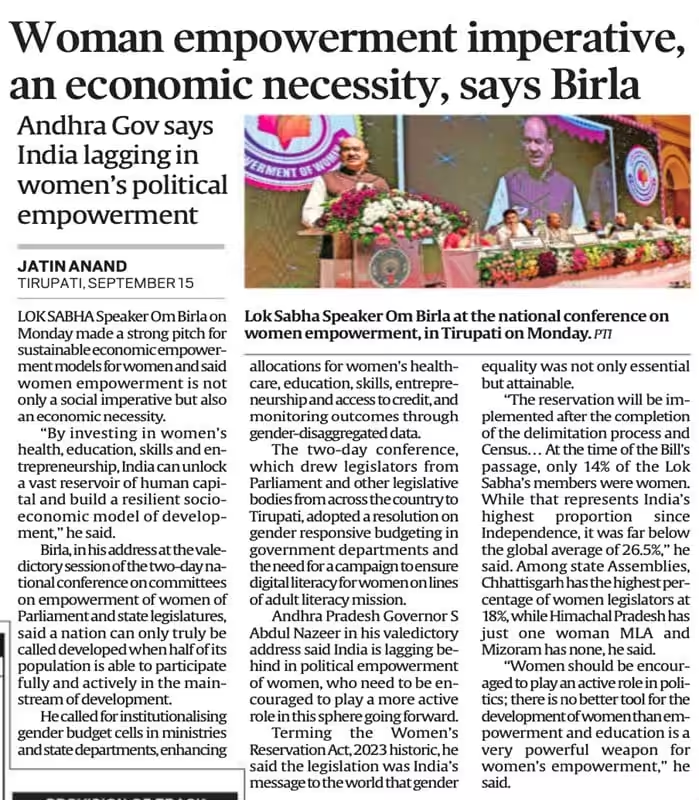
Context:
In a recently given speech, Lok Sabha Speaker Om Birla has emphasized that women empowerment is multi-dimensional imperative, covering political, social and economic aspects of development.
UPSC Relevance:
Role of women and women’s organizations: Issues related to women: Globalization’s impact on women: Welfare schemes for vulnerable sections like women.
UPSC Mains PYQ:
Q1. Explain why suicide among young women is increasing in Indian society.
Q2. ‘Women’s movement in India has not addresses the issues of women of lower social strata.’ Substantiate your view.
Steps taken by government to strengthen the position of women in India:
Political empowerment of women:
- Women Reservation Bill (106th Constitutional Amendment Act, 2023): The bill postulates that one-third (including the seats reserved for women belonging to the Scheduled Castes and Scheduled Tribes) of the total number of seats to be filled by direct election to the House of People shall be reserved for women.
- Reservation in Panchayats and Municipalities for women candidates through 73rd and 74th constitutional amendment respectively.
Economic empowerment of women:
- Stand up India Scheme: Promotes entrepreneurship among women from Scheduled Castes, Scheduled Tribes, and minority communities by providing them with bank loans.
- Mahila Shakti Kendra: The Mahila Shakti Kendra (MSK) Scheme was approved in November, 2017 as a centrally sponsored scheme to empower rural women through community participation.
- Mahila E-Haat as an online marketing platform for women entrepreneurs.
- PM-Jan Dhan Yojana for financial inclusion of women.
- Gender Budgeting to make the government budget and financial allocation more gender sensitive and uplift vulnerable sections of women.
Socio-Cultural empowerment:
- Nirbhaya Fund to support initiatives aimed at improving the safety of women.
- Beti Bachao Beti Padhao scheme: Aims to improve the child sex ratio and ensure the education and empowerment of girls.
- One Stop Centres to provide integrated support services to women affected by violence.
Legislative Provisions:
- Protection of women from domestic violence act, 2005: Provides a civil remedy for victims of domestic violence and empowers them to seek protection orders and residence rights.
- Dowry Prohibition Act, 1961: Prohibits the giving or taking of dowry and prescribes punishment for violations.
- Prohibition of Child marriage act, 2006: Raises the legal age of marriage for girls to 18 years, aiming to eradicate child marriage and its associated harms.
- Sexual Harassment of women at workplace (Prevention, Prohibition and Redressal) Act, 2013: Creates a mechanism for preventing and redressing sexual harassment at workplaces, both public and private. Thus, it helps the cause of gender equality in the workplace.
Necessity of women empowerment in India:
Gender Equality:
- Women’s empowerment is essential for achieving gender equality, which is a fundamental human right. Gender equality means that women and men have equal rights, opportunities, and resources, and can participate equally in all aspects of life.
Economic Growth:
- Women’s empowerment is also important for economic growth and development. When women have equal access to education, employment, and other opportunities, they are better able to contribute to the economy and society as a whole.
- According to UN Women, Women’s economic empowerment increases economic diversification and income equality for shared prosperity
Social Justice:
- Women’s empowerment is also essential for achieving social justice. Women and girls are often subject to discrimination, violence, and other forms of oppression simply because of their gender. Empowering women helps to create a more just and equitable society for everyone.
Health and well-being:
- Women’s empowerment is also important for promoting health and well-being. When women have access to education and healthcare, they can better take care of themselves and their families.
Sustainable Development:
- Women’s empowerment is critical for achieving sustainable development. When women are empowered, they are better able to contribute to efforts to address environmental challenges, reduce poverty, and promote social justice.
Social issues related to women:
- Domestic violence: The National Commission for Women said in 2020-21, it received 26,513 complaints from women, an increase of 25.09 per cent, compared with the 20,309 complaints registered in 2019-20.
- Crime against women: Such as rape, acid attacks, dowry killings, honour killings, and the forced prostitution of young girls has been reported in India.
- Feminisation of poverty: The feminization of poverty has been used to illustrate differences between male and female poverty in a given context as well as changes in male and female poverty over time.
- Missing women and unwanted girls: The term “missing women” indicates a shortfall in the number of women relative to the expected number of women in a region or country. Twenty-one million unwanted girls under the age of 25 in India. These girls are more precisely described as “less wanted” children. They are daughters that parents gave birth to when they were really hoping for a son.