World Bank Approves $1.5 Billion to Back India’s Reform Programmes
Why in News?
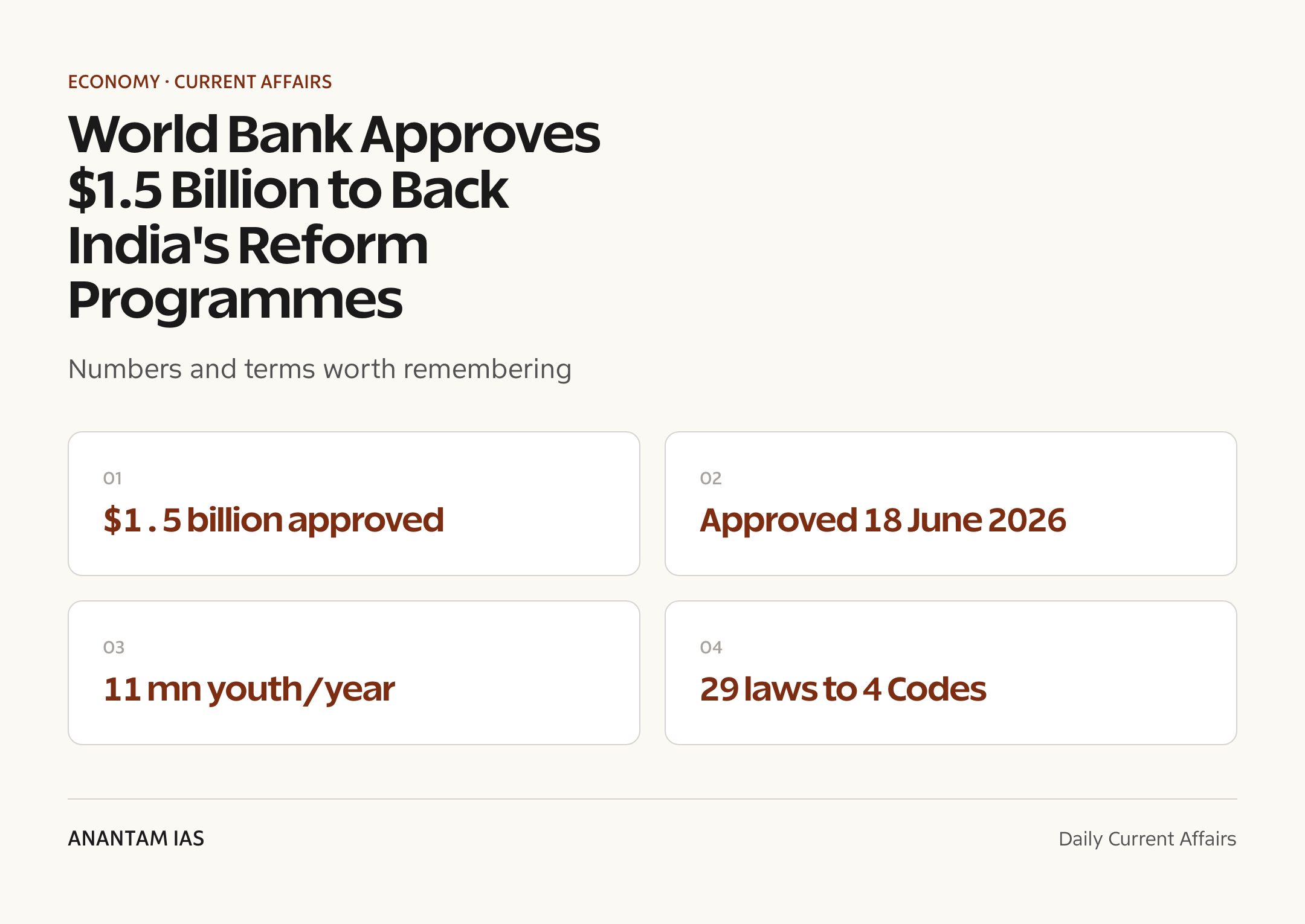
The World Bank’s Board of Executive Directors approved $1.5 billion in financing on 18 June 2026 to support India’s structural reforms, under a single operation called the Boosting Job Creation in the Private Sector Development Policy Financing (DPF) Operation. The Hindu reported the approval as multilateral backing tied directly to India’s reform agenda rather than to a brick-and-mortar project.
This is budget-support lending — a Development Policy Financing operation — where money flows against agreed policy and institutional reforms, not against a road or a power plant. The World Bank said the operation builds on reforms in tax simplification, trade integration and labour law consolidation, aiming to unlock private capital and create jobs for the roughly 11 million youth entering India’s labour market every year over the next two decades.
- $1.5 billion approved on 18 June 2026 via the Boosting Job Creation in the Private Sector DPF Operation.
- It is a Development Policy Financing (DPF) / budget-support loan — disbursed against reforms, not a physical project.
- Reforms backed: Next-Generation GST, simplified tax regime, broader MSME definitions, trade and investment streamlining, and capital mobilisation.
- Anchored on the November 2025 consolidation of 29 labour laws into four Labour Codes and measures to raise women’s formal-sector participation.
- Complements parallel International Finance Corporation (IFC) investments to widen credit access for MSMEs and underserved rural and semi-urban borrowers.
- Johannes Zutt, World Bank Vice President for South Asia, said India is well paced in its reforms agenda to unlock private capital and create jobs.
The development matters in the context of:
- Sits inside the new India Country Partnership Framework (CPF) FY26–31, which centres jobs and private investment.
- India is among the World Bank’s largest borrowers, drawing on the IBRD (middle-income window) rather than the concessional IDA.
- DPF loans count as external commercial borrowing on the government’s books and add to the external-sector liability stock.
- The operation links external multilateral finance to domestic fiscal, ease-of-doing-business and factor-market reforms.
UPSC Relevance
Prelims Relevance
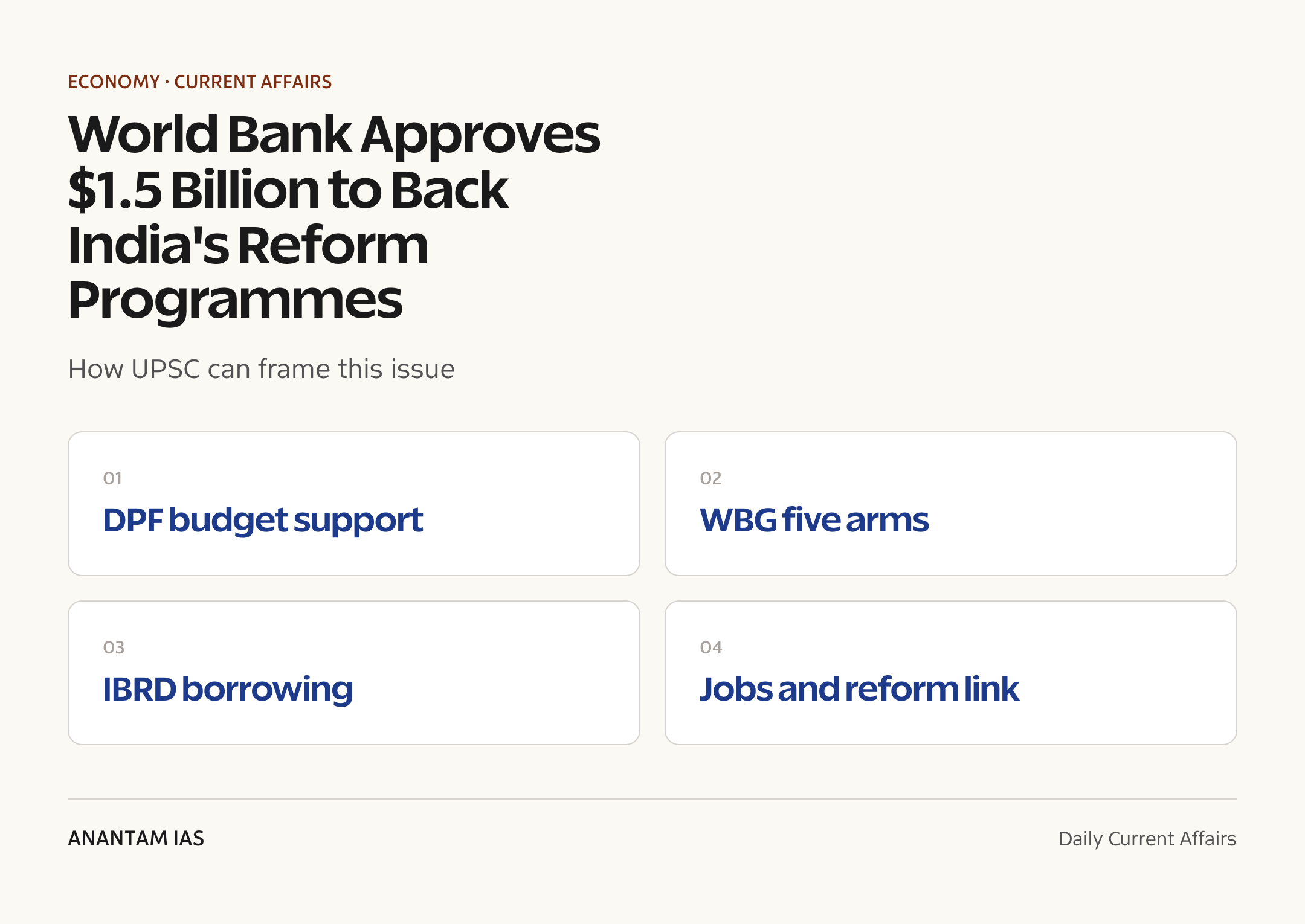
- The World Bank Group (WBG) has five arms: IBRD, IDA, IFC, MIGA and ICSID.
- IBRD lends to middle-income and creditworthy governments; India borrows mainly from IBRD, not concessional IDA.
- IDA provides concessional credits and grants to the poorest countries; India graduated as an IDA borrower in 2014.
- IFC finances the private sector; MIGA provides political-risk guarantees; ICSID settles investment disputes.
- Development Policy Financing (DPF) is budget support disbursed against policy actions, distinct from Investment Project Financing (IPF) tied to specific projects.
- WBG and the IMF are Bretton Woods institutions, both established at the 1944 conference.
- In India, sovereign borrowing from the World Bank is routed through the Department of Economic Affairs (DEA), Ministry of Finance.
- A Country Partnership Framework (CPF) is the World Bank’s medium-term engagement strategy for a borrowing country.
Mains Relevance
GS Paper 3
- Multilateral development finance as a lever for structural reform — how reform-linked DPF lending interacts with fiscal policy, ease of doing business and private-sector job creation.
- External-sector implications of sovereign borrowing from MDBs: debt sustainability, foreign-exchange inflows and the trade-off between external commercial borrowing and reform credibility.
GS Paper 2
- Role and reform of Bretton Woods institutions and the World Bank Group in supporting developing economies; India’s evolving relationship from aid recipient to major borrower and shareholder voice.
Essay
- Reform from within, finance from abroad: the political economy of conditional development lending.
- Jobs, not just growth — financing the demographic dividend before the window closes.
Background and Context
The World Bank Group — five arms, one mission
The institution India borrowed from is one part of a wider Group.
- The World Bank Group (WBG) is a development institution of five agencies, headquartered in Washington, D.C., born of the 1944 Bretton Woods conference alongside the IMF.
- IBRD (International Bank for Reconstruction and Development) — lends at near-market rates to middle-income and creditworthy governments. India’s $1.5 billion DPF flows through this window.
- IDA (International Development Association) — concessional credits and grants for the poorest countries; India was a borrower until graduating in 2014 and is now an IDA donor.
- IFC (International Finance Corporation) — invests in the private sector; here it complements the loan with MSME and rural-credit financing.
- MIGA offers political-risk and credit guarantees; ICSID arbitrates investor-state disputes.
Development Policy Financing vs Investment Project Financing
The form of this loan matters as much as the amount.
- Development Policy Financing (DPF) is fast-disbursing budget support — funds are released against a government’s completed and committed prior actions (policy and institutional reforms).
- It does not finance a specific asset; the money enters the general budget once reform milestones are met.
- Investment Project Financing (IPF), by contrast, funds tangible projects — highways, transmission lines, water systems — disbursed against verified expenditure.
- A Program-for-Results (PforR) instrument links disbursement to delivered results.
- DPF rewards reform credibility, which is why this operation reads as an endorsement of India’s policy direction, not a project cheque.
The reforms being backed
The World Bank tied the financing to a specific reform stack.
- Tax simplification, including the Next-Generation GST rollout, to make compliance smoother, faster and more transparent.
- Broader, more inclusive MSME definitions and easier business compliance to lower entry barriers for entrepreneurs.
- Trade and investment streamlining to deepen integration with global value chains.
- Consolidation of 29 labour laws into four Labour Codes (November 2025) to modernise compliance and ease formal hiring.
- Measures to raise women’s participation in formal employment and to facilitate capital mobilisation for firms.
- This connects to India’s ongoing push on the ease of doing business and factor-market reform.
India's borrowing relationship with multilateral banks
India is now a major client, not a small recipient.
- India is among the largest IBRD borrowers and an active client of the Asian Development Bank (ADB), the AIIB and the New Development Bank (NDB).
- Sovereign loans are negotiated and routed through the Department of Economic Affairs (DEA) in the Finance Ministry.
- This operation sits within the India Country Partnership Framework (CPF) FY26–31, which puts jobs and private investment at the centre of engagement.
- Having graduated from concessional IDA in 2014, India both borrows from IBRD and contributes to IDA as a donor — a dual role few economies hold.
- Multilateral finance brings not just funds but technical assistance, benchmarking and reform discipline.
Fiscal and external-sector implications
A budget-support loan touches both the fisc and the balance of payments.
- DPF proceeds count as external commercial borrowing by the sovereign, adding to the external-debt stock that must be serviced in foreign currency.
- The inflow supports the capital account of the balance of payments and adds to forex reserves at the margin.
- Reform-linked lending strengthens India’s standing with rating agencies and other lenders, lowering the cost of future borrowing.
- The jobs focus targets the demographic dividend — roughly 11 million youth entering the labour force each year — where employability and formalisation are the binding constraints.
- The trade-off: external liabilities and conditionality against cheaper finance, reform momentum and a credibility signal to private capital.
Way Forward
Convert reforms on paper into measurable outcomes
- Track Labour Code implementation, GST simplification and MSME formalisation against jobs and female labour-force participation, not just legislative milestones.
- Use DPF technical assistance to build state-level capacity, since factor-market reforms ultimately play out in states.
Manage the external-sector footprint prudently
- Keep multilateral borrowing within a sustainable external-debt path and match foreign-currency liabilities to productive, growth-raising reforms.
- Blend IBRD funds with IFC private-capital mobilisation to crowd in, rather than crowd out, market financing.
Deepen India's voice in global finance
- Leverage India’s status as a major borrower and IDA donor to push for governance and quota reform across MDBs.
- Coordinate World Bank, ADB, AIIB and NDB lending to avoid duplication and maximise reform impact.
Conclusion
The World Bank’s $1.5 billion is small against India’s budget, but the form is the message: a Development Policy Financing operation rewards a reform stack — Next-Generation GST, four Labour Codes, trade and MSME liberalisation — rather than a single project. It reads as a vote of confidence in India’s direction and a bet on its ability to turn a young population into formal employment.
The real test now lies in execution. Reforms that look clean in a press release must convert into jobs, higher female participation and easier business at the state and district level. Handled well, reform-linked multilateral finance buys India cheaper capital and global credibility; handled loosely, it adds external liabilities without the structural payoff.
UPSC Practice Questions
Prelims MCQ 1
With reference to the World Bank Group, consider the following statements:
- The International Bank for Reconstruction and Development (IBRD) lends primarily to middle-income and creditworthy governments.
- The International Development Association (IDA) provides concessional finance to the poorest member countries.
- The Multilateral Investment Guarantee Agency (MIGA) settles investment disputes between investors and states.
How many of the above statements are correct?
(a) Only one (b) Only two (c) All three (d) None
Answer: (b) Only two
Explanation:
Statements 1 and 2 are correct. Statement 3 is wrong: MIGA provides political-risk and credit-enhancement guarantees, while the settlement of investor-state disputes is done by the International Centre for Settlement of Investment Disputes (ICSID).
Prelims MCQ 2
The ‘Development Policy Financing (DPF)’ instrument of the World Bank is best described as:
(a) A grant tied to the construction of a specific infrastructure project (b) Budget-support finance disbursed against a government’s agreed policy and institutional reforms (c) A guarantee covering political risk for foreign private investors (d) Concessional credit available only to least-developed countries
Answer: (b) Budget-support finance disbursed against a government's agreed policy and institutional reforms
Explanation:
DPF is fast-disbursing budget support released against completed ‘prior actions’ — policy and institutional reforms — not against a physical project (that is Investment Project Financing). It is not a guarantee instrument, and it is available to eligible borrowers including middle-income countries like India.
UPSC Mains Questions
- Reform-linked multilateral lending is increasingly used to support structural change in emerging economies. Examine the merits and risks of the World Bank’s Development Policy Financing model for India, with reference to its fiscal, external-sector and reform-credibility implications. (250 words)
- Discuss how India’s relationship with the World Bank Group has evolved from that of an aid recipient to a major borrower and donor. What does this transition reveal about India’s position in the architecture of global development finance? (250 words)
Source: The Hindu.
Frequently Asked Questions
How much did the World Bank approve and when?
The World Bank’s Board approved $1.5 billion in financing on 18 June 2026 to support India’s structural reforms. It was approved as a single operation, the Boosting Job Creation in the Private Sector Development Policy Financing Operation, with the money flowing as budget support rather than as funding for a specific physical project.
What is Development Policy Financing and how is it different from a project loan?
Development Policy Financing (DPF) is fast-disbursing budget support released once a government completes agreed policy and institutional reforms, called prior actions. It enters the general budget. Investment Project Financing, by contrast, pays for a specific asset such as a highway or power line, disbursed against verified spending. DPF rewards reform, not construction.
Which arm of the World Bank Group lent the money, IBRD or IDA?
India borrows mainly through the International Bank for Reconstruction and Development (IBRD), the Group’s middle-income lending window, since it graduated from the concessional International Development Association (IDA) as a borrower in 2014. India is now an IDA donor, making it both a borrower and a contributor within the same Group.
What reforms is the financing supporting?
The operation backs tax simplification including the Next-Generation GST, broader MSME definitions, easier business compliance, trade and investment streamlining, and capital mobilisation. It is anchored on the November 2025 consolidation of 29 labour laws into four Labour Codes and on measures to raise women’s participation in formal employment.
What are the five arms of the World Bank Group?
The five agencies are the IBRD (lends to middle-income governments), IDA (concessional finance for the poorest countries), IFC (invests in the private sector), MIGA (political-risk and credit guarantees) and ICSID (settles investment disputes). Together they form the World Bank Group, distinct from the IMF, though both are Bretton Woods institutions founded in 1944.
What are the fiscal and external-sector implications for India?
The proceeds count as external commercial borrowing by the sovereign, adding to external debt that must be serviced in foreign currency, while supporting the capital account and forex reserves. The reform-linked nature strengthens India’s credibility with lenders and rating agencies, which can lower the cost of future borrowing, provided the external-debt path stays sustainable.