Yamuna Floodplains Ruling: Evidence and Environmental Compensation Before the NGT
Why in News?
On August 22, the Supreme Court set aside an NGT finding of damage to the Yamuna floodplains because the tribunal had not adequately established additional harm attributable to the appellant.
- The Court said the site was already damaged before the event and the NGT had not identified what additional damage the appellant caused.
- It found that the tribunal relied heavily on an expert report and a solitary satellite image without testing them against other contemporaneous evidence.
- The Court still criticised permission for an event on an active floodplain as inconsistent with the precautionary principle and public trust doctrine.
- The Delhi Development Authority’s continuing responsibility to manage and rehabilitate the floodplain remained unchanged, separating restoration duty from disputed private liability.
- Environmental adjudication must protect vulnerable ecosystems quickly, but urgency does not remove the need for a reasoned link between an actor, an act and proven damage.
- The ruling distinguishes prevention and public restoration from compensation imposed on a particular party; each may rest on a different legal and evidentiary basis.
- Floodplains store water, moderate floods and support ecological processes, making permission, monitoring and baseline documentation central to the public trust obligation.
UPSC Relevance
Prelims Relevance
- The National Green Tribunal Act, 2010 established the NGT for expeditious environmental adjudication.
- Section 14 covers civil cases involving a substantial environmental question arising from laws listed in Schedule I.
- Section 15 empowers the NGT to grant relief, compensation and restitution of damaged property or environment.
- Section 19 says the NGT is guided by natural justice and is not bound by the Code of Civil Procedure’s procedure.
- Section 20 requires application of sustainable development, the precautionary principle and the polluter-pays principle.
- Section 22 provides an appeal from an NGT award, decision or order to the Supreme Court.
Mains Relevance
GS Paper 2
- Tribunal jurisdiction, expert adjudication, natural justice and appellate review
- Reasoned orders, institutional accountability and the public trust doctrine
GS Paper 3
- Environmental compensation, ecosystem restoration and evidentiary causation
Essay
- Good environmental governance joins ecological urgency with procedural fairness; weakening either makes protection less durable.
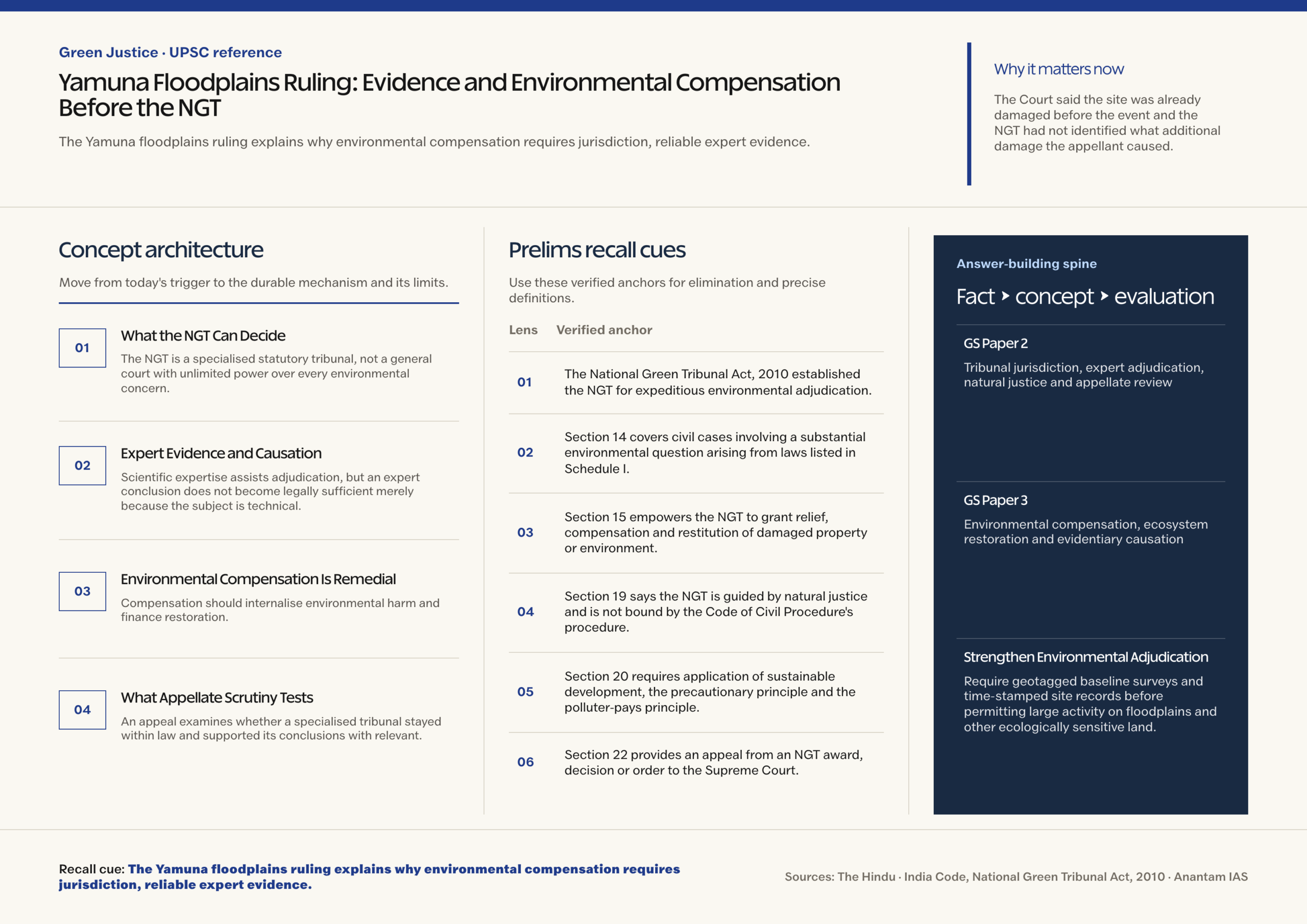
Background and Context
What the NGT Can Decide
The NGT is a specialised statutory tribunal, not a general court with unlimited power over every environmental concern.
- Its original jurisdiction under Section 14 requires a civil case, a substantial environmental question and a connection to an enactment listed in Schedule I.
- Section 15 authorises relief to victims, compensation for damaged property and restitution of the environment, allowing adjudication to combine individual and ecological remedies.
- The tribunal may regulate its own procedure, receive evidence and draw on expert members, but flexibility must remain consistent with natural justice and reasoned decision-making.
- A tribunal should identify the dispute, statutory source of power, liable actor, proved harm and legal basis of each remedy before fixing responsibility.
Expert Evidence and Causation
Scientific expertise assists adjudication, but an expert conclusion does not become legally sufficient merely because the subject is technical.
- A damage assessment needs a credible baseline: the condition of the site before the disputed activity, measured against its condition afterward.
- Satellite images can reveal land-cover change, but date, resolution, interpretation and corroboration determine whether they establish who caused a specific ecological alteration.
- Contemporaneous letters, inspections, photographs, prior restoration orders and site records must be reconciled rather than displaced by one later expert inference.
- Where several actors or pre-existing pressures contributed to degradation, the order must explain incremental harm, attribution and uncertainty instead of assigning the whole condition to one event.
Environmental Compensation Is Remedial
Compensation should internalise environmental harm and finance restoration, not operate as an unexplained penalty detached from proven damage.
- The polluter-pays principle makes a polluter bear prevention and remediation costs, but it still requires a defensible finding that the party caused or contributed to pollution.
- A sound computation connects the affected area, ecological functions, duration, restoration measures and responsible share to the amount imposed.
- The precautionary principle can justify preventive controls amid scientific uncertainty; it does not automatically prove retrospective causation against a named party.
- Public authorities may retain independent restoration duties under the public trust doctrine even when compensation against a private actor is set aside.
What Appellate Scrutiny Tests
An appeal examines whether a specialised tribunal stayed within law and supported its conclusions with relevant, tested material.
- Section 22 permits an aggrieved person to appeal an NGT award, decision or order to the Supreme Court on specified legal grounds.
- Appellate review asks whether relevant evidence was ignored, irrelevant material dominated, findings lacked reasons or the remedy exceeded the dispute actually adjudicated.
- Judicial correction of a liability finding does not erase the ecological problem; it can leave regulatory criticism and restoration directions intact while correcting attribution.
- For durable green justice, a tribunal order must be both scientifically credible and legally reviewable, with a clear chain from evidence to finding to remedy.
Way Forward
Strengthen Environmental Adjudication
- Require geotagged baseline surveys and time-stamped site records before permitting large activity on floodplains and other ecologically sensitive land.
- Use multidisciplinary expert panels with disclosed methods, competing evidence, uncertainty ranges and opportunities for affected parties to respond.
- Adopt transparent compensation protocols that separate proven incremental damage, restoration cost, deterrence and each actor’s contribution.
- Track compliance with restoration orders independently of compensation litigation so ecosystem repair does not wait for final allocation of liability.
Conclusion
- The ruling’s durable lesson is not weaker floodplain protection; it is that environmental liability must be evidenced, causally attributed and matched to a reasoned remedy.
- A balanced Mains answer should defend precautionary regulation and public restoration while insisting that expert material be tested before imposing compensation on a specific party.
UPSC Practice Questions
Prelims MCQ 1
With reference to the National Green Tribunal Act, 2010, consider the following statements:
- The NGT may order restitution of a damaged environment.
- The NGT is bound by the procedure laid down in the Code of Civil Procedure, 1908.
- The NGT must apply the precautionary principle and polluter-pays principle while passing orders or awards.
How many of the above statements are correct?
(a) Only one (b) Only two (c) All three (d) None
Answer: (b) Only two
Explanation:
Statements 1 and 3 are correct under Sections 15 and 20. Under Section 19, the NGT is guided by natural justice and is not bound by CPC procedure.
Prelims MCQ 2
An appeal against an award, decision or order of the National Green Tribunal lies directly to which institution under Section 22 of the NGT Act?
(a) The concerned High Court (b) The Central Pollution Control Board (c) The Supreme Court of India (d) The Ministry of Environment, Forest and Climate Change
Answer: (c) The Supreme Court of India
Explanation:
Section 22 provides a statutory appeal from an NGT award, decision or order to the Supreme Court.
UPSC Mains Questions
- Environmental compensation must be restorative, but it cannot be detached from proof of causation. Discuss with reference to the powers of the National Green Tribunal.
- How can expert evidence and appellate review strengthen rather than weaken environmental justice in India?
Sources: The Hindu and India Code, National Green Tribunal Act, 2010.
Frequently Asked Questions
What was the central evidentiary issue in the Yamuna floodplains ruling?
The Court found that pre-existing degradation and other contemporaneous material were not adequately tested before attributing additional damage to the appellant.
Can the NGT order environmental restoration?
Yes. Section 15 empowers the NGT to order restitution of damaged property and the environment, alongside relief and compensation within its statutory jurisdiction.
Does the polluter-pays principle remove the need to prove causation?
No. It determines who should bear prevention and remediation costs after responsibility is established; it does not replace evidence connecting a party to the harm.
Why does baseline evidence matter in environmental cases?
A reliable baseline separates pre-existing degradation from incremental harm, allowing experts and adjudicators to identify change, attribute responsibility and design proportionate restoration.
Can restoration continue when private compensation is set aside?
Yes. A public authority’s management and restoration duties may survive because they arise from regulatory obligations and public trust, independently of disputed private liability.