Zaporizhzhia Power Loss: Why Off-Site Electricity Is a Nuclear Safety Pillar
Why in News?
On 29 August 2026, the IAEA reported that the Zaporizhzhia Nuclear Power Plant had remained without off-site power for more than a week and was relying on emergency diesel generators.
- The plant lost its sole remaining 330 kV off-site line on 20 August, leaving several emergency diesel generators to supply essential loads.
- Electricity was needed primarily for pumps cooling the six shut-down reactors and their spent-fuel pools.
- The IAEA was told on 28 August that diesel available on site could support operations for about 10 days under the prevailing configuration.
- This was a warning about eroded defence in depth, not evidence of radiation release or reactor-core damage.
- A reactor stops producing electricity after shutdown, but radioactive fission products continue releasing decay heat that must be removed.
- Off-site grid power is the preferred supply for cooling, instrumentation and other safety functions; diesel generators are a temporary on-site backup.
- The episode connects nuclear engineering with disaster-risk reduction: safety depends on equipment, electricity, fuel logistics, staff access and communication working together.
UPSC Relevance
Prelims Relevance
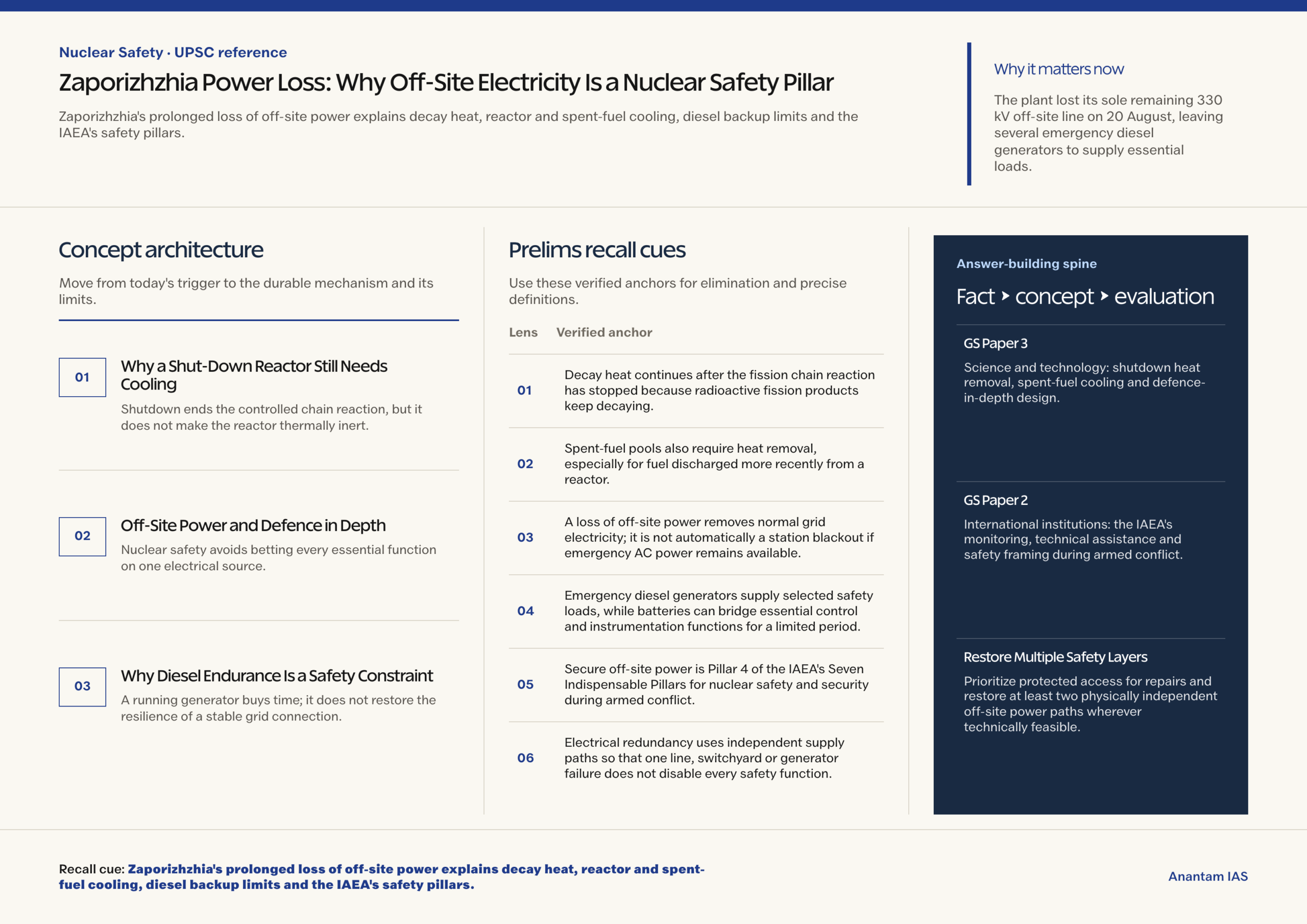
- Decay heat continues after the fission chain reaction has stopped because radioactive fission products keep decaying.
- Spent-fuel pools also require heat removal, especially for fuel discharged more recently from a reactor.
- A loss of off-site power removes normal grid electricity; it is not automatically a station blackout if emergency AC power remains available.
- Emergency diesel generators supply selected safety loads, while batteries can bridge essential control and instrumentation functions for a limited period.
- Secure off-site power is Pillar 4 of the IAEA’s Seven Indispensable Pillars for nuclear safety and security during armed conflict.
- Electrical redundancy uses independent supply paths so that one line, switchyard or generator failure does not disable every safety function.
Mains Relevance
GS Paper 3
- Science and technology: shutdown heat removal, spent-fuel cooling and defence-in-depth design.
- Disaster management: cascading infrastructure failure, backup endurance and continuity of critical services.
GS Paper 2
- International institutions: the IAEA’s monitoring, technical assistance and safety framing during armed conflict.
- International relations: protection of civilian nuclear facilities and the limits of technical oversight in conflict zones.
Essay
- Resilience is not the absence of failure; it is the ability of independent safeguards to prevent one failure from becoming a catastrophe.
Background and Context
Why a Shut-Down Reactor Still Needs Cooling
Shutdown ends the controlled chain reaction, but it does not make the reactor thermally inert. The heat decline is gradual, not an on-off switch.
- Unstable fission products continue radioactive decay and release decay heat; this heat falls over time but initially remains high enough to demand reliable removal.
- Cooling systems carry residual heat from the reactor core to an ultimate heat sink, preventing fuel and coolant temperatures from rising unchecked over time.
- Used fuel stored underwater also generates heat. The pool’s water removes heat, provides radiation shielding and must remain at a safe level.
- Cold shutdown substantially lowers heat demand, but pumps, valves, controls, monitoring and water-management systems still need dependable power to preserve stable conditions.
- The key exam distinction is simple: reactor shutdown stops power production; safe shutdown also requires continuing heat removal and monitoring.
Off-Site Power and Defence in Depth
Nuclear safety avoids betting every essential function on one electrical source.
- The grid normally supplies robust, continuous electricity to plant auxiliaries, including cooling pumps, instrumentation, ventilation and water-treatment systems that support safe conditions.
- Independent off-site connections reduce common-cause failure: damage to one line or switchyard should not remove every physically separated external supply path.
- On-site diesel generators form another protective layer and are designed to start automatically when qualified safety buses lose normal power, supplying prioritized essential loads.
- Batteries support selected direct-current loads and controls during transfer, but their stored energy is finite and cannot replace sustained high-power cooling indefinitely.
- A station blackout is the more severe condition in which both off-site AC power and on-site emergency AC power are unavailable.
Why Diesel Endurance Is a Safety Constraint
A running generator buys time; it does not restore the resilience of a stable grid connection.
- Diesel endurance depends on fuel inventory, generator loading, maintenance condition, cooling, lubricants and the ability to rotate or repair units; a stated runtime is conditional.
- Fuel stored on site creates an endurance window. Once replenishment becomes uncertain, secure transport and access routes become part of the nuclear-safety system.
- Several generators may provide equipment redundancy, yet they can remain exposed to shared hazards such as damaged supply routes or impaired maintenance access.
- Restoring multiple independent off-site connections reduces reliance on consumable fuel and returns the plant to a stronger layer of defence in depth.
- Neither generator operation nor a normal radiation reading proves that the underlying risk has vanished; both describe the plant’s condition at a particular time and require continued verification.
Way Forward
Restore Multiple Safety Layers
Risk falls when power, fuel and oversight are secured together rather than treated as separate problems.
- Prioritize protected access for repairs and restore at least two physically independent off-site power paths wherever technically feasible.
- Maintain verified diesel stocks, tested generators, spare parts and secure replenishment routes for the full period assumed in emergency plans.
- Keep reactor, spent-fuel, electrical and radiation parameters under continuous monitoring, with prompt reporting to the regulator and the IAEA.
- Use the IAEA’s safety pillars as a minimum operating frame: protect equipment, staff, power, logistics, emergency preparedness and reliable communication.
Conclusion
- Off-site electricity is a nuclear safety input because cooling and monitoring continue after generation stops; backup diesel reduces immediate risk but has finite endurance.
- In a Mains answer, frame the issue through defence in depth: independent grid lines, emergency power, fuel logistics, trained staff, monitoring and international oversight must reinforce one another.
- The durable lesson is to distinguish a serious loss of safety margin from an accident already in progress; the evidence supported the former, not claims of core damage or radiation release.
UPSC Practice Questions
Prelims MCQ 1
With reference to electrical safety at a nuclear power plant, consider the following statements:
- Decay heat continues to be produced after the fission chain reaction is stopped.
- A loss of off-site power necessarily means that all on-site AC power is also unavailable.
- Spent-fuel pools may require active cooling and monitoring even when reactors are shut down.
How many of the above statements are correct?
(a) Only one (b) Only two (c) All three (d) None
Answer: (b) Only two
Explanation:
Statements 1 and 3 are correct. Off-site power can be lost while emergency diesel generators continue supplying on-site safety buses, so Statement 2 is incorrect.
Prelims MCQ 2
Which one of the following best describes a station blackout at a nuclear power plant?
(a) Loss of the reactor’s ability to generate electricity while grid power remains available (b) Loss of off-site AC power together with on-site emergency AC power (c) Automatic shutdown of a reactor following a grid disturbance (d) Temporary loss of one transmission line while another line supplies the plant
Answer: (b) Loss of off-site AC power together with on-site emergency AC power
Explanation:
A station blackout is more severe than a loss of off-site power because the emergency AC sources are also unavailable; limited battery-backed DC power may remain.
UPSC Mains Questions
- A nuclear reactor’s need for safety-grade electricity does not end when power generation stops. Explain with reference to decay heat, spent-fuel cooling and defence in depth.
- Repeated loss of off-site power at a nuclear facility is both an engineering and a governance challenge. Discuss the role of redundancy, logistics, emergency preparedness and international monitoring.
Sources: The Hindu, citing IAEA and International Atomic Energy Agency, Update 364.
Frequently Asked Questions
Why does a shut-down nuclear reactor still need electricity?
Radioactive fission products continue producing decay heat after shutdown. Electricity runs pumps, valves, controls and monitoring equipment that remove this heat and keep the reactor in a safe state.
What is off-site power at a nuclear plant?
Off-site power is electricity received from the external grid through transmission lines and switchyards. It normally supplies the plant’s auxiliary and safety-related electrical loads.
Are emergency diesel generators enough for long-term safety?
They provide crucial backup, but their endurance depends on fuel, maintenance, cooling and resupply. Stable, redundant grid connections remain the preferred long-duration electrical source.
Does loss of off-site power mean a nuclear accident has occurred?
No. It is a serious reduction in safety margin. If emergency power keeps cooling and monitoring functional, loss of off-site power does not by itself establish core damage or radiation release.
Which IAEA safety pillar covers electricity supply?
Pillar 4 of the IAEA’s Seven Indispensable Pillars states that a secure off-site power supply from the grid must exist for all nuclear sites.