Zojila Tunnel Project
Why in News?
The Zojila Tunnel Project achieved the final breakthrough when the excavation faces from the Kashmir and Ladakh sides met beneath the Zojila Pass.
The project is expected to be fully commissioned around 2028 and will provide all-weather connectivity between the Kashmir Valley and Ladakh.
| UPSC Relevance: GS-1 Geography: Locations; GS-3 Economy: Infrastructure Prelims: Zojila Tunnel Project |
About Zojila Tunnel:
- The Zojila Tunnel is an under-construction all-weather high-altitude road tunnel beneath the Zojila Pass on the Srinagar-Leh National Highway.
- Key Features
- Length: 13.14-13.15 km
- Altitude: 11,578 feet (≈3,500 m)
- Location: Between Baltal (Kashmir) and Minamarg/Meenamarg (Ladakh)
- Cost: Approximately ₹6,500-6,800 crore
- Implementing Agency: National Highways and Infrastructure Development Corporation Limited
- Geological Zone: Seismic Zone IV
- Construction Technique: New Austrian Tunnelling Method (NATM)
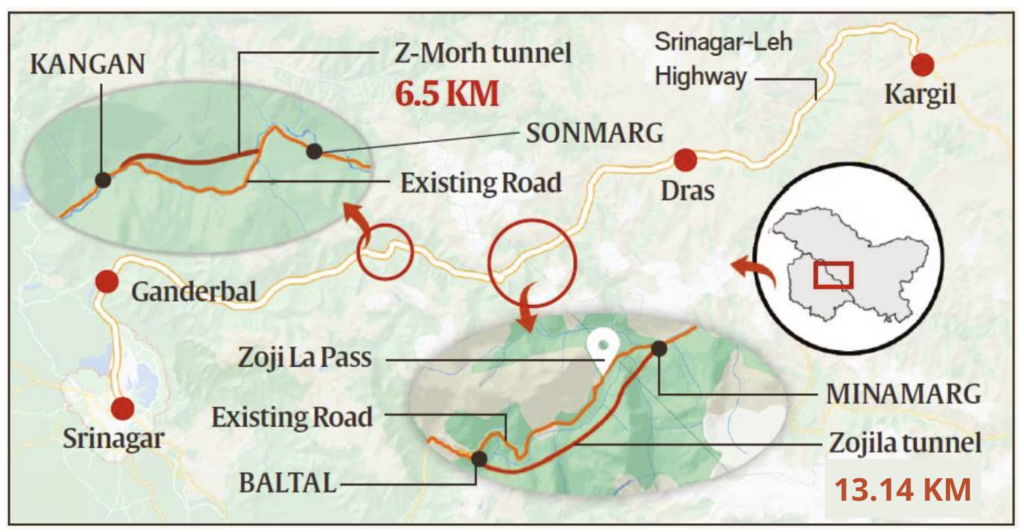
The strategic Zojila Pass connects the Kashmir Valley (specifically Srinagar) to its west with the Ladakh region (specifically Leh, via the Dras and Suru valleys) to its northeast.
Why was the Tunnel Needed?
Seasonal Isolation of Ladakh:
- Historically, the Zojila Pass has been one of the most difficult mountain passes in India.
- Heavy snowfall and avalanches regularly block the pass.
- The route traditionally remained inaccessible for nearly 160-180 days annually.
- Even after improved snow-clearing operations, closures continue depending on weather conditions.
- Such disruptions isolate Ladakh from the Kashmir Valley and the rest of India for extended periods.
Lifeline for Defence Logistics:
- The Srinagar-Leh highway passing through Zojila is the primary supply route for troops deployed in Ladakh, including those stationed in the Siachen Glacier region and along the Line of Actual Control (LAC) with China. The tunnel will ensure the uninterrupted movement of troops, Heavy military equipment, fuel, ammunition, and emergency reinforcements throughout the year.
Lessons from Kargil and Galwan:
- The Kargil War (1999) highlighted the vulnerability of supply routes passing through the Zojila region. Pakistani intrusions targeted heights overlooking the highway to disrupt Indian logistics.
- The Galwan Clash (2020) reinforced the need for rapid troop mobilisation and reliable connectivity in high-altitude border regions.
As a result, border infrastructure development became a major strategic priority.
Connectivity Benefits:
- Reduction in Travel Time: The tunnel will dramatically improve transportation efficiency.
- Present Situation: Time across the Zojila Stretch is around 90 minutes to 3 hours, depending on conditions.
- After Completion: About 15-20 minutes
- Integration with Z-Morh Tunnel: The recently operational Z-Morh Tunnel and the Zojila Tunnel together will create seamless year-round connectivity on the Srinagar-Leh corridor.
- Tourism Growth: The tunnel is expected to boost tourism in Ladakh and Kargil. Promote winter tourism. It will also improve access to Baltal, the base camp for the annual Amarnath Yatra.
- Regional Development: Year-round connectivity can reduce transportation costs, improve agricultural market access, facilitate movement of goods and services and encourage private investment.
Part of a Larger Border Infrastructure Strategy:
The Zojila Tunnel is not an isolated project. According to government data:
- 31 border road tunnels are under construction in Jammu & Kashmir and Ladakh. These include 20 tunnels in Jammu & Kashmir and 11 in Ladakh.
- They form part of a broader set of 73 border infrastructure projects aimed at strengthening connectivity and strategic preparedness along India’s northern frontiers.
The initiative reflects India’s shift towards developing robust infrastructure in border regions to support both security and socio-economic objectives.