Cycle of Erosion: Davis, Penck and King Compared
Davis's geographical cycle, Penck's slope replacement and King's pediplanation set against one another, with the panplain and etchplain alternatives and the reasons cyclic models fell from favour.
The cycle of erosion is geomorphology’s founding theory of how a landscape evolves through time, and the argument between its three great versions, from William Morris Davis, Walther Penck and Lester King, is really an argument about a single question: does a slope wear down or wear back? Everything else follows from the answer.
The three models are usually learned as a list of stages. They are far more useful learned as three answers to that one question, because then the differences between them become predictions that can be tested against a real landscape.
Davis: the Geographical Cycle
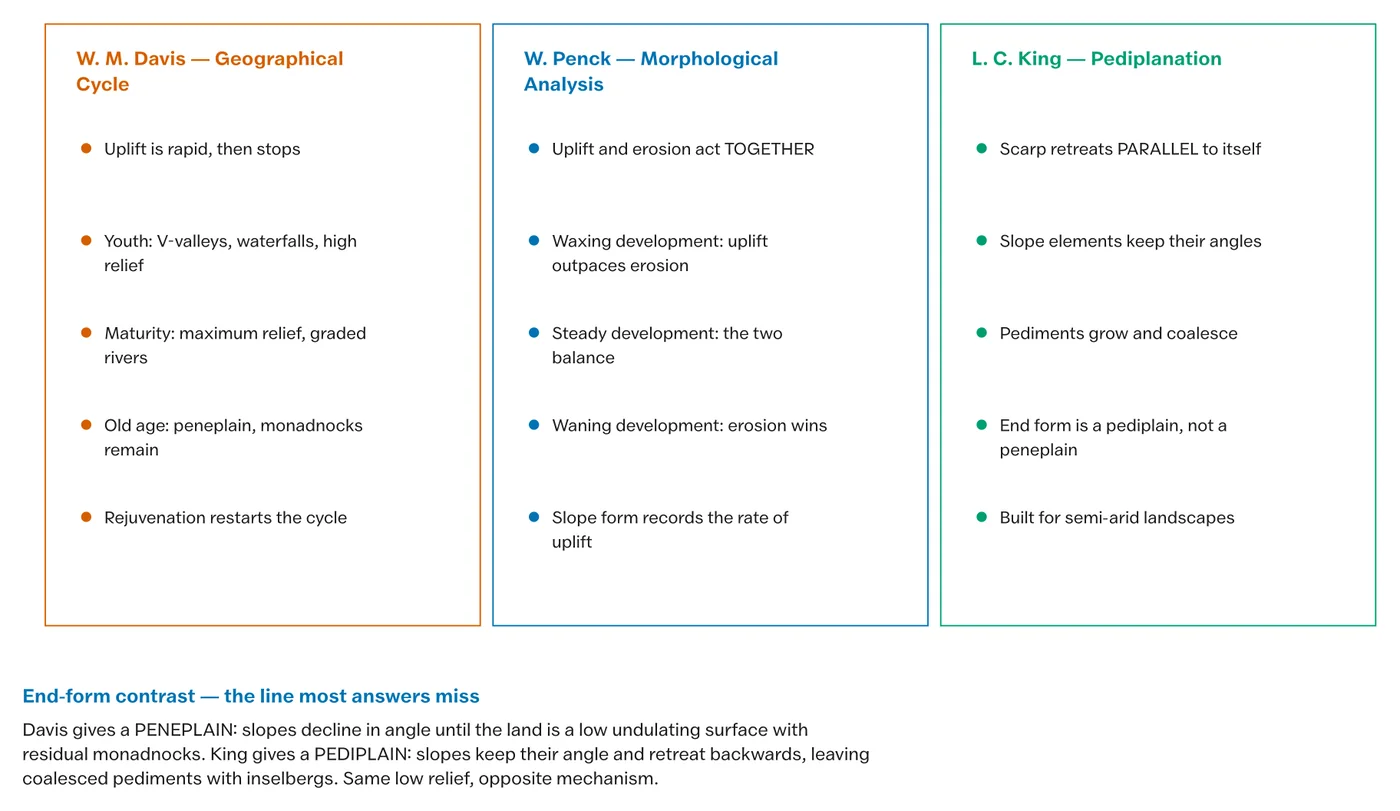
William Morris Davis published his cycle in 1899 and it dominated the subject for half a century. His scheme assumes rapid uplift followed by prolonged tectonic quiet, during which erosion works uninterrupted.
| Stage | Relief | Valleys | Slopes | Drainage |
|---|---|---|---|---|
| Youth | Increasing | Narrow V-shaped gorges, rapids and falls | Steep and irregular | Poorly integrated, lakes and swamps common |
| Maturity | At maximum | Wide, graded, well-developed | Smoothly graded, convex above and concave below | Fully integrated, maximum drainage density |
| Old age | Low | Very broad, meandering on wide floodplains | Gentle, declining | Sluggish, with monadnocks standing above the surface |
The endpoint is the peneplain, an almost-plain of very low relief, with occasional resistant residuals called monadnocks rising above it. The mechanism throughout is slope decline: slopes become progressively gentler as the landscape wastes downward.
Davis also allowed for interruption. Renewed uplift or a fall in sea level restarts the cycle, producing rejuvenation with its incised meanders, river terraces and knickpoints. A landscape can therefore carry evidence of several cycles at once, which is the basis of denudation chronology.
Penck: Slope Replacement
Walther Penck, writing in the 1920s, rejected Davis’s central assumption. Uplift and erosion are not sequential; they are simultaneous, and the form of a landscape records the ratio between the rate of uplift and the rate of downcutting.
- Waxing development (aufsteigende Entwicklung), where uplift accelerates and convex slopes form.
- Uniform development, where uplift and erosion are in balance and straight slopes form.
- Waning development (absteigende Entwicklung), where uplift slows and concave slopes form.
His slope mechanism is parallel retreat with slope replacement. The steepest element retreats, and as it does a gentler element extends upward from below and replaces it. The slope does not become gentler overall; it is progressively consumed from beneath while its angle is preserved. Debris accumulates at the base as a concave haldenhang. The endpoint is the endrumpf, a reduced surface reached by waning development, distinct from Davis’s peneplain in origin though similar in appearance.
Davis read a landform as a stage in a sequence. Penck read it as a record of the ratio between uplift and erosion at the moment it formed.
King: Pediplanation and Parallel Retreat
Lester King, working in southern Africa in the 1940s and 1950s, generalised Penck’s parallel retreat and built a cycle for semi-arid and savanna landscapes, where the dominant process is scarp retreat rather than valley deepening.
His standard slope has four elements, and naming them in order is the core of any answer on King.
- The waxing slope, a convex crest where weathering dominates.
- The free face, a steep bare rock cliff from which material is shed. This is the element that retreats.
- The debris slope, a straight scree accumulation at the angle of rest.
- The pediment, a gently concave rock-cut surface extending outward, thinly veneered with sediment.
As the free face retreats parallel to itself, the pediment at its base extends. Neighbouring pediments eventually meet and coalesce into a pediplain, above which isolated steep-sided residuals called inselbergs stand. The critical distinction from Davis is that relief is not reduced gradually across the whole landscape. It is consumed from the edges inward, and until it is consumed the slopes retain their angle.
The Three Compared
| Davis | Penck | King | |
|---|---|---|---|
| Tectonic assumption | Rapid uplift, then quiescence | Uplift and erosion simultaneous | Episodic uplift, long stillstands |
| Slope behaviour | Decline: slopes flatten | Replacement: consumed from below, angle kept | Parallel retreat: angle kept, backwearing |
| Dominant process | Downwearing | Ratio-dependent | Backwearing |
| Endpoint | Peneplain with monadnocks | Endrumpf | Pediplain with inselbergs |
| Climate assumed | Humid temperate | Not specified | Semi-arid and savanna |
The modern position is that all three describe real behaviour under different conditions. Downwearing dominates in humid regions with a continuous soil and vegetation cover, where mass movement is slow and diffuse. Backwearing dominates in semi-arid regions with bare rock faces, where undercutting and rockfall are efficient. Penck’s insight that form records the uplift-to-erosion ratio is the one most fully vindicated by modern work on tectonic geomorphology.
Two Further Endpoints
Davis, Penck and King are not the only proposals, and two more appear in question papers often enough to be worth knowing.
- Panplain, from C.H. Crickmay. A plain formed not by downwasting but by the lateral coalescence of adjacent floodplains, as meander belts widen until the interfluves between them are consumed. It requires lateral corrasion to do the work Davis assigned to slope decline.
- Etchplain, from Julius Büdel. Deep chemical weathering under a humid tropical climate rots the rock to considerable depth; a later change of climate or base level strips the weathered mantle, exposing an irregular basal weathering surface. The plain is etched out from below rather than worn down from above, and the tors and inselbergs left standing are the parts of that basal surface that resisted rotting.
Büdel’s scheme also gives geomorphology its climatic dimension, in the concept of the morphogenetic region: a region in which a distinctive combination of climate-controlled processes produces a characteristic assemblage of landforms.
Why the Cycle Concept Fell Out of Favour
- The tectonic assumption is unrealistic. Uplift is rarely a single rapid event followed by quiet; it is usually episodic or continuous, which is Penck’s point.
- The stages are not verifiable. Youth, maturity and old age are analogies, and no absolute timescale attaches to them.
- Full peneplains are rare. Very few undisputed examples exist, because the tectonic quiet required is longer than most regions get.
- It is qualitative. Modern geomorphology measures process rates directly, using cosmogenic nuclides and sediment yields, rather than inferring history from form.
What survives is substantial: the idea that landscape has a history readable from its form, the concept of grade, the recognition of rejuvenation, and the whole practice of denudation chronology, which is how the erosion surfaces of peninsular India were mapped.
Practice Questions
Prelims
1. The endpoint of Davis’s geographical cycle is the
- (a) pediplain
- (b) endrumpf
- (c) peneplain
- (d) etchplain
Answer: (c)
2. Parallel retreat of slopes is most closely associated with
- (a) W.M. Davis
- (b) Walther Penck and Lester King
- (c) Julius Büdel
- (d) C.H. Crickmay
Answer: (b)
3. Inselbergs are residual hills standing above a
- (a) peneplain
- (b) pediplain
- (c) panplain
- (d) floodplain
Answer: (b)
4. Waxing development in Penck’s scheme corresponds to slopes that are
- (a) concave
- (b) straight
- (c) convex
- (d) stepped
Answer: (c)
5. A panplain is formed chiefly by
- (a) deep chemical weathering and stripping
- (b) lateral coalescence of floodplains
- (c) parallel scarp retreat
- (d) glacial scour
Answer: (b)
Mains
- Describe the stages of Davis’s geographical cycle and identify its endpoint. (10 marks)
- Distinguish between slope decline, slope replacement and parallel retreat. (10 marks)
- Compare the models of Davis, Penck and King, and state the conditions under which each best applies. (15 marks)
- “Penck read landform as a record of the ratio between uplift and erosion.” Examine this statement. (15 marks)
- Assess the continuing relevance of cyclic models of landscape evolution in modern geomorphology. (20 marks)