Determinism, Possibilism and Probabilism in Geography
The oldest argument in human geography: environmental determinism from Ratzel to Huntington, possibilism from Vidal de la Blache, and the middle positions of probabilism and stop-and-go determinism.
Determinism and possibilism is the oldest argument in human geography and the one that shaped the discipline’s sense of itself. The question is simple to state and hard to settle: does the physical environment determine how people live, or does it merely offer a set of options from which a culture chooses? A century of answers has produced two hard positions, one useful middle position, and a lasting change in how geographers write.
The argument is worth learning properly rather than as a pair of slogans, because the strongest treatments name the specific claims each side actually made and the specific reasons determinism collapsed.
Environmental Determinism
Determinism holds that physical environment governs human activity, social organisation and cultural development. Its lineage runs from classical antiquity through to the early twentieth century, when it was the discipline’s orthodoxy.
- Friedrich Ratzel imported an organic analogy from biology, treating the state as an organism that grows, requires living space, and competes for territory. His Anthropogeographie made environment the driver of human distribution.
- Ellen Churchill Semple, his student, carried the position into English. Her opening line, that man is a product of the earth’s surface, is the most quoted sentence in the tradition and the fairest summary of it.
- Ellsworth Huntington pushed it furthest, arguing in Civilization and Climate that climate determines energy, efficiency and ultimately civilisation itself, with the temperate zones inevitably advantaged.
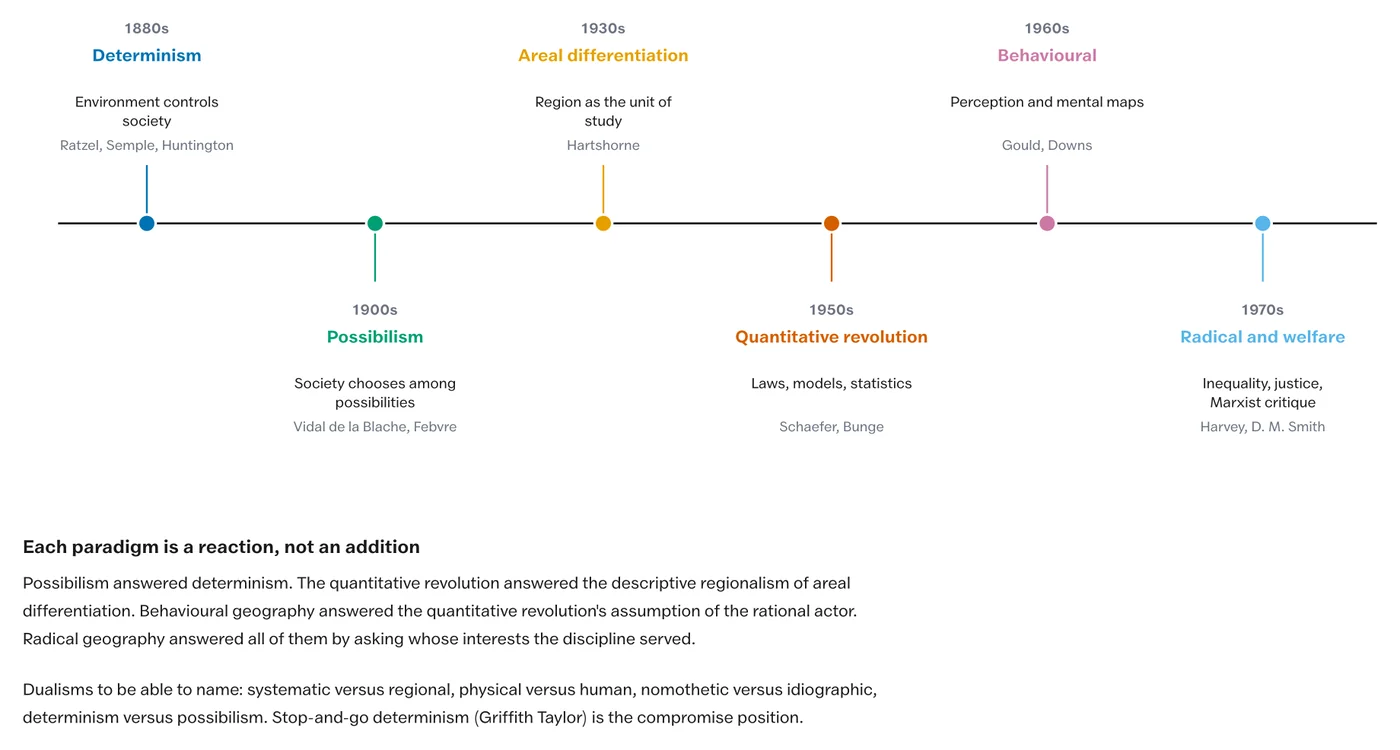
The position collapsed for three reasons, and naming all three is what a full answer requires. It was empirically wrong, since similar environments plainly support very different societies and the same environment supports different societies at different times. It was methodologically weak, resting on selected correlations rather than on mechanisms. And it was put to political use, supplying an intellectual justification for colonial rule and for racial hierarchy, which is why the reaction against it was as much moral as scientific.
Possibilism
Possibilism holds that the environment offers a range of possibilities, and that which of them is taken up is decided by a culture’s values, history and technology. Nature proposes; society disposes.
- Paul Vidal de la Blache founded the French school and made genre de vie, the way of life, his central concept: the accumulated technical and cultural repertoire through which a community works its environment.
- Lucien Febvre, a historian, gave the doctrine its name and its sharpest formulation, that there are no necessities but everywhere possibilities.
- Jean Brunhes extended it into the detailed study of the human occupance of small regions.
Possibilism corrected determinism’s central error and introduced a lasting one of its own. If the environment merely offers options, it is hard to explain why particular options are taken so consistently in particular places. Taken strictly, possibilism makes environment almost irrelevant, which is no more defensible than making it everything.
Probabilism and the Middle Positions
Two intermediate formulations resolve most of the difficulty, and knowing both is what distinguishes a considered treatment.
| Position | Proposed by | The claim |
|---|---|---|
| Probabilism | O.H.K. Spate | Environment neither dictates nor merely permits. It makes some outcomes more probable than others, because some possibilities are far cheaper in labour and capital than others. |
| Stop-and-go determinism | Griffith Taylor | Environment sets the pace and the ultimate limits of development while leaving the direction to society. Nature signals stop and go; society chooses the route. |
Probabilism is the more useful of the two because it restores a weighting that possibilism removed. Wet rice on the Bengal delta and pastoralism on the Thar are not arbitrary selections from an open menu. They are the high-probability outcomes given the moisture available, and a society choosing otherwise pays a heavy and continuing cost to do so.
Determinism made environment the cause. Possibilism made it the stage. Probabilism makes it the odds.
Where the Argument Stands Now
No serious geographer holds strict determinism today, but environmental explanation has returned in qualified forms that are worth naming because they are the contemporary half of the question.
- Political ecology rejects both poles, arguing that environmental outcomes are produced by the interaction of ecological conditions with unequal political and economic power. Drought becomes famine through entitlement failure, not through rainfall alone.
- Cultural ecology, from Julian Steward, studies how specific cultural practices adapt to specific environmental constraints, which is possibilism with a mechanism attached.
- Neo-determinism appears in work such as Jared Diamond’s, arguing that continental axis orientation and the availability of domesticable species shaped the broad course of history. It is empirically richer than Huntington and attracts the same objection: it explains too much from too little.
- Climate change research has revived environmental causation legitimately, since sea-level rise and heat stress genuinely constrain what societies can do, while leaving the distribution of the damage to be explained politically.
Why the Debate Still Matters
It is tempting to treat this as an exhausted quarrel between dead scholars. Three things keep it live.
- It fixed the discipline’s self-definition. Geography’s insistence on studying environment and society together, rather than either alone, is the settlement this argument produced.
- It supplies the vocabulary for contemporary questions. Every debate about climate vulnerability, disaster risk and resource conflict is a version of it.
- It is a caution about method. Determinism failed because it read correlation as cause and generalised from selected cases, and that failure mode has not gone away.
What is environmental determinism?
The position that the physical environment governs human activity, social organisation and cultural development. Its principal figures are Friedrich Ratzel, Ellen Churchill Semple and Ellsworth Huntington, who argued that climate determines energy, efficiency and civilisation itself.
What is possibilism?
The position that the environment offers a range of possibilities and that culture, history and technology decide which are taken up. Paul Vidal de la Blache founded the school, Lucien Febvre named the doctrine, and genre de vie, the way of life, is its central concept.
Who gave the concept of probabilism?
O.H.K. Spate. He argued that environment neither dictates outcomes nor merely permits them, but makes some outcomes more probable than others, because some possibilities are far cheaper in labour and capital than the alternatives.
What is stop-and-go determinism?
Griffith Taylor’s formulation that environment sets the pace and the ultimate limits of development while leaving the direction to society. In his image, nature signals stop and go while society chooses the route.
Why did environmental determinism decline?
For three reasons together. It was empirically wrong, since similar environments support very different societies. It was methodologically weak, resting on selected correlations rather than mechanisms. And it was used to justify colonial rule and racial hierarchy, which made the reaction against it moral as well as scientific.
Is environmental determinism completely dead?
Strict determinism is. Qualified environmental explanation has returned through political ecology, cultural ecology, neo-determinist work such as Jared Diamond’s, and climate change research, all of which allow environment real causal force while leaving the distribution of outcomes to be explained socially.
Practice Questions
Prelims
1. The phrase genre de vie is associated with
- (a) Friedrich Ratzel
- (b) Ellen Churchill Semple
- (c) Paul Vidal de la Blache
- (d) Griffith Taylor
Answer: (c)
2. Probabilism was proposed by
- (a) Lucien Febvre
- (b) O.H.K. Spate
- (c) Ellsworth Huntington
- (d) Jean Brunhes
Answer: (b)
3. Civilization and Climate was written by
- (a) Ratzel
- (b) Semple
- (c) Huntington
- (d) Taylor
Answer: (c)
4. Stop-and-go determinism holds that environment determines
- (a) the direction of development only
- (b) the pace and limits of development, not its direction
- (c) nothing at all
- (d) both the pace and the direction
Answer: (b)
5. The organic analogy treating the state as a growing organism was introduced by
- (a) Vidal de la Blache
- (b) Ratzel
- (c) Febvre
- (d) Spate
Answer: (b)
Mains
- Distinguish between determinism and possibilism, naming the principal figures of each. (10 marks)
- Explain the concept of genre de vie and its place in the possibilist argument. (10 marks)
- “Environment makes some outcomes more probable than others.” Examine probabilism as a resolution of the determinism-possibilism debate. (15 marks)
- Account for the decline of environmental determinism in the twentieth century. (15 marks)
- Has environmental determinism returned in a new form? Discuss with reference to political ecology and contemporary climate research. (20 marks)