Difference Between Plant Cell and Animal Cell (With Comparison Table and Diagram)
A plant cell carries a cellulose cell wall, plastids and a large central vacuole; an animal cell carries centrioles and abundant lysosomes instead. Here is the full comparison, structure by structure.
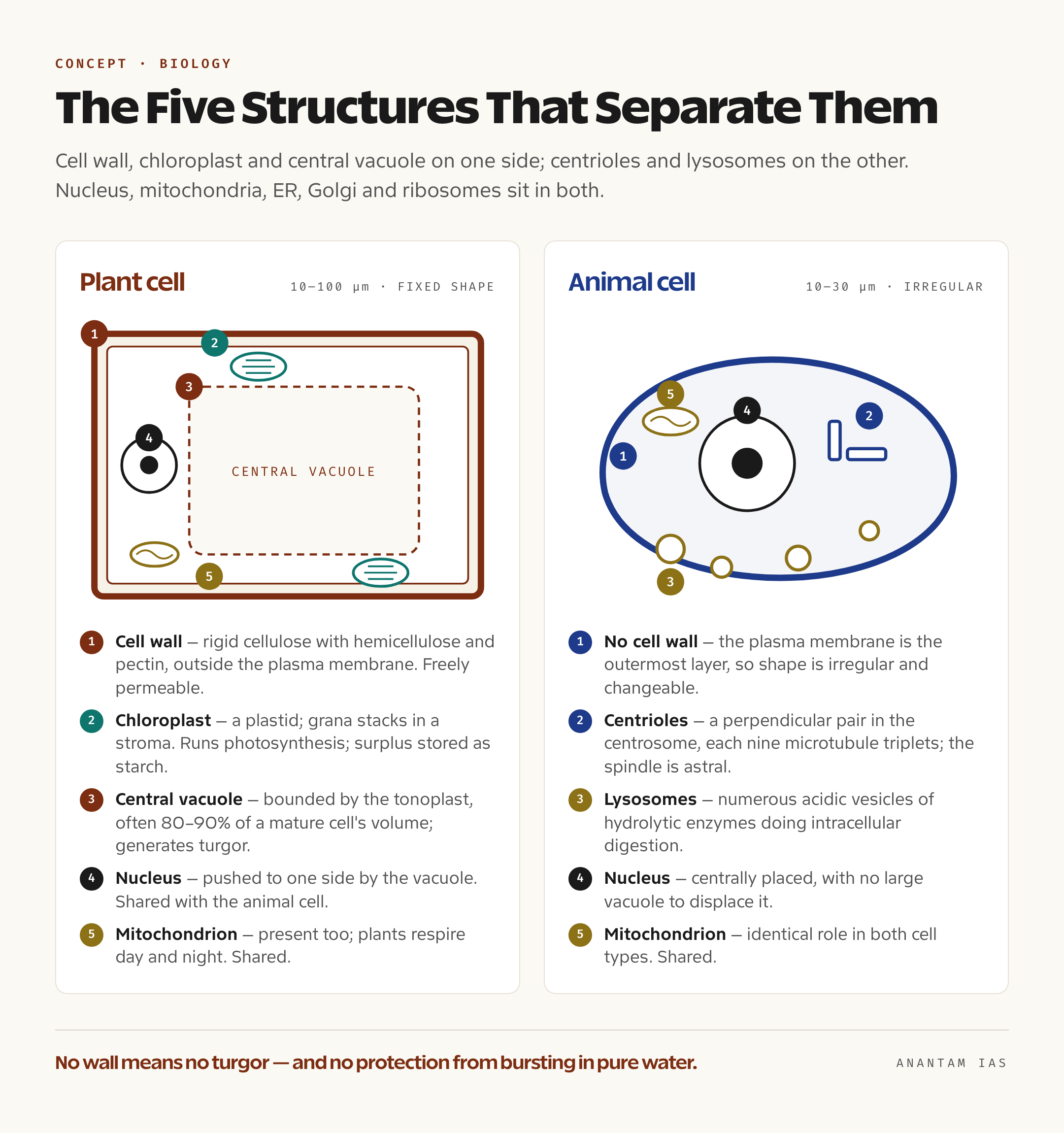
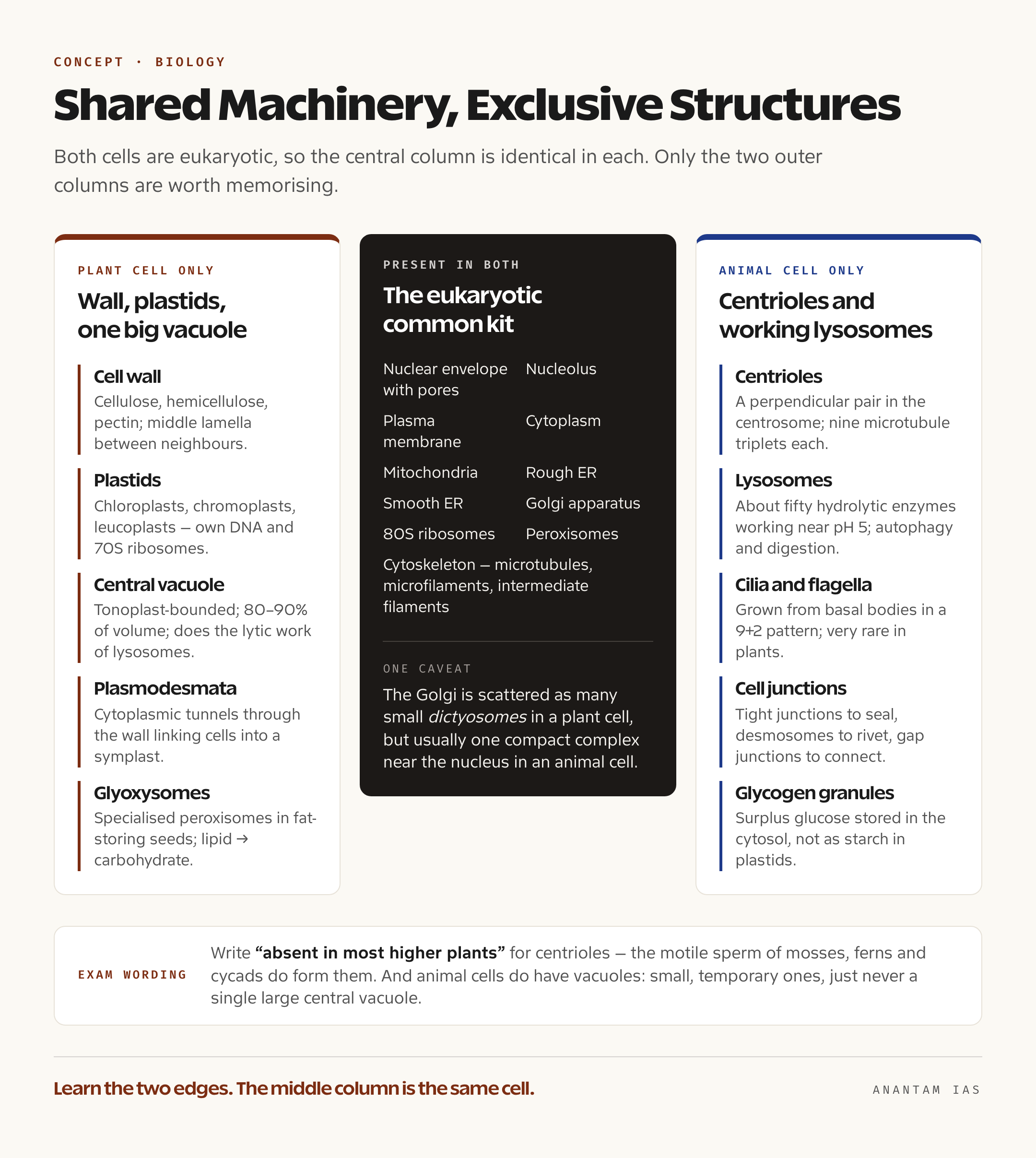
A plant cell has three things an animal cell simply does not have: a rigid cellulose cell wall outside the plasma membrane, plastids (including the chloroplasts that run photosynthesis), and one large central vacuole that can occupy most of the cell’s volume. An animal cell has two things most mature plant cells lack: a pair of centrioles inside the centrosome, and a working population of lysosomes. Everything else — nucleus, mitochondria, endoplasmic reticulum, Golgi complex, ribosomes, plasma membrane, cytoskeleton — is shared by both.
That short list explains almost every downstream difference you will read about. Because a plant cell is boxed in by a wall, it holds a fixed shape and survives being dunked in pure water. Because it makes its own food, it stores the surplus as starch. Because an animal cell has no wall, it stays flexible, changes shape, and has to control its internal salt balance far more carefully. Getting these five structures right is the whole topic.
Defining Each Term
A plant cell is the eukaryotic structural unit of members of the kingdom Plantae. Eukaryotic means its genetic material sits inside a true membrane-bound nucleus. The plant cell’s defining feature is the cell wall — a layer of cellulose microfibrils embedded in a matrix of hemicellulose and pectin, laid down outside the plasma membrane, typically 0.1 to several micrometres thick. Inside, a mature plant cell is dominated by a central vacuole bounded by a membrane called the tonoplast, and it carries plastids: chloroplasts (green, photosynthetic, holding chlorophyll), chromoplasts (carrying carotenoid pigments, as in a ripe tomato) and leucoplasts (colourless storage plastids such as the amyloplasts that pack starch into a potato). Typical size runs from about 10 to 100 micrometres.
An animal cell is the eukaryotic structural unit of members of the kingdom Animalia. It has no wall — the plasma membrane is the outermost boundary — so its shape is irregular and can change from minute to minute. It contains a centrosome holding two centrioles at right angles, each built from nine triplets of microtubules, which organises the spindle during division and gives rise to the basal bodies of cilia and flagella. Animal cells are usually smaller, roughly 10 to 30 micrometres across, and depend on lysosomes — acidic vesicles full of hydrolytic enzymes — for intracellular digestion. Being heterotrophic, animal cells take in ready-made organic food and store surplus carbohydrate as glycogen.
Both are eukaryotic, so both share the nuclear envelope with pores, nucleolus, rough and smooth endoplasmic reticulum, Golgi apparatus, mitochondria, peroxisomes, 80S ribosomes and a cytoskeleton of microtubules, microfilaments and intermediate filaments.
The Key Differences at a Glance
| Basis of comparison | Plant cell | Animal cell |
|---|---|---|
| Cell wall | Present — rigid, mainly cellulose with hemicellulose and pectin, outside the plasma membrane | Absent — plasma membrane is the outermost layer |
| Plastids | Present — chloroplasts, chromoplasts, leucoplasts | Absent |
| Mode of nutrition | Autotrophic; makes food by photosynthesis | Heterotrophic; takes in ready-made organic food |
| Vacuole | One large central vacuole, bounded by the tonoplast, often 80-90% of cell volume in mature cells | Many small, temporary vacuoles, or none |
| Centrioles / centrosome | Absent in almost all higher plant cells; the spindle forms without them (anastral) | Present — a pair of centrioles in the centrosome; the spindle is astral |
| Lysosomes | Rare; the central vacuole carries out most lytic and storage work | Numerous and functionally important for intracellular digestion |
| Shape and size | Fixed, usually rectangular or polygonal; commonly 10-100 µm | Irregular and changeable, often rounded; commonly 10-30 µm |
| Storage carbohydrate | Starch (in amyloplasts) | Glycogen (in the cytosol) |
| Intercellular connections | Plasmodesmata — cytoplasmic channels through the wall | Gap junctions, tight junctions and desmosomes across membranes |
| Cytokinesis | By cell plate formation, growing outward from the centre | By a cleavage furrow, pinching inward from the surface |
| Behaviour in hypotonic solution | Takes up water and becomes turgid; the wall prevents bursting | Swells and may burst (lysis) |
| Golgi apparatus | Many small, scattered units called dictyosomes | Usually one compact, well-defined Golgi complex near the nucleus |
| Cilia | Very rare (present in motile sperm of mosses, ferns and cycads) | Common in many cell types |
Read the table as a package rather than as thirteen unrelated facts. The wall creates the fixed shape, the turgor response and the need for plasmodesmata. Photosynthesis explains the plastids and the starch. The absence of a wall in animals explains the cleavage furrow, the flexible shape and the danger of lysis.
The Plant Cell Explained in Detail
The cell wall is laid down in layers. A thin, flexible primary wall forms first while the cell is still expanding. Between adjacent cells sits the middle lamella, rich in pectin (calcium and magnesium pectate), which glues neighbouring cells together — this is the layer that softens as a fruit ripens. Cells that finish growing may add a thick secondary wall, often stiffened with lignin, as in the xylem vessels and sclerenchyma fibres that hold a tree upright. The wall is fully permeable to water and dissolved solutes, so it is not a selective barrier. Selectivity belongs to the plasma membrane just inside it.
Plastids are double-membrane organelles with their own circular DNA and 70S ribosomes, which is why they are treated as descendants of an engulfed cyanobacterium under the endosymbiotic theory. The chloroplast contains stacks of thylakoid discs called grana, suspended in a protein-rich stroma. Light reactions run on the thylakoid membranes; carbon fixation runs in the stroma. Chromoplasts give petals and ripe fruit their yellow, orange and red colours and often develop from chloroplasts. Leucoplasts store starch, oil or protein.
The central vacuole is far more than a water bag. Its tonoplast pumps solutes inward, and the resulting osmotic uptake of water generates turgor pressure — the outward push against the wall that keeps a non-woody stem erect and a leaf flat. A wilting plant is a plant whose cells have lost turgor. The vacuole also stores ions, sugars, pigments called anthocyanins, and waste products the plant cannot excrete, and its acidic interior holds hydrolytic enzymes, which is why plant cells need few separate lysosomes.
Plasmodesmata are narrow cytoplasmic tunnels, each lined by plasma membrane and threaded by a strand of endoplasmic reticulum, that pass through the wall and link the cytoplasm of neighbouring cells into a continuous system called the symplast. Signals, small proteins and even some viruses travel through them.
Plant cells also carry glyoxysomes, specialised peroxisomes found in fat-storing seeds, which convert stored lipid into carbohydrate so a germinating seedling can grow before its first leaf ever sees light.
The Animal Cell Explained in Detail
Without a wall, the plasma membrane does all the boundary work: it is a fluid mosaic of phospholipids with embedded proteins, stiffened by cholesterol, and studded on the outside with a sugar coat called the glycocalyx that handles cell recognition. Because the membrane alone cannot resist osmotic pressure, an animal cell placed in distilled water swells and bursts. Animals solve this by keeping the extracellular fluid close to isotonic and by pumping ions continuously — the sodium-potassium pump alone consumes a large share of a resting cell’s energy budget.
Centrioles sit as a perpendicular pair in the centrosome beside the nucleus. Each is a barrel of nine microtubule triplets. Before division the centrosome duplicates, the two copies migrate to opposite poles, and the spindle radiates from them with star-like astral rays. Centrioles also migrate to the cell surface and become basal bodies, from which cilia and flagella grow with their characteristic 9+2 arrangement of microtubules — the reason the cells lining your windpipe can sweep mucus upward and a sperm can swim. Most flowering plants have neither centrioles nor motile cells, and their spindles assemble perfectly well without them.
Lysosomes bud from the Golgi carrying about fifty hydrolytic enzymes that work best near pH 5, maintained by proton pumps in the lysosomal membrane. They digest material brought in by endocytosis, recycle worn-out organelles through autophagy, and are sometimes called suicide bags because their rupture can digest the cell itself. An inherited failure of a single lysosomal enzyme causes storage disorders such as Tay-Sachs disease, which shows how central these vesicles are to animal cells specifically.
Animal cells store surplus glucose as glycogen, a highly branched polymer kept as cytosolic granules in liver and muscle, and they hold their tissues together with junction proteins rather than a shared wall — tight junctions to seal, desmosomes to rivet, gap junctions to let ions and small molecules pass between adjacent cytoplasms.
Where Students Get Confused
“Animal cells have no vacuoles.” They do — just small, scattered and temporary ones, including food vacuoles formed during phagocytosis and contractile vacuoles that bail out excess water in freshwater protists. The correct statement is that animal cells lack a single large central vacuole.
“Plant cells never have centrioles.” Almost all higher plants lack them, but the motile sperm of mosses, ferns, cycads and Ginkgo are produced by cells that do form centrioles. Write “absent in most higher plants” rather than “absent in plants”.
“The cell wall is the plant’s selective barrier.” It is not. The wall is freely permeable; the plasma membrane inside it is the selectively permeable layer. When a plant cell is placed in a strong salt solution, the protoplast shrinks away from the wall — plasmolysis — precisely because water leaves through the membrane while the wall stays put.
“Only plant cells have chloroplasts, so only plants have double-membrane organelles.” Mitochondria are double-membraned too, and both plant and animal cells have them. Plant cells respire exactly as animal cells do; photosynthesis is an addition, not a replacement.
“Fungi are plants because they have cell walls.” Fungal walls are made of chitin, not cellulose, and fungi have no plastids and no photosynthesis. Bacterial walls are peptidoglycan. A wall by itself does not make a cell a plant cell — the combination of cellulose wall plus plastids does.
Diagram trap. In an unlabelled sketch, look for the wall as a straight double outline with squared corners, the chloroplasts as oval bodies with internal stacks, and the vacuole as a large clear space pushing the nucleus to one side. An animal cell diagram shows a rounded outline, a centrally placed nucleus, two short rods (centrioles) beside it and several small dark vesicles (lysosomes).
FAQ
Which structures are found in both plant and animal cells? The nucleus with its nuclear envelope and nucleolus, plasma membrane, cytoplasm, mitochondria, rough and smooth endoplasmic reticulum, Golgi apparatus, ribosomes of the 80S type, peroxisomes and a cytoskeleton of microtubules and microfilaments are present in both.
Why does a plant cell not burst in pure water while an animal cell does? Water enters both by osmosis. In the plant cell the rigid cellulose wall pushes back once the cell becomes turgid, and the inward wall pressure balances the osmotic pull. An animal cell has no such wall, so it keeps swelling until the plasma membrane tears.
Do plant cells have mitochondria if they already have chloroplasts? Yes. Chloroplasts capture light energy and build sugar; mitochondria break that sugar down to release usable energy as ATP. Plants respire day and night, so mitochondria are essential.
What replaces lysosomes in a plant cell? The central vacuole. Its interior is acidic and contains hydrolytic enzymes, so it performs the digestive and recycling work that lysosomes handle in animal cells, alongside its storage and turgor roles.
How do plant and animal cells differ in cell division? The nuclear division stages are the same, but cytokinesis differs. A plant cell builds a cell plate outward from the centre, which matures into a new wall and middle lamella. An animal cell forms a contractile ring of actin and myosin that pinches the surface inward as a cleavage furrow.
Practice Questions
Practice MCQs
- Which of the following is present in a plant cell but absent in an animal cell? (a) Mitochondria (b) Golgi apparatus (c) Plastids (d) Ribosomes Answer: (c) Plastids, including chloroplasts, chromoplasts and leucoplasts, are exclusive to plant cells; the other three occur in both.
- The membrane that bounds the central vacuole of a plant cell is called the (a) plasmalemma (b) tonoplast (c) middle lamella (d) thylakoid Answer: (b) The tonoplast is the vacuolar membrane; the plasmalemma is the plasma membrane and the thylakoid is a chloroplast membrane.
- Cytokinesis in a plant cell takes place by (a) cleavage furrow formation (b) cell plate formation (c) budding (d) constriction of the centrosome Answer: (b) A cell plate grows outward from the centre of the plant cell and matures into the new wall; animal cells use an inward cleavage furrow.
- Plasmodesmata in plant cells are functionally most similar to which animal cell structure? (a) Tight junctions (b) Desmosomes (c) Gap junctions (d) Microvilli Answer: (c) Both plasmodesmata and gap junctions create direct cytoplasmic continuity between adjacent cells for the passage of small molecules.
- Which statement about centrioles is correct? (a) They are found in all plant and animal cells (b) They are absent in most higher plant cells (c) They are made of cellulose (d) They form the cell wall during division Answer: (b) Most higher plant cells lack centrioles and form anastral spindles, although the motile sperm of mosses, ferns and cycads arise from centriole-bearing cells.