Difference Between Speed and Velocity: Definitions, Formulas and Examples
Speed is a scalar quantity: how fast something moves, with no direction attached. Velocity is a vector: how fast it moves and in which direction, measured as displacement per unit time.
Speed is a scalar quantity — it tells you how fast an object is moving and nothing else. Velocity is a vector quantity — it tells you how fast an object is moving and in which direction, and it is calculated from displacement rather than distance. Both are measured in metres per second, and both share the dimensional formula [LT⁻¹], but they are not interchangeable.
The distinction is not pedantry. A car going round a roundabout at a steady 30 km/h has constant speed and changing velocity, which means it is accelerating even though the speedometer never moves. A runner who completes one lap of a track has a healthy average speed and an average velocity of exactly zero. Once you see that speed depends on the path taken and velocity depends only on the start and end points, most of the confusion in kinematics dissolves.
Defining Each Term
Speed is the rate at which an object covers distance. Average speed is total distance travelled divided by the total time taken:
> average speed = total distance ÷ total time
Speed has magnitude only. It can never be negative, and the smallest value it takes is zero, when the object is at rest. The SI unit is the metre per second (m/s); kilometres per hour is common in everyday use, and you convert km/h to m/s by multiplying by 5/18, or dividing by 3.6. A speedometer measures instantaneous speed — the speed at one particular moment, formally the limit of distance over time as the time interval shrinks to zero.
Velocity is the rate of change of position. Average velocity is total displacement divided by total time:
> average velocity = total displacement ÷ total time, or v⃗ = Δx⃗ ÷ Δt
Displacement is the straight-line vector from the starting point to the finishing point, so velocity inherits a direction. In one-dimensional motion that direction is expressed by a sign: +8 m/s and −8 m/s describe the same rapidity in opposite directions. Instantaneous velocity is the derivative of position with respect to time, v = dx/dt, and geometrically it is the slope of the tangent to a position-time graph.
The quantities they are built from behave differently too. Distance is the total length of the path actually travelled and is never negative. Displacement is the shortest straight-line change in position and can be zero even after a long journey. Distance is always greater than or equal to the magnitude of displacement, and the two are equal only when motion is in a straight line without reversal.
The Key Differences at a Glance
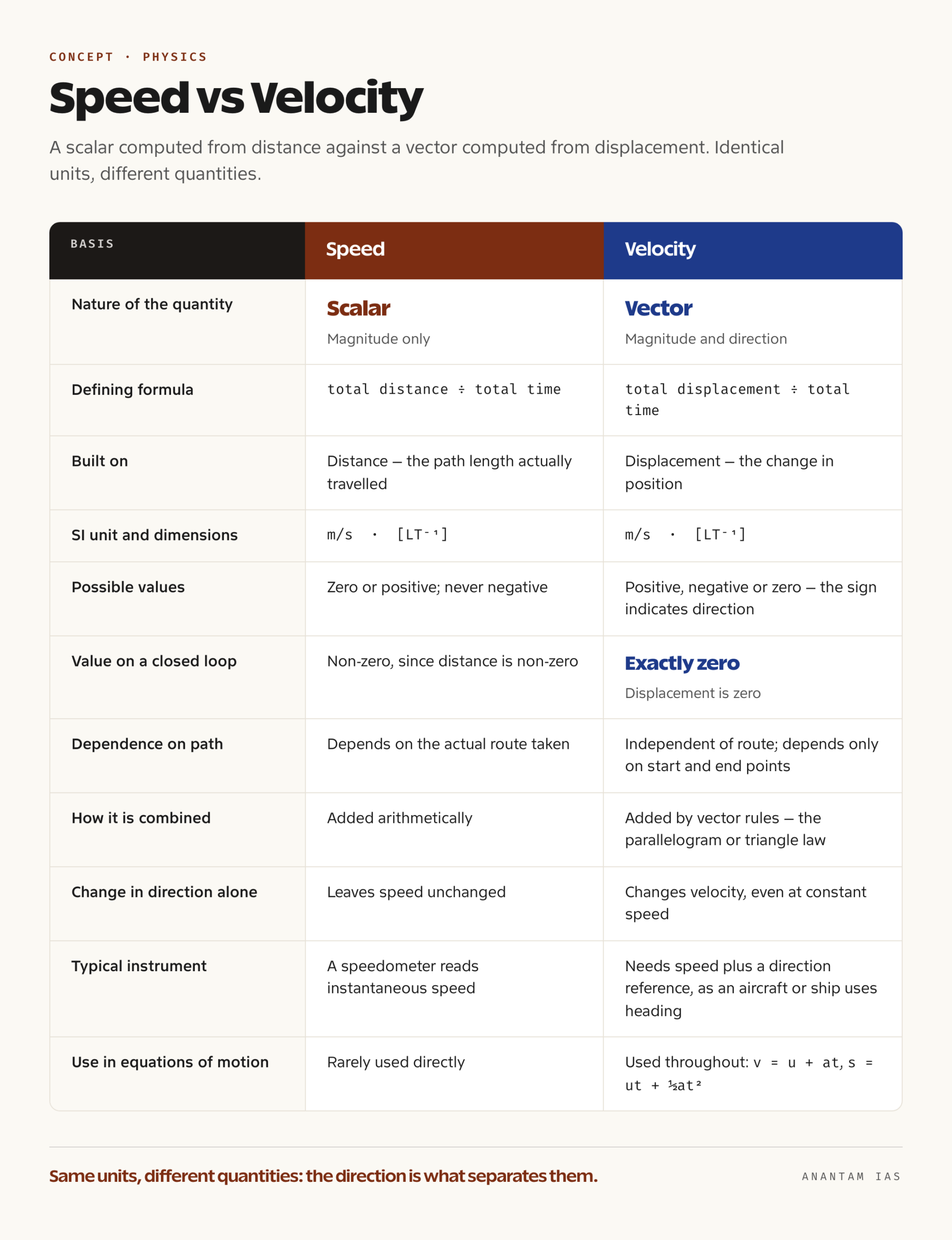
| Basis of Comparison | Speed | Velocity |
|---|---|---|
| Nature of the quantity | Scalar — magnitude only | Vector — magnitude and direction |
| Defining formula | Total distance ÷ total time | Total displacement ÷ total time |
| Quantity it is built on | Distance (path length) | Displacement (change in position) |
| SI unit and dimensions | metre per second, [LT⁻¹] | metre per second, [LT⁻¹] |
| Possible values | Zero or positive; never negative | Positive, negative or zero, the sign indicating direction |
| Value on a closed loop | Non-zero, since distance is non-zero | Exactly zero, since displacement is zero |
| Dependence on path | Depends on the actual route taken | Independent of route; depends only on start and end points |
| How it is combined | Added arithmetically | Added by vector rules, such as the parallelogram or triangle law |
| Change in direction alone | Leaves speed unchanged | Changes velocity, even at constant speed |
| Relation to acceleration | Changing speed implies acceleration, but constant speed does not rule it out | Any change in velocity, in magnitude or direction, is acceleration |
| Typical instrument | Speedometer reads instantaneous speed | Requires speed plus a direction reference, as an aircraft or ship uses heading |
| Use in equations of motion | Rarely used directly | Used throughout: v = u + at, s = ut + ½at² |
Speed Explained in Detail
Speed answers one question: how much ground is covered per unit time. Because it ignores direction, it adds up whatever the object does, in whatever direction, and the total only ever grows.
Uniform speed means equal distances covered in equal intervals of time, however small the interval. A vehicle covering exactly 20 m in every second is moving with uniform speed. Non-uniform or variable speed means the distance covered per unit time changes, which is what almost all real motion looks like.
Average speed flattens a whole journey into one number. Drive 150 km in 3 hours and your average speed is 50 km/h, whether the trip involved a steady cruise or a series of sprints and traffic jams. The average tells you nothing about the moments in between.
Instantaneous speed fills that gap. It is the speed at a single instant, and it is exactly what a speedometer displays. Here is a relationship worth committing to memory: instantaneous speed is always equal to the magnitude of instantaneous velocity. At a single instant there is no path to accumulate, so the two coincide. Average speed and the magnitude of average velocity, by contrast, are generally different, and average speed is always greater than or equal to it.
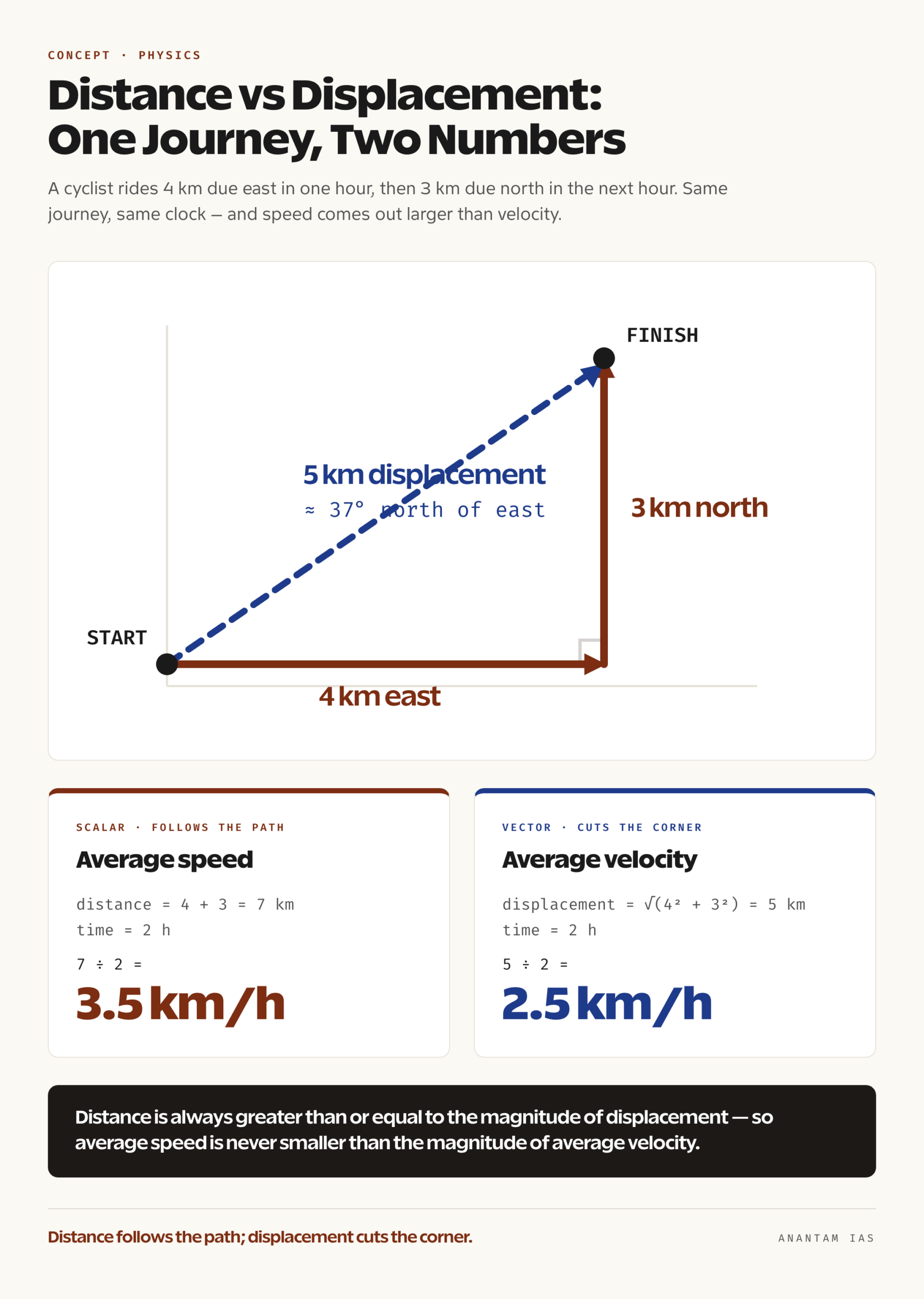
A worked example makes the arithmetic concrete. A cyclist rides 4 km due east in one hour, then 3 km due north in the next hour. Distance covered is 7 km, so average speed is 3.5 km/h. Displacement is the hypotenuse of a 4-3 right triangle — 5 km — so the magnitude of average velocity is 2.5 km/h, directed about 37° north of east. Same journey, same clock, two different numbers, and speed is the larger one.
For everyday calibration: sound travels through air at roughly 343 m/s at 20°C, the Earth orbits the Sun at close to 29.8 km/s, and light in vacuum moves at exactly 299,792,458 m/s, a figure the International Bureau of Weights and Measures fixes by definition because the metre itself is defined from it.
Velocity Explained in Detail
Velocity carries direction, and everything distinctive about it follows from that.
Uniform velocity is a strict condition: both magnitude and direction must stay constant. An object with uniform velocity travels in a straight line at a fixed rate. The moment it turns, its velocity has changed, however smoothly the speedometer holds steady.
That single fact powers uniform circular motion. A satellite in a circular orbit, or a ball whirled on a string, moves at constant speed while its velocity — always tangential to the circle — points in a new direction at every instant. Changing velocity means acceleration, so the object is accelerating continuously. The acceleration is directed towards the centre and has magnitude v²/r, where r is the radius. It changes only the direction of velocity, never its magnitude, which is why the speed stays put.
Sign conventions are how direction enters one-dimensional problems. Pick a positive direction, and a body moving the other way has negative velocity. Negative velocity does not mean slowing down. A ball thrown upward has positive velocity going up and negative velocity coming down, while its speed is a plain positive number throughout, dipping to zero only at the top of the flight.
Relative velocity is the other place the vector nature pays off. The velocity of A with respect to B is v⃗ₐ − v⃗_b, a vector subtraction. Two trains at 60 km/h approaching head-on close on each other at 120 km/h; travelling in the same direction, their relative velocity is zero and each appears stationary from the other. You cannot do this arithmetic with speeds alone.
Velocity is also the quantity the kinematic equations are written in. In v = u + at, s = ut + ½at², and v² = u² + 2as, the symbols u and v are initial and final velocities, and s is displacement, not distance. Substituting speeds and path lengths into these equations is a reliable way to get the wrong answer whenever motion reverses direction.
On a position-time graph, velocity is the slope. A straight line means uniform velocity, a curve means the velocity is changing, and a horizontal line means the object is at rest. On a velocity-time graph, the slope gives acceleration and the area under the curve gives displacement — with area below the time axis counting as negative.
Where Students Get Confused
Treating “average speed” as the average of two speeds. Drive to a town at 60 km/h and return along the same road at 40 km/h. The average speed is not 50 km/h. For equal distances, the correct figure is the harmonic mean: total distance 2d, total time d/60 + d/40 = d/24, giving 48 km/h. The slower leg takes longer, so it carries more weight.
Believing constant speed means no acceleration. Acceleration is the rate of change of velocity. Uniform circular motion has perfectly constant speed and non-zero acceleration at every instant, because the direction keeps changing.
Reading negative velocity as deceleration. The sign encodes direction, not slowing. An object with velocity going from −5 m/s to −9 m/s is speeding up while its velocity becomes more negative. Deceleration means the magnitude of velocity is falling, which happens when velocity and acceleration have opposite signs.
Confusing distance with displacement on closed paths. A runner finishing a 400 m lap has covered 400 m of distance and zero displacement, so a 50-second lap gives an average speed of 8 m/s and an average velocity of exactly zero. Half a lap on a circular track of radius r gives distance πr and displacement 2r, the diameter.
Assuming zero velocity means zero speed at every instant. Average velocity being zero says only that the object returned to its starting point. Its speed may have been high throughout. Zero instantaneous velocity, on the other hand, does mean zero instantaneous speed, since the two are equal in magnitude at any instant.
Forgetting to convert units before comparing. A speed of 72 km/h and one of 25 m/s look different until you convert: 72 × 5/18 = 20 m/s, so 25 m/s is the faster. Mixing km/h with m/s inside a single calculation is the most common source of wrong numerical answers in kinematics.
Using distance in the equations of motion. The standard equations are vector relations in disguise. For motion that reverses — a ball thrown up and caught again — the displacement over the whole flight is zero even though the distance is twice the maximum height, and only the displacement belongs in s.
FAQ
Q1. Can speed and velocity ever have the same numerical value? Yes. When an object moves in a straight line without reversing direction, the distance equals the magnitude of the displacement, so the average speed equals the magnitude of the average velocity. Instantaneous speed always equals the magnitude of instantaneous velocity, in any motion.
Q2. Why can velocity be negative when speed cannot? Velocity is a vector, and in one-dimensional motion the sign is how direction is written down. Speed is the magnitude of that vector, and a magnitude is never negative.
Q3. What does a speedometer actually measure? Instantaneous speed. It has no way of registering direction, so it cannot show velocity. An aircraft or ship reports velocity by pairing speed with a heading.
Q4. If a body moves in a circle at a steady rate, is its velocity constant? No. The magnitude stays constant but the direction changes continuously, so the velocity changes. That change is centripetal acceleration, of magnitude v²/r directed towards the centre.
Q5. Which is used in the equations of motion, speed or velocity? Velocity. In v = u + at, s = ut + ½at² and v² = u² + 2as, u and v are velocities and s is displacement. Substituting scalar speeds and path lengths breaks the equations whenever the motion changes direction.
Practice Questions
Practice MCQs
- A car travels once around a circular track of circumference 1 km in 2 minutes and returns to its starting point. Its average velocity for the trip is (a) 30 km/h (b) 0.5 km/h (c) zero (d) 60 km/h — Answer: (c) Displacement over a complete loop is zero, so the average velocity is zero regardless of how fast the lap was.
- Which statement about a body in uniform circular motion is correct? (a) Both speed and velocity are constant (b) Speed is constant but velocity changes (c) Velocity is constant but speed changes (d) Neither is constant — Answer: (b) The magnitude stays fixed while the direction of the velocity vector changes at every point.
- A body covers the first half of a journey at 40 km/h and the second half, of equal distance, at 60 km/h. Its average speed for the whole journey is (a) 50 km/h (b) 48 km/h (c) 45 km/h (d) 52 km/h — Answer: (b) For equal distances the average speed is the harmonic mean, 2 × 40 × 60 ÷ 100 = 48 km/h.
- For any journey, the magnitude of average velocity is (a) always greater than the average speed (b) always equal to the average speed (c) never greater than the average speed (d) unrelated to the average speed — Answer: (c) Displacement can never exceed the distance travelled, so the magnitude of average velocity is at most the average speed.
- A person walks 3 m east and then 4 m north in a total of 7 seconds. The magnitude of the average velocity is (a) 1 m/s (b) 5/7 m/s (c) 7/5 m/s (d) 0.5 m/s — Answer: (b) Displacement is √(3² + 4²) = 5 m, so the average velocity has magnitude 5/7 m/s while the average speed is 1 m/s.