Dowry System in India: Meaning, Causes, Laws & Impact (UPSC Notes)
The dowry system in India — comprehensive UPSC notes on its history, causes, social impact, legal framework, constitutional provisions and reform measures.
The dowry system is a deep-rooted social practice in India where the bride's family transfers cash, goods, property, or other valuables to the groom or his family as a condition of marriage. Though legally prohibited under the Dowry Prohibition Act, 1961, the practice persists across regions, religions, and castes, driving gender inequality, domestic violence, and even dowry deaths. For UPSC aspirants, the dowry system is a crucial GS Paper I (Indian Society) and GS Paper II (Social Justice) topic, linking directly with women empowerment, fundamental rights, family law, and sustainable development goals on gender equality. Understanding its causes, consequences, and reform mechanisms is essential for both Mains essays and Ethics (GS IV) case studies.
What Is the Dowry System?
Dowry (stridhan in classical context, but distinct in modern usage) refers to property, goods, or money given by the bride's family to the groom's family at the time of marriage. Under Section 2 of the Dowry Prohibition Act, 1961, dowry is defined as:
"Any property or valuable security given or agreed to be given either directly or indirectly by one party to a marriage to the other party, or by the parents of either party, or by any other person, at or before or any time after the marriage, in connection with the marriage."
Gifts given without any demand or coercion, in line with customs, are excluded if duly recorded.
Historical Evolution
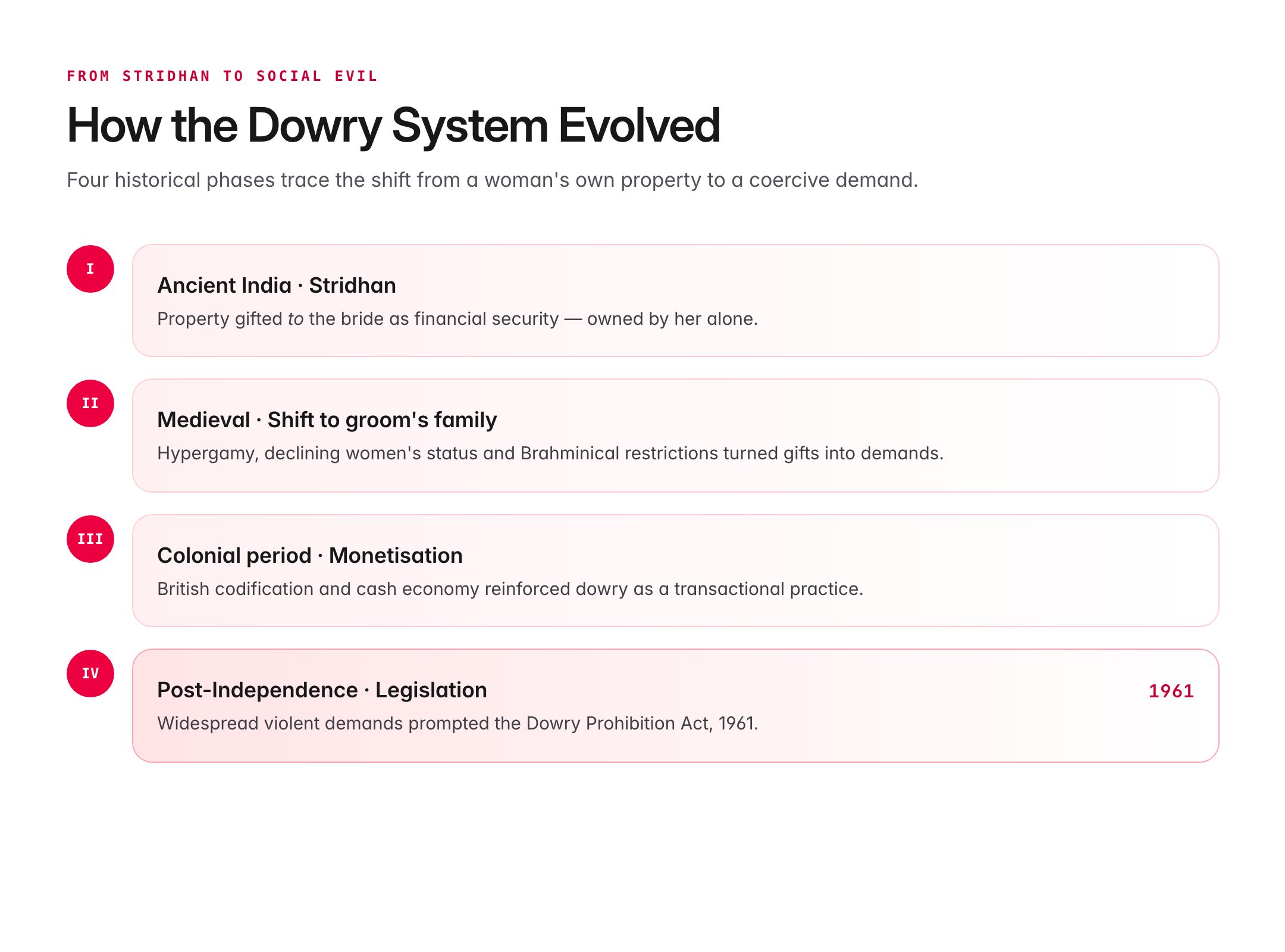
- Ancient India: Stridhan (woman's own property) was gifted to the bride as financial security — she alone owned it.
- Medieval period: With hypergamy, declining status of women, and Brahminical restrictions, dowry gradually shifted from woman's property to demands made by the groom's family.
- Colonial period: British codification and monetization of the economy reinforced dowry as a transactional practice.
- Post-Independence: Dowry demand became widespread and violent, prompting legislation in 1961.
Causes of the Dowry System
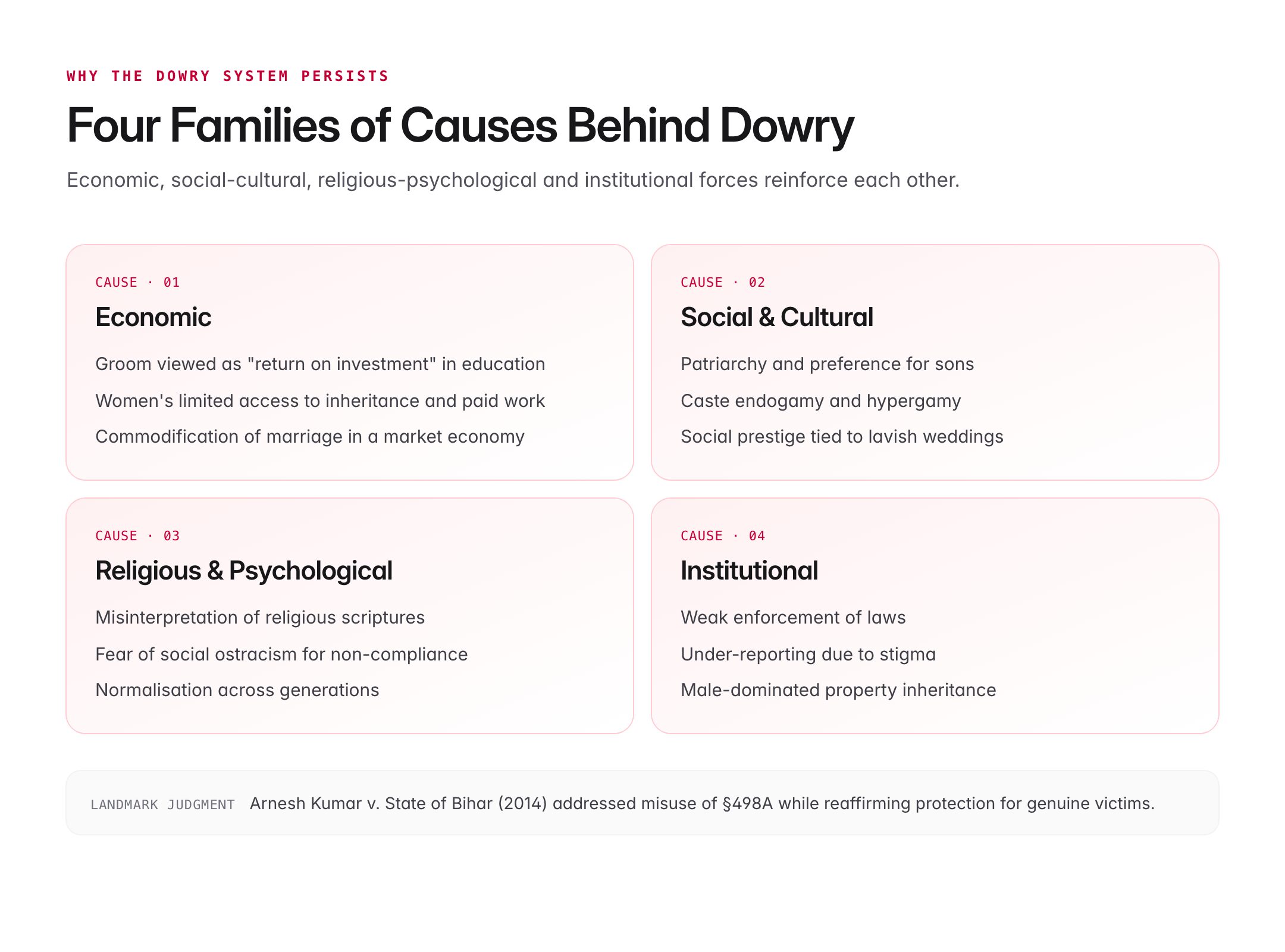
Economic Causes
- Groom seen as a "return on investment" in education.
- Women's limited access to inheritance and paid work.
- Commodification of marriage in a market economy.
Social and Cultural Causes
- Patriarchy and preference for sons.
- Caste endogamy and hypergamy (marriage upward).
- Social prestige tied to lavish weddings and dowry displays.
- Low status of women in the family hierarchy.
Religious and Psychological Causes
- Misinterpretation of religious scriptures.
- Fear of social ostracism for non-compliance.
- Normalization across generations.
Institutional Causes
- Weak enforcement of laws.
- Under-reporting due to stigma.
- Male-dominated property inheritance.
Legal Framework Against Dowry
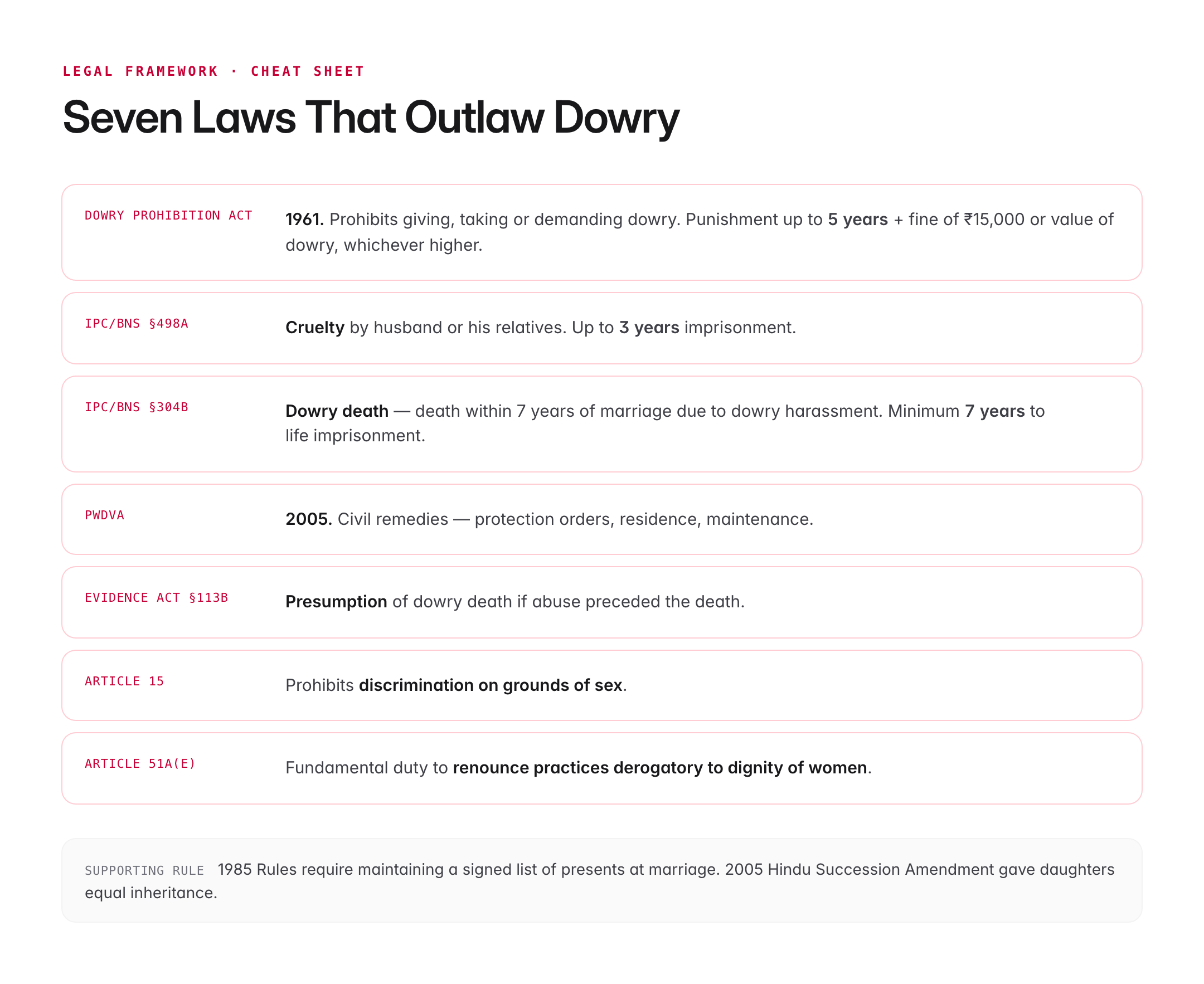
| Law / Provision | Key Features |
|---|---|
| Dowry Prohibition Act, 1961 | Prohibits giving, taking, or demanding dowry; punishment up to 5 years & ₹15,000 fine or value of dowry, whichever higher |
| Section 498A IPC / BNS | Cruelty by husband or his relatives; up to 3 years imprisonment |
| Section 304B IPC / BNS (Dowry Death) | Death within 7 years of marriage due to dowry harassment; minimum 7 years to life imprisonment |
| Protection of Women from Domestic Violence Act, 2005 | Civil remedies — protection orders, residence, maintenance |
| Indian Evidence Act, Section 113B | Presumption of dowry death if abuse preceded death |
| Article 15 of Constitution | Prohibits discrimination on grounds of sex |
| Article 51A(e) | Fundamental duty to renounce practices derogatory to dignity of women |
The Dowry Prohibition (Maintenance of Lists of Presents to the Bride and Bridegroom) Rules, 1985 mandate maintaining a signed list of gifts exchanged.
Impact of the Dowry System
On Women
- Violence: Physical, mental, emotional abuse; dowry deaths.
- Female foeticide and infanticide: Daughters seen as liabilities.
- Mental health issues: Depression, suicide.
- Denial of education and autonomy.
On Society
- Reinforces patriarchy and gender inequality.
- Encourages consumerism and ostentatious weddings.
- Widens caste and class inequities.
- Skewed sex ratio — India's child sex ratio has declined historically.
Data Snapshot (NCRB)
National Crime Records Bureau (NCRB) reports indicate several thousand dowry death cases registered annually in India, with additional cases under cruelty-related provisions. Under-reporting is widely acknowledged.
Reform Measures and Way Forward
- Stricter enforcement of Dowry Prohibition Act with specialised cells.
- Fast-track courts for dowry death and cruelty cases.
- Mandatory gift registration under the 1985 rules.
- Education and economic empowerment of women — Beti Bachao Beti Padhao, SHG-based programmes.
- Financial independence: Equal inheritance under Hindu Succession (Amendment) Act, 2005.
- Public awareness: Campaigns in schools and colleges.
- Community-led reforms: Simpler weddings, "no dowry" pledges.
- Role of NGOs and media in exposing violations.
- Behavioural change through family-level interventions.
Supreme Court judgments such as Arnesh Kumar v. State of Bihar (2014) addressed misuse of Section 498A but reaffirmed the need to protect genuine victims.
Comparative Perspective
- Countries like Nepal, Pakistan, Bangladesh share similar dowry challenges.
- In contrast, many Western societies have bride price or reverse dowry traditions, while modern legal systems emphasise prenuptial agreements and community property.
- India's approach is unique in combining criminal law + civil remedies + constitutional rights.
UPSC Relevance
- Prelims focus: Year of Dowry Prohibition Act (1961), key sections (498A, 304B), Section 113B Evidence Act, Article 15, Article 51A(e), Hindu Succession Amendment 2005.
- Mains GS-I angle: Role of women; social empowerment; effects of patriarchy. GS-II: Government policies, vulnerable sections, laws. GS-IV (Ethics): Case studies on dowry demand, moral courage, family pressure.
- Sample PYQ angle: "Discuss the causes and consequences of the dowry system in India. How effective have legal measures been in curbing this social evil?" — structure with historical roots, legal architecture, NCRB trends, and a way-forward with education and empowerment.