e-NAM Platform of Platforms: Modules, Benefits & UPSC Notes 2026
e-NAM Platform of Platforms unifies FPO, logistics, fintech, warehousing modules. 1,389 mandis, 23 states, Rs 3+ lakh crore trade. Benefits, challenges, UPSC GS-III.
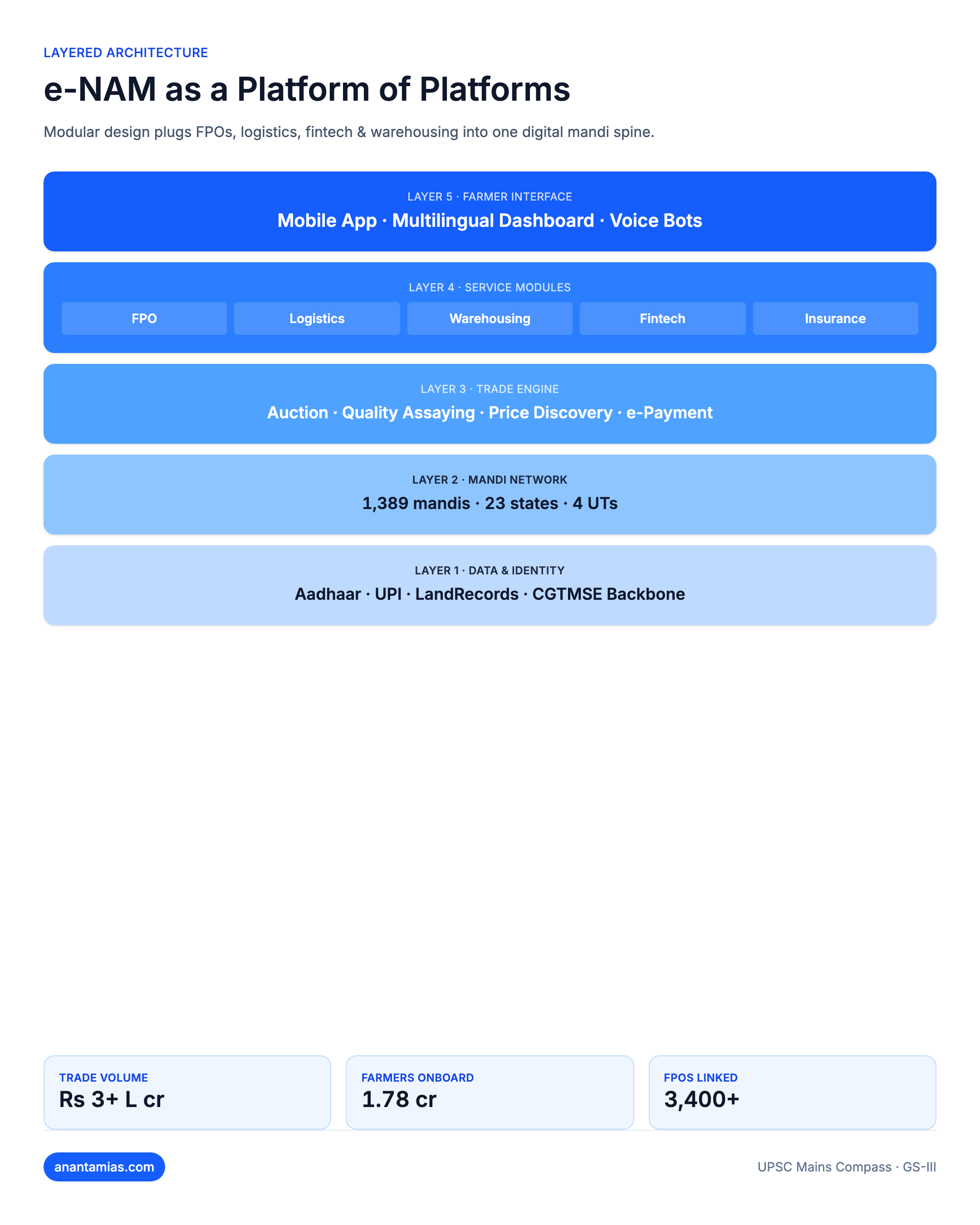
e-NAM (National Agriculture Market) is a pan-India electronic trading portal launched on 14 April 2016 to network physical APMC mandis into a single unified online market for agricultural commodities. The Small Farmers' Agribusiness Consortium (SFAC), an autonomous body under the Ministry of Agriculture and Farmers Welfare, is the implementing agency. After six years of pure e-trading, e-NAM was transformed in 2022 into a "Platform of Platforms" (PoP) — an integration layer that brings together logistics aggregators, fintech players, warehousing services, FPO portals, and e-commerce platforms so farmers and traders can access the entire post-harvest value chain from a single login.
For UPSC, e-NAM is a high-frequency GS-III topic intersecting with agricultural marketing reform, doubling farmers' income, technology in agriculture, FPOs, food processing, and Digital India. Prelims has tested launch year (2016), implementing agency (SFAC), number of mandis, and PoP modules. Mains has asked about e-NAM as a marketing reform tool and why physical APMC dependence persists despite e-NAM.
What is e-NAM?
e-NAM is an online auction and trading platform that allows:
- Farmers to consign produce to a participating APMC and have it auctioned to traders across India.
- Traders to bid on lots from any participating mandi without physical presence.
- Buyers (processors, exporters, retailers) to source directly from mandis nationwide.
- APMC committees to oversee assaying, weighment, payment, and dispute resolution.
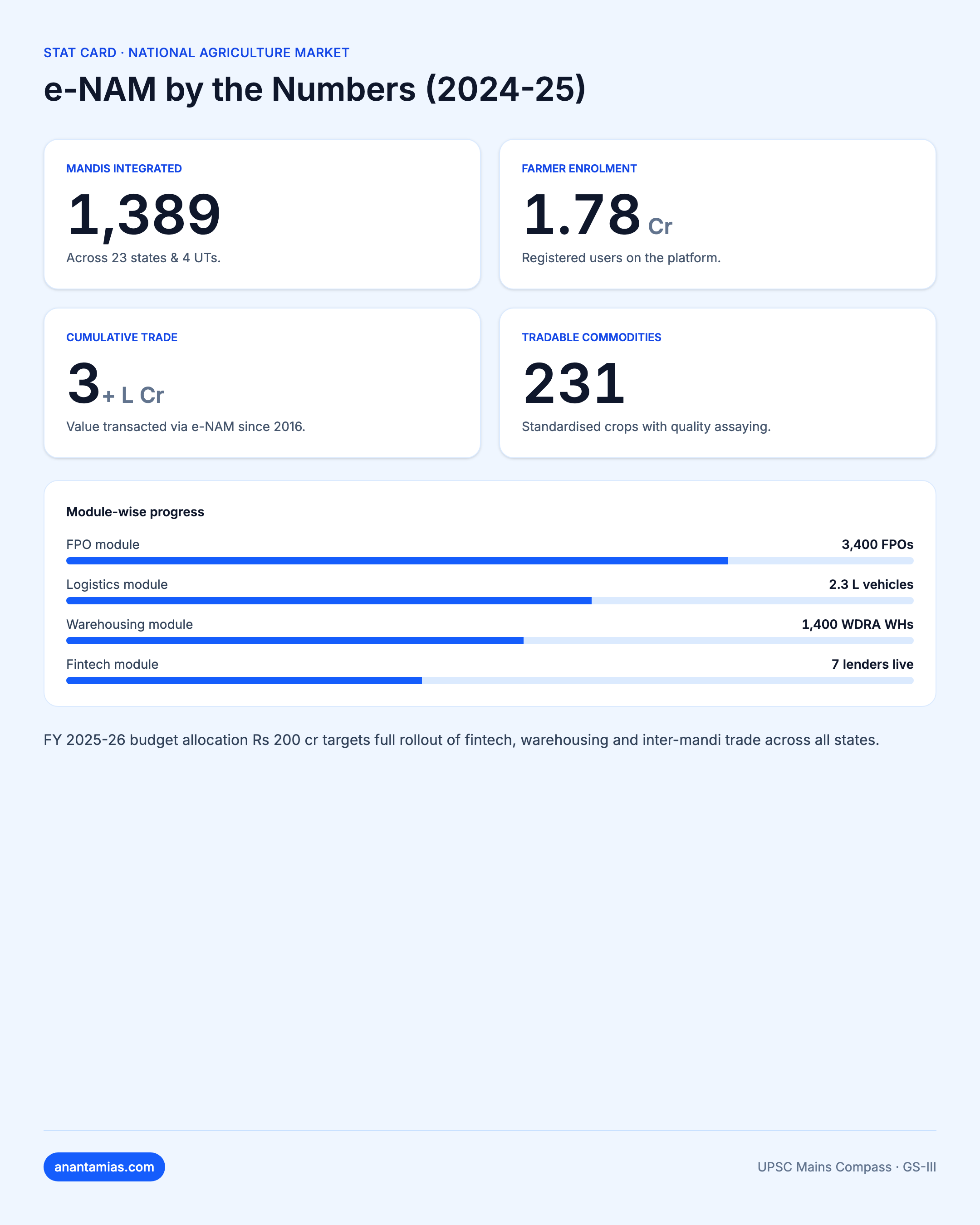
As of 2025-26, e-NAM has integrated 1,389+ mandis across 23 states/UTs, with 2.1 crore+ farmers and 2.4+ lakh traders registered. Cumulative trade volume crossed Rs 3.5 lakh crore by FY26.
Background: Why e-NAM Was Needed
Before e-NAM, every APMC functioned as a closed island under its state's APMC Act. A wheat farmer in Bihar's Gaya mandi could not access higher prices in Madhya Pradesh's Gwalior mandi, even if the price differential was Rs 200/quintal. This fragmentation imposed information asymmetry, suppressed price discovery, and trapped farmers in local cartels.
The Acharya Committee 2002, Vajpayee Committee 2003, and Dalwai Committee on DFI 2018 all recommended a national unified market for agriculture. e-NAM was the operational answer.
Pre-conditions for an APMC to Join e-NAM
A state's APMC must adopt three reforms:
- Single trading licence valid across the state.
- Single-point levy of mandi fee across the state.
- Provision for e-auction as a mode of price discovery.
States that resisted these reforms (parts of Kerala, North-East) initially stayed outside e-NAM. By 2025-26, all major agri-producing states had joined.
Components: The Platform of Platforms (PoP) Architecture
The 2022 PoP overhaul transformed e-NAM from a single auction platform to an interoperable digital backbone connecting multiple service providers. The principal modules:
1. FPO Module
Allows Farmer Producer Organisations to:
- Upload photographs and quality details of pooled produce directly from collection centres without bringing it to a mandi.
- Conduct virtual auctions before physical movement.
- Access assaying-on-demand services.
This drastically cuts logistics costs for 86% of Indian farmers who are small/marginal and who pool through FPOs.
2. Logistics Module
Integrates large logistics aggregators (e.g., Mahindra Logistics, BlackBuck, Rivigo, Vahak, Trukky, FreightWalla) with traders for:
- Real-time freight booking.
- Reefer truck access for perishables.
- Tracking of in-transit consignments.
- Volume-based discounts.
3. Warehousing-Based Trading Module
Linked to WDRA (Warehousing Development and Regulatory Authority)-registered warehouses, this module allows:
- Farmers to sell produce directly from the warehouse without bringing it to mandi.
- Use of electronic Negotiable Warehouse Receipts (eNWR) as collateral for credit.
- Reduction in handling and transport costs.
4. Fintech Module
Integrates fintechs with the platform to provide:
- Real-time price information to farmers.
- Linkages with bulk buyers through digital matchmaking.
- Credit scoring for farmers based on transaction history.
- Loan disbursement through partner banks/NBFCs.
- Crop insurance bundling with PMFBY.
5. Integration with Other Platforms
- Inputs: seeds, fertilisers, machinery on rent, credit.
- Information: weather updates, advisory services, crop forecasts.
- Post-harvest: cleaning, grading, sorting, packaging service providers.
- E-commerce: link with B2B and B2C platforms.
Benefits of e-NAM
- Wider market access: A farmer in Karnataka can sell to a buyer in Maharashtra; inter-state trade previously blocked is now viable.
- Better price discovery: Auction-based bidding replaces aarthiya cartel pricing.
- Quality-linked pricing: Pre-auction assaying provides quality grades; better grades fetch better prices, incentivising quality investment.
- Reduced post-harvest losses: Faster auction and transport reduce time spent in mandi yards.
- Transparency: Digital audit trail of price discovery and payment.
- Direct payment to farmers: Bank transfers within 24-48 hours; eliminates aarthiya delay.
- Lower intermediation: Multiple intermediaries replaced by direct farmer-trader-buyer linkage.
- FPO integration: Aggregation enables collective bargaining; transaction history builds creditworthiness.
- Dovetails with AgriStack: Plot-level data feeds advisory and pricing.
- Inclusivity for small farmers: PoP modules lower transport and logistics burden; FPO module enables auction without travel.
Challenges and Criticism
- Uneven adoption: Of 1,389 integrated mandis, only ~30-40% see active e-NAM trading; rest are paper-integrated.
- Limited inter-state trade: Most e-NAM trades remain intra-state because of logistics cost and physical inspection norms.
- Quality assaying gaps: Many mandis lack assaying labs for non-grain commodities; without quality grade, distant buyers hesitate to bid.
- Connectivity issues: Poor internet in rural mandis disrupts live auctions.
- APMC resistance: Aarthiyas and traders perceive e-NAM as a threat to their commission income; some go-slow on adoption.
- Limited commodity coverage: Only 200+ commodities listed; perishables like flowers, exotic vegetables, livestock products under-represented.
- Payment delays in some states despite digital architecture.
- Lack of awareness among farmers about how to register, use the app, and receive proceeds.
- Logistics still ad hoc: Reefer trucks, cold chain integration patchy.
- Cyber-security concerns as transaction volumes grow.
- Dependence on physical mandis: Despite PoP, most settlement still occurs after physical movement to mandi yard.
Recent Developments (2024-2026)
| Year | Update |
|---|---|
| 2024 | PoP modules expanded to include drone-based assaying pilots in 50 mandis |
| 2024 | eNWR integration with 30+ banks; warehouse-based trading scales |
| Budget 2024-25 | Rs 250 crore for e-NAM expansion to 200 more mandis |
| 2025 | AgriStack-eNAM linkage rolled out — plot-level data for price discovery |
| 2025 | Pilot Bharat Krishi Setu procurement portal in 6 states |
| Budget 2025-26 | Rs 350 crore for e-NAM modernisation; PoP goes live with FPO API for B2B platforms |
| 2025-26 | Cumulative trade Rs 3.5+ lakh crore; 2.1+ crore farmers registered |
| 2026 | Cross-border B2B integration with Bangladesh, Nepal, Bhutan piloted |
Reforms and Way Forward
- Mandate inter-state trade share at each e-NAM mandi to drive geographic price discovery.
- Universal assaying labs at every e-NAM mandi with AI-powered drone/CCTV-based grading.
- Reefer-truck guarantee through Logistics Module for perishables.
- AgriStack integration for plot-to-mandi traceability.
- Strengthen FPO Module as the default path for small/marginal farmers.
- Cyber-security and data-privacy framework for farmer data under DPDP Act 2023.
- Bring perishables and livestock under e-NAM with appropriate quality protocols.
- Mandate digital payments within 24 hours of transaction.
- Subsidise smartphone and connectivity for farmer access.
- Pair with Contract Farming Act so e-NAM also hosts contract-farming registrations.
- State-level performance dashboards for transparency.
- Cross-border e-NAM nodes for SAARC and ASEAN agri-trade.
Government Schemes and Budget Allocations (2025-26)
- e-NAM: implemented by SFAC under Department of Agriculture & Farmers Welfare; Rs 350 crore (2025-26).
- Agriculture Infrastructure Fund (AIF): Rs 1.25 lakh crore corpus — co-funds mandi modernisation.
- PM Kisan Sampada Yojana: cold chain, packaging — feeds into e-NAM logistics.
- Operation Greens: 22 perishable crops; price stabilisation aligned with e-NAM data.
- Digital Agriculture Mission: AgriStack-eNAM integration.
- National Cooperative Policy: 2 lakh PACS to act as e-NAM-linked aggregation centres.
- WDRA: warehousing-based trading.
Mains Answer Hook
A high-scoring GS-III answer should: (a) frame e-NAM as the digital backbone of agricultural marketing reform, complementing physical APMCs rather than replacing them; (b) cite scale — 1,389 mandis, 23 states, Rs 3.5 lakh crore cumulative trade, 2.1 crore farmers; (c) explain the PoP modules — FPO, Logistics, Warehousing, Fintech — and how they collectively transform farmer experience; (d) flag adoption gaps and the inter-state trade challenge; (e) connect to AgriStack, AIF, FPO Mission, PM-AASHA.
Use the line: "e-NAM is not just an auction site; it is the foundation for an interoperable agricultural economy."
Prelims Pointers
- e-NAM launch: 14 April 2016.
- Implementing agency: SFAC (Small Farmers' Agribusiness Consortium).
- Ministry: Department of Agriculture & Farmers Welfare.
- Mandis integrated: 1,389+ across 23 states/UTs.
- PoP launch: 2022.
- PoP modules: FPO, Logistics, Warehousing-based Trading, Fintech, E-commerce, Inputs, Information.
- eNWR: Electronic Negotiable Warehouse Receipt; issued under WDRA.
- Pre-conditions for state to join: single licence, single fee, e-auction.
- Cumulative trade by 2025-26: Rs 3.5+ lakh crore.
- Registered farmers: 2.1+ crore.
State-Wise Performance Snapshot
| State | Mandis Integrated (2025) | Trade Volume Notes |
|---|---|---|
| Uttar Pradesh | 125+ | Largest mandi network; volume scale leader |
| Madhya Pradesh | 80+ | Soybean, gram, mustard active |
| Rajasthan | 145+ | Mustard, gram, cumin |
| Andhra Pradesh | 33 | Cotton, paddy, chilli |
| Telangana | 60+ | Maize, paddy, turmeric |
| Maharashtra | 130+ | Onion, soyabean, tur |
| Karnataka | 175+ | Pioneer state — Unified Market Platform predates e-NAM; integrated later |
| Haryana | 81 | Wheat, paddy concentration |
| Punjab | 44 | Wheat, paddy; FCI procurement-driven |
| West Bengal | 17 | Limited adoption pre-2024; expanding |
| Bihar | 0 (APMC repealed 2006) | Bihar is outside APMC framework — special e-NAM model |
| Tamil Nadu | 63 | Cotton, oilseeds |
| Odisha | 41 | Paddy, pulses, oilseeds |
| Gujarat | 122+ | Cotton, groundnut, cumin |
Karnataka's prior Rashtriya e-Market Services Pvt Ltd (ReMS) / Unified Market Platform had pioneered electronic trading even before e-NAM; its integration template later informed e-NAM design.
How e-NAM Compares with Other Reforms
While APMC remains the mandi-side regulator, e-NAM functions as the digital trading layer above APMCs. It is complemented by:
- Model APLM Act, 2017 — provides the legal basis for state-wide single licences.
- Model Contract Farming Act, 2018 — governs farmer-buyer agreements.
- Agriculture Infrastructure Fund (AIF) — Rs 1.25 lakh crore corpus funds physical infrastructure that supports e-NAM (warehouses, pack-houses, logistics).
- Operation Greens — price stabilisation for 22 perishable crops; uses e-NAM data.
- National Cooperative Policy 2023 — 2 lakh PACS being multipurposed as e-NAM-linked aggregation centres.
FAQ on e-NAM Platform of Platforms
What is e-NAM?
A pan-India electronic trading portal that networks APMC mandis to create a unified online market for agricultural commodities.
Who runs e-NAM?
SFAC (Small Farmers' Agribusiness Consortium) under the Department of Agriculture & Farmers Welfare.
What is u0022Platform of Platformsu0022?
The 2022 upgrade integrating logistics, fintech, warehousing, FPO, and e-commerce service providers as modules within e-NAM.
Can farmers sell perishables on e-NAM?
Yes, but coverage of perishables is limited; new modules pilot fruit/vegetable trading via images and drone assaying.
How is payment made?
Direct bank transfer to the farmer's account within 24-48 hours of auction confirmation.
What is eNWR?
Electronic Negotiable Warehouse Receipt — a digital instrument issued by WDRA-registered warehouses; usable as collateral and for warehouse-based e-NAM trading.
e-NAM is India's most ambitious digital intervention in agriculture. For UPSC, anchor your answers in the 2016 launch, SFAC implementation, 1,389-mandi network, PoP modules, and Rs 3.5 lakh crore cumulative trade. Pair these facts with the inter-state trade challenge and the AgriStack integration story for a Mains-grade answer.