e-Samridhi Portal: Farmer Registration, MSP Sale and Payment Guide
Use the e-Samridhi portal to register for a notified NAFED procurement cycle, choose a purchase centre, track the sale, and receive payment.
The e-Samridhi portal is NAFED’s farmer registration, procurement, and payment platform for notified government purchase cycles. A farmer can register directly or through a PACS or FPO, provide Aadhaar, land, bank and crop details, choose a purchase centre when available, and track the application.
Registration does not guarantee that every crop, state, centre, or procurement window is active. Check the live scheme shown in your account, use the crop and centre listed for that cycle, and carry the documents requested by the local procurement agency.
How to Register on e-Samridhi
- Open the portal or the official e-Samridhi mobile app.
- Create or verify the farmer profile with Aadhaar and contact details.
- Add land records, bank account information, crop and expected quantity.
- Select an active scheme and the nearest available purchase centre.
- Save the application and track scheduling, procurement, and payment status.
Use the official e-Samridhi portal or install the official Android app. The app listing identifies NAFED’s e-Samridhi service and supports registration, application tracking, and purchase-centre scheduling.
e-Samridhi Registration Checklist
| Item | What to prepare |
|---|---|
| Identity | Aadhaar number and the mobile/contact details requested in the form |
| Land | Land record or cultivation details accepted for the active state process |
| Payment | Bank account information mapped to the farmer profile |
| Crop | Crop, expected quantity, season and other scheme-specific details |
| Procurement | An active scheme and available purchase centre for the farmer’s location |
| Final authority | The live portal, the notified procurement cycle and the local agency’s instructions |
Background and Historical Context
India’s pulses and oilseeds market has historically suffered from a structural price paradox. Prices crash at harvest when market arrivals peak, yet rise sharply in the lean months. The Commission for Agricultural Costs and Prices recommends MSPs each year for 22 notified crops, but effective procurement by public agencies has long been concentrated in rice and wheat. Pulses and oilseeds procurement remained thin, fragmented, and largely invisible to the digital administrative state.
To correct this asymmetry the Union government rolled out the Pradhan Mantri Annadata Aay SanraksHan Abhiyan, popularly known as PM-AASHA, in September 2018. PM-AASHA bundled three sub-schemes, the Price Support Scheme, the Price Deficiency Payment Scheme, and the Private Procurement and Stockist Scheme. NAFED and the Food Corporation of India were named central nodal agencies. The Price Support Scheme component made physical procurement of pulses and oilseeds at MSP a central government commitment whenever market prices dipped below MSP during the notified procurement window.
NAFED first launched e-Samridhi for Price Support Scheme procurement in Kharif 2017 and later expanded the platform. In 2024, the portal also became the registration, procurement, and payment route for the tur initiative announced by the Ministry of Cooperation. Current government material describes NAFED’s e-Samridhi and NCCF’s e-Samyukti as separate platforms used for notified procurement programmes.
Key Features
The portal’s design aims to make every procurement transaction a transparent, Aadhaar-authenticated, and bank-routed event.
Pre-registration of Farmers
The registration module asks for basic farmer details, Aadhaar number, land records, bank information and crop details. The farmer can register directly or through a PACS or FPO. Scheme availability, supported crops, dates and purchase centres depend on the notified procurement cycle shown in the portal.
Slot Allocation and Purchase Centres
A pre-registered farmer who wants to offer produce can choose the nearest available purchase centre. The portal then schedules the physical visit for the active procurement cycle. Centre activation and slot availability can vary by crop, state and date.
Quality Check and Weighment
At the centre, produce is graded against Fair Average Quality norms notified by the Department of Agriculture and Farmers Welfare. Moisture content, foreign matter, and broken grain percentage are logged on the portal. After weighment the system generates a digital receipt with a unique sale identifier.
Direct Benefit Transfer
After accepted procurement, payment is transferred directly to the bank account mapped in the farmer’s profile. The portal and app allow the farmer to track application and payment status without relying on an intermediary for updates.
Application and Payment Tracking
The farmer-facing portal and app show the status of registration, scheme participation, scheduling, procurement and payment. If a centre or scheme is not active, the farmer should follow the live portal and the local procurement agency rather than an unofficial registration promise.
Aadhaar, Land, Bank and Crop Checks
Government guidance lists Aadhaar, land records, bank account information and crop details as the core registration inputs. State verification processes can differ. PM-Kisan registration alone should not be treated as proof that an e-Samridhi procurement application is complete.
Significance for UPSC and General Knowledge
- e-Samridhi is the digital rail on which the Price Support Scheme of PM-AASHA actually runs, making it essential for agriculture and economy questions in GS Paper 3.
- It exemplifies Digital Public Infrastructure applied to farm procurement, following the India Stack template of Aadhaar authentication and Direct Benefit Transfer.
- It offers a concrete case study for answers on MSP reform, farmer income, and the debate around expanding procurement beyond rice and wheat.
- It supports the Union Budget 2024-25 thrust on pulses and oilseeds self-sufficiency, a recurring theme in the Economic Survey.
- For Prelims the portal, its operating agency NAFED, and the umbrella scheme PM-AASHA are high frequency factual items.
- For Mains the portal is a ready anchor for discussing transparency, efficiency, and federalism issues in agricultural procurement.
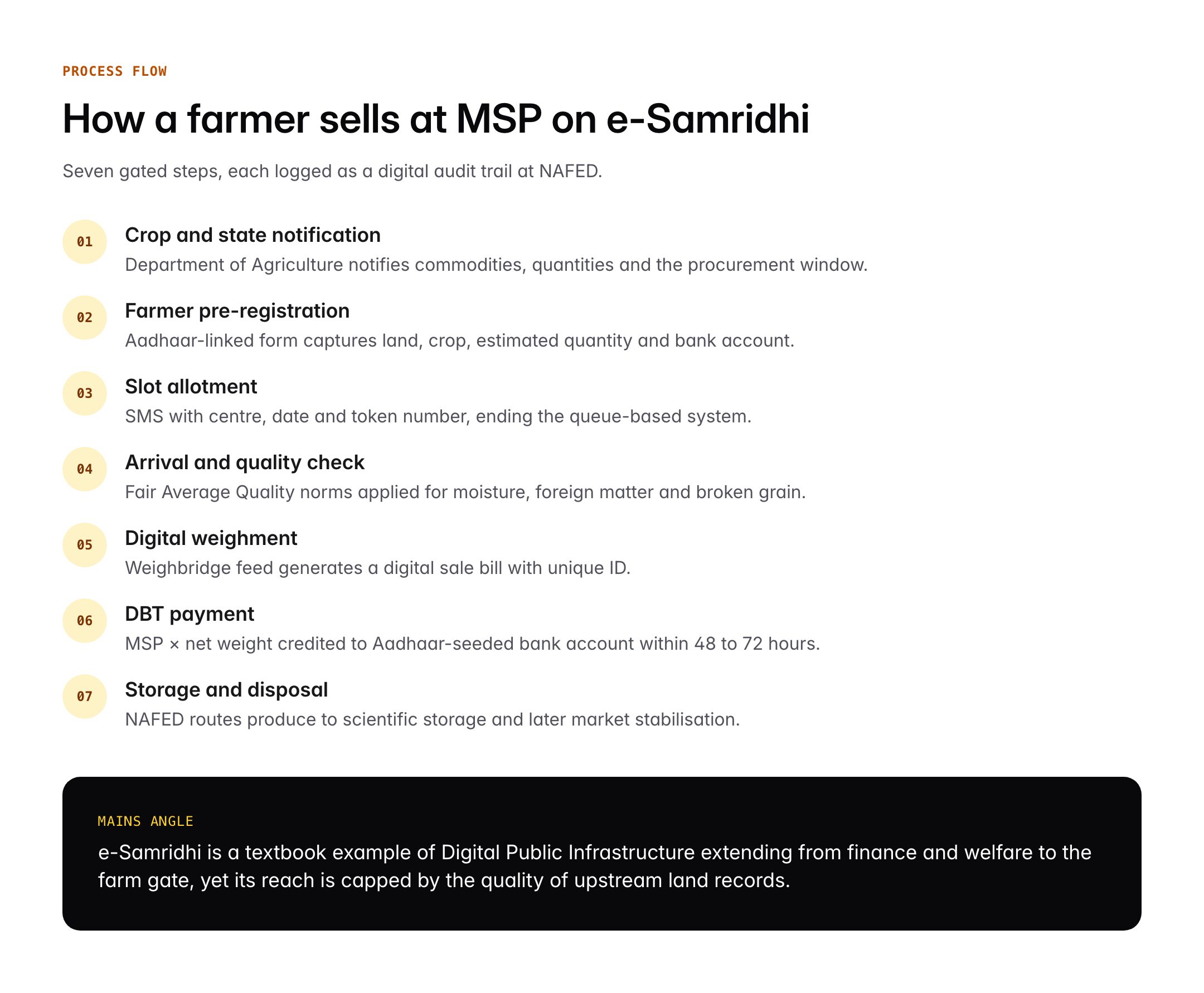
How e-Samridhi MSP Procurement Works
e-Samridhi connects registration to payment in five practical stages. Each stage still depends on the crop, state, purchase centre, procurement window and quality rules notified for that operation.
- Register: submit farmer, Aadhaar, land, bank and crop details directly or through a PACS or FPO.
- Join an active scheme: select the procurement programme available for the crop and location.
- Choose a centre: select the nearest available purchase centre and follow the scheduled visit.
- Complete procurement: take the produce and required records to the centre for verification, quality assessment and weighment.
- Track payment: after acceptance, follow the status until the amount reaches the mapped bank account.
The Ministry of Agriculture and Farmers Welfare describes this flow from farmer registration to purchase-centre scheduling and direct payment. That official description is safer than assuming a fixed payment time or a universal list of active crops.
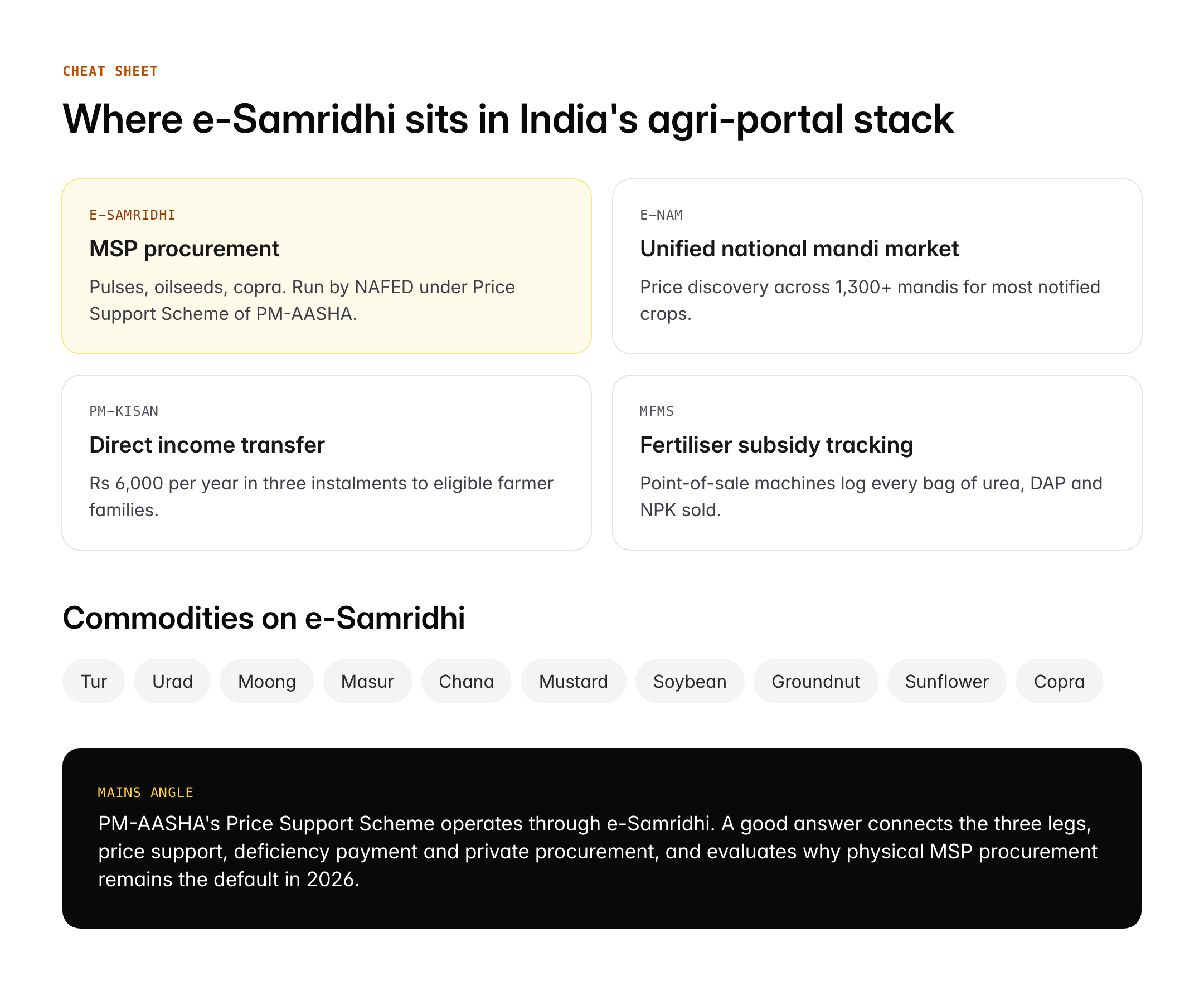
Comparative Perspective
The e-Samridhi portal is not the only procurement-related portal in India. A comparison helps situate its role.
| Portal | Agency | Primary purpose | Crops covered |
|---|---|---|---|
| e-Samridhi | NAFED | MSP procurement under Price Support Scheme | Pulses, oilseeds, copra |
| e-NAM | Small Farmers Agri-business Consortium | Unified national market, price discovery | All mandi-notified crops |
| PM-Kisan portal | Department of Agriculture | Direct income transfer of Rs 6,000 per year | Not crop-specific |
| MFMS portal | Department of Fertilizers | Fertiliser subsidy tracking | Urea, DAP, NPK |
| Meri Fasal Mera Byora (Haryana) | State of Haryana | State procurement of rabi crops | Wheat, mustard, chana |
Where e-NAM is a trading platform linking mandis, e-Samridhi is strictly a government procurement platform. Where PM-Kisan transfers a flat income supplement, e-Samridhi pays against actual sale of produce. The four portals together illustrate how India’s agricultural governance stack is being digitised in parallel streams rather than a single monolith.
Challenges and Criticisms
Critics point out that the portal’s reach is still uneven. Small and tenant farmers without formal land records struggle to complete pre-registration. In several states, land digitisation remains incomplete, creating verification gaps that either exclude genuine farmers or allow fraudulent declarations. Connectivity gaps in aspirational districts mean that farmers often rely on a distant Common Service Centre operator, adding a human intermediary back into a supposedly direct flow.
Second, procurement capacity is a binding constraint. Registration can remain open while a crop, centre, state allocation or purchase window is limited. A farmer should therefore treat registration as an application to participate, not as a universal guarantee that every quantity offered will be purchased.
Third, the quality rejection process is a recurring grievance. Farmers argue that moisture readings swing arbitrarily and that rejected produce must still be transported home at personal cost. Finally, there is a policy debate about whether digital MSP procurement entrenches a rice-wheat-pulses bias and diverts attention from structural reforms such as Farmer Producer Organisations, crop diversification and income insurance.
Prelims Pointers
- e-Samridhi is operated by NAFED, a multi-state cooperative under the Ministry of Agriculture and Farmers Welfare.
- The portal operationalises the Price Support Scheme component of PM-AASHA, launched in September 2018.
- PM-AASHA has three components: Price Support Scheme, Price Deficiency Payment Scheme, Private Procurement and Stockist Scheme.
- Minimum Support Prices are recommended by the Commission for Agricultural Costs and Prices.
- MSP covers 22 notified crops plus fair and remunerative price for sugarcane.
- NAFED was established in 1958 and is registered under the Multi State Cooperative Societies Act.
- Payments after accepted procurement are transferred directly to the bank account mapped in the farmer profile.
- Supported crops depend on the notified procurement operation. Recent central programmes have emphasized tur, urad, masur and maize.
- Procurement quantity and eligibility are set for each notified Price Support Scheme operation.
- Fair Average Quality norms are notified by the Department of Agriculture and Farmers Welfare.
- Buffer stock of pulses is maintained by NAFED and the Food Corporation of India.
- Registration uses Aadhaar, land, bank and crop details; verification can vary by state.
Mains Practice Questions
- Digital procurement platforms such as e-Samridhi are only as effective as the land records and MSP architecture behind them. Examine in the context of PM-AASHA.
- Map the Price Support Scheme and the roles of NAFED, NCCF, state agencies, PACS and FPOs.
- Show how incomplete land digitisation, Aadhaar gaps and connectivity shortfalls limit portal effectiveness.
- Suggest reforms, including tenancy recognition, shared land record APIs and Farmer Producer Organisation onboarding.
- Critically assess the role of MSP procurement in achieving self-sufficiency in pulses and edible oils.
- Present data on India’s import dependence in edible oils and fluctuating pulses output.
- Weigh incentives created by MSP procurement against WTO concerns and fiscal cost.
- Argue for a hybrid approach combining price support, income support and productivity-linked investments.
Conclusion
e-Samridhi is a quiet but consequential piece of India’s farm policy architecture. It transforms an opaque, queue-driven MSP procurement system into a traceable, Aadhaar-authenticated, DBT-linked pipeline, and in doing so extends Digital Public Infrastructure principles to the agricultural sector. For a farmer in an active NAFED procurement cycle, the portal is the registration and tracking route for the notified purchase.
For the UPSC aspirant the portal is worth remembering precisely because it is unglamorous. Examiners favour schemes that combine institutional detail, digital governance and farmer welfare, and e-Samridhi checks every one of those boxes. A balanced answer acknowledges both the administrative gains from digitisation and the unresolved questions of procurement caps, tenancy and crop diversification that no portal alone can solve.
Frequently Asked Questions
What is the e-Samridhi portal?
e-Samridhi is a digital pre-registration and procurement portal run by NAFED for buying pulses and oilseeds at the Minimum Support Price under the Price Support Scheme component of PM-AASHA. Farmers register online, select an available purchase centre, follow the scheduled visit and track direct payment to the bank account mapped in their profile.
Why is e-Samridhi important for UPSC?
It combines three high-value themes: Minimum Support Price policy, Digital Public Infrastructure and farmer welfare. Prelims questions can target its nodal agency NAFED and parent scheme PM-AASHA, while Mains answers on agricultural marketing and procurement reform often need e-Samridhi as a concrete example of digital governance at the farm gate.
How is e-Samridhi related to PM-AASHA?
PM-AASHA, launched in 2018, is the umbrella scheme for remunerative prices to farmers and has three components. The Price Support Scheme component uses physical procurement of pulses and oilseeds at MSP, and e-Samridhi is the technology platform through which this Price Support Scheme procurement is operated by NAFED and state agencies.
Who can register on e-Samridhi?
A farmer can register when a relevant crop, state and procurement cycle is active. Government guidance lists Aadhaar, land records, bank account information and crop details among the inputs. The portal or local agency may request additional records, and accepted produce must meet the notified quality norms.
Which crops are procured through e-Samridhi?
The active crop list depends on the notified procurement cycle. Recent government programmes have used NAFED’s e-Samridhi for tur, urad, masur and maize registration. Farmers should check the live portal rather than use a permanent crop list.
How does payment work on e-Samridhi?
After produce is accepted at the purchase centre, the procurement record is used to process direct payment to the bank account mapped in the farmer profile. The farmer can track payment status in e-Samridhi. Do not rely on an unofficial fixed payment time.
What is the role of NAFED in e-Samridhi?
The National Agricultural Cooperative Marketing Federation of India is the central nodal agency for Price Support Scheme procurement of pulses and oilseeds. NAFED operates the portal, coordinates with state agencies like MARKFED, manages storage and buffer stock, and releases stocks for market stabilisation under directions of the Department of Agriculture and Farmers Welfare.
What are the main criticisms of the e-Samridhi portal?
Critics flag three issues. Gaps in digitised land records exclude tenants and small farmers. Procurement limits and centre capacity can mean that registration does not guarantee purchase in every cycle. Quality rejection at purchase centres is often opaque, and rejected farmers bear transport costs. These structural issues limit how much a portal alone can fix.