Ecological Succession, the Sere and the Niche
Primary against secondary succession, the seres and their stages, the three curves that a stage list conceals, Clements against Gleason, plagioclimax in India, the fundamental and realised niche, and the edge effect.
Ecological succession is the orderly change in the composition of a community at a site over time, from the first colonisers to a self-replacing climax. It is usually taught as a list of stages, and taught that way it conceals the three things that make it interesting: diversity does not simply rise, productivity does not simply rise, and the endpoint is not necessarily single.
Primary and Secondary Succession
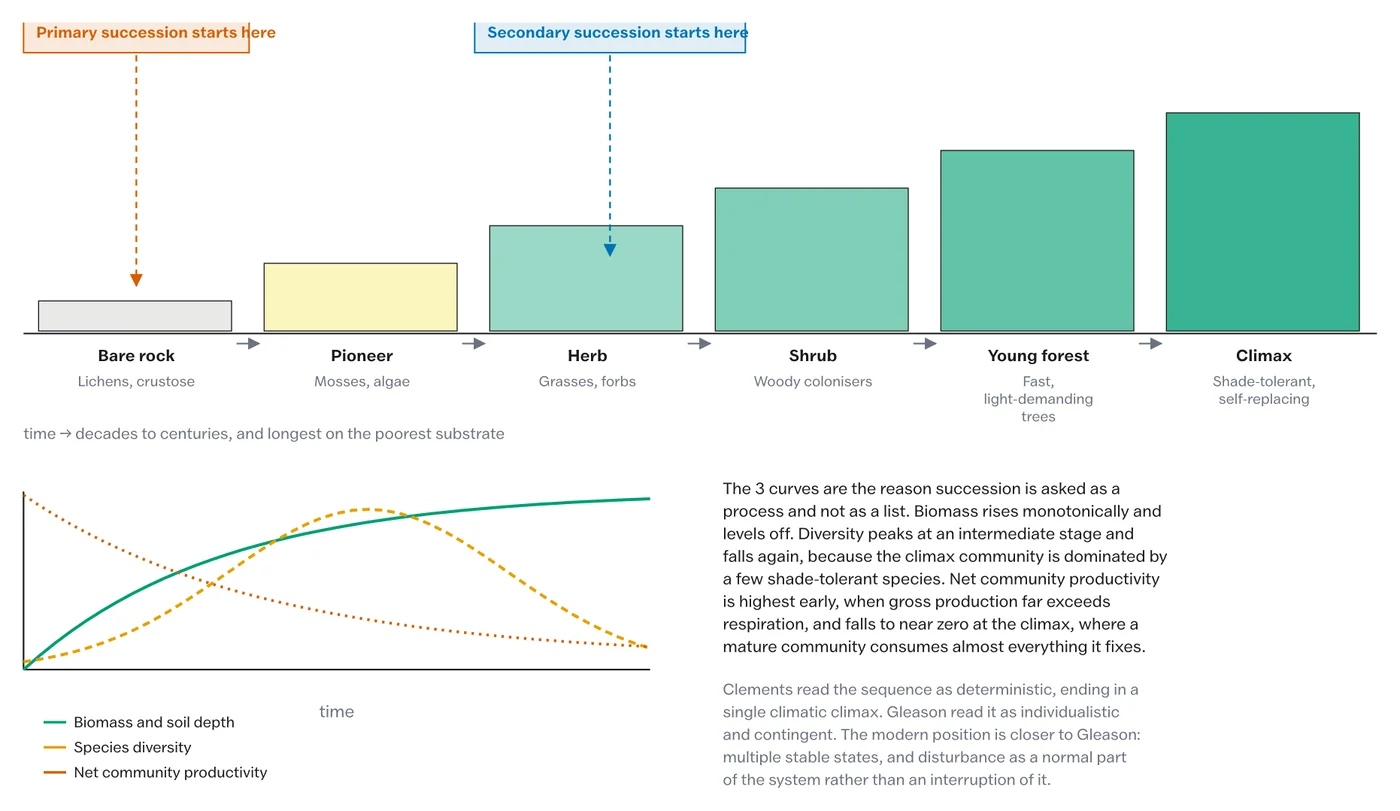
- Primary succession begins on a substrate that has never carried a community and has no soil: bare rock, a new lava flow, a glacial moraine, a sand dune. It must build soil before it can build vegetation, so it is slow, running to centuries or millennia.
- Secondary succession begins on a site that has been disturbed but retains its soil and often a seed bank: an abandoned field, a burnt forest, a cleared plot. It is far faster, running to decades, because the hardest work is already done.
The distinction is not a technicality. It is why an abandoned field returns to woodland within a human lifetime while a lava flow does not.
The Sere and Its Stages
The whole sequence at a site is a sere, and each stage within it is a seral stage. Seres are named for where they begin.
- A hydrosere begins in open water and proceeds through submerged and floating plants, reed swamp, marsh, carr and finally woodland as sediment and organic matter fill the basin.
- A xerosere begins on dry bare surfaces. A lithosere starts on rock, with crustose lichens; a psammosere starts on sand.
- A halosere begins in saline conditions, as in a salt marsh or mangrove.
Where climate permits, different seres converge on a similar climax, which is the observation that made succession look deterministic in the first place.
The Three Curves
This is the part a stage list cannot deliver, and it is what makes succession a process rather than a sequence.
| Quantity | Behaviour through succession | Why |
|---|---|---|
| Biomass and soil depth | Rise steadily, then level off | Material accumulates faster than it decomposes until the community matures |
| Species diversity | Rises, peaks at an intermediate stage, then falls | The climax is dominated by a few shade-tolerant competitors that exclude others |
| Net community productivity | Highest early, falls to near zero at climax | Early on, gross production far exceeds respiration; a mature community consumes almost everything it fixes |
Diversity peaks in the middle, not at the end. A climax forest holds more biomass and fewer species than the woodland that preceded it.
The third row explains something practical. A mature forest is close to carbon-neutral in net terms, because respiration nearly balances photosynthesis. Young, vigorously growing vegetation sequesters carbon fastest. That is a real consideration in afforestation policy, and it does not make old-growth forest less valuable, since it holds an enormous accumulated stock even while its net annual uptake is small.
Clements Against Gleason
The theoretical argument behind succession is worth naming because it is still unsettled.
- Frederic Clements read succession as deterministic and directional, ending in a single climatic climax determined by regional climate. He treated the community as a superorganism with a developmental sequence of its own.
- Henry Gleason read it as individualistic: each species responds to conditions on its own terms, and a community is a coincidence of overlapping tolerances rather than an entity. Succession is contingent rather than programmed.
The modern position is much closer to Gleason. Ecologists now speak of multiple stable states rather than one climax, and treat disturbance as a normal part of the system rather than an interruption of it. Two intermediate concepts remain useful: a polyclimax allows several climaxes within one climatic region according to soil, drainage and slope, and a plagioclimax is a community held short of climax by continuing human activity, of which grazed grassland and coppiced woodland are the standard examples.
A great deal of what looks like natural vegetation in India is plagioclimax, held there by grazing, lopping and fire.
The Niche
Succession works because species differ in what they tolerate and in what they can outcompete, which is the language of the niche.
- The fundamental niche is the full range of conditions in which a species could live in the absence of competitors and predators.
- The realised niche is the smaller range it actually occupies once competition, predation and disease are accounted for.
Early successional species typically have broad fundamental niches, disperse widely and grow fast but compete poorly. Late successional species tolerate shade, grow slowly and compete well. Succession is therefore the progressive replacement of good colonisers by good competitors, and the distinction between the two niches is the concept that whole explanation rests on.
The Ecotone
Where two communities meet, the ecotone between them holds species from both plus some found only in the transition, so species richness peaks there. That peak is the edge effect.
The edge effect is often quoted approvingly and is double-edged. Fragmenting a forest creates a great deal of edge and raises the count of edge-adapted species, while eliminating the interior conditions that forest specialists need. A fragmented forest can show higher species richness and lower conservation value at the same time, and that is the reason corridor design matters more than reserve area alone.
Practice Questions
Prelims
1. A succession beginning on a bare rock surface is termed a
- (a) hydrosere
- (b) psammosere
- (c) lithosere
- (d) halosere
Answer: (c)
2. Species diversity through a succession typically
- (a) rises continuously to the climax
- (b) peaks at an intermediate stage and then falls
- (c) falls continuously
- (d) remains constant
Answer: (b)
3. Net community productivity is lowest
- (a) in the pioneer stage
- (b) at an intermediate stage
- (c) at the climax
- (d) after a disturbance
Answer: (c)
4. A community maintained short of climax by grazing is a
- (a) climatic climax
- (b) polyclimax
- (c) plagioclimax
- (d) disclimax sere
Answer: (c)
5. The realised niche of a species is
- (a) larger than its fundamental niche
- (b) equal to its fundamental niche
- (c) smaller than its fundamental niche
- (d) unrelated to it
Answer: (c)
Mains
- Distinguish between primary and secondary succession and explain the difference in their timescales. (10 marks)
- Describe the behaviour of biomass, species diversity and net community productivity through a succession. (15 marks)
- Compare the Clementsian and Gleasonian views of succession, and state the modern position. (15 marks)
- Distinguish between the fundamental and realised niche, and relate the distinction to successional replacement. (10 marks)
- “A fragmented forest can show higher species richness and lower conservation value.” Examine this statement with reference to the edge effect. (20 marks)