Ekman Transport, Upwelling and the Ocean Gyres
The Ekman spiral and the 90-degree rule, why the richest fisheries lie off deserts, geostrophic currents and western intensification, the thermocline, halocline and pycnocline, and why the Indian Ocean reverses.
Ekman transport is the reason the world’s richest fisheries sit off deserts. Wind blowing along a coast does not push surface water along the coast; it moves it at right angles, and where that movement is offshore, cold nutrient-rich water rises to replace it. The mechanics behind that are the same mechanics that drive the ocean gyres, and they are worth learning as one system rather than as separate facts.
The Ekman Spiral
Wind drags the topmost layer of water. The Coriolis force deflects that layer, to the right in the northern hemisphere, so it moves at about 45 degrees to the wind rather than with it. That layer then drags the one beneath it, which is deflected further and moves more slowly, and so on downward.
The result is the Ekman spiral: direction rotating progressively with depth while speed decays. Integrating the whole spiral gives the net Ekman transport, which is at 90 degrees to the wind, to the right in the northern hemisphere and to the left in the southern. That 90-degree result is the operative fact, and it holds regardless of the 45-degree surface angle.
Upwelling and Downwelling
Two coastal cases follow directly, and they explain the distribution of ocean productivity better than any other single mechanism.
- Upwelling. Where the wind blows equatorward along a west-facing coast in the northern hemisphere, Ekman transport carries surface water offshore. Cold, nutrient-rich water rises from 100 to 300 metres to replace it. Nitrate and phosphate reach the sunlit layer, phytoplankton bloom, and a food chain follows.
- Downwelling. Where transport converges on a coast, surface water piles up and sinks, carrying oxygen down and nutrients away. Such coasts are biologically poor.
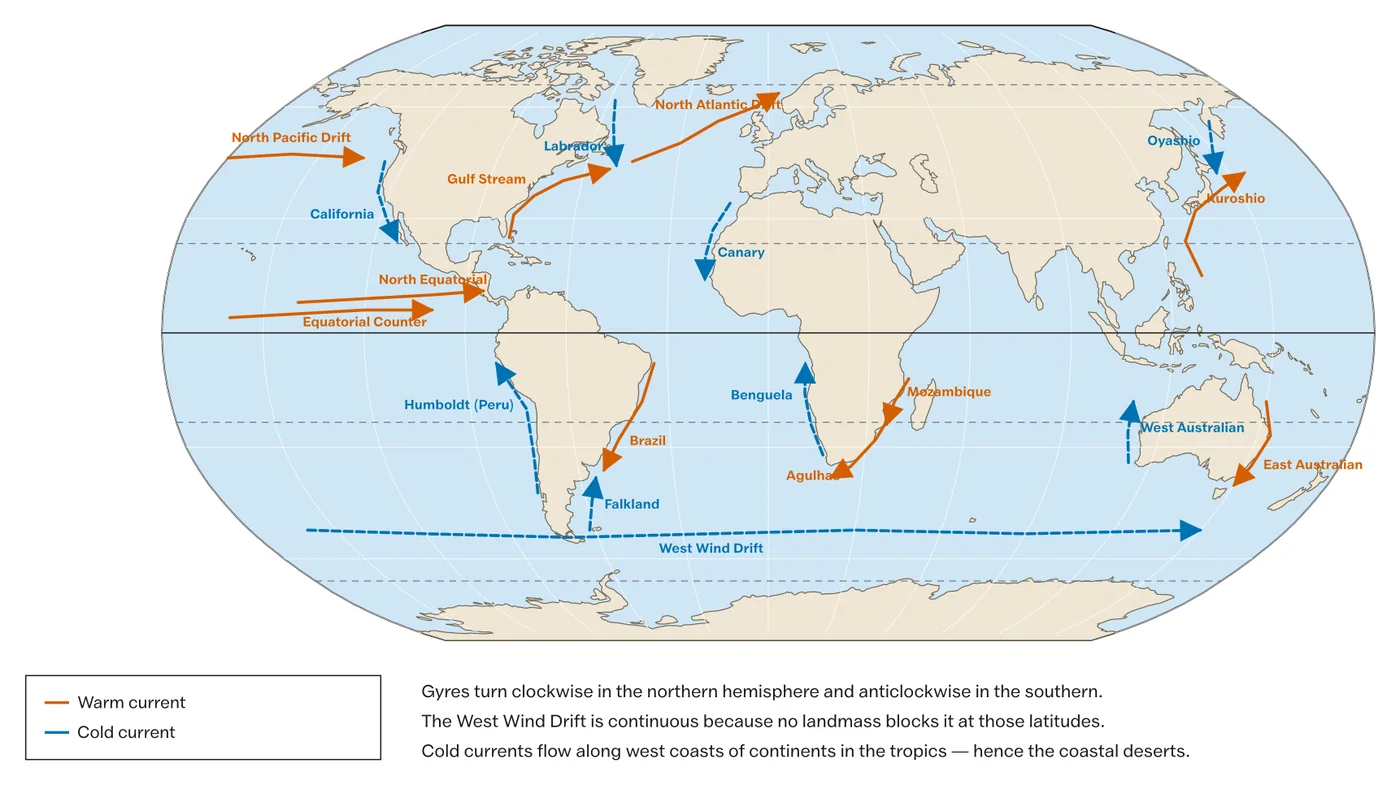
The great upwelling systems are the Peru-Humboldt, California, Canary and Benguela, and they sit beside the Atacama, the Baja, the Sahara and the Namib respectively. The coincidence is not accidental: the same subtropical high that drives the alongshore wind also produces the coastal desert. Upwelling zones occupy a small fraction of the ocean surface and supply a wholly disproportionate share of the world fish catch.
Equatorial upwelling works differently. At the equator the Coriolis force changes sign, so the easterly trades drive transport to the right north of the equator and to the left south of it. Water diverges away from the line on both sides and upwelling occurs along it, which is why a band of high productivity runs across the equatorial Pacific.
Geostrophic Currents and the Gyres
Ekman transport also explains why the ocean has gyres and why they are lopsided.
Within a subtropical gyre, Ekman transport converges toward the centre and piles water up into a low mound, a metre or so higher than the surrounding ocean. That mound creates a horizontal pressure gradient, and where that gradient is balanced by the Coriolis force the resulting flow is a geostrophic current, running along the contours of the mound rather than down its slope.
The gyre is therefore a closed circulation around a raised centre, clockwise in the northern hemisphere and anticlockwise in the southern.
Western Intensification
Gyres are not symmetrical. Their western limbs are narrow, deep and fast; their eastern limbs are broad, shallow and slow. The Gulf Stream and the Kuroshio move at several knots in a stream under 100 km wide; the Canary and California currents drift at a fraction of that across many hundreds of kilometres.
The cause is again the latitudinal variation of the Coriolis parameter, and it is the same physics that produces Rossby waves in the atmosphere. Because planetary vorticity increases poleward, the vorticity budget of the gyre can only be closed by a narrow, intense return flow on the western side. Henry Stommel supplied the explanation in 1948.
The Gulf Stream is narrow and fast for the same reason the jet stream meanders: the earth’s rotation varies with latitude.
The Vertical Structure
Three transition layers describe the water column, and they are frequently conflated.
| Layer | Property changing rapidly | Note |
|---|---|---|
| Thermocline | Temperature | Permanent in the tropics, seasonal in mid latitudes, largely absent in polar seas |
| Halocline | Salinity | Strong where rivers or ice melt freshen the surface |
| Pycnocline | Density | The product of the other two, and the layer that actually resists vertical mixing |
The pycnocline is the one that matters biologically, because it is the barrier that keeps deep nutrients away from the sunlit surface. Upwelling matters precisely because it breaches it. A strengthening pycnocline under surface warming is one of the mechanisms by which climate change is expected to reduce ocean productivity.
Below all of this, the carbonate compensation depth is the level at which calcium carbonate dissolves as fast as it settles, at roughly 4,000 to 5,000 metres. Above it the sea floor accumulates calcareous ooze; below it, red clay. Ocean acidification raises that depth, shrinking the area of sea floor on which carbonate can accumulate.
Why the Indian Ocean Is Different
The Indian Ocean is the one basin where this system reverses annually, and the reason is the monsoon.
- In the south-west monsoon, winds blow from the south-west and drive the Somali Current northward, producing intense upwelling off Somalia and Arabia and a rich seasonal fishery.
- In the north-east monsoon, the winds reverse and so does the circulation.
No other ocean does this. In every other basin the gyre runs the same way all year, so the relationship between wind and current has to be inferred; in the Indian Ocean it can simply be watched. That is why it is the standard case for demonstrating that the surface circulation is wind-driven.
Practice Questions
Prelims
1. Net Ekman transport is directed at what angle to the wind?
- (a) 0 degrees
- (b) 45 degrees
- (c) 90 degrees
- (d) 180 degrees
Answer: (c)
2. Coastal upwelling occurs where Ekman transport is directed
- (a) onshore
- (b) offshore
- (c) alongshore
- (d) downward
Answer: (b)
3. Western intensification of ocean gyres was explained by
- (a) Vagn Walfrid Ekman
- (b) Henry Stommel
- (c) Matthew Maury
- (d) Harald Sverdrup
Answer: (b)
4. The layer that most effectively resists vertical mixing is the
- (a) thermocline
- (b) halocline
- (c) pycnocline
- (d) mixed layer
Answer: (c)
5. The Indian Ocean’s surface circulation is distinctive because it
- (a) has no gyre
- (b) reverses seasonally
- (c) lacks upwelling
- (d) is entirely geostrophic
Answer: (b)
Mains
- Explain the Ekman spiral and derive the direction of net Ekman transport. (10 marks)
- Why do the world’s most productive fisheries lie off desert coasts? (10 marks)
- Account for western intensification in ocean gyres. (15 marks)
- Distinguish between the thermocline, halocline and pycnocline, and explain the biological significance of the last. (15 marks)
- “The relationship between winds and currents is best seen in the Indian Ocean.” Justify. (20 marks)