15 Common Errors in UPSC English Compulsory Paper
Fifteen frequent UPSC English Compulsory errors — with examples, fixes, a category-wise mark-loss table, and a 14-day correction sprint.
Year after year, examiners’ reports highlight the same mistakes in UPSC English Compulsory answer scripts. Avoiding these errors is the single fastest way to raise your score. Below are the fifteen most common, with examples and corrections.
Why This List Matters
The English Compulsory paper does not reward brilliance as much as it punishes error. A candidate who writes a plain but correct answer outscores one who writes an ambitious but flawed answer. The errors below represent the majority of marks routinely lost by otherwise well-prepared aspirants.
The Fifteen Errors
1. Exceeding the precis word limit
UPSC specifies length. Overshoot by 15% or more and you lose 4–6 marks automatically. Fix: cut adjectives and examples in your second draft; count twice.
2. Copying phrases verbatim in RC
Writing “the author says that ‘tolerance is the civic virtue’” when the passage says exactly those words invites a paraphrase penalty. Fix: rewrite every answer in your own words.
3. Missing essay conclusions
Time management failures leave essays dangling. A missing conclusion costs 8–12 marks on its own. Fix: at 50 minutes into the essay, stop writing body and start the conclusion.
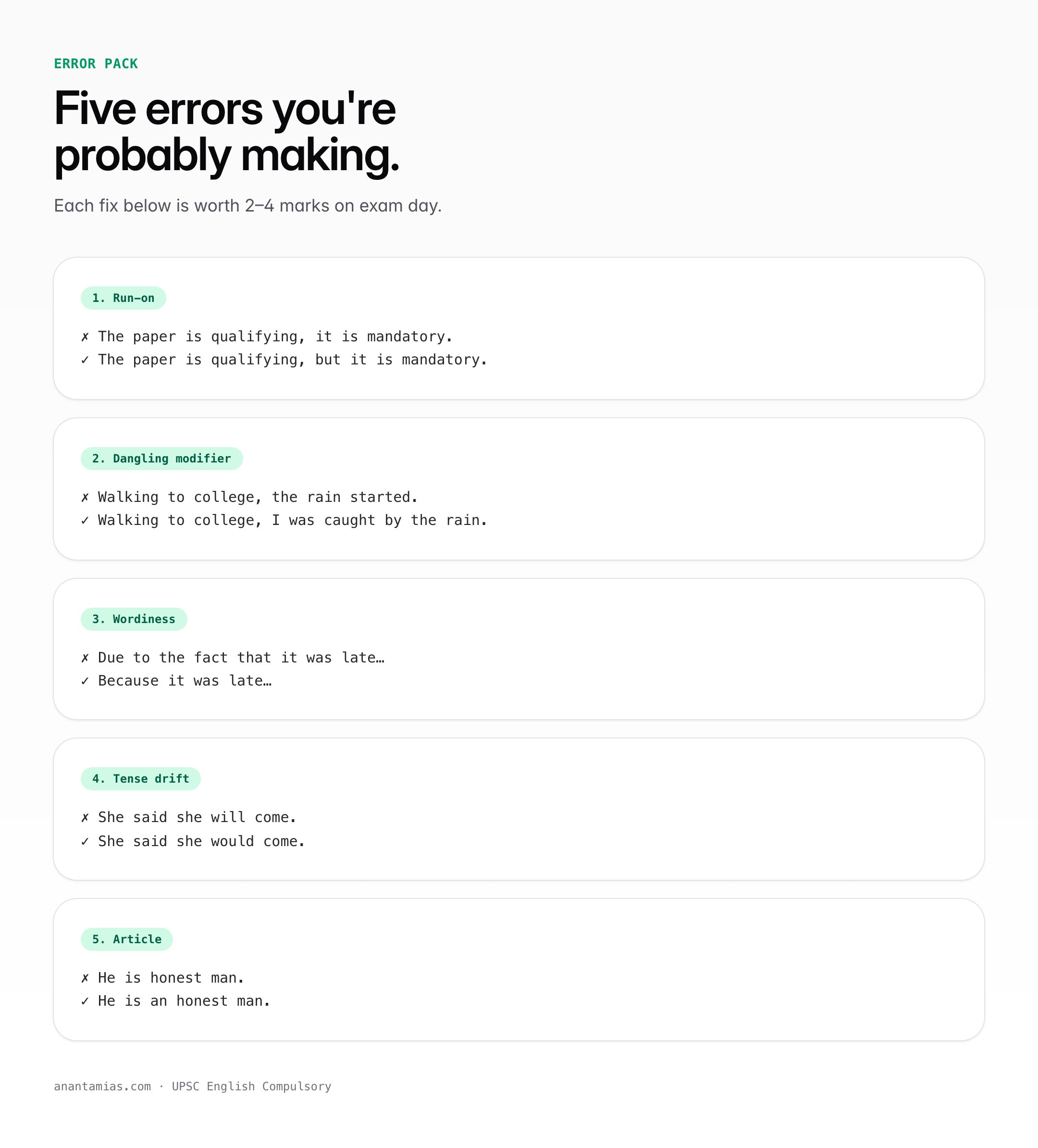
4. Subject-verb agreement slips
“One of the students are absent” is wrong; the subject is one, not students. Fix: identify the true subject before choosing the verb.
5. Incorrect prepositions
Discuss about, comprise of, different than, married with are all incorrect. Fix: memorise the 30 most-tested verbs and their prepositions.
6. Wrong tense sequences
“He said he is tired” should be “He said he was tired.” Fix: past-tense reporting verbs require past-tense dependent clauses (with exceptions for universal truths).
7. Article errors
“He is best student in class” needs the best and the class. Fix: review the three article rules weekly.
8. Direct-indirect speech backshift errors
Forgetting to backshift now to then, or this to that, loses easy marks. Fix: learn the six adverb transformations by heart.
9. Indian-English idioms
Prepone, do the needful, please revert are acceptable in speech but flagged as informal in exam prose. Fix: use bring forward, do what is required, please reply.
10. Passive-voice overuse
A string of it is said that, it was felt that, it is believed dilutes your essay. Fix: prefer active voice unless the agent is genuinely unknown.
11. Translation by transliteration
Rendering Parliament as पार्लियामेंट is transliteration, not translation. Fix: translate meaning; transliterate only proper names.
12. Introducing personal opinion in RC
When the question asks “What does the author mean?”, writing your own view loses the mark. Fix: stick strictly to the author’s argument.
13. Essay clichés
Since time immemorial, in today’s world, from birth to death — examiners have read these thousands of times. Fix: replace with specific, dated, concrete openings.
14. Idiom misuse
Using a blessing in disguise for an outright disaster, or hit the nail on the head for partial accuracy, shows shallow learning. Fix: learn each idiom through two example sentences.
15. Illegible handwriting
Examiners read up to 200 scripts daily. An unreadable script is a silently penalised script. Fix: write at 22–25 words per line, not 40; use a slightly larger hand than in daily life.
Error-Type Summary Table
| Category | Count above | Typical mark loss |
|---|---|---|
| Grammar (agreement, tense, preposition, article, speech) | 5 | 8–12 |
| Structure (precis length, essay conclusion, verbatim copying) | 4 | 10–15 |
| Register (Indian English, clichés, idiom misuse) | 3 | 5–8 |
| Translation | 1 | 3–5 |
| Presentation (handwriting) | 1 | 2–4 (indirect) |
A 14-Day Error-Correction Sprint
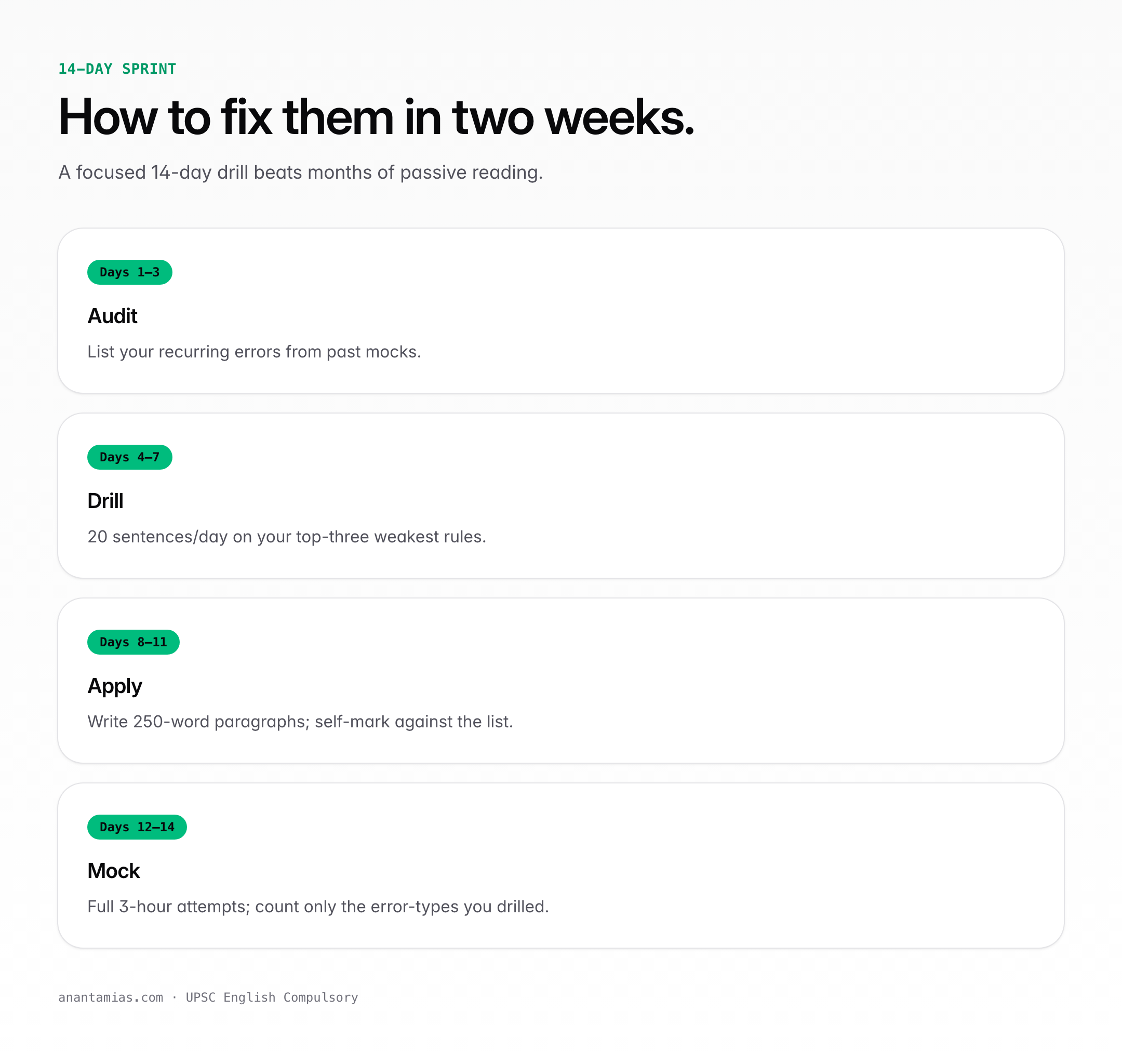
- Days 1–3: list your last 10 written answers; mark every error by type.
- Days 4–7: drill the two most frequent error types — usually grammar and precis length.
- Days 8–10: rewrite old answers correctly.
- Days 11–14: full-paper simulation; keep your error log open for comparison.
Frequently Asked Questions
What is the most common error in the UPSC English paper?
Exceeding the precis word limit. Candidates routinely write 20–30 percent over the target, costing 4–6 marks.
Does handwriting affect marks?
Indirectly but consistently. Illegible scripts frustrate examiners, who may miss parts of answers. Aim for clean, medium-sized handwriting.
Are Indian English idioms penalised?
Words like ‘prepone’ and ‘do the needful’ are flagged as informal. Use standard equivalents in exam prose.
How do I stop running out of time in the essay?
Set an internal clock: 10 minutes to plan, 45 to write, 5 to revise. Start the conclusion at the 50-minute mark regardless of where you are.
Is passive voice always wrong?
No, but overuse is. Use passive when the agent is unknown or irrelevant; otherwise prefer active voice for clarity.
How long before Mains should I start this error drill?
Six to eight weeks. The pattern of your errors stabilises quickly; the remaining weeks are for entrenched correction.