English Grammar Essentials for UPSC Compulsory Paper
Grammar essentials for the 40-mark UPSC English Compulsory section — tenses, voice, speech conversion, conditionals, prepositions, articles, and high-yield idioms.
Grammar and usage accounts for 40 marks in the UPSC English Compulsory paper — questions on transformation of sentences, voice, direct-indirect speech, tense errors, and idioms. Unlike precis or essay, grammar rewards memorisation of rules. A methodical learner can target 30+ out of 40.
Typical Grammar Question Types
| Question type | Typical marks | Example |
|---|---|---|
| Correct the error | 5–10 | Spot the error in the underlined portion |
| Transform the sentence | 5–10 | Rewrite active to passive, affirmative to negative |
| Fill in the blank | 5 | Choose the correct preposition/article |
| Direct to indirect speech | 5–10 | Convert narration while preserving meaning |
| Idioms and phrases | 5 | Explain or use in a sentence |
Tenses: The Most-Tested Area
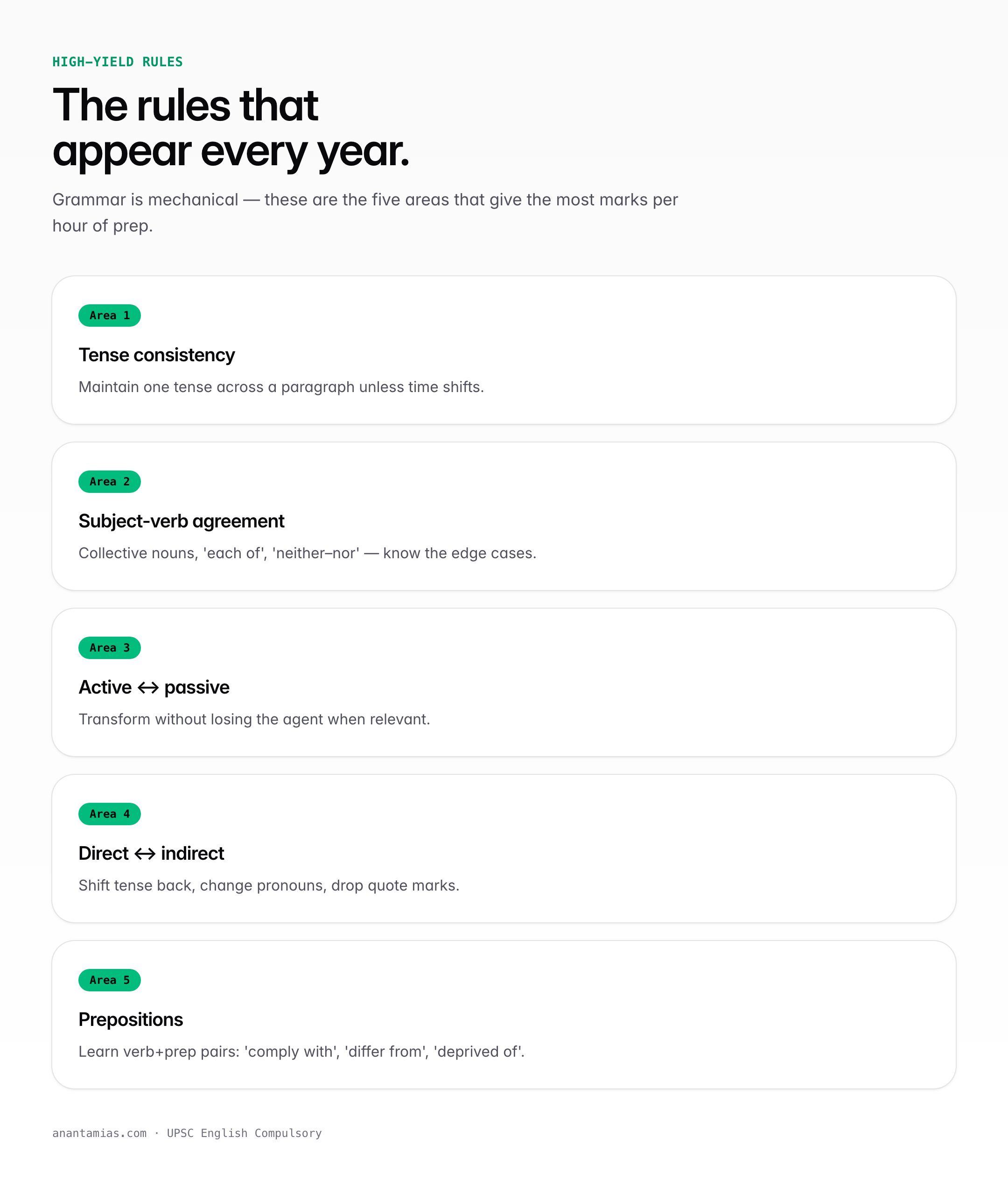
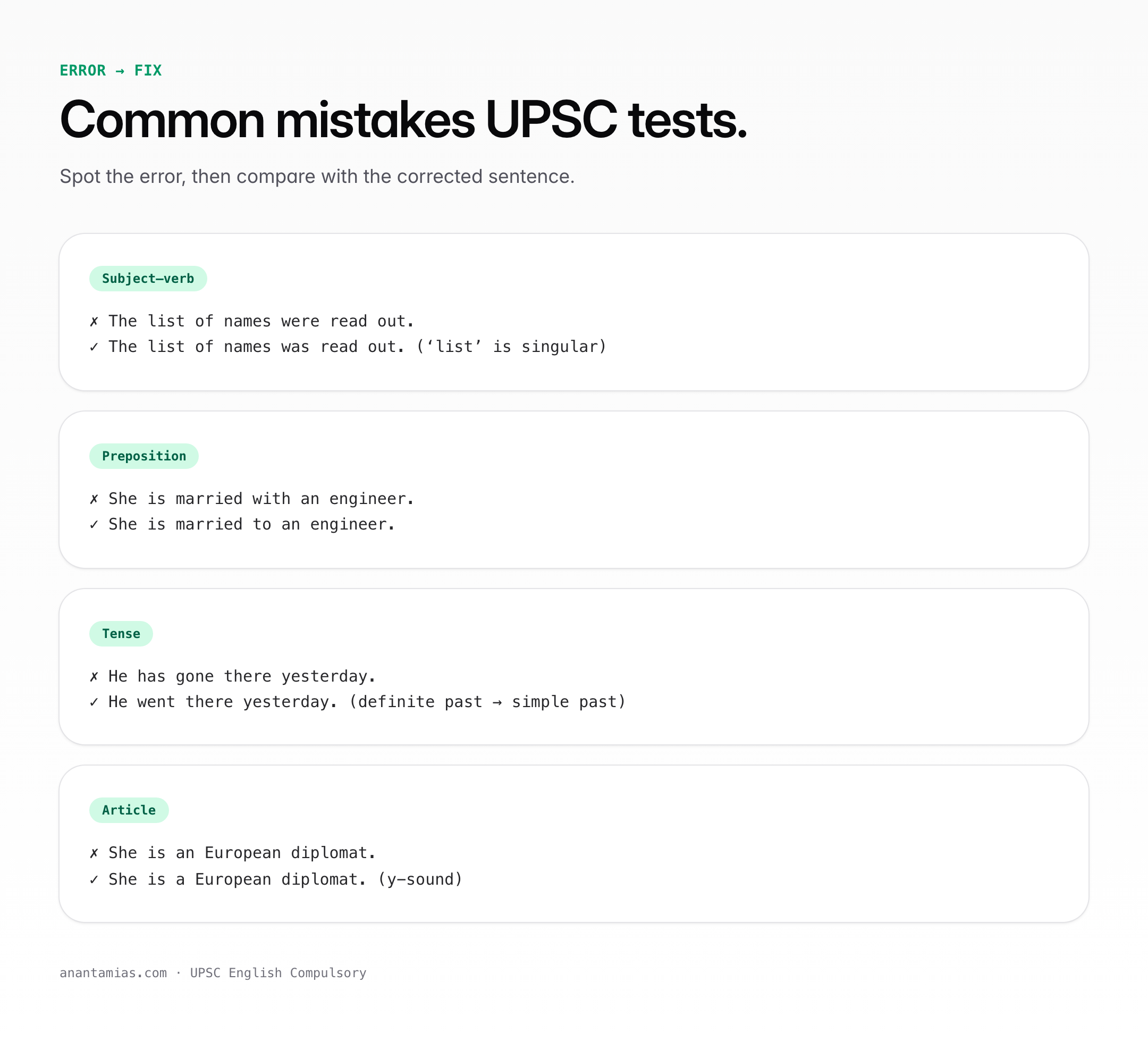
Roughly a third of grammar errors on the UPSC paper involve tense mismatches. Three rules cover 80% of cases:
- In past-tense narration, subordinate clauses generally shift to past: He said he was tired (not is tired).
- Present perfect with since and for: I have lived here since 2015, not I live here since 2015.
- Use simple past, not present perfect, with specific past time: I met him yesterday, not I have met him yesterday.
Subject-Verb Agreement
- Collective nouns (team, committee, jury) take singular verbs when acting as one unit.
- Either…or and neither…nor: verb agrees with the nearer subject.
- A number of = plural; the number of = singular.
- Distances, amounts, and periods of time take singular verbs: Ten kilometres is a long walk.
Active and Passive Voice
The rule is simple: object of active becomes subject of passive; verb becomes form of be + past participle; subject of active becomes agent introduced by by (often dropped).
Active: The committee approved the proposal.
Passive: The proposal was approved by the committee.
Watch for modal verbs: must do → must be done; has completed → has been completed.
Direct and Indirect Speech
Three changes: quotation marks dropped, reporting verb adjusted, and tense/pronoun/time-word backshifted.
| Direct form | Indirect form |
|---|---|
| now | then |
| today | that day |
| tomorrow | the next day |
| yesterday | the previous day |
| here | there |
| this | that |
Prepositions: High-Frequency Traps
- Different from (not different than)
- Comprises takes no preposition — not comprises of
- Consist of, but consist in when meaning ‘to lie in’
- Discuss takes no about: We discussed the issue
- Married to, not married with
Articles
- Use a/an before singular countable nouns first introduced.
- Use the for specific, previously mentioned, or unique nouns.
- No article with proper nouns (India, Gandhi), abstract nouns (honesty), and most meals (breakfast).
- Use the with rivers, seas, mountain ranges, and official titles: the Ganges, the Himalayas, the Prime Minister.
Conditionals
| Type | Pattern | Example |
|---|---|---|
| Zero | If + present, present | If water boils, it turns to steam. |
| First | If + present, will + verb | If it rains, we will cancel. |
| Second | If + past, would + verb | If I had time, I would travel. |
| Third | If + past perfect, would have + PP | If he had studied, he would have passed. |
Idioms UPSC Has Repeatedly Tested
- A blessing in disguise — something that seems bad but turns out good
- Bite the bullet — face a difficulty bravely
- Cut corners — do something cheaply or hastily
- Hit the nail on the head — describe exactly what is causing a problem
- Let the cat out of the bag — reveal a secret unintentionally
Grammar Drill: 10 Minutes a Day
Keep a two-column notebook. On the left, write five sentences with common errors (from Wren & Martin or High School English Grammar). On the right, write the corrected form and the rule violated. Over 60 days, this produces a personalised grammar manual no textbook can match.
Frequently Asked Questions
Which grammar book is best for UPSC English Compulsory?
Wren & Martin’s High School English Grammar and Composition remains the standard. Supplement with Raymond Murphy’s English Grammar in Use for modern usage.
How much grammar is tested in the paper?
Forty marks out of 300 — roughly 13 percent. It includes error correction, voice, speech, fill-in-the-blanks, and idioms.
Do I need to memorise idioms?
Learn 100–150 high-frequency idioms. UPSC tests both meaning and usage in sentences.
Is active-to-passive voice asked every year?
Almost every year, either as transformation or embedded in error-correction. Master modal and perfect-tense passives.
What is the most common grammar error aspirants make?
Subject-verb agreement with collective nouns and ‘either/or’ constructions, followed by incorrect prepositions after verbs like ‘discuss’ and ‘comprise’.
How do I improve grammar in 30 days?
Do five error-spotting sentences and one voice-conversion exercise daily. Keep a personal error log and revise it weekly.