Letter & Report Writing in UPSC English Compulsory
Formal letter and report writing for UPSC English Compulsory — formats, full samples of a municipal complaint and accident report, register table, and practice topics.
Letter and report writing appears as a sub-question in the composition section of UPSC English Compulsory in some years, either as an alternative to the essay or as part of the grammar-and-usage section. The weight is 15–20 marks. Formal letter conventions, report structure, and register are the examinable skills.
Formats UPSC May Ask
- Formal letter to a government officer or newspaper editor
- Official memorandum or notice
- Report based on a given situation (accident, inspection, committee meeting)
- Minutes of a meeting (rare, but tested twice in the last 15 years)
Anatomy of a Formal Letter
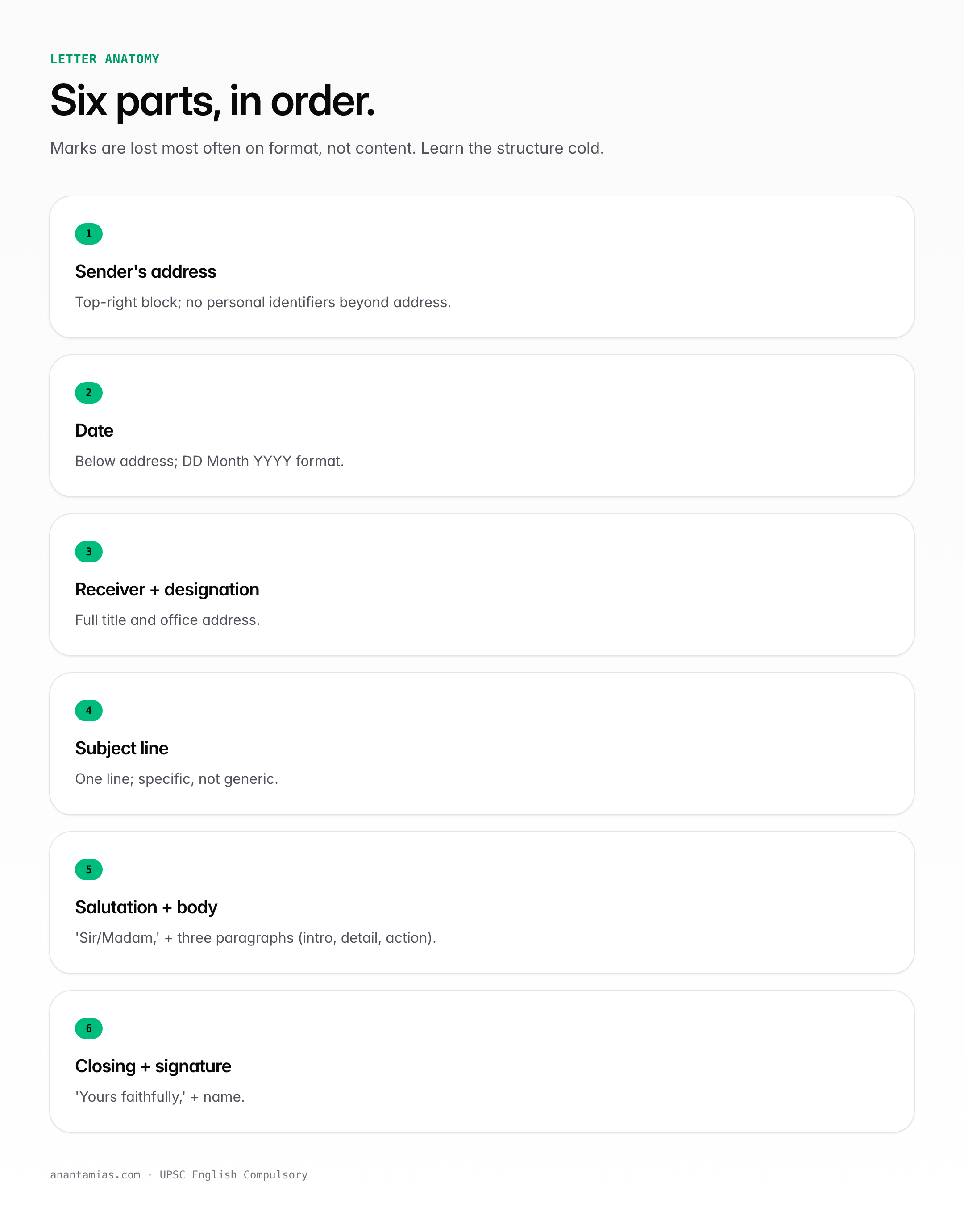
- Sender’s address (top-right or top-left, no personal names)
- Date below the address
- Receiver’s designation and address (top-left, below sender if right-aligned)
- Subject line — concise, capitalised, bolded if permitted
- Salutation (Sir/Madam; never Dear Sir for formal)
- Body — three paragraphs: context, main content, call to action
- Closing (Yours faithfully/sincerely) with signature, name, designation
Sample Letter: Complaint to Municipal Commissioner
12 Gandhi Road
Mumbai – 400 001
17 April 2026
The Municipal Commissioner
Municipal Corporation of Greater Mumbai
Mumbai – 400 001
Subject: Request for Immediate Repair of Broken Sewage Line on Gandhi Road
Sir,
I am writing to bring to your notice that the sewage line along Gandhi Road, in Ward 201, has remained broken for the past fifteen days. The overflow has caused stagnant water to collect along a 200-metre stretch, leading to mosquito breeding and a strong odour that affects residents and passers-by.
Repeated complaints to the ward office since 2 April have not yielded any action. I respectfully request that you direct the concerned engineer to inspect and repair the line at the earliest, and to spray the area with disinfectant to contain the health hazard.
Your prompt intervention will be deeply appreciated by the residents of Gandhi Road and the surrounding lanes.
Yours faithfully,
[Signature]
Ramesh Sharma
President, Gandhi Road Residents’ Welfare Association
Report Writing: What Makes It Different
Unlike a letter, a report is descriptive and impersonal. The writer recounts events, evidence, and conclusions for a designated reader (a superior officer, a committee, a court). The report uses past tense, third person, and no first-person pronouns.
Anatomy of a Formal Report
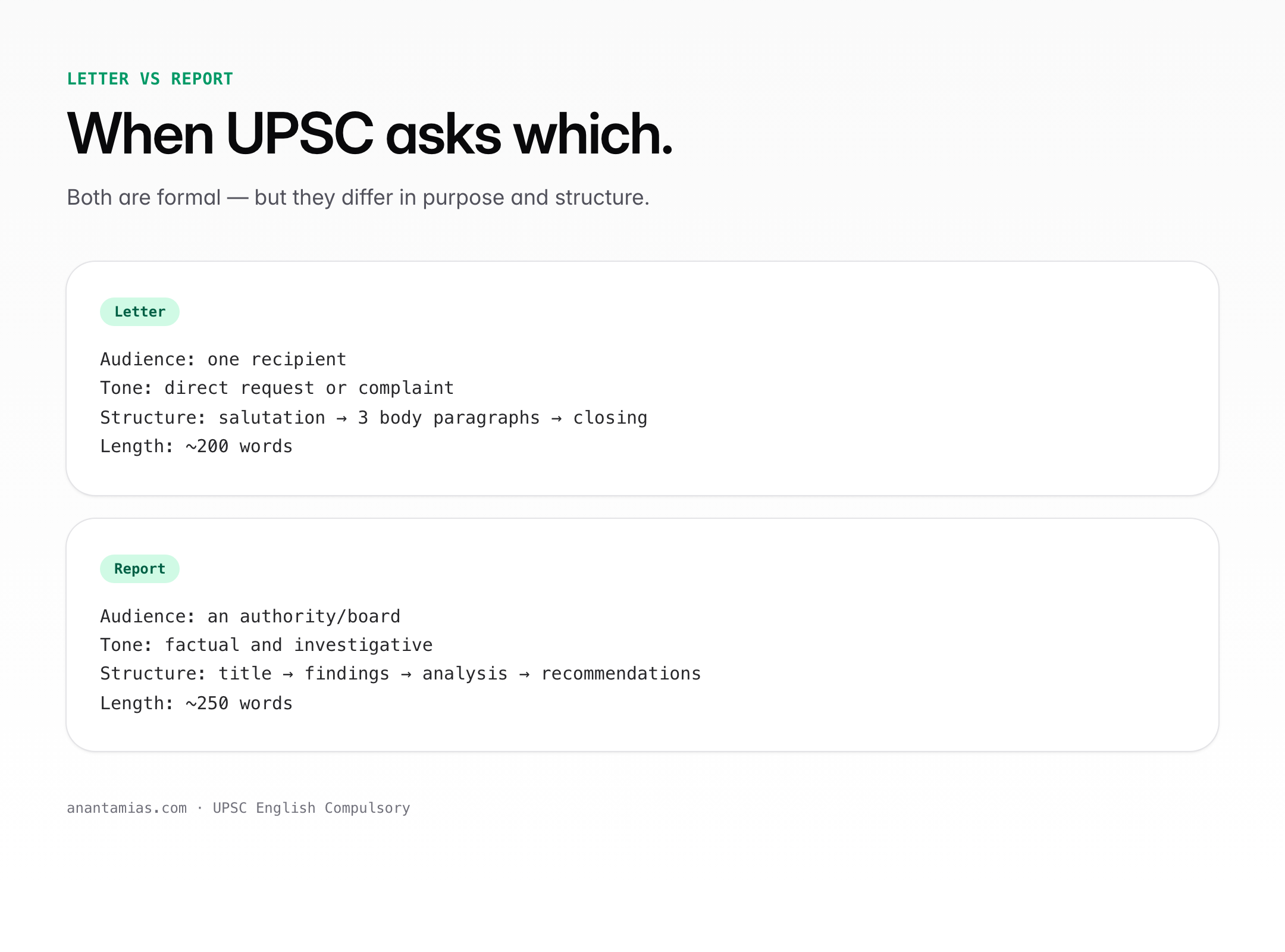
- Title: descriptive, in capitals
- To / From / Subject / Date (inter-office memo style)
- Introduction — one paragraph stating purpose and scope
- Findings — bullet points or numbered paragraphs
- Analysis — interpretation of findings
- Recommendations — specific, actionable, numbered
- Signature, name, designation
Sample Report: Road Accident Investigation
TITLE: REPORT ON THE ROAD ACCIDENT ON NH-8 ON 14 APRIL 2026
To: Superintendent of Police, Gurgaon District
From: Inspector, Manesar Police Station
Date: 17 April 2026
1. Introduction
This report details the accident that occurred on National Highway 8, near kilometre marker 62, on the evening of 14 April 2026 at approximately 19:40 hours.
2. Findings
(a) Two vehicles were involved — a private car (registration HR-26-BK-2041) and a goods truck (registration DL-01-GB-8823).
(b) The weather was clear; visibility was good.
(c) Skid marks indicate the truck was travelling at approximately 80 km/h in a zone restricted to 60 km/h.
(d) The car sustained front-end damage; the driver was moderately injured and admitted to Medanta Hospital.
(e) No fatalities were recorded.
3. Analysis
The collision appears to have been caused primarily by the truck’s excessive speed. The absence of road signage at the approach to the flyover may have contributed to the driver’s misjudgement.
4. Recommendations
(a) FIR against the truck driver under Sections 279 and 337 IPC.
(b) Request the NHAI to install speed-warning signs at the approach to the flyover.
(c) Deploy additional patrol units on the stretch during peak hours.
[Signature]
Rajendra Singh
Inspector, Manesar Police Station
Register and Tone
| Context | Correct phrase | Avoid |
|---|---|---|
| Opening | I am writing to… | Hi, I just wanted to… |
| Request | I respectfully request… | Please do the needful |
| Complaint | I wish to bring to your notice | You have totally failed to |
| Closing | Yours faithfully | Best regards / Thanks |
| Report neutrality | It was observed that | I think that |
Common Errors Specific to Letters and Reports
- Mixing sincerely (for named recipients) with faithfully (for unnamed)
- Using contractions (can’t, won’t) in formal letters
- First-person pronouns in reports
- Missing subject lines
- Over-long openings — state purpose in the first sentence
Practice Topics
- Letter to the editor on water scarcity in your city
- Report on a fire accident in an office building
- Letter to the Principal requesting a seminar hall for a student event
- Report of a committee on improving hospital sanitation
- Letter to the Commissioner of Police on traffic congestion
Frequently Asked Questions
Is letter writing always asked in UPSC English Compulsory?
Not every year. It is tested in 3–4 out of every 10 papers, usually as a 15–20 mark composition question.
Should I use ‘Yours sincerely’ or ‘Yours faithfully’?
‘Yours sincerely’ when the recipient is addressed by name (Dear Mr Sharma); ‘Yours faithfully’ when the opening is Sir/Madam.
Can I use bullet points in a report?
Yes, for the findings and recommendations sections. Keep the introduction and analysis in prose.
How long should a formal letter be?
Roughly 150–200 words — three paragraphs: context, main content, closing request.
Should I invent names and addresses?
Yes. Use neutral placeholder names (Ramesh Sharma, 12 Gandhi Road). Never use your real name in exam answers.
Are contractions allowed in formal writing?
No. Write ‘cannot’ for ‘can’t’, ‘will not’ for ‘won’t’, ‘have not’ for ‘haven’t’ in all formal letters and reports.